
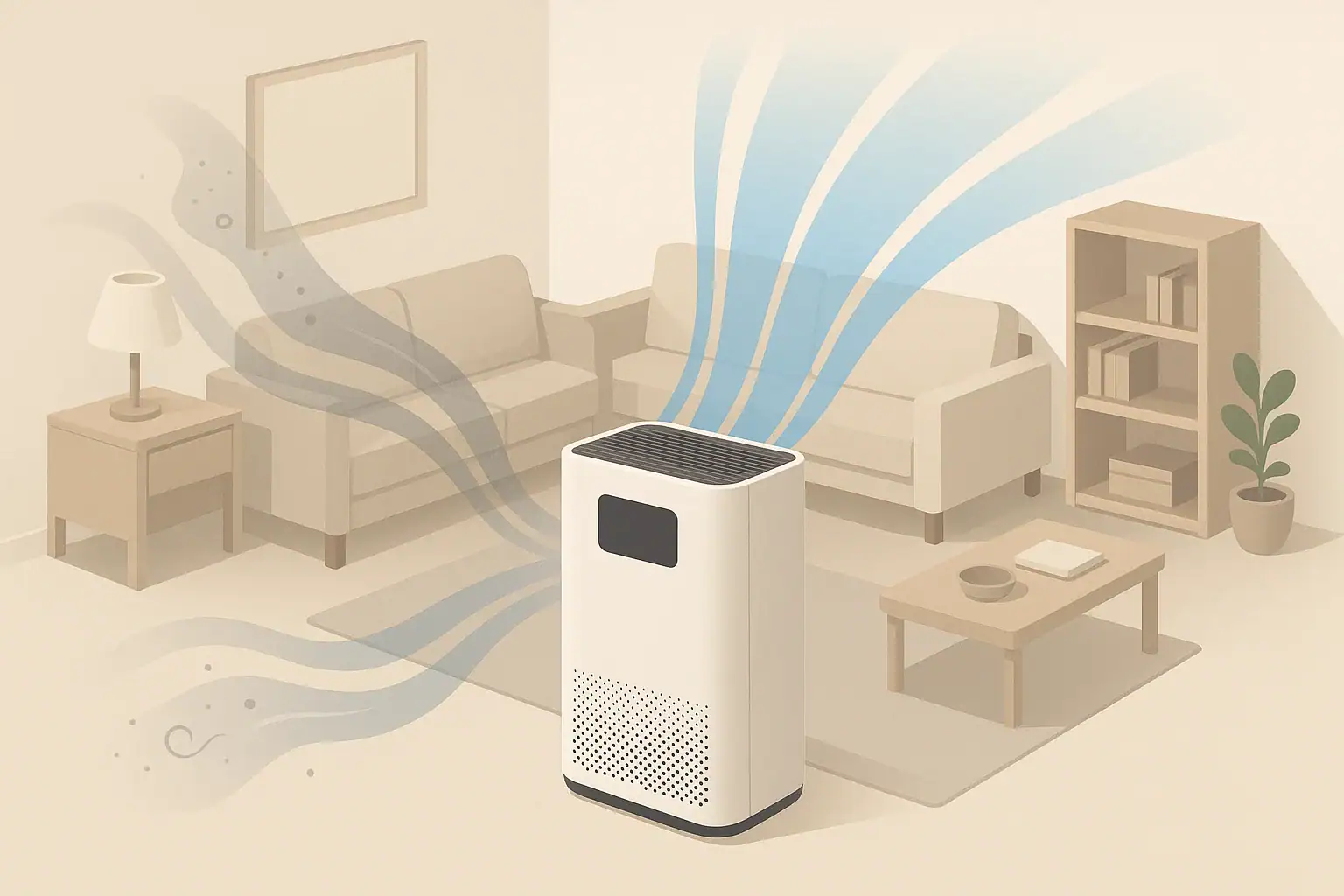
Air purifiers can significantly reduce smoke and many odors in a room, but they cannot erase every smell or health risk on their own. For wildfire smoke, cooking smoke, and general indoor smells, the right combination of particle filtration and gas-phase media often makes the air look clearer and smell cleaner, especially in a properly sized room.
However, smoke and odors are made up of both particles and gases, and no single device captures every component perfectly. Understanding what air purifiers are good at, where they fall short, and how to use them alongside ventilation and source control will help you get realistic results. This guide walks through how air purifiers handle smoke and smells, practical examples from everyday homes, common mistakes, safety basics, and the key specs to look for before you buy.
What “Smoke and Odor Control” Really Means (and Why It Matters)
When people ask whether an air purifier helps with smoke and odors, they are usually dealing with one of a few situations:
- Seasonal wildfire smoke drifting indoors.
- Lingering cooking fumes after frying, broiling, or searing.
- Smell from fireplaces, candles, incense, or tobacco.
- General musty or stale odors in a closed-up home or apartment.
All of these involve two main pollutant types:
- Particles: Soot, ash, tar droplets, and fine aerosols that make air look hazy and contribute to PM2.5 levels.
- Gases and vapors: Volatile organic compounds (VOCs) and other odor molecules that remain in the air as invisible gases.
Smoke and odor control matters for more than comfort. Fine particles can reach deep into the lungs, and high levels of smoke are linked to irritation and longer-term health risks. Strong odors can also signal poor ventilation or ongoing pollutant sources. Air purifiers are one tool to lower exposure indoors, especially when outdoor air is poor or when you cannot immediately remove the source.
How Air Purifiers Work on Smoke and Odors
Most home air purifiers are recirculating devices: they pull room air in, pass it through one or more filters or media, then push the cleaned air back out. For smoke and smells, two technologies matter most.
Particle Filters for Visible Smoke and Haze
High-efficiency particle filters are designed to capture very small particles suspended in the air. For smoke, this includes soot, ash, and tar droplets in the fine (PM2.5) and ultrafine ranges. When particle filtration is effective, you typically notice:
- Less visible haze in the room after a smoke event.
- Lower readings on a particle monitor, if you use one.
- Less dust-like residue settling as quickly on surfaces.
Performance depends on both filter efficiency and airflow. A highly efficient filter in a weak fan will clean slowly; a strong fan with a poor filter will push a lot of air but not remove enough particles.
Gas-Phase Media for Odors and VOCs
Most odors are caused by gases that pass straight through particle filters. To address these, many air purifiers add gas-phase media such as:
- Activated carbon: A porous form of carbon that holds gas molecules on its surface.
- Other sorbents: Media designed to target specific gases, sometimes blended with carbon.
These materials work by adsorption, not by sieving like a particle filter. Effectiveness depends on:
- The mass of media (more media generally means more capacity).
- Contact time (air should not rush through too quickly).
- The chemistry of the odor (some compounds are harder to capture).
When the gas-phase media are undersized or saturated, you may see clear air but still notice strong smells, especially from cooking, smoke, or pets.
Other Technologies You May See
Some purifiers include extra features:
- Pre-filters: Capture larger dust and hair, protecting the main filter.
- Ionizers or electrostatic collectors: Charge particles so they stick to plates or nearby surfaces.
- UV-based systems: Aim to inactivate microbes but do not directly remove smoke or most odors.
These can be useful in specific cases, but they do not replace the need for strong particle filtration and meaningful gas-phase media when your primary goal is smoke and odor reduction.
Real-World Examples: What to Expect in Typical Rooms
How well an air purifier handles smoke and odors depends on room size, device capacity, and how you operate it. The examples below assume doors and windows are closed and the purifier is running on a higher setting.
Example 1: Wildfire Smoke in a Bedroom
During a wildfire event, outdoor air may be visibly hazy and smell smoky. Indoors, you might notice:
- A smoky smell when you wake up.
- Scratchy throat or irritated eyes.
- Fine ash dusting on window sills over time.
A correctly sized purifier with a high-efficiency particle filter can often lower indoor particle levels substantially compared with outdoors. You may notice:
- Visible haze clearing within tens of minutes to an hour after closing windows.
- Less smell over a few hours as gas-phase media gradually adsorb some smoke compounds.
- More comfortable breathing in the room where the purifier is running continuously.
Example 2: Cooking Odors in an Open Kitchen–Living Area
After pan-frying or broiling, it is common to have both visible smoke and strong odors. A purifier can:
- Clear visible particles faster once cooking is done and the source is off.
- Reduce the intensity and duration of lingering cooking smells.
However, if the space is large and open, a single small purifier may not keep up. You might still smell fried food hours later, especially in nearby fabrics and upholstery. Using a range hood that vents outdoors, plus an air purifier, usually works better than relying on the purifier alone.
Example 3: Occasional Indoor Smoking
In a room where someone occasionally smokes, a purifier with both particle and gas-phase filtration can:
- Lower the concentration of airborne smoke particles while it runs.
- Reduce—but rarely eliminate—the smell of smoke afterward.
Even with a strong purifier, smoke residue can still deposit on walls, curtains, and carpets. If smoking continues in the same space, filters will load quickly and odors may become embedded in surfaces.
Room Size and Capacity Comparison
The match between purifier capacity and room size is one of the biggest factors in real-world performance. The table below shows illustrative values for how sizing affects expectations.
| Room type | Approx. area | Purifier capacity match | Typical smoke/odor result |
|---|---|---|---|
| Small bedroom | 120 sq ft | Purifier rated for small rooms | Noticeable particle reduction and moderate odor reduction within 30–60 minutes after a smoke event. |
| Medium living room | 250 sq ft | Purifier rated for medium rooms | Good particle control; odors fade but may still be detectable on fabrics for several hours. |
| Open-plan living / kitchen | 400+ sq ft | Only a small-room purifier | Visible haze may clear slowly; strong cooking or smoke odors can linger much longer than expected. |
Common Mistakes and Troubleshooting Smoke and Odor Problems
Many people are disappointed with air purifiers for smoke and smells because of a few predictable missteps. Recognizing these patterns makes troubleshooting easier.
Mistake 1: Expecting a Particle-Only Purifier to Remove Odors
Symptom: Air looks clear, but the room still smells smoky or like last night’s dinner.
Likely cause: The purifier has a good particle filter but little or no gas-phase media.
What to do:
- Confirm whether the unit includes a substantial odor or carbon filter, not just a thin deodorizing layer.
- Combine filtration with ventilation (open windows when outdoor air is acceptable).
- Clean fabrics and soft surfaces that may be holding smells.
Mistake 2: Undersizing the Purifier for the Space
Symptom: The purifier runs, but smoke or odors seem to hang around for hours.
Likely cause: The device’s clean air capacity is too low for the room volume or open layout.
What to do:
- Measure the floor area and consider ceiling height to estimate room volume.
- Use a purifier rated for at least the size of the room, ideally more during heavy smoke periods.
- For open-plan spaces, consider confining the purifier to a smaller “cleaner-air room” by closing doors.
Mistake 3: Running the Purifier Only When You Notice a Problem
Symptom: You turn the purifier on during smoky or smelly events but still feel like it is “too late.”
Likely cause: Short run times mean the air does not pass through the filters enough times to make a difference.
What to do:
- Run the purifier continuously during wildfire smoke or other ongoing sources.
- Use higher fan speeds at the start of an event, then reduce speed once air is clearer.
- Keep doors and windows closed when outdoor air is poor so the purifier is not constantly chasing new smoke.
Mistake 4: Ignoring Filters Until They Look Dirty
Symptom: The purifier is on, but performance has dropped and odors no longer fade.
Likely cause: Particle filters are clogged, and gas-phase media are saturated, even if they do not appear obviously dirty.
What to do:
- Follow recommended replacement intervals, shortening them after heavy smoke exposure.
- Pay attention to changes in odor control; if smells linger longer than before, gas-phase media may be spent.
- Keep pre-filters clean to avoid overworking the main filter.
Common Mistakes and Fixes at a Glance
| Problem you notice | Probable mistake | Practical fix |
|---|---|---|
| Room still smells smoky after hours of use | No or minimal gas-phase (carbon) media | Add or upgrade to a unit with substantial odor media and combine with ventilation and cleaning. |
| Visible haze clears very slowly | Purifier too small for room volume | Use a higher-capacity unit or confine the purifier to a smaller, closed-off room. |
| Purifier sounds louder and airflow feels weak | Particle filter heavily loaded with smoke and dust | Replace the main filter and clean pre-filters according to instructions. |
| Odors return quickly after turning unit off | Saturated gas-phase media or strong surface reservoirs | Replace odor media and clean or launder fabrics and soft furnishings. |
Safety Basics When Using Air Purifiers for Smoke and Odors
Air purifiers are generally safe household appliances, but there are a few safety and health points to keep in mind, especially when using them heavily for smoke events.
Avoiding Unwanted Byproducts
Some technologies can generate byproducts if not designed or used carefully. When choosing and operating a purifier:
- Be cautious with devices that intentionally generate reactive gases or strong oxidizers for “odor removal.”
- Use ionizing or electrostatic features according to instructions and only if you are comfortable with their operation.
- Remember that the core need for smoke and odors is strong particle and gas-phase filtration, not chemical reactions in the air.
Electrical and Placement Safety
During wildfire season or extended smoke events, purifiers often run around the clock. To use them safely:
- Place units on stable, flat surfaces where they cannot tip easily.
- Keep cords away from walkways and under rugs to prevent tripping or overheating.
- Do not block air inlets or outlets with curtains, furniture, or bedding.
- Leave adequate space around the unit so it can pull and push air freely.
Health Expectations and Sensitive Groups
For people with asthma, allergies, or other respiratory conditions, lower indoor particle levels can make a noticeable difference in symptoms. Still:
- Do not treat an air purifier as a substitute for medical care or medications.
- Use purifiers as part of a broader plan that includes source control, ventilation when possible, and cleaning.
- Create at least one “cleaner-air” room for sensitive individuals during heavy smoke episodes.
Maintenance and Long-Term Use for Smoke and Odor Control
Keeping an air purifier effective over time requires more than just turning it on. Smoke and odors are particularly hard on filters, so maintenance matters.
Filter Replacement Timing
For particle filters:
- Heavy smoke exposure can shorten filter life compared with normal dust-only conditions.
- If airflow feels weaker or the unit sounds strained, the filter may be loaded.
- Follow recommended replacement intervals, but be prepared to change filters sooner after major smoke events.
For gas-phase (odor) media:
- Odor filters usually do not look dirty when spent.
- If odors that used to fade quickly now linger, the media may be saturated.
- Track how often you deal with heavy smoke or strong smells to estimate a realistic replacement schedule.
Routine Cleaning Practices
Simple cleaning steps help your purifier maintain performance:
- Vacuum or gently wash reusable pre-filters as instructed to keep airflow strong.
- Wipe intake and outlet grilles with a dry or slightly damp cloth to remove dust buildup.
- Check that nothing has shifted to block air circulation around the unit.
Off-Season Storage
If you primarily use a purifier during wildfire season or for occasional events:
- Store it in a dry, clean area away from strong odors that could load the filters.
- Seal the unit in a bag or box if it will sit unused for many months to limit dust buildup.
- Inspect filters before the next smoke season and replace them if they smell stale or musty.
Practical Takeaways and Specs to Look For
Putting everything together, air purifiers can be very helpful for smoke and odors when used realistically and as part of a broader indoor air quality strategy. They are most effective when you:
- Control or relocate smoke and odor sources whenever possible.
- Use a purifier that is properly sized for the room where you need relief.
- Run the unit long enough and at high enough speed during events.
- Replace particle and odor filters often enough to maintain performance.
Specs to Look For in an Air Purifier for Smoke and Odors
When you are comparing models for wildfire smoke, cooking fumes, or general odor control, focus on these practical specifications and features:
- Particle filter efficiency: A high-efficiency filter designed to capture fine and ultrafine particles, with a good seal so air cannot bypass it.
- Gas-phase media mass: A substantial amount of activated carbon or similar media, not just a thin, lightly coated pad.
- Clean air capacity appropriate for your room: Look for information that indicates suitability for your room size; larger or open spaces need higher capacity.
- Multiple fan speeds: High speeds for clearing smoke quickly, lower speeds for quieter continuous use.
- Noise level you can live with: A setting that is quiet enough for sleep or work, so you will actually run the purifier.
- Filter access and cost: Filters that are easy to replace and realistically affordable at the intervals you will need, especially if you face frequent smoke seasons.
- Simple controls or automation: Timers, auto modes, or clear indicators that help you keep the unit running when it matters most.
Used this way, an air purifier will not remove every trace of smoke or odor, but it can make a noticeable difference in comfort and exposure during both everyday activities and severe smoke events.
Frequently asked questions
Which specifications most affect an air purifier’s ability to remove smoke and odors?
Particle-filter efficiency, the amount and type of gas-phase media (for example, activated carbon), and the unit’s clean-air capacity (airflow/CADR and a good filter seal) are the main factors. Fan speed options and correct sizing for the room determine how quickly and effectively the device will reduce smoke and odors.
Why does the room still smell even after running my air purifier?
Often the unit removes particles but has little or no gas-phase media, or the carbon is already saturated; odors can also be held in fabrics and other surfaces. Combining a purifier with substantial odor media, ventilation when outdoor air is acceptable, and cleaning of soft furnishings usually reduces lingering smells.
Are air purifiers safe to run continuously during wildfire smoke?
Yes—most particle-and-carbon recirculating purifiers are safe for continuous operation when used per the manufacturer’s instructions and with proper placement and electrical precautions. Avoid devices that produce ozone or other reactive gases and ensure good ventilation and stable placement for long run times.
Can an air purifier remove smoke odors embedded in furniture and carpets?
Air purifiers help remove airborne molecules but generally cannot remove odors already adsorbed into fabrics, carpets, or walls; those typically require cleaning, laundering, or professional treatment. Addressing the source and cleaning contaminated surfaces speeds odor removal.
How soon should I change filters after a major smoke event?
Heavy smoke shortens filter life; replace particle filters sooner if airflow drops or the unit sounds strained. For gas-phase media, replace when odors that used to fade quickly begin to persist, since spent media often look clean despite reduced capacity.
Will a single small air purifier protect an open-plan kitchen and living area from cooking smoke and odors?
A small purifier may reduce particles and odors locally but often cannot keep up in large, open-plan spaces; you need a unit sized for the full volume or multiple units. Using a venting range hood while cooking provides much better immediate control of smoke and odors.
- Clear sizing logic (room size → CADR/ACH)
- HEPA vs carbon explained for real use-cases
- Humidity + ventilation basics to reduce mold risk