
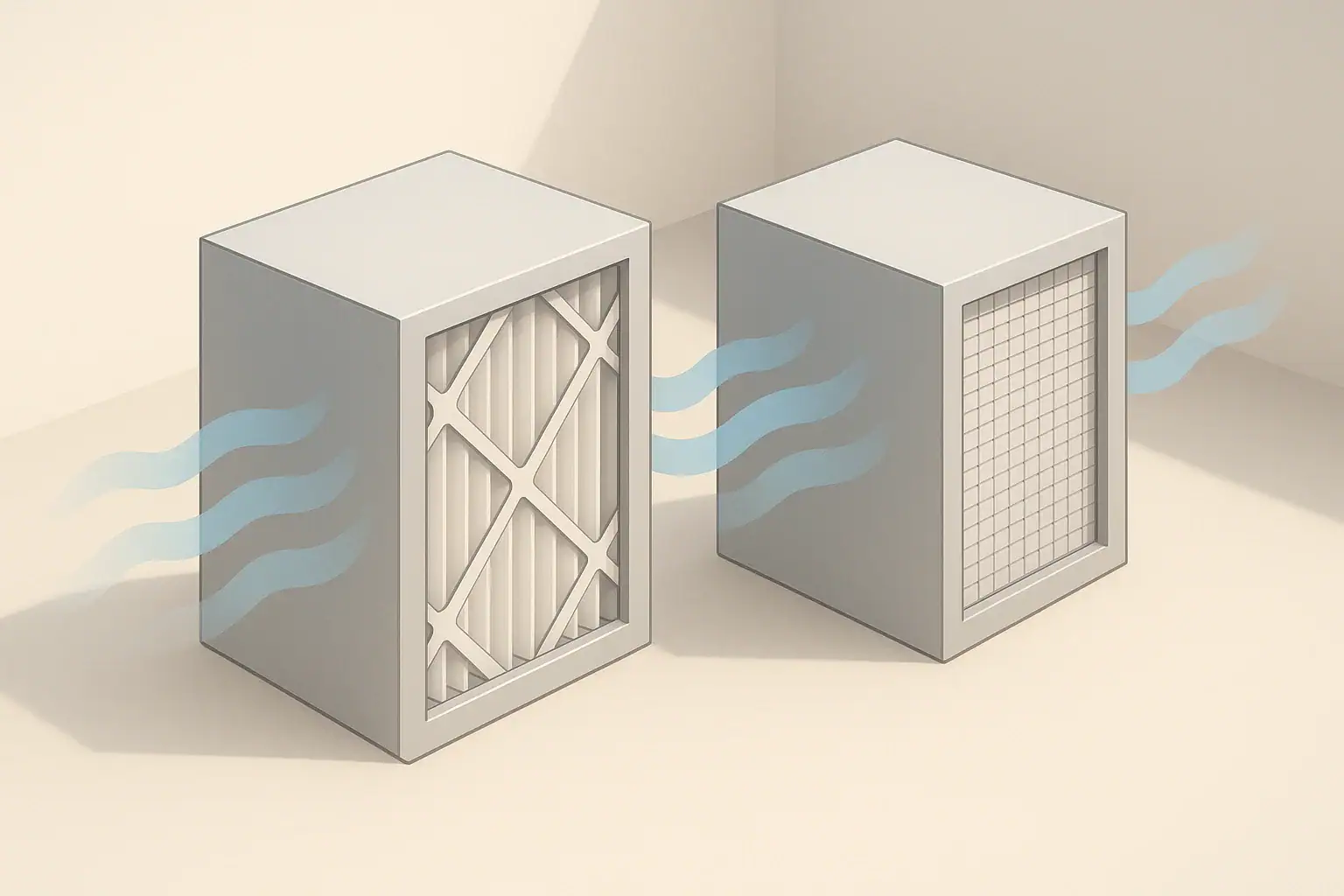
True HEPA filters are tested to capture at least 99.97% of 0.3 micron particles, while HEPA-type filters usually have lower or undefined efficiency, especially for the finest dust, smoke, and allergen-sized particles. In practice, that means a True HEPA purifier is typically more reliable for asthma, allergies, and smoke, while HEPA-type is better thought of as an upgraded dust filter.
Because packaging often uses vague wording like “HEPA-like” or “captures up to 99% of particles,” it can be hard to know what you are really getting. This guide breaks down what the labels mean, how HEPA filtration works, and how to read the specs so you can match the filter type to your real indoor air problems.
You will also see concrete examples, comparison tables, and a checklist of specs to look for before you buy or replace an air purifier filter. The goal is to help you make a practical decision, not just decode technical jargon.
What True HEPA and HEPA-Type Really Mean (and Why It Matters)
HEPA stands for High Efficiency Particulate Air. It is a performance standard, not a material or a brand name. In most residential contexts, a filter is considered HEPA-level if it can:
- Capture at least 99.97% of particles that are about 0.3 micrometers (μm) in diameter under defined test conditions, and
- Maintain that efficiency at a specified airflow and pressure drop.
The 0.3 μm size is called the “most penetrating particle size” (MPPS) because it is the hardest size to capture. If a filter performs well at 0.3 μm, it will usually perform as well or better for both smaller and larger particles.
In everyday shopping, you will see two broad groups of labels:
- True HEPA (or HEPA H13/H14, HEPA-grade): Indicates that the filter media has been tested to a recognized HEPA efficiency at or near 0.3 μm.
- HEPA-type / HEPA-like / HEPA-style: Suggests “similar to HEPA,” but with no guaranteed efficiency at 0.3 μm and often tested only on larger particles.
This difference matters most when you care about the smallest particles that stay suspended in the air for a long time and reach deep into the lungs. Those include smoke, fine dust, and many allergen fragments. For mainly visible dust and lint, HEPA-type can still help, but it is not equivalent to True HEPA.
Key Concepts: How HEPA Filtration Works
Both True HEPA and HEPA-type filters use a dense mat of fibers to capture particles from the air. The difference is how efficient that mat is at stopping the most difficult particle sizes.
Core HEPA Performance Standard
In general indoor air applications, a HEPA filter is expected to:
- Capture at least 99.97% of 0.3 μm particles in a single pass
- Be tested at a specified airflow (for example, a certain number of cubic feet per minute)
- Operate within an acceptable pressure drop so the fan can still move enough air
Some standards further divide HEPA into classes like H13 and H14. These classes describe minimum efficiencies for ultrafine particles at very specific test sizes and conditions. For homes, you will more often see “True HEPA” without a class number, but the idea is the same: a defined, tested minimum performance.
How Fibers Capture Particles
Inside the filter, air moves through a tangled web of fibers. Particles are captured by several physical mechanisms:
- Inertial impaction: Larger particles (like coarse dust) cannot follow the air streamlines around fibers, so they crash into the fibers and stick.
- Interception: Medium-sized particles follow the air stream but pass close enough to a fiber that they touch it and adhere.
- Diffusion: Very small particles move randomly (Brownian motion) and wander into fibers, where they are captured.
These mechanisms overlap. Efficiency is high for very small and very large particles, and lowest around 0.3 μm, which is why that size is used for rating.
True HEPA vs HEPA-Type in Concept
From a design standpoint, True HEPA filters generally use denser media and tighter seals, which:
- Increase capture of fine particles
- Increase resistance to airflow (the fan has to work harder)
HEPA-type filters often use looser media that is easier to push air through but does not stop as many of the smallest particles per pass. They may still capture a high percentage of larger dust and lint.
| Feature | True HEPA | HEPA-Type |
|---|---|---|
| Rated efficiency | ≈99.97% at 0.3 μm | Often 85–95% at ≥1–2 μm (or not specified) |
| Fine smoke / PM2.5 | High removal per pass | Moderate or unknown removal |
| Visible dust & lint | Very effective | Usually effective |
| Airflow resistance | Higher (denser media) | Lower (easier airflow) |
| Noise at same clean air output | Often higher fan speed/noise needed | Often lower fan speed/noise |
| Best suited for | Allergies, asthma, smoke, pollution | General dust reduction, light use |
Real-World Examples: When the Difference Shows Up
On paper, the difference between 95% and 99.97% might not sound dramatic. In a real room, it can be noticeable—especially over hours of breathing the air.
Typical Indoor Particle Sizes
Common indoor contaminants span a wide size range:
- Visible dust and lint: Often tens of micrometers (μm) across
- Pollen grains: Roughly 10–100 μm
- Mold spores: Commonly 2–10 μm
- Pet dander fragments: Often below 5 μm, some near 1 μm
- Fine smoke particles: Frequently below 1 μm
- Traffic-related fine particles (PM2.5): Less than 2.5 μm, many far smaller
True HEPA filters are designed to be efficient across this entire range, including the submicron fraction that makes up much of PM2.5. HEPA-type filters usually do well on the larger end of this list but may let more of the finest fraction pass through.
Example 1: Seasonal Allergies in a Bedroom
Imagine a small bedroom where the main triggers are pollen and pet dander:
- A True HEPA purifier can significantly reduce both the larger pollen grains and the smaller dander fragments that stay airborne longer. Over several hours of continuous operation, the overall allergen load in the room air drops noticeably.
- A HEPA-type purifier may still capture a large portion of pollen, because pollen is relatively big, but may be less effective on the smallest dander fragments. Symptoms might improve, but not as much as they could with a verified HEPA-level filter.
Example 2: Wildfire Smoke Infiltrating a Living Room
During a smoke event, most of the concerning particles are in the fine and ultrafine range:
- With True HEPA, each pass through the purifier removes a large fraction of those fine smoke particles, so the indoor haze and odor decrease more quickly and stay lower while the purifier runs.
- With HEPA-type, visible haze may still improve, but the smallest smoke particles responsible for deep lung penetration may be removed more slowly or less completely.
Example 3: Light Dust Control in a Home Office
In a relatively clean home office where the main annoyance is visible dust settling on surfaces:
- A HEPA-type purifier that moves a lot of air can noticeably slow dust buildup on desks and equipment.
- Upgrading to True HEPA may still help, but the difference might be smaller than in the smoke or allergy examples, especially if no one in the room has respiratory sensitivities.
| Scenario | Main particles of concern | True HEPA impact | HEPA-Type impact |
|---|---|---|---|
| Wildfire smoke | Submicron smoke, PM2.5 | Strong reduction in fine particles | Moderate; may leave more fine particles |
| Seasonal pollen & dander | 10–100 μm pollen, 1–5 μm dander | High reduction across sizes | Good on pollen, weaker on smallest dander |
| General dust control | Coarse dust >10 μm | Very effective | Usually effective enough |
| Near busy road | Traffic-related fine particles | Better PM2.5 reduction | Variable; depends on actual efficiency |
Common Mistakes and Troubleshooting HEPA Performance
Even with a True HEPA filter, it is easy to set up a purifier in a way that limits its real-world benefit. The same is true for HEPA-type units. Watching for these common mistakes can help you get closer to the performance promised on the box.
Mistake 1: Assuming Any “HEPA” Label Means True HEPA
Marketing phrases can be confusing. Examples that often indicate HEPA-type rather than True HEPA include:
- “HEPA-style filtration” with no particle size listed
- “Captures up to 99% of airborne particles” without stating the size
- “Traps particles as small as 2 microns” but no mention of 0.3 μm
Troubleshooting cue: If your main concern is smoke, fine dust, or asthma triggers and the packaging never mentions 0.3 μm or 99.97%, treat it as HEPA-type performance and adjust expectations.
Mistake 2: Undersizing the Purifier for the Room
Even the best filter media cannot help if too little air passes through it. Common signs that a purifier is undersized include:
- Odors or smoke lingering for hours despite continuous operation
- Dust still settling quickly on surfaces
- Noticeable improvement only when you sit very close to the unit
Troubleshooting cue: Check the clean air delivery rate (often expressed as a clean air delivery rate). If it is designed for a much smaller room than you are using, consider moving it to a smaller space or adding a second unit.
Mistake 3: Running Only on the Quietest Fan Setting
Low fan speeds are quieter but move less air. For many purifiers, the highest or second-highest speed is needed for meaningful particle reduction during active pollution events (like cooking or nearby fires).
Troubleshooting cue: If you only ever use the lowest speed, try running a higher speed for a few hours when pollution is worst, then dropping back to a lower setting to maintain cleaner air.
Mistake 4: Ignoring Filter Seals and Bypass
Air naturally takes the path of least resistance. If there are gaps around the filter frame, a portion of the air will bypass the media entirely. Signs of bypass include:
- Visible dust streaks around the edges of the filter
- Strong odor at the air outlet even with a new filter installed
- A filter that looks unusually clean while the room still seems dusty
Troubleshooting cue: Make sure the filter is fully seated, any gaskets are intact, and the access panel closes tightly. If parts are warped or damaged, performance can drop regardless of the media rating.
Mistake 5: Letting Filters Load Until Airflow Collapses
As both True HEPA and HEPA-type filters load with dust, they become harder to push air through. Symptoms of an overloaded filter include:
- Fan noise changing pitch as it works harder
- Noticeably weaker airflow at the outlet
- Dust buildup on surfaces increasing again after previously improving
Troubleshooting cue: If performance drops and the filter looks heavily loaded, replacement or cleaning (if allowed by the manufacturer) often restores airflow and overall effectiveness.
Safety Basics Around HEPA and HEPA-Type Use
HEPA filtration is generally considered safe for home use, but there are a few safety-related points to keep in mind when choosing and operating a purifier.
Airflow and Breathing Comfort
True HEPA filters can be more restrictive, so some units use stronger fans to maintain adequate airflow. This is usually not a problem, but in very small rooms you may notice drafts or noise if you sit directly in the airflow path.
- If the air feels uncomfortably strong, angle the outlet away from seating or move the unit slightly farther from where you sit or sleep.
- Avoid blocking the intake or outlet with furniture or curtains, which can strain the motor and reduce performance.
Electrical and Overheating Considerations
Any device that runs for many hours should be used with basic electrical safety in mind:
- Place the purifier on a stable, flat surface where it cannot tip over.
- Keep vents clear of fabric, paper, and other materials that might block airflow.
- Do not cover the unit while it is operating, and avoid running it in enclosed cabinets or tight corners with no space around it.
Filter Handling and Dust Exposure
When replacing a heavily loaded True HEPA or HEPA-type filter, some of the captured dust can be released if you shake or squeeze it.
- Turn the purifier off before opening the filter compartment.
- Handle used filters gently and avoid banging them to “clean” them unless the manufacturer specifically allows it.
- Consider wearing a simple mask if you are sensitive to dust and must handle a very dirty filter.
Ozone and Add-On Technologies
HEPA media itself does not produce ozone. However, some air cleaners combine HEPA or HEPA-type filters with additional technologies that may generate ozone or byproducts. If you are sensitive to respiratory irritants, focusing on mechanical filtration (HEPA) without active chemical or ionizing add-ons is often the safer choice.
Maintenance and Long-Term Use
Whether you choose True HEPA or HEPA-type, consistent maintenance has a major impact on how well the purifier works over months and years.
Filter Replacement Timing
Typical replacement intervals for home HEPA-style filters range from several months to about a year, depending on:
- How many hours per day the purifier runs
- Indoor particle levels (pets, smoking, cooking, outdoor pollution)
- Whether a washable pre-filter is used to catch larger dust
Signs that replacement may be due include reduced airflow, increased fan noise, or visible heavy loading on the filter surface.
Pre-Filters and Multi-Stage Systems
Many purifiers place a coarse pre-filter in front of the main True HEPA or HEPA-type media. The pre-filter captures hair, lint, and larger dust, which:
- Extends the life of the main filter
- Helps keep airflow more stable over time
Cleaning or replacing the pre-filter on schedule can meaningfully improve long-term performance, especially in homes with pets or visible dust problems.
Storage and Downtime
If you plan to store a purifier for a season (for example, only using it during wildfire season):
- Inspect the filter before storage; if it is near the end of its life, consider replacing it before the next season.
- Store the unit in a dry area to avoid moisture exposure that could affect the filter media.
- When bringing it back into service, run it on a higher speed for a while to flush any stale air from the housing.
Monitoring Performance Over Time
You do not need specialized instruments to notice when performance changes. Simple observations help:
- Compare dust buildup on surfaces before and after starting regular purifier use.
- Pay attention to how quickly cooking odors or smoke clear when the unit is running.
- Note any change in allergy or asthma symptoms when the purifier is in regular use versus off.
These practical checks can tell you if the current filter type and maintenance schedule are working for your home.
Practical Takeaways and Specs to Look For
When comparing True HEPA vs HEPA-type, it helps to think in terms of your main air quality goals, not just the label on the box.
When True HEPA Is Usually Worth It
- You are dealing with smoke from wildfires, cooking, or nearby traffic.
- Someone in the home has asthma, allergies, or other respiratory sensitivities.
- Outdoor PM2.5 levels are frequently elevated and you want a clearer reduction indoors.
- You want the best possible filtration in bedrooms where you spend many hours each night.
When HEPA-Type May Be Acceptable
- Your main concern is visible dust, lint, and larger debris on surfaces.
- No one in the home has severe respiratory sensitivities.
- You prioritize lower noise and cost over maximum fine-particle removal.
Specs to Look For Checklist
Use this checklist when you review product descriptions or replacement filter packaging:
- Filter type wording
Look for “True HEPA” or a clearly stated HEPA class (such as H13) if you need high performance; treat “HEPA-type,” “HEPA-like,” and “HEPA-style” as lower or undefined efficiency. - Efficiency and particle size together
Prefer claims like “99.97% at 0.3 μm.” Be cautious with claims that list only a percentage (for example, “99%”) without a particle size. - Room size or clean air output
Confirm that the unit is sized for your actual room. A HEPA filter in an undersized purifier will not clean a large space effectively. - Fan speeds and noise
Check that the purifier can run at a higher speed when needed, and that the noise level is acceptable for where you plan to use it. - Filter replacement schedule
Note the recommended replacement interval and estimated cost so you understand the long-term upkeep for either True HEPA or HEPA-type media. - Pre-filter presence
A washable or replaceable pre-filter can significantly extend the life of the main filter, especially in homes with pets. - Seal quality and construction
Look for mentions of gaskets, tight-fitting frames, or sealed filter compartments that limit bypass around the media.
By focusing on these concrete specs—and matching True HEPA or HEPA-type performance to your actual indoor air concerns—you can choose an air purifier that delivers realistic, noticeable improvements in everyday use.
Frequently asked questions
Which product specifications and features matter most when choosing between True HEPA and HEPA-type?
Prioritize a stated efficiency at a test size (for example, “99.97% at 0.3 μm”), the clean air delivery rate (CADR) or recommended room size, and filter class if provided. Also check seal quality, presence of a washable pre-filter, fan speed range, noise levels, and the expected replacement interval and cost. These specs together determine real-world performance more than marketing terms alone.
How can I tell if my air purifier is undersized or not working for the room?
Signs include odors or smoke lingering, dust continuing to settle quickly, and noticeable improvement only when you sit near the unit. Compare the purifier’s CADR or recommended room size to your actual room and consider adding a second unit or moving it to a smaller space if it is undersized.
Are HEPA and HEPA-type filters safe to use around children, pets, and people with respiratory issues?
Mechanical HEPA filtration itself is generally safe and does not produce ozone. Avoid units that add ionizers or ozone-generating technologies if occupants are sensitive; follow electrical safety guidance, keep vents clear, and perform regular filter maintenance to minimize any dust release during handling.
Can I clean or reuse a True HEPA filter to save money?
Most True HEPA filters are designed to be replaced rather than washed; washing or aggressive cleaning can damage the media and reduce efficiency. Some units include washable pre-filters meant for reuse—cleaning those can extend the life of the main filter, but follow the manufacturer’s instructions for the primary HEPA element.
Will a True HEPA filter make a big difference during wildfire smoke compared with HEPA-type?
Yes—True HEPA filters are much more effective at removing submicron smoke particles (PM2.5 and smaller), so they reduce indoor haze and fine-particle exposure more quickly and thoroughly. HEPA-type filters may improve visible haze but often remove fewer of the smallest, most health-relevant particles.
What simple maintenance steps help keep an air purifier performing well over time?
Replace the main filter according to the recommended schedule, clean or wash any pre-filter regularly, check for tight seals around the filter frame, and avoid blocking intakes or outlets. Running the unit at higher speeds during pollution events and storing it in a dry place when not in use also helps maintain performance.
- Clear sizing logic (room size → CADR/ACH)
- HEPA vs carbon explained for real use-cases
- Humidity + ventilation basics to reduce mold risk