
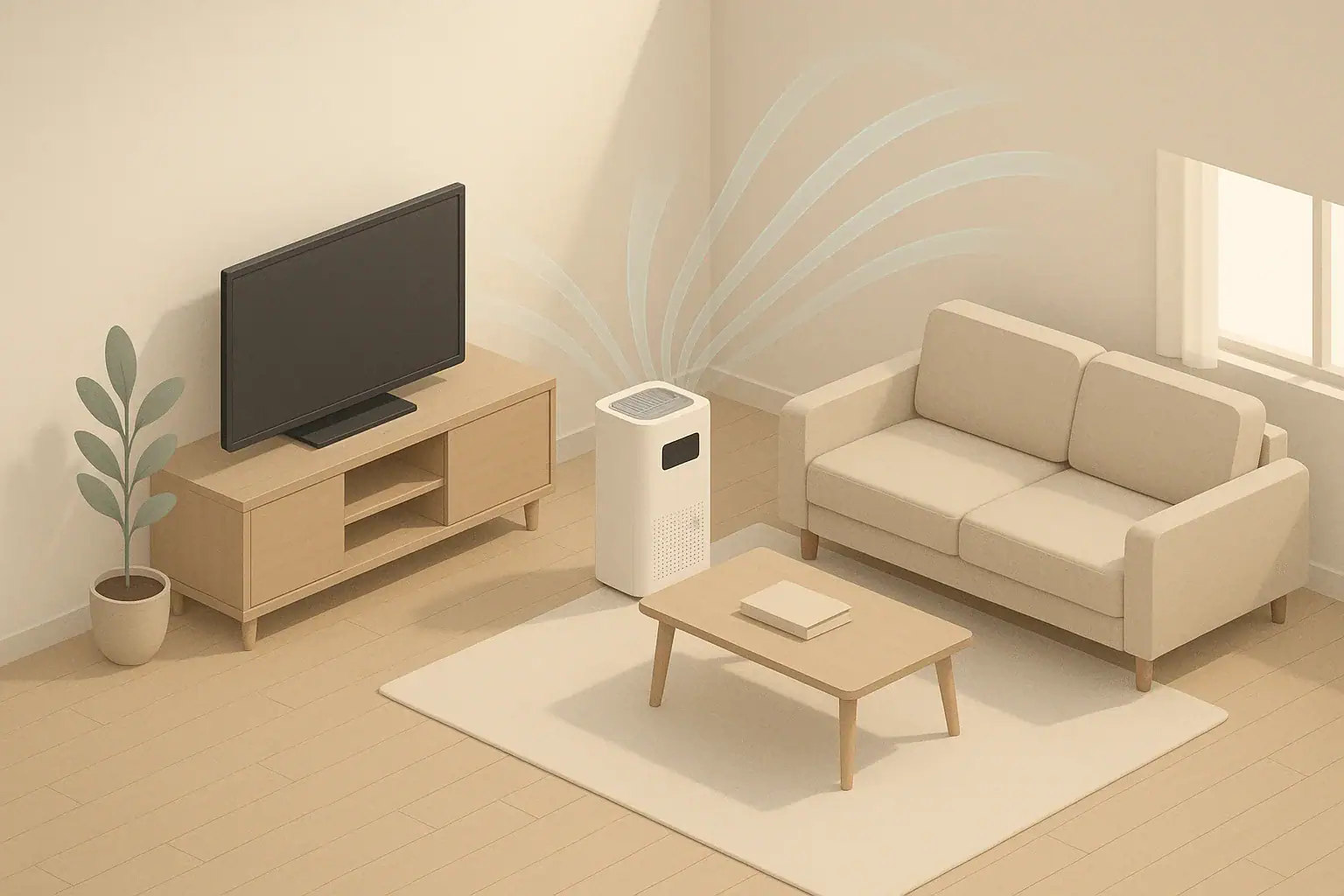
The right air purifier size for your room is the one that can fully filter your room’s air volume at least 4–5 times per hour without being too loud or inefficient. To get there, you match your room’s square footage and ceiling height to the purifier’s Clean Air Delivery Rate (CADR) and your target air changes per hour (ACH).
When people say an air cleaner is “not working,” the most common reason is that it is undersized for the actual room volume or open floor plan. Marketing terms like “large room” or “whole home” are vague; what matters is whether the purifier can move enough clean air for your real space. This guide walks through simple measurements, example calculations, and practical checks so you can size an air purifier correctly for bedrooms, living rooms, and open-plan areas.
What “Right Size” Air Purifier Really Means (And Why It Matters)
Choosing an air purifier for room size is about balancing three things: how big the room is, how clean you want the air to be, and how fast you want it cleaned. The “right size” purifier can keep up with your room’s air volume without having to run at maximum speed all the time.
If your purifier is too small, it may run constantly and still leave dust, pollen, smoke, or pet dander hanging in the air. You might notice musty or smoky smells that never fully clear, or allergy symptoms that only improve a little. On the other hand, an oversized unit can cost more up front, take up more space, and be noisier than needed if you do not use its capacity wisely.
Room size affects how quickly particles and odors are reduced. A purifier that is perfect for a 150-square-foot bedroom can struggle in a 350-square-foot living room with high ceilings. To avoid guesswork, you will use a few technical ideas—room area, ceiling height, CADR, and ACH—to translate your space into a realistic capacity target.
Key Sizing Concepts: CADR, ACH, and Room Volume
Once you know your room size, you can connect it to purifier performance using CADR and ACH. These numbers turn vague labels like “small room” and “large room” into something measurable.
Step 1: Measure Room Area and Volume
Start with the floor area in square feet:
- Room area (sq ft) = length (ft) × width (ft)
Example: A bedroom that is 12 feet by 15 feet has an area of 180 square feet.
For irregular rooms, break the space into rectangles, calculate each area, and add them together. If a living room flows openly into a dining room with no real separation, treat it as one combined space. Closed doors to other rooms can usually be ignored for sizing.
Next, account for ceiling height by calculating volume:
- Room volume (cubic feet) = area (sq ft) × ceiling height (ft)
Example: A 180-square-foot room with 9-foot ceilings has a volume of 1,620 cubic feet. Taller ceilings mean more air to clean, so a stronger purifier or higher CADR is needed for the same ACH.
Step 2: Understand CADR (Clean Air Delivery Rate)
CADR is a standardized measure of how much filtered air a purifier delivers, usually in cubic feet per minute (CFM). Many products list separate CADR values for:
- Smoke (fine particles, similar to PM2.5)
- Dust
- Pollen
For room sizing, the smoke or dust CADR is usually the most relevant because it reflects performance on fine particles that stay airborne longer. Higher CADR means the purifier can clean more air per minute.
Step 3: Understand ACH (Air Changes per Hour)
Air Changes per Hour (ACH) tells you how many times per hour the purifier can theoretically clean the room’s full air volume. It directly links CADR to room size:
- ACH = (CADR × 60) ÷ room volume
This formula converts CADR (cubic feet per minute) into cubic feet per hour, then divides by room volume. A higher ACH means faster reduction of airborne particles, as long as the purifier is running.
Step 4: Choose a Target ACH for Your Needs
Your ideal ACH depends on how clean you want the air and what you are trying to remove:
- 2–3 ACH: Basic freshness in relatively clean environments.
- 4–5 ACH: Common target for allergies, moderate dust, or urban air pollution.
- 5–8 ACH: Often used for asthma, wildfire smoke, or high outdoor pollution events.
For most bedrooms and living spaces where the goal is better day-to-day air quality, 4–5 ACH is a practical baseline.
Step 5: Use CADR and ACH Together
To find the CADR you need, rearrange the formula:
- CADR = (ACH × room volume) ÷ 60
Once you have a target CADR, you can compare it to product specs instead of relying on vague “room size” labels.
| Room area (sq ft) | Ceiling height (ft) | Room volume (cu ft) | Target ACH | Minimum smoke/dust CADR (CFM) |
|---|---|---|---|---|
| 120 | 8 | 960 | 5 | 80 |
| 180 | 9 | 1,620 | 5 | 135 |
| 250 | 8 | 2,000 | 4 | 134 |
| 350 | 9 | 3,150 | 5 | 263 |
| 500 | 9 | 4,500 | 5 | 375 |
Real-World Room Size Examples and Layout Scenarios
Abstract formulas are helpful, but it is easier to choose an air purifier when you see how sizing works in real rooms. These examples show how room size, ceiling height, and use case interact.
Example 1: Small Bedroom or Home Office
Scenario: 10 ft × 12 ft bedroom used for sleep and remote work.
- Area: 120 sq ft
- Ceiling height: 8 ft
- Volume: 120 × 8 = 960 cubic ft
- Target ACH: 5 (for allergy support and nighttime comfort)
- Required CADR ≈ (5 × 960) ÷ 60 = 80 CFM
A purifier with a smoke or dust CADR around 80 CFM or higher should be able to maintain clean air in this space. In practice, you might choose a unit with a bit more capacity so it can run on a quieter medium speed overnight.
Example 2: Medium Living Room
Scenario: 14 ft × 18 ft living room where the family spends evenings, with occasional cooking odors drifting in from a nearby kitchen.
- Area: 252 sq ft (rounded to 250 for simplicity)
- Ceiling height: 9 ft
- Volume: 250 × 9 = 2,250 cubic ft
- Target ACH: 4 (general comfort and moderate dust)
- Required CADR ≈ (4 × 2,250) ÷ 60 = 150 CFM
Here, a purifier rated around 150 CFM or higher is appropriate. If the room has a high-traffic entryway or is connected to a hallway that is usually open, consider stepping up slightly in CADR to compensate for more air exchanging with other spaces.
Example 3: Large Open-Plan Area
Scenario: Combined kitchen, dining, and living space with cooking, pets, and some outdoor smoke during wildfire season.
- Area: 500 sq ft
- Ceiling height: 9 ft
- Volume: 500 × 9 = 4,500 cubic ft
- Target ACH: 5 (due to cooking particles and smoke)
- Required CADR ≈ (5 × 4,500) ÷ 60 = 375 CFM
In this case, you can either use a single very high-capacity purifier or place two smaller units in different zones (for example, one near the seating area and one closer to the kitchen). Multiple units often give more even coverage in L-shaped or open layouts.
Example 4: High-Ceiling Room vs. Standard Ceiling
Two rooms with the same floor area can require different purifier sizes:
- Room A: 200 sq ft with 8 ft ceilings → volume = 1,600 cubic ft
- Room B: 200 sq ft with 12 ft ceilings → volume = 2,400 cubic ft
If both target 5 ACH:
- Room A CADR ≈ (5 × 1,600) ÷ 60 ≈ 133 CFM
- Room B CADR ≈ (5 × 2,400) ÷ 60 = 200 CFM
Room B needs roughly 50% more CADR than Room A even though the floor area is identical. This is why simply matching square footage to a box label can be misleading in homes with high or vaulted ceilings.
| Scenario | Key room details | Pollution level | Suggested strategy |
|---|---|---|---|
| Small bedroom | 120 sq ft, 8 ft ceiling, door usually closed | Light dust, seasonal pollen | Single purifier sized for 5 ACH; prioritize low noise at night |
| Medium living room | 250 sq ft, 9 ft ceiling, open to hallway | Moderate dust, occasional cooking odors | Medium CADR unit for 4–5 ACH; place near seating area with clear airflow |
| Open-plan space | 500 sq ft, 9 ft ceiling, kitchen plus seating | Cooking particles, pet dander, outdoor smoke | High CADR unit or two smaller purifiers; focus on zones where people stay longest |
| High-ceiling great room | 300 sq ft, 12 ft vaulted ceiling | Similar to rest of home | Upsize based on volume; consider ceiling fan to improve mixing |
Common Sizing Mistakes and Troubleshooting Signs
Even with the right formulas, it is easy to misjudge air purifier room size. Recognizing common mistakes and warning signs helps you correct course without replacing your entire setup.
Mistake 1: Trusting Only the “Maximum Room Size” on the Box
Many manufacturers list a single maximum room size that assumes a relatively low ACH (often near 2 ACH). That may be enough for mild odor control, but not for allergies, asthma, or smoke events.
Warning signs:
- Allergy symptoms improve only slightly even with the purifier on high.
- Fine dust or pet hair still settles quickly on surfaces.
- Smoke or cooking odors linger longer than 30–60 minutes.
Fix: Use the CADR and ACH calculations for your actual room volume. If your current unit is undersized, consider moving it to a smaller room and using a higher-capacity purifier for the larger space.
Mistake 2: Ignoring Ceiling Height and Open Layouts
Relying only on floor area can under-size purifiers in homes with tall ceilings or open-plan layouts. Air flows freely between connected spaces, effectively increasing the volume the purifier must handle.
Warning signs:
- Air feels cleaner near the purifier but not in distant corners.
- Particle readings (if you use a monitor) differ noticeably across the room.
Fix: Recalculate based on full volume, including any areas that are always open. You may need to reposition the unit more centrally, add a second purifier, or choose a higher CADR.
Mistake 3: Poor Placement and Blocked Airflow
Even a correctly sized purifier can underperform if it is hidden behind furniture or pushed into a corner.
Warning signs:
- Visible dust accumulates on one side of the room more than the other.
- Air from the outlet hits a wall or furniture immediately.
Fix:
- Place the unit where both intake and outlet have several inches of clearance.
- Avoid tucking it under low shelves or behind sofas.
- Position it closer to where people spend the most time, not in an unused corner.
Mistake 4: Running Only on the Quietest Setting
Most purifiers reach their rated CADR only on the highest fan speed. If you always use the lowest speed, you might be getting far fewer air changes than you expect.
Warning signs:
- The room feels fresh only when you briefly run the fan on high.
- Odors clear eventually but much more slowly than expected.
Fix:
- During high-pollution times (cooking, smoke, vacuuming), use higher speeds temporarily.
- Consider a slightly oversized purifier so your target ACH can be reached at a medium, quieter speed.
Mistake 5: Underestimating Pollution Sources
Two same-size rooms may need different purifier capacities if one has smoking, frequent frying, multiple pets, or nearby traffic pollution.
Warning signs:
- Persistent odors even when the room volume and CADR technically match.
- Visible haze during cooking or wildfire events that never fully clears.
Fix: Increase target ACH, add a second unit, or combine purification with better source control (for example, using range hoods, reducing indoor smoking, or closing windows during high outdoor pollution).
Safety Basics When Using an Air Purifier in Any Room Size
Most modern air purifiers are straightforward to use, but sizing and placement choices can affect safety and comfort, especially in bedrooms and children’s rooms.
Electrical and Placement Safety
- Plug the purifier directly into a wall outlet rather than into overloaded power strips.
- Ensure the power cord does not create a tripping hazard across walkways.
- Keep the unit on a stable, level surface where it cannot be easily knocked over.
- Maintain the manufacturer’s recommended clearance around air intakes and outlets to prevent overheating.
Filter and Ozone Considerations
- Follow the manual for filter replacement intervals; clogged filters can reduce airflow and strain the motor.
- Avoid using any optional ionizing or ozone-generating modes if you are sensitive to respiratory irritants, especially in small, tightly sealed rooms.
- Do not attempt to wash or vacuum disposable HEPA filters unless the manual specifically says they are washable; this can damage fibers and reduce filtration efficiency.
Safe Use in Bedrooms and Children’s Rooms
- Choose a noise level that does not disturb sleep; a unit that is too loud may be turned off at night, reducing protection when you need it most.
- Position the purifier so air flows across the room rather than directly at a sleeping child’s face at very close range.
- Ensure small children cannot easily access or play with the controls or tip the unit over.
Long-Term Use, Filter Maintenance, and Seasonal Storage
Once you have a purifier matched to your room size, consistent maintenance keeps its performance close to the original CADR rating over time.
Filter Maintenance and Performance
- Pre-filters: These capture large dust and hair. Clean or replace them on the schedule in your manual, or more often in homes with pets.
- HEPA or particle filters: These remove fine particles such as pollen, pet dander, and smoke. Replace them when the indicator light suggests, or sooner if you notice reduced airflow or persistent odors.
- Gas/odor filters: Activated carbon or similar media can help with odors and some gases. Their lifespan depends heavily on pollution levels and may be shorter in homes with heavy cooking or smoking.
Running a purifier with clogged filters effectively reduces its CADR, so your carefully calculated ACH may no longer be accurate until filters are replaced.
Runtime Strategy for Different Room Types
- Bedrooms: Many people run purifiers continuously at a low or medium speed, increasing to high briefly before bedtime to quickly clean the air.
- Living rooms and open areas: Continuous use on a moderate speed is helpful if you have pets, dust, or outdoor pollution. For occasional use, run on high for 30–60 minutes before gatherings.
- Home offices: If you only occupy the room during the day, you can run the purifier mainly when you are present, with a higher speed for the first part of the day.
Seasonal Storage Tips
- Before storing, wipe down the exterior and replace or remove filters according to the manual.
- Store the purifier in a dry, clean area to prevent mold growth inside the housing.
- When you bring it back into service, inspect the interior for dust buildup and verify that the fan spins freely without unusual noise.
Practical Takeaways and Specs to Look For
By this point, you have the tools to match an air purifier to your room size using room volume, CADR, and ACH instead of guesswork. A correctly sized purifier should quietly maintain clean air in your most-used spaces with minimal manual adjustment.
Step-by-Step Sizing Summary
- Measure your room’s length, width, and ceiling height.
- Calculate area (sq ft) and volume (cubic ft).
- Choose a target ACH based on your needs (4–5 ACH for most allergy and comfort goals; higher for smoke or asthma).
- Use CADR = (ACH × volume) ÷ 60 to find your minimum smoke/dust CADR.
- Compare that CADR to product specs, and adjust upward for high ceilings, open layouts, or heavy pollution sources.
- Place the purifier for good airflow, maintain filters, and adjust fan speeds based on real-world comfort and noise.
Specs to Look For on the Box or Product Sheet
- CADR ratings: Look for clearly listed smoke and/or dust CADR values that meet or exceed your calculated target.
- Recommended room size: Use this only as a rough check; confirm with your own volume and ACH calculations.
- Noise levels (dB): Check noise at low and medium speeds, especially for bedrooms and offices where quiet operation matters.
- Fan speed options: Multiple speeds or automatic modes help balance cleaning power with noise and energy use.
- Filter type and replacement interval: Confirm that filters match your needs (fine particles, odors) and that replacement timing is realistic for your budget.
- Power consumption (watts): Lower wattage at your typical fan speed can reduce long-term operating cost, especially if you run the purifier 24/7.
- Dimensions and weight: Make sure the unit fits comfortably in your intended location with enough clearance for airflow.
When you combine these specs with a clear understanding of your room’s size and layout, you can choose an air purifier that is powerful enough to keep your air cleaner, yet quiet and efficient enough to use every day.
Frequently asked questions
Which specifications or features should I prioritize when choosing an air purifier for my room?
Prioritize CADR (smoke/dust) to ensure the unit can meet your ACH target for the room’s volume, plus noise levels at the speeds you’ll use most. Also check filter type and replacement intervals, fan speed options, and physical size so the unit fits and performs well in your space.
Why isn’t my air purifier improving air quality even though it’s rated for my room size?
Common causes include poor placement, blocked airflow, clogged filters, or relying on a “room size” rating that assumes a low ACH. Verify CADR against actual room volume, ensure clearance around the unit, replace filters as needed, and run higher speeds during pollution events.
Can air purifiers pose any risks, and how can I minimize them?
Most HEPA-style purifiers are safe when used according to instructions, but avoid modes that intentionally generate ozone and follow electrical and placement guidance. Keep units stable, plug them into appropriate outlets, and replace filters on schedule to prevent reduced performance or mechanical strain.
How should I size an air purifier for an oddly shaped or open-plan room?
Break oddly shaped spaces into rectangles to calculate total floor area and use the average or actual ceiling height to get volume, or treat connected areas as one combined volume for ACH calculations. For very open plans, consider multiple units placed in different zones to achieve even coverage.
Is it better to use multiple smaller purifiers or one large unit in an open-plan area?
Multiple units often provide more even coverage and reduce dead zones in L-shaped or multi-zone spaces, allowing placement near high-use areas like the kitchen or seating. A single high-CADR unit can work if its airflow effectively reaches all occupied zones, but multiple units offer flexibility and redundancy.
How often should I replace filters to keep the purifier’s CADR accurate?
Follow the manufacturer’s recommended intervals, but expect shorter lifespans in homes with pets, smoking, or heavy cooking. Inspect pre-filters monthly and replace HEPA or carbon filters when indicator lights suggest, if performance drops, or if persistent odors return.
- Clear sizing logic (room size → CADR/ACH)
- HEPA vs carbon explained for real use-cases
- Humidity + ventilation basics to reduce mold risk