
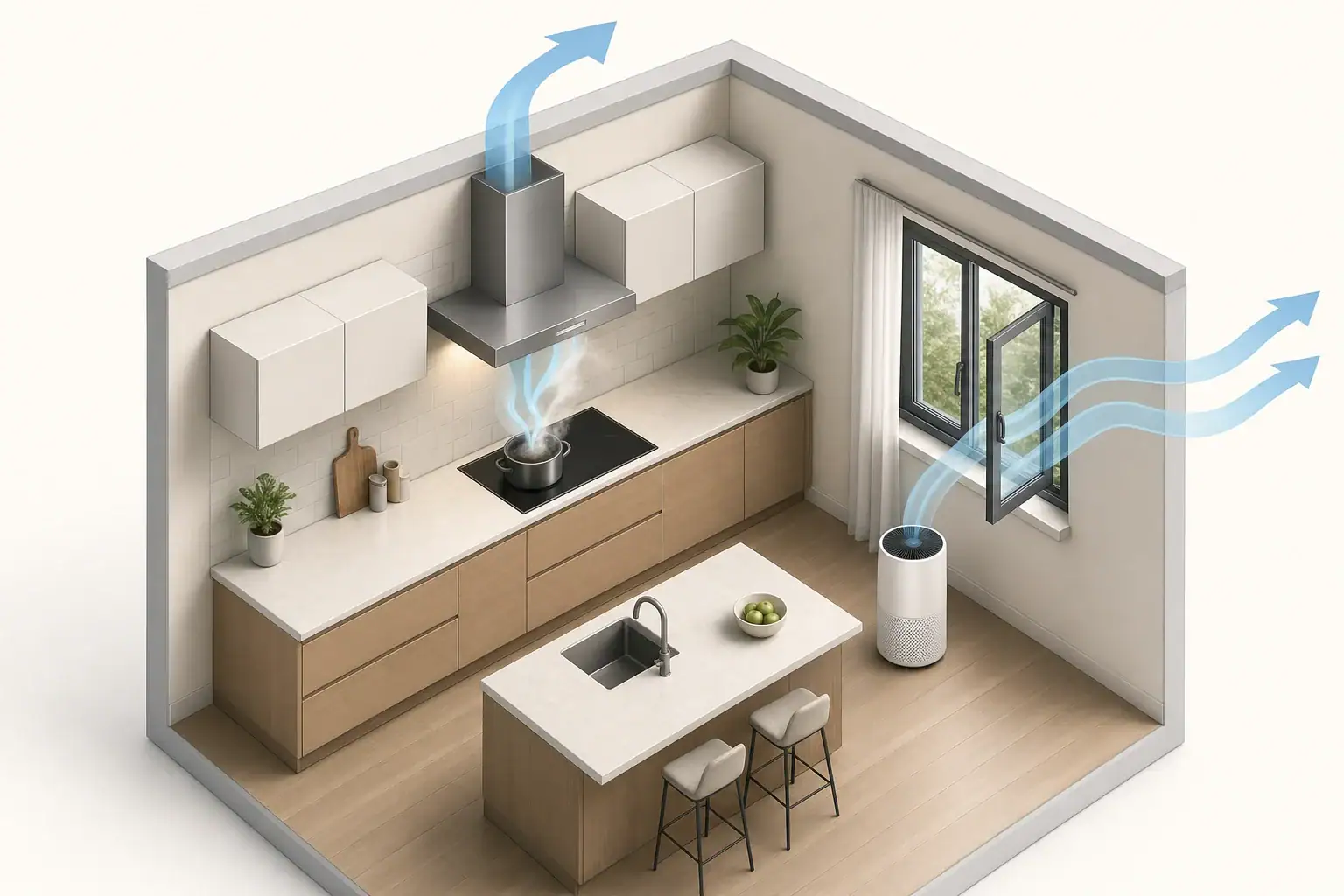
Run kitchen ventilation throughout cooking and for about 10 to 30 minutes afterward, extending it to 30 to 60 minutes when frying, searing, smoke, or persistent odors are involved. A portable air purifier can generally run on a higher setting for 30 to 60 minutes after cooking, or until a particle monitor returns near its usual baseline. Actual clearing time depends on the cooking method, fan capture, room layout, and outdoor conditions.
- Turn on an exhaust hood before cooking and leave it on for roughly 10 to 30 minutes afterward.
- After frying, broiling, searing, or visible smoke, consider 30 to 60 minutes of continued ventilation.
- Run a suitably sized particle purifier on high for about 30 to 60 minutes, then return it to its normal setting.
- Use windows only when outdoor air quality, weather, and security conditions are suitable.
- If available, use a PM2.5 monitor trend rather than odor alone to decide when particle levels have settled.
Why Ventilating After Cooking Matters
Cooking can release airborne particles, moisture, odors, grease droplets, and gases. The amount varies considerably. Boiling water mainly adds moisture, while frying and searing tend to produce more fine particles and oil aerosols. Gas burners can also add combustion byproducts to the room.
Emissions do not disappear as soon as a burner is turned off. Air can continue circulating from the kitchen into connected rooms, and particles may remain suspended or settle onto surfaces. Continued ventilation gives the exhaust system time to capture material left in the air.
The main goal is source control: capture cooking emissions close to the stove and move them outdoors. A vented range hood is normally more direct than opening a distant window or relying only on a portable purifier. Purification can supplement ventilation, but it does not replace outdoor exhaust for moisture or combustion gases.
How Long to Run Fans and Purifiers
There is no single exact run time for every meal. As general guidance, use a vented range hood during cooking and continue for 10 to 20 minutes after light activity such as simmering or steaming. Continue for 20 to 30 minutes after typical stovetop cooking, and consider 30 to 60 minutes after high-heat frying, searing, broiling, or an event that produced visible haze.
A bathroom-style exhaust fan elsewhere in the home is not a substitute for a range hood, but it may support general air exchange if it exhausts outdoors. Keep in mind that air must have a path into the home for any exhaust fan to work effectively. A slightly open window in another room may help provide makeup air when conditions allow.
For a portable purifier, 30 to 60 minutes on a high setting is a practical starting range. Larger open-plan spaces, low purifier airflow, closed interior doors, and poor placement can increase the time needed. Continuous operation at a quieter speed may provide steadier control than switching the unit on only after cooking.
Air changes offer another way to estimate timing. Approximate air changes per hour, or ACH, can be estimated as purifier clean air delivery rate multiplied by 60 and divided by room volume. At 5 ACH, one theoretical air change takes about 12 minutes, but real rooms do not mix perfectly. Several cycles may be needed before a monitor reading approaches its previous level.
Example values for illustration.
| Situation | Primary action | Example post-cooking time |
|---|---|---|
| Boiling or light simmering | Use the vented hood to remove moisture | 10 to 20 minutes |
| Routine stovetop cooking | Use the hood and supplement with a purifier if needed | 20 to 30 minutes |
| Frying or high-heat searing | Use high hood airflow and higher purifier speed | 30 to 60 minutes |
| Visible smoke or haze | Stop the source, exhaust outdoors, and increase particle filtration | Until the haze clears and readings settle |
| Persistent humidity | Continue outdoor exhaust or use appropriate humidity control | Until moisture returns near its normal range |
| Poor outdoor air quality | Keep windows closed and prioritize mechanical exhaust and filtration | Adjust according to indoor conditions |
Choosing Between a Range Hood, Window, and Purifier
Vented range hoods
A hood that exhausts outdoors is usually the most useful first step because it captures contaminants near the stove. Turn it on before the pan becomes hot, use a speed appropriate for the cooking method, and cook on the rear burners when practical because they are often better covered by the hood.
A recirculating hood passes air through filters and returns it to the kitchen. Its grease filter can collect larger oil droplets, and a carbon filter may reduce some odors. However, it does not remove moisture or combustion gases outdoors, and thin carbon filters have limited capacity.
Open windows and cross-ventilation
An open window can dilute indoor pollutants, especially when two openings create a cross-flow. Results depend on wind, temperature differences, window position, and the layout of the home. Before opening windows, consider outdoor smoke, pollen, traffic pollution, humidity, extreme temperatures, noise, and security.
Portable air purifiers
A purifier with an effective particle filter can reduce cooking-related airborne particles that escape the hood. Place it near the kitchen but outside the immediate grease and heat plume. Avoid positioning it where its airflow pushes emissions away from the hood or where oil can rapidly coat the filter.
Particle filters do not remove water vapor, carbon monoxide, or every gaseous pollutant. Activated carbon may help with some odors and gases, but performance depends on the amount and type of carbon, contact time, and remaining filter capacity. Odor reduction should not be treated as proof that all pollutants have cleared.
A Practical Post-Cooking Ventilation Checklist
A simple routine is more reliable than waiting until the kitchen smells smoky. Use the following steps for everyday cooking:
- Start the range hood shortly before turning on the burner or oven.
- Match fan speed to the activity, using more airflow for frying, searing, or multiple burners.
- Keep lids on pots when practical to reduce moisture and airborne droplets.
- Use rear burners when they fit beneath the hood capture area.
- Leave the hood running for at least 10 to 30 minutes after cooking.
- Increase the post-cooking period if there is visible haze, persistent humidity, or an elevated particle reading.
- Run a suitably sized purifier at a higher speed while cooking and for 30 to 60 minutes afterward.
- Open windows only after checking outdoor conditions.
- Wipe greasy surfaces after they cool rather than relying on airflow to manage deposited residue.
Avoid a common mistake: placing a powerful fan so that it blows sideways across the stove. Strong cross-currents can disrupt the rising plume and reduce the hood’s capture. Ceiling fans may have a similar effect when operated at high speed directly over or near the cooking area.
Also check whether the exhaust fan is actually moving air outdoors. A loud hood is not necessarily an effective hood. Weak capture may result from dirty grease filters, a blocked exterior outlet, restrictive ductwork, insufficient makeup air, or a hood that is too small for the cooking surface.
Timing Examples for Different Homes and Meals
Light cooking in a closed kitchen
After boiling pasta or simmering soup, run the vented hood during cooking and for roughly 10 to 20 minutes afterward. If windows are fogging or humidity remains noticeably elevated, continue ventilation until the room moves back toward its usual condition.
Frying in an open-plan apartment
Open layouts allow particles and odors to spread into a larger volume. Start the hood early, use its higher practical setting, and operate a purifier where air from the kitchen naturally enters the living area. A 30- to 60-minute post-cooking period may be reasonable, but a PM2.5 trend can provide a better stopping cue.
High-heat cooking with weak hood capture
If a hood does not fully cover the cooking surface, reduce emissions at the source where practical. Use lids or splatter screens, cook on covered rear burners, and avoid overheating oils. Continue exhaust and filtration after cooking, but recognize that longer run time cannot fully compensate for poor capture during the event.
Cooking when outdoor air is smoky
Keep windows closed when outdoor particle levels are elevated. Use the range hood as needed for source control, recognizing that exhaust operation can draw some replacement air through building gaps. Run a particle purifier continuously at an effective but tolerable speed and reduce high-emission cooking methods when convenient.
Safety Considerations for Cooking Air Quality
Use cooking appliances according to their instructions, and never use a gas oven or stovetop to heat a room. Homes with fuel-burning appliances should have working carbon monoxide alarms installed and maintained according to local requirements and alarm instructions. A standard air purifier does not detect or remove carbon monoxide.
If a carbon monoxide alarm activates, follow the alarm instructions and local emergency guidance. Do not remain inside merely to operate fans or open windows. Unusual soot, persistent burner problems, or repeated alarm events should be evaluated by an appropriately qualified professional.
Some air cleaners add ionization, electrostatic collection, plasma, or ultraviolet features. These are not necessary for basic post-cooking particle filtration. If considering an electronic air-cleaning feature, look for credible evidence of low or no ozone emissions and use it only as directed. Do not intentionally generate ozone in an occupied home.
Ultraviolet light is primarily intended for microbial control in specifically designed systems; it does not remove cooking particles, moisture, or most gases. For cooking emissions, outdoor exhaust, effective particle filtration, adequate airflow, and source control remain the practical priorities.
Maintenance and Monitor Cues
Grease filters need regular cleaning because accumulated oil can restrict airflow and become difficult to remove. Follow the appliance instructions for cleaning methods and intervals. Households that fry frequently may need to inspect filters more often than households that mainly boil or bake.
Replace disposable purifier filters according to their condition and the manufacturer’s general schedule rather than time alone. Cooking aerosols can load particle filters and carbon media faster than ordinary household dust. Reduced airflow, persistent odor, visible loading, or an unusually high fan sound can indicate that inspection is due.
A basic PM2.5 monitor can help show whether fine-particle levels rose during cooking and how quickly they declined. Focus on the trend rather than treating a single reading as exact. Consumer sensors vary, and steam or aerosol droplets may temporarily affect some particle sensors.
Carbon dioxide is not a direct measure of cooking particles. It can offer general information about occupancy and ventilation, but it should not be used to determine whether grease aerosols or combustion pollutants have cleared. Likewise, broad TVOC readings can react to cleaning products, fragrances, alcohol, and humidity, so changes require context.
Example values for illustration.
| Metric or cue | What it may indicate | Practical response |
|---|---|---|
| PM2.5 trend | Fine particles increased during cooking | Continue exhaust and filtration until the trend approaches its usual baseline |
| Humidity trend | Steam or moisture remains in the room | Continue outdoor exhaust and reduce moisture sources |
| TVOC trend | A broad sensor response to gases or aerosols | Check for cooking, cleaning, fragrance, and humidity influences |
| Carbon dioxide trend | General ventilation relative to occupancy | Use as a ventilation clue, not as a cooking-particle measurement |
| Visible haze | Substantial airborne droplets or particles | Stop the source and increase safe outdoor exhaust and filtration |
| Persistent odor | Odorous compounds or residue remain | Ventilate, inspect carbon media, and clean cooled surfaces |
Related guides: Cooking PM2.5 Spikes: What to Do Before, During, and After Cooking • Ventilation vs Air Purifier: When You Need One, the Other, or Both • Kitchen Ventilation Without a Range Hood: Practical Alternatives • Ventilating During Wildfire Smoke: When Keeping Windows Closed Is Better
Summary of Post-Cooking Run Times
For most meals, run a vented kitchen fan throughout cooking and for about 10 to 30 minutes afterward. Extend that period to approximately 30 to 60 minutes after frying, searing, broiling, visible smoke, or cooking that spreads emissions through an open-plan space.
A portable particle purifier can run on high for 30 to 60 minutes after cooking or until PM2.5 readings return near their normal baseline. Use it as a supplement to source capture, not as a replacement for outdoor exhaust. Longer operation may be needed when airflow is weak, the space is large, or purifier capacity is limited.
The most practical stopping cues are a settled particle trend, normal room humidity, no visible haze, and restored airflow conditions. Odor can be useful context, but it should not be the only measure because particle, moisture, and gas removal do not occur at the same rate.
Frequently asked questions
How long should I run the range hood after cooking?
For boiling, steaming, or light simmering, running a vented range hood for about 10 to 20 minutes afterward is often a practical starting point. For typical stovetop meals, 20 to 30 minutes is commonly appropriate, while frying, searing, broiling, or visible smoke may call for 30 to 60 minutes.
Should I leave the kitchen fan on longer after frying food?
Yes, frying releases more fine particles and oil aerosols than lower-heat cooking methods, so a longer post-cooking period is often useful. Keep the hood running for roughly 30 to 60 minutes and use a particle purifier as a supplement if particles or odors have spread beyond the kitchen.
Can I use a portable air purifier instead of a range hood?
A portable purifier can help reduce airborne particles that escape the cooking area, but it does not replace a hood that exhausts outdoors. Particle filters do not remove moisture or carbon monoxide, and their ability to reduce gases and odors depends on the filter media and airflow.
How do I know when the air has cleared after cooking?
A PM2.5 monitor trend approaching its usual baseline, normal room humidity, and the absence of visible haze are useful cues. Odor can provide context, but it should not be the only stopping signal because odors, particles, moisture, and gases can clear at different rates.
Should I open windows after cooking if the outdoor air is smoky?
When outdoor particle levels are elevated, keeping windows closed usually helps limit the amount of polluted outdoor air entering the home. Use the range hood for source control as needed, run particle filtration, and choose lower-emission cooking methods when practical.
Recommended next:
- Ventilation vs Air Purifier: When You Need One, the Other, or Both
- CO2 in Bedrooms: What Levels Mean and How to Improve Air Exchange
- How to Ventilate in Winter Without Freezing: Practical Strategies
- Exhaust Fan Best Practices: Bathrooms and Kitchens That Actually Clear Air
- Air Exchange Basics: ACH, Infiltration, and Why “Stuffy” Happens
- ERV vs HRV: What They Do for Indoor Air Quality
- Clear sizing logic (room size → CADR/ACH)
- HEPA vs carbon explained for real use-cases
- Humidity + ventilation basics to reduce mold risk