
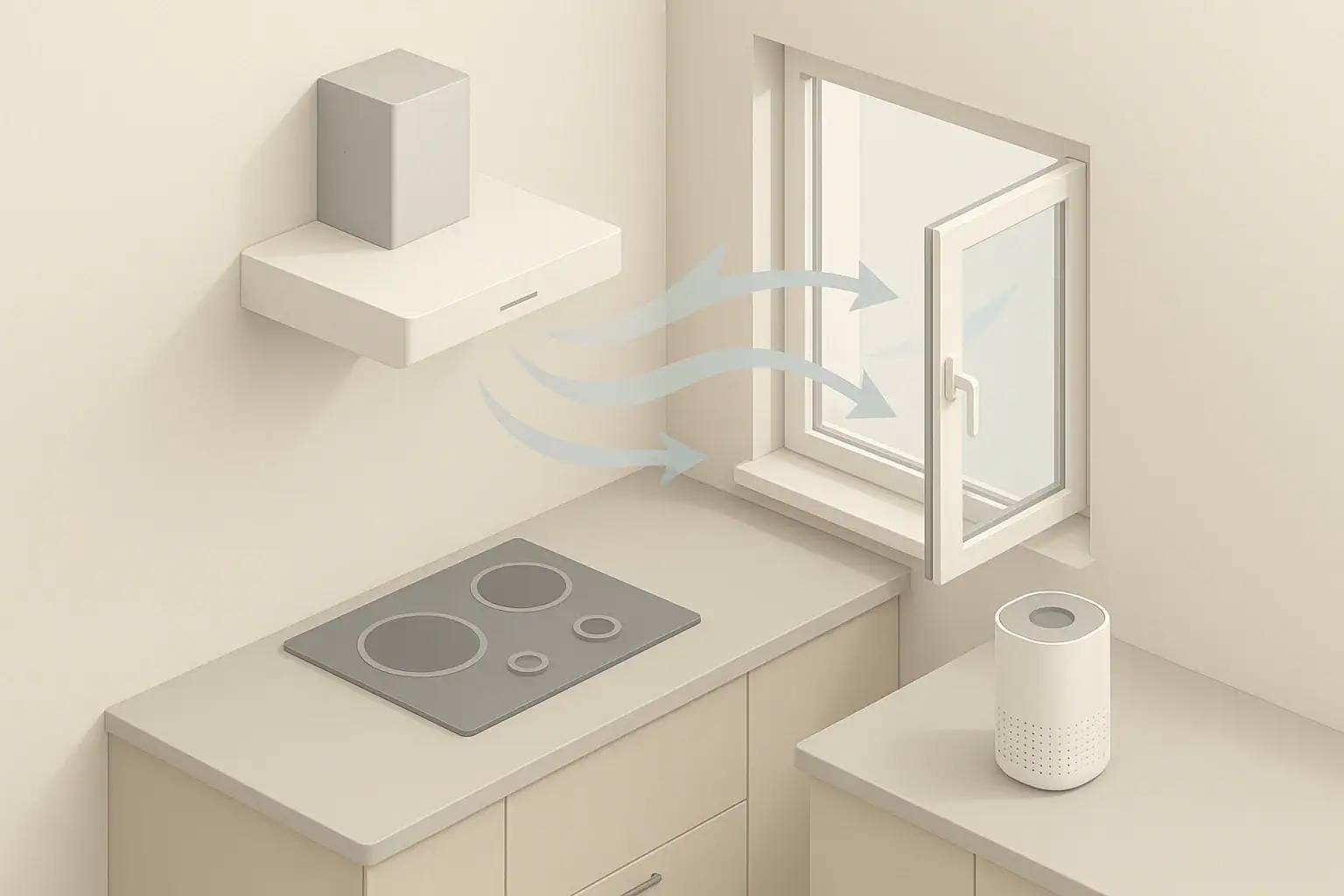
- Use a window exhaust fan or open window during cooking and for about 10 to 20 minutes afterward when outdoor conditions allow.
- Create cross-ventilation by opening a second window or door 1 to 3 inches on the opposite side of the space when practical.
- For particles from frying, searing, or smoke-prone cooking, use a portable HEPA air cleaner sized for the kitchen or adjacent open area.
- Activated carbon can help reduce some cooking odors, but it is not a substitute for exhausting humid or combustion-related air outdoors.
- Keep indoor relative humidity roughly in the 30% to 50% range when possible to limit dampness from cooking steam.
- If cooking with gas, use working carbon monoxide alarms and follow appliance ventilation requirements.
Why kitchen ventilation matters when there is no hood
Cooking adds more than smells to indoor air. It can produce moisture, grease aerosols, fine particles, and heat. Gas cooking can also add combustion byproducts, while electric cooking can still create particles and odors from food, oils, and high-temperature cooking.
A range hood works well because it captures air close to the source. Without one, the strategy changes from source capture to dilution, exhaust, filtration, and cooking adjustments. That means you are trying to reduce buildup and spread, not perfectly capture everything at the pan.
This is especially important in small apartments, open-plan homes, and tight modern buildings where kitchen air can move quickly into living and sleeping areas. The most practical approach is to choose methods that fit your layout, weather, lease rules, and cooking style.
Key concepts for no-hood kitchen ventilation
Before choosing an alternative, it helps to separate three concepts: exhaust, supply air, and filtration. Exhaust removes indoor air to the outdoors. Supply air replaces what leaves. Filtration cleans some airborne pollutants but does not remove heat, moisture, or all gases.
Exhaust is usually the first priority
If you can safely move kitchen air outdoors with a window fan, through-wall exhaust fan, or existing nearby bathroom fan, that air is actually leaving the home. This is different from a recirculating device, which passes air through filters and sends it back indoors.
For everyday cooking, a practical target is to start ventilation before the pan gets hot, keep it running during cooking, and continue for 10 to 20 minutes after cooking. Longer may be useful after frying, broiling, or strong odors.
Makeup air keeps airflow moving
An exhaust fan needs replacement air. If the home is very tight, a fan may perform poorly unless another opening allows air in. A small opening in a window or door on the other side of the kitchen can make a noticeable difference.
In cold, hot, humid, smoky, or high-pollen outdoor conditions, balance is important. Short bursts of ventilation may be better than leaving windows open for long periods.
Filtration helps with particles, not moisture
A portable air cleaner with a mechanical particle filter can reduce airborne particles that escape the cooking area. It is most useful for smoke-prone cooking, open-plan spaces, or kitchens near living areas.
Activated carbon can help with some odors and gases, but performance depends on carbon amount, airflow, and saturation. A thin carbon prefilter may reduce mild smells but should not be expected to handle heavy cooking odors for long.
| Option | Works best for | Limits | Practical note |
|---|---|---|---|
| Open window near stove | Quick dilution of heat, steam, and odor | Depends on weather and wind direction | Open before cooking and keep open briefly afterward |
| Window fan exhausting outward | Removing kitchen air outdoors | Needs safe placement and replacement air | Pair with a small inlet opening elsewhere |
| Cross-ventilation | Moving air through the home | Can spread odors if airflow path is poor | Try to pull air away from living areas |
| Portable HEPA air cleaner | Reducing airborne particles | Does not remove moisture or heat | Place near but not beside the stove |
| Activated carbon filtration | Mild odor control | Carbon becomes saturated over time | Use with ventilation rather than alone |
| Nearby bath or utility exhaust fan | Supplemental exhaust | May be far from the cooking source | Run during and after cooking if it vents outdoors |
| Cooking method changes | Reducing emissions at the source | Requires habit changes | Use lids, lower heat, and avoid overheating oils |
Common mistakes and troubleshooting cues
A common mistake is using a fan in the wrong direction. A fan blowing into the kitchen from a window can push cooking air deeper into the home. For ventilation, the fan usually works better exhausting outward, with replacement air entering from another opening.
Another mistake is placing a portable air cleaner too close to the stove. Grease, heat, and splatter can damage filters or create a safety concern. Keep the unit out of the cooking zone, away from water, and where air can circulate around the intake and outlet.
If odors linger for hours, the space may need more exhaust time, better cross-flow, or carbon replacement. If condensation forms on windows or cabinets during cooking, moisture is not leaving quickly enough. Use lids, reduce boiling time when possible, and increase short-term exhaust.
If a fan seems weak, check whether the incoming air path is blocked. Interior doors, closed windows, and tight weatherstripping can reduce airflow. Opening a second window slightly can improve the fan’s ability to move air.
Practical checklist for cooking without a hood
The best routine starts before the first smoke or steam appears. A few minutes of preparation can reduce buildup and make cleanup easier.
Before cooking
- Open a nearby window if outdoor air is acceptable.
- Place a window fan to exhaust outward if the design allows safe use.
- Open a second window or interior path slightly to provide makeup air.
- Turn on a nearby exhaust fan that vents outdoors, such as a bathroom or utility fan.
- Move portable air cleaners away from splatter and heat, but close enough to serve the kitchen or adjacent room.
During cooking
- Use lids when boiling or simmering to reduce steam.
- Choose lower heat when practical, especially with oils.
- Avoid heating empty pans or oils past the point where they smoke.
- Use back burners if a window or exhaust path pulls air away from the cook.
- Keep interior doors arranged so airflow moves toward the exhaust point, not toward bedrooms.
After cooking
- Keep ventilation running for 10 to 20 minutes, or longer for heavy odors.
- Wipe greasy surfaces after they cool to reduce lingering odors.
- Check for condensation on windows, walls, or cabinets.
- Empty trash or compost that contains strong-smelling food scraps.
Real-world setups for apartments and houses
Different homes need different no-hood strategies. The right setup depends on where the windows are, how the kitchen connects to other rooms, and whether there is an outdoor-vented fan nearby.
Small apartment with one kitchen window
A window fan exhausting outward can be the main tool. Slightly opening a living room window or entry path can provide makeup air. A compact portable air cleaner may help in the adjacent living area, especially after frying or high-heat cooking.
Open-plan home with kitchen and living room combined
Open plans dilute air into a larger space, but odors and particles can travel farther. Use short, controlled cross-ventilation. Place an air cleaner in the shared area where it can circulate air without being exposed to grease or splatter.
Interior kitchen with no window
If the kitchen has no window, look for a nearby exhaust fan that vents outdoors. A bathroom fan down a hallway may help some, but it is not equivalent to a hood. In this layout, source control matters more: use lids, avoid smoke-prone methods when possible, and run a properly sized air cleaner in the closest practical location.
Cold or humid weather
When outdoor conditions are uncomfortable, use shorter ventilation periods. Five to ten minutes of stronger exhaust during the highest-emission part of cooking may be more practical than a long window-opening session. Afterward, monitor humidity and condensation rather than relying on smell alone.
Safety and standards to keep in mind
Do not modify cooking appliances, block required vents, or bypass safety systems to create airflow. If you are considering a permanent fan, wall penetration, or ductwork, follow local building rules and use qualified help where appropriate.
Gas cooking deserves extra attention because combustion appliances have specific ventilation and safety requirements. Keep carbon monoxide alarms installed according to local guidance and manufacturer instructions. If an alarm sounds, follow the alarm instructions and leave the area as directed.
Be cautious with air cleaning features that intentionally generate ozone. Ozone is not needed for kitchen ventilation and can be an indoor air irritant. Ionizers and UV-C features should be evaluated carefully by their safety listings, maintenance requirements, and whether they can be disabled if not wanted.
Portable fans should be kept away from water, hot burners, and unstable surfaces. Extension cords should not be used in a way that creates trip, heat, or overload risks. Grease buildup on fan blades or grilles can reduce performance and should be cleaned regularly when the device is unplugged.
Maintenance and upkeep for a no-hood setup
No-hood kitchen ventilation depends on clean, working equipment. A dusty fan, clogged air filter, or saturated carbon filter can make the setup less effective and noisier.
Clean window fan grilles and blades as grease and dust accumulate. In kitchens with frequent frying, this may be needed more often than in other rooms. Always unplug portable fans before cleaning and let nearby cooking surfaces cool first.
For portable air cleaners, follow the filter replacement schedule, but adjust based on cooking frequency and particle load. Heavy cooking, smoke events, pets, and dusty homes can shorten filter life. A filter that looks loaded, smells persistent, or reduces airflow may need attention sooner.
Carbon filters require realistic expectations. Once saturated, they can stop reducing odors effectively. If odor control is a priority, plan for recurring replacement costs and confirm that the device has enough carbon media to be useful for your needs.
| Metric | What it can indicate | Common pitfall | Action idea |
|---|---|---|---|
| PM2.5 | Fine particles from smoke-prone cooking | Spikes can be brief and location-dependent | Ventilate and run particle filtration during and after cooking |
| CO2 | General ventilation and occupancy buildup | Not a direct cooking pollution measurement | Use as a clue that fresh air exchange may be low |
| TVOC | Broad changes in gases and odors | Readings vary by sensor and are not compound-specific | Look for trends rather than exact interpretation |
| Relative humidity | Steam and moisture buildup | Room readings may lag behind cooking peaks | Use lids, exhaust moisture, and watch for condensation |
| Temperature | Heat buildup from cooking | Comfort changes do not show all pollutants | Use short exhaust bursts if the kitchen overheats |
| Odor observation | Lingering cooking smells | Nose fatigue can make odors less noticeable | Increase post-cooking exhaust time or replace carbon |
Related guides: Do Air Purifiers Help With Cooking Smoke and Grease Particles? • Activated Carbon Filters Explained: VOCs, Odors, and What They Can’t Do • Ventilation vs Air Purifier: When You Need One, the Other, or Both
Frequently asked questions
What is the best way to ventilate a kitchen without a range hood?
The most effective no-hood setup is usually outdoor exhaust, such as a window fan blowing air out, paired with a small opening elsewhere for makeup air. Cross-ventilation and a portable HEPA air cleaner can help, but they work best as supporting measures rather than stand-alone solutions.
Can a portable air purifier replace a range hood?
No. A portable air purifier can reduce airborne particles and sometimes odors, but it does not remove heat, moisture, or all cooking-related gases. It is best used alongside ventilation that moves air outdoors when possible.
Should a kitchen window fan blow air in or out during cooking?
For ventilation, it generally works better to blow air out of the kitchen rather than into it. Exhausting outward helps remove heat, steam, and pollutants, while a second opening can bring replacement air in from another part of the home.
How long should I run ventilation after cooking?
A common practical range is 10 to 20 minutes after cooking, with longer times after frying, broiling, or heavy smoke. If odors or condensation remain, extend the ventilation period until the air clears and moisture is reduced.
What can I do if my kitchen has no window at all?
Use any nearby fan that vents outdoors if available, and focus more on source control by using lids, lower heat, and avoiding smoke-prone cooking methods when possible. A properly sized portable air cleaner can help with particles in the nearby space, but it will not solve moisture or combustion exhaust by itself.
Is activated carbon enough for cooking odors?
Activated carbon can help reduce some odors, especially when the filter has enough carbon and is replaced regularly. However, it does not remove humidity and is not a substitute for exhaust ventilation when cooking produces a lot of steam or combustion byproducts.
Summary takeaways
Kitchen ventilation without a range hood is a practical balancing act. The strongest approach is to reduce emissions at the stove, exhaust air outdoors when possible, provide makeup air, and use filtration for particles that escape into the room.
A window fan exhausting outward, short cross-ventilation periods, lids on pots, lower cooking temperatures, and a properly placed portable air cleaner can work together. None is a perfect replacement for a ducted hood, but a consistent routine can make everyday cooking air easier to manage.
Focus on airflow direction, safe equipment placement, humidity control, and regular maintenance. These basics are usually more useful than complicated setups, especially in apartments or homes where adding a permanent range hood is not realistic.
Recommended next:
- Ventilation vs Air Purifier: When You Need One, the Other, or Both
- CO2 in Bedrooms: What Levels Mean and How to Improve Air Exchange
- How to Ventilate in Winter Without Freezing: Practical Strategies
- Exhaust Fan Best Practices: Bathrooms and Kitchens That Actually Clear Air
- Air Exchange Basics: ACH, Infiltration, and Why “Stuffy” Happens
- ERV vs HRV: What They Do for Indoor Air Quality
- More in Ventilation & Air Exchange →
- Clear sizing logic (room size → CADR/ACH)
- HEPA vs carbon explained for real use-cases
- Humidity + ventilation basics to reduce mold risk