
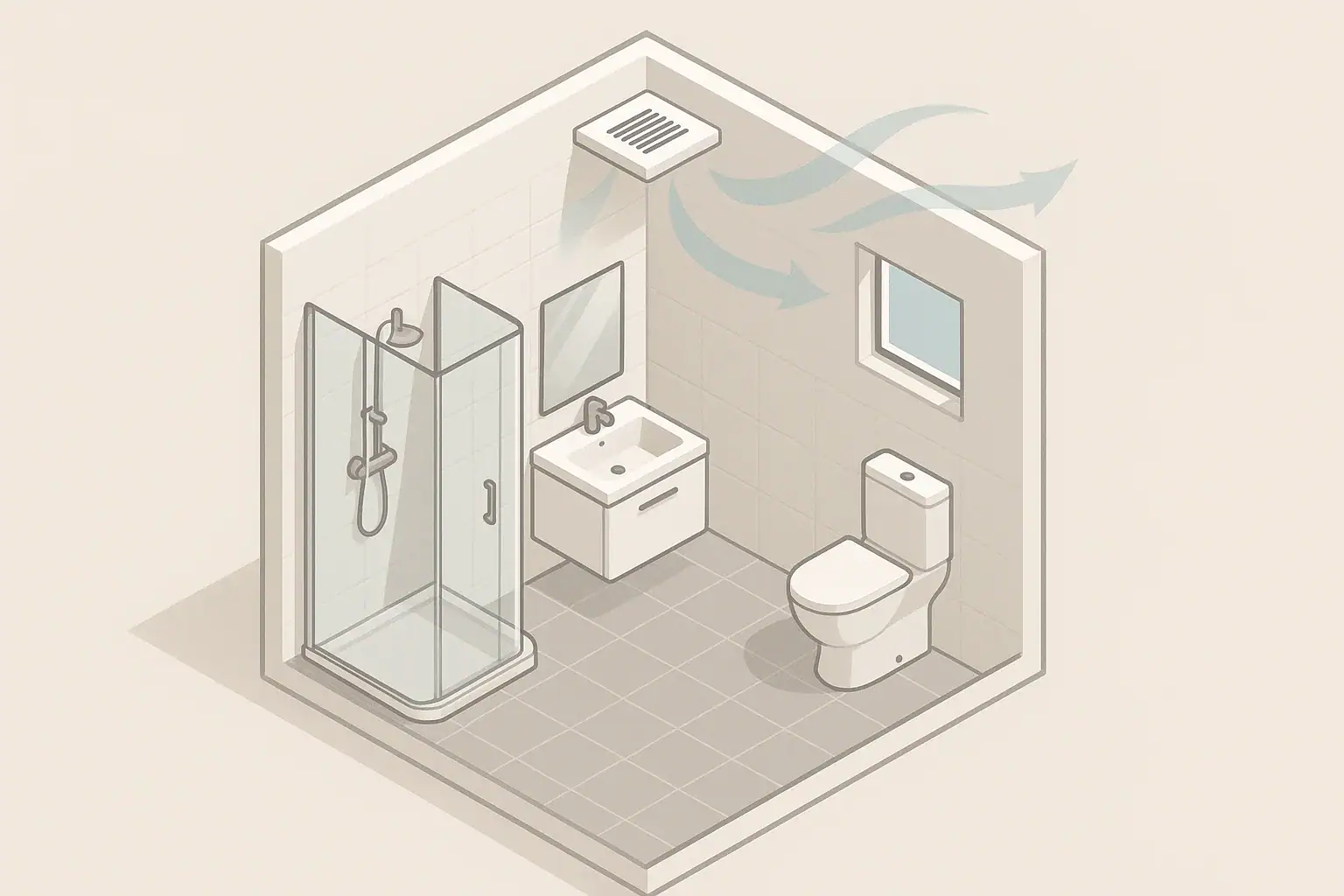
Most bathroom fans should run for about 20 to 30 minutes after a typical shower to help clear moisture and reduce conditions that support mold growth.
The right bathroom fan timer setting depends on shower length, bathroom size, fan performance, outdoor weather, and whether surfaces stay damp afterward. A timer is useful because it keeps ventilation running after you leave the room without relying on memory.
Quick answer
- Use 20 to 30 minutes after a normal shower as a practical starting point.
- Use 30 to 60 minutes after long, hot, or back-to-back showers, especially in small or windowless bathrooms.
- Aim for bathroom relative humidity to fall back below about 60% soon after showering, with many homes feeling comfortable around 30% to 50%.
- If mirrors, walls, ceilings, or grout stay wet after the fan shuts off, increase the timer or check fan performance.
- Run the fan during the shower and keep the door slightly open afterward when privacy and household conditions allow.
Why bathroom fan timer settings matter
Showers add a large amount of water vapor to a small room in a short time. When that vapor contacts cooler surfaces, it can condense on mirrors, painted ceilings, tile, grout, trim, and inside corners.
A bathroom fan removes moisture-laden air and replaces it with drier air from the rest of the home. A timer extends that air exchange long enough for humidity to drop after the visible steam has cleared.
The goal is not to make the bathroom perfectly dry instantly. The practical goal is to shorten how long surfaces stay damp, because persistent dampness is one of the main conditions that allows mold and mildew to appear on bathroom surfaces.
How long to run the fan after a shower
A good starting setting is 20 minutes after a standard shower. If the room still feels damp, the mirror remains fogged, or visible water sits on walls and ceiling areas, move the setting to 30 minutes and compare results over several days.
Longer run times are often useful for bathrooms with no window, multiple showers in a row, poor air movement under the door, or a fan that is older, noisy, dusty, or undersized. In those cases, 45 to 60 minutes may be reasonable, especially during humid seasons.
Use humidity as a practical check
A small humidity monitor can help you avoid guessing. Place it away from direct splash and not directly under the fan. After a shower, watch how long it takes for relative humidity to fall below about 60% and trend toward the home’s normal range.
Humidity readings vary by device and placement, so treat them as a guide rather than a perfect measurement. The pattern matters more than a single number: humidity should rise during a shower, then steadily fall while the fan runs.
Match run time to the bathroom, not just the shower
Fan capacity also matters. A common residential rule of thumb for many bathrooms is about 1 cubic foot per minute of fan airflow per square foot of floor area, with higher needs for large bathrooms or rooms with separate enclosed toilet or shower areas. Actual performance can be lower if ducts are long, kinked, dirty, or vented poorly.
If a fan sounds like it is running but humidity falls slowly, the timer may not be the only issue. Air has to leave the room through the fan and replacement air has to enter from under the door, a transfer grille, or an open door.
| Condition | Starting timer setting | What to watch |
|---|---|---|
| Short normal shower | 20 minutes | Mirror clears and walls dry soon after |
| Long or very hot shower | 30 to 45 minutes | Humidity drops steadily after use |
| Back-to-back showers | 45 to 60 minutes | No lingering damp smell or wet surfaces |
| Small windowless bathroom | 30 to 45 minutes | Ceiling corners and grout dry out |
| Humid outdoor weather | 30 to 60 minutes | Room returns near home baseline humidity |
| Oversized or well-ventilated bathroom | 15 to 30 minutes | Surfaces are dry without over-running |
| Fan seems weak or loud | Timer may not solve it | Check cleaning, ducting, and airflow |
Common mistakes that leave bathrooms damp
The most common mistake is turning the fan off when the shower ends. Steam may clear quickly, but moisture remains on tile, glass, towels, walls, and ceiling surfaces. A timer helps keep air moving during this drying period.
Another common issue is running the fan with the bathroom door sealed tightly. Exhaust fans need replacement air. If there is little gap under the door, the fan may move less air than expected and may become noisier.
- Starting the fan too late: Turn it on before or at the start of the shower.
- Using only an open window: Windows can help in mild, dry weather but may be less useful during humid, cold, or still conditions.
- Ignoring dust buildup: A dusty grille and fan wheel can reduce airflow.
- Relying on scent: Air fresheners do not remove moisture.
- Venting into an attic or wall cavity: Bathroom exhaust should discharge outdoors, not into enclosed building spaces.
If mold-like spotting keeps returning soon after cleaning, treat it as a moisture control clue. The next step is usually improving drying time, checking the fan path, and looking for leaks or condensation sources.
A practical checklist for daily use
Good timer settings work best when paired with simple habits. The fan does not need to do all the drying alone.
Before and during the shower
- Turn the fan on before the room fills with steam.
- Use the shower door or curtain in a way that limits spray onto walls and floors.
- Keep the bathroom door cracked if privacy and household airflow allow.
- Avoid blocking the fan grille with towels, decorations, or storage.
After the shower
- Set the timer for 20 to 30 minutes as a baseline.
- Squeegee shower glass or tile if water tends to linger.
- Spread towels open so they dry faster.
- Leave the shower curtain or door partly open to improve air movement.
- Increase the timer if surfaces are still wet when it shuts off.
For many homes, small changes such as leaving the door ajar and opening the shower enclosure after use can reduce how long the fan needs to run. The best setting is the shortest practical time that clears humidity and dries surfaces reliably.
Real-world timer examples
Bathroom conditions vary, so examples are more useful than a single universal number. Use these scenarios as starting points, then adjust based on moisture, humidity readings, and surface drying.
Small interior bathroom
A compact bathroom with no window may collect steam quickly. Start the fan before showering and set the timer for 30 minutes afterward. If ceiling corners or the mirror remain damp, try 45 minutes and check whether the room returns to its normal feel.
Shared family bathroom
When several people shower within a short period, moisture has less time to clear between uses. A 45- to 60-minute timer after the last shower may work better than several short fan cycles. Keeping towels spread out and the door open between showers can also help.
Large bathroom with separate shower area
A large bathroom may still have a damp shower stall if airflow does not reach it well. A 20- to 30-minute timer may clear the main room but leave the shower enclosure wet. In that case, increase run time and improve airflow by leaving the shower door open after use.
Humid climate or humid season
When the rest of the home is already humid, the bathroom may dry more slowly. A longer timer can help, but whole-home humidity control may also matter. If indoor humidity commonly stays above about 60%, a dehumidifier or HVAC humidity strategy may be worth considering.
Safety, codes, and ventilation limits
Bathroom exhaust fans are ventilation devices, not mold removal devices. They help control moisture, but they cannot fix plumbing leaks, wet building materials, missing insulation, or long-term condensation problems by themselves.
Exhaust air should be ducted outdoors through an appropriate termination point. Sending moist bathroom air into an attic, crawlspace, garage, or wall cavity can move the dampness problem to another part of the home.
If you want a wall timer, humidity-sensing control, or fan replacement, use components rated for the location and follow local electrical code. For wiring changes, a qualified electrician is the appropriate route. Do not bypass safety devices or modify a fan outside its intended use.
Air purifiers, ionizers, fragrances, and ozone-generating devices are not substitutes for bathroom moisture control. Ozone generators should not be used in occupied indoor spaces, and devices marketed for odor control do not remove the water vapor that drives bathroom dampness.
Maintenance that keeps the timer effective
A timer can only work as well as the fan and duct allow. If airflow is restricted, extending the timer may use more energy without solving dampness.
Clean the grille regularly with the power off according to the fan’s instructions. Dust and lint can collect at the cover and on the fan wheel. A visibly dirty grille is a sign that airflow may be reduced.
Check the outdoor vent termination when accessible and safe to do so. The flap or damper should open when the fan runs and should not be blocked by lint, debris, nests, paint, or exterior obstructions.
Listen for changes. Grinding, rattling, or sudden loudness can indicate wear, looseness, or blockage. A fan that is very noisy may also discourage regular use, which reduces the benefit of having a timer.
If the fan runs but a tissue will not lightly hold to the grille, airflow may be weak. This is only a rough check, not a measurement, but it can help you notice when cleaning or professional evaluation is needed.
| Goal | Simple actions | Helpful tool | Note |
|---|---|---|---|
| Clear shower steam | Run fan during shower and after | Fan timer | Start with 20 to 30 minutes |
| Reduce lingering dampness | Open shower door or curtain | Squeegee | Helps surfaces dry faster |
| Track humidity trend | Compare after-shower readings | Humidity monitor | Look for steady decline |
| Improve replacement air | Crack door when practical | Door undercut or transfer path | Fan needs incoming air |
| Control whole-home moisture | Keep indoor humidity moderate | HVAC or dehumidifier | Often useful in humid seasons |
| Maintain airflow | Clean grille and check outlet | Vacuum or soft brush | Follow fan instructions |
| Address recurring damp spots | Look for leaks or cold surfaces | Professional inspection if needed | Timer may not be enough |
Related guides: Bathroom Mold Prevention: Exhaust Fan Timing and Humidity Control • Best Indoor Humidity Level to Prevent Mold (With Seasonal Targets) • Ventilation vs Air Purifier: When You Need One, the Other, or Both
Frequently asked questions
How long should a bathroom fan run after a shower to help prevent mold?
A practical starting point is 20 to 30 minutes after a normal shower. Longer showers, small bathrooms, or humid conditions may need 30 to 60 minutes.
Should the bathroom fan run during the shower or only afterward?
It should run during the shower and continue afterward. Running it while you shower helps limit how much moisture builds up in the room, and the extra run time helps dry remaining surfaces.
What is the best way to know if my timer setting is long enough?
Watch whether mirrors, walls, grout, and the shower enclosure are dry soon after the fan turns off. A humidity monitor can also help by showing whether relative humidity drops steadily and falls below about 60% after showering.
Why does my bathroom still feel damp even when the fan runs?
The fan may be undersized, dirty, poorly ducted, or blocked by limited replacement air. High outdoor humidity, repeated showers, or a sealed bathroom door can also slow drying.
Can I use the window instead of a bathroom fan timer?
A window can help in mild, dry weather, but it is less reliable in humid, cold, or still conditions. A fan timer is usually more consistent because it keeps ventilation going after the shower ends.
What should I do if mold keeps coming back even with a longer fan timer?
Look beyond the timer for leaks, poor exhaust ducting, blocked vents, or recurring condensation on cold surfaces. If the problem continues, the bathroom may need maintenance or a professional inspection to find the moisture source.
Summary takeaways
For most bathrooms, set the fan timer to run 20 to 30 minutes after a shower, then adjust based on how quickly humidity falls and surfaces dry. Use 30 to 60 minutes for long showers, repeated showers, windowless bathrooms, humid weather, or rooms that stay damp.
The fan should run during the shower, not only afterward. Good replacement air, an open shower enclosure, dry towels, and a clean fan grille all help the timer setting work better.
If dampness persists despite longer run times, look beyond the timer. Weak airflow, blocked ducting, poor exterior venting, leaks, or high whole-home humidity may need attention before the bathroom can dry reliably.
Recommended next:
- Ventilation vs Air Purifier: When You Need One, the Other, or Both
- CO2 in Bedrooms: What Levels Mean and How to Improve Air Exchange
- How to Ventilate in Winter Without Freezing: Practical Strategies
- Exhaust Fan Best Practices: Bathrooms and Kitchens That Actually Clear Air
- Air Exchange Basics: ACH, Infiltration, and Why “Stuffy” Happens
- ERV vs HRV: What They Do for Indoor Air Quality
- More in Ventilation & Air Exchange →
- Clear sizing logic (room size → CADR/ACH)
- HEPA vs carbon explained for real use-cases
- Humidity + ventilation basics to reduce mold risk