
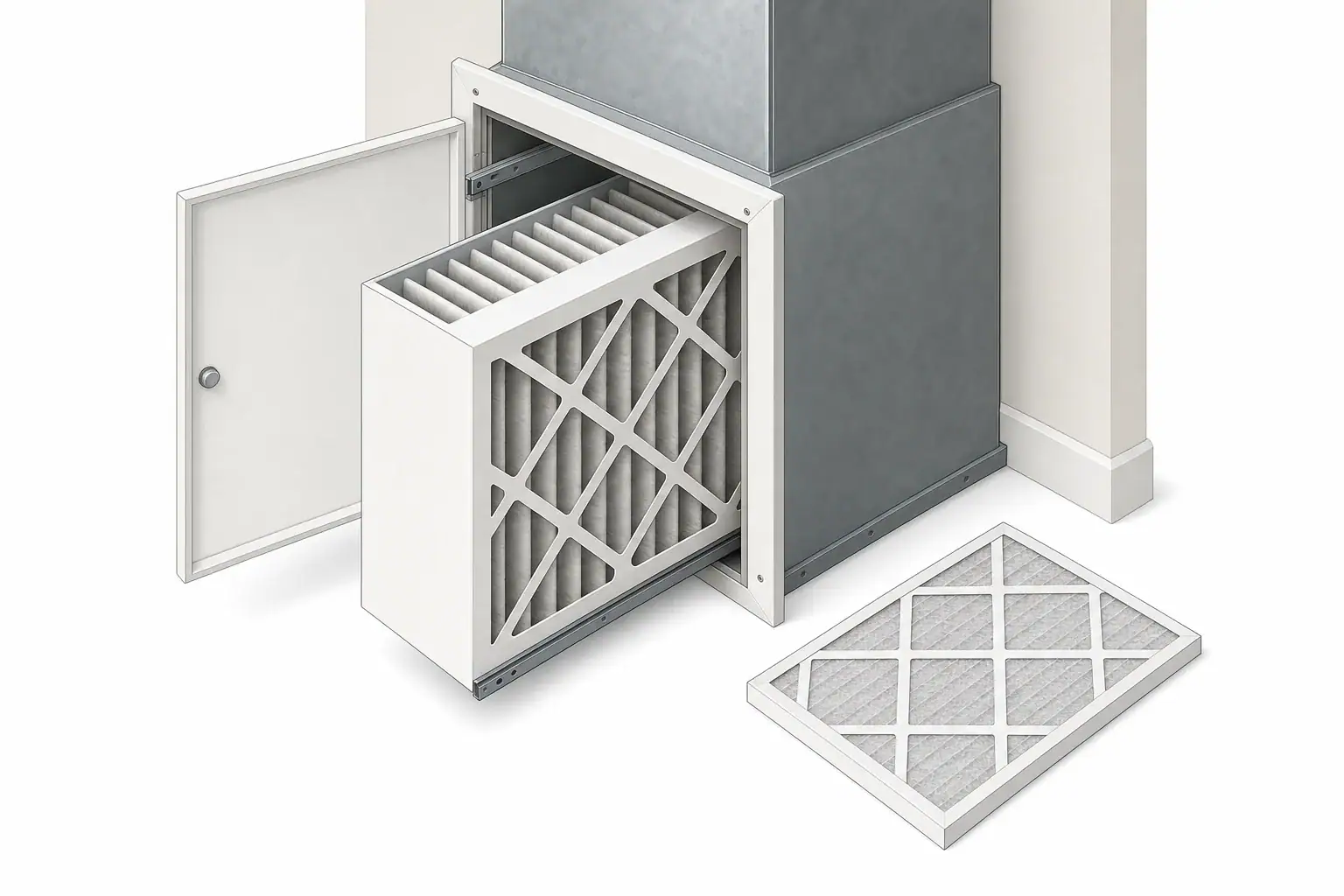
What an HVAC media filter is
In residential heating and cooling systems, an HVAC media filter generally means a deep, extended-surface pleated filter cartridge in the central return-air path. Its added depth provides room for more folded filter material than a typical one-inch filter.
The terminology can be confusing. Filter media can mean the material inside any filter. But when a contractor or retailer describes a media-filter upgrade, they usually mean a deep replacement cartridge plus the housing that holds it.
Depth alone does not establish a filter’s particle-capture efficiency, airflow resistance, replacement interval, or suitability for a particular system. Those depend on the specific cartridge, its tested rating, the airflow through it, and how loaded it becomes in service.
Standard one-inch filter versus deep media filter
| Question | Typical one-inch filter | Deep media filter |
|---|---|---|
| Where does it fit? | A one-inch equipment slot or compatible filter grille | A compatible deep cabinet, rack, or purpose-built return grille |
| How is the material arranged? | A relatively shallow pleat package | Usually more folded material within a deeper cartridge |
| What determines efficiency? | The filter’s tested rating, not its depth | The filter’s tested rating, not its depth |
| How is fit confirmed? | Actual dimensions, slot dimensions, and airflow direction | Cartridge part number, actual dimensions, cabinet model, and airflow direction |
| What determines airflow resistance? | Product design, airflow rate, and filter condition | Product design, airflow rate, and filter condition; depth alone is not enough |
| Is it HEPA? | Not automatically | Not automatically |
Does a media filter need a dedicated cabinet?
A deep cartridge needs a housing that supports it, seals around it, and provides access for replacement. That housing may be an equipment-mounted cabinet, an in-duct rack, or a purpose-built deep-filter return grille.
If a system has only an ordinary one-inch slot, a deep cartridge cannot simply be pushed into that opening. Adding a media filter commonly requires a compatible cabinet and may also require changes to the return ductwork. If a media cabinet is already installed, the appropriate purchase is usually the exact replacement cartridge specified for that cabinet.
Do not choose a cartridge from the visible opening of a nearby return grille unless the filter is actually installed there. First locate all existing filters and identify the housing where the proposed cartridge would sit.
Nominal size and actual size are different measurements
A dimension printed on a filter can be a nominal product designation rather than the physical dimensions of the cartridge. Deep cartridges may also have proprietary rails, gaskets, shapes, or folded-media arrangements that prevent interchangeability.
For example, AprilAire lists its 413 replacement filter as nominally 16 × 25 × 4 inches, while listing actual dimensions of 16.52 × 29.38 × 4 inches and naming compatible cabinets. See the manufacturer’s AprilAire 413 product specifications. This is a product-specific example, not a general dimensional allowance, but it shows why a shared nominal label does not guarantee a match.
When possible, match the cabinet model to the manufacturer-approved cartridge part number. If that information is missing, document the current cartridge’s actual dimensions, the internal supports, and the cabinet-door arrangement before selecting a replacement.
Plan for cartridge-removal clearance
The access side of the cabinet needs enough unobstructed space for the cartridge to slide out. Walls, pipes, framing, drain lines, or nearby equipment can block removal even when the cabinet itself fits between ducts.
Clearance is cabinet-specific. For example, the Resideo F100/F200 professional installation guide specifies at least 26 inches (660 mm) of front clearance for cartridge removal. Use the installation instructions for the exact cabinet under consideration rather than applying that measurement to another product.
Airflow: compare pressure drop, not just filter depth
Every installed filter resists airflow. The useful specification is the manufacturer’s pressure drop at an airflow relevant to the system, not whether the cartridge is one inch or several inches deep. Pleat geometry, media type, face area, efficiency rating, and collected dust all affect resistance.
More folded media can create more effective filtering area, but there is no universal surface-area multiple for deep filters. Likewise, a deep cartridge is not automatically less restrictive than every one-inch filter.
ASHRAE’s residential air-filtration guidance advises evaluating airflow with a filter when new and near its replacement condition. It also notes that, at the same filter depth, higher MERV commonly brings higher pressure drop. Compare manufacturer data at the expected system airflow instead of inferring performance from depth or MERV alone.
For a retrofit, an HVAC installer can identify the equipment’s allowable total external static pressure and expected airflow, then assess operation after installation using the equipment manufacturer’s service procedures. The cabinet and return duct connections should be sealed so return air does not bypass the cartridge through gaps.
Why media filter does not mean HEPA
“Media” describes a material or a deep-cartridge format; it is not an efficiency classification. MERV and HEPA describe performance using different classification frameworks. For a fuller comparison, see MERV 13 vs. HEPA: What the Numbers Mean.
The U.S. Environmental Protection Agency’s explanation of MERV and HEPA describes MERV as a rating for particle capture across specified particle-size ranges. EPA identifies HEPA as capturing at least 99.97% of particles at 0.3 microns and notes that HEPA performance is not rated under the MERV system. EPA also advises selecting a filter no more efficient than the system fan and filter slot can accommodate.
A deep cartridge with a MERV rating should not be called HEPA unless the product is specifically identified and tested as HEPA. Choosing a higher-rated cartridge also does not prove that an existing system can operate with it.
Before buying: cabinet fit and airflow checklist
Record these details
- Photograph the cabinet label, HVAC equipment information, and current filter part number.
- Identify every filter location in the return-air path.
- Record the printed nominal size and measure the current cartridge’s actual dimensions.
- Measure the filter housing or cabinet opening, not only a nearby return grille.
- Note rails, clips, gaskets, doors, and other proprietary supports that affect fit.
- Confirm the direction the cartridge must slide out and measure unobstructed removal clearance.
- Find the airflow arrow and record the required installation orientation.
- Obtain the cabinet manual and the proposed cartridge’s pressure-drop data.
Ask an installer to confirm
- The cartridge is approved for, or physically compatible with, the selected cabinet.
- The cabinet location and orientation follow its installation instructions.
- Any required return-duct transitions and supports are included in the scope of work.
- Pressure-drop data have been considered at the system’s expected airflow.
- The equipment’s allowable external static pressure and airflow requirements can still be met.
- Operating static pressure or airflow will be checked after the retrofit using applicable service guidance.
- Cabinet and duct joints will be sealed to limit bypass around the filter.
- The former filter is removed unless the system was specifically designed to use both filter locations.
- The cartridge can be replaced later without removing unrelated equipment or building materials.
Related guides: HVAC Filter Upgrade for Allergies: MERV Ratings and Airflow Trade-Offs • How to Change an HVAC Filter: Location, Direction, and Fit • Air Purifier vs. HVAC Filter: What Each One Does
Frequently asked questions
Can I put a deep HVAC media filter in a one-inch filter slot?
No. A deep cartridge needs a compatible cabinet, rack, or purpose-built return grille that supports and seals it. A system with only a one-inch slot commonly needs a new housing and may need return-duct modifications.
Should I buy a media filter based only on its printed size?
No. Printed dimensions may be nominal rather than actual, and cartridges can use proprietary rails, shapes, or gaskets. Match the cabinet model and approved cartridge part number when available, then verify the current cartridge’s actual dimensions and supports.
Does a deeper media filter always have less airflow resistance?
No. Pressure drop depends on the cartridge design, efficiency rating, airflow rate, and loading condition. Compare manufacturer pressure-drop data at the expected system airflow and have a retrofit checked after installation.
Is a deep HVAC media filter a HEPA filter?
Not necessarily. “Media” describes a material or cartridge format, while HEPA is a separate performance classification. Call a filter HEPA only when it is specifically identified and tested as HEPA.
Bottom line
A media-filter upgrade is primarily a housing, fit, and airflow decision—not simply a choice of depth or MERV rating. Confirm the cabinet-and-cartridge pairing, physical dimensions, service clearance, sealing, and model-specific pressure-drop information before buying. If those details cannot be verified from equipment documentation, have an HVAC professional assess the return-air arrangement and operating airflow.
Recommended next:
- True HEPA vs HEPA-Type: What the Labels Really Mean
- HEPA H13 vs H14: Differences, Efficiency, and When It Matters
- How Often Should You Replace a HEPA Filter?
- Do HEPA Filters Remove Viruses, Bacteria, and Allergens?
- HEPA Filter Grades Explained: E10–E12 vs H13–H14
- HEPA Filter Label Claims: How to Check the Evidence
- Clear sizing logic (room size → CADR/ACH)
- HEPA vs carbon explained for real use-cases
- Humidity + ventilation basics to reduce mold risk