
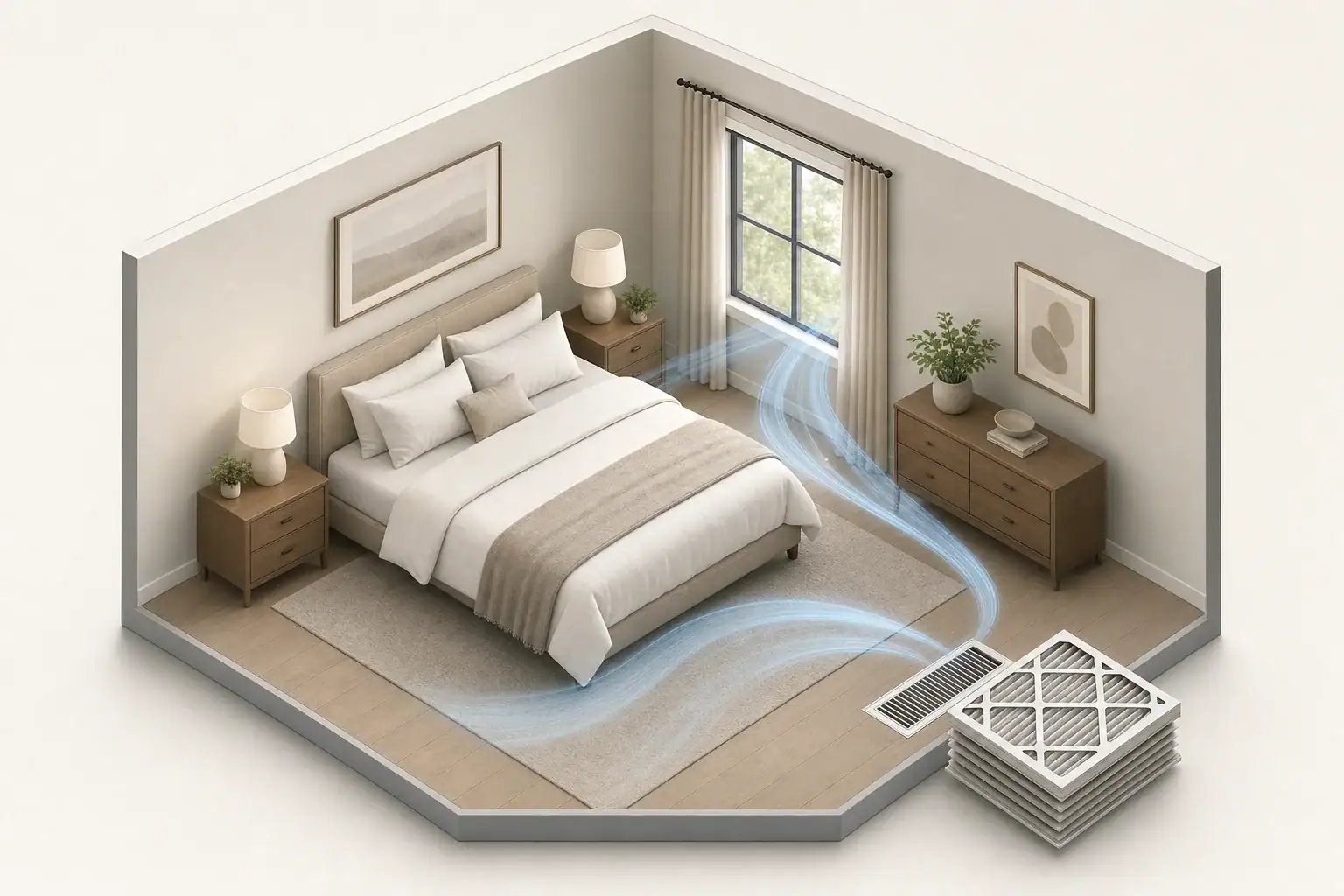
For allergy-focused particle control, upgrade to the highest-MERV HVAC filter your system can support without unacceptable airflow loss—often MERV 11 to 13, although equipment limits and pressure drop matter. A higher rating can improve capture of smaller airborne particles, but MERV alone does not show how a filter will behave in a particular system. Filter dimensions, installation, blower performance, duct design, and accumulated dust all affect the result.
Quick answer
- MERV 11 to 13 is a practical target range for many homes when the HVAC system supports it.
- Check the equipment manual or filter cabinet specifications before increasing filtration resistance.
- Match the exact filter dimensions and prevent gaps that allow air to bypass the filter.
- Inspect a new higher-MERV filter after about two to four weeks, then establish a replacement schedule based on loading.
- If airflow becomes weak, rooms become uneven, or the system cycles abnormally, return to a suitable filter and consult an HVAC professional.
What an HVAC Filter Upgrade Means for Allergies
An HVAC filter captures particles carried through the return-air system. These particles may include household dust, pollen, fibers, pet-related debris, and a portion of smaller airborne particles. Reducing recirculating particles may support a cleaner indoor environment, but filtration does not diagnose, treat, or eliminate allergies.
The filter works only while the HVAC fan is moving air. A high-rated filter provides limited benefit when the system rarely runs, when air bypasses the filter frame, or when pollutants are generated faster than the system can remove them.
Filtration is also only one part of indoor air quality management. Source control, routine cleaning, moisture management, and appropriate outdoor-air ventilation remain important. A portable particle air cleaner may provide additional room-level filtration where central HVAC runtime or duct coverage is limited.
How MERV Ratings and Airflow Trade-Offs Work
MERV, or Minimum Efficiency Reporting Value, is a rating from 1 through 16 under a standardized test method. In general, a higher MERV rating indicates better capture across specified particle-size ranges. MERV does not directly state total household dust removal, filter life, energy use, or airflow in a specific home.
Why a higher MERV rating can restrict airflow
Air must pass through the filter media, creating resistance known as pressure drop. A filter with more media area may provide higher efficiency with less resistance than a thinner filter with the same MERV rating. For that reason, MERV ratings should not be used as pressure-drop ratings.
Resistance also rises as dust accumulates. If the system cannot overcome that resistance, delivered airflow may decline. Possible operational signs include reduced air from supply registers, longer heating or cooling cycles, uneven room temperatures, a frequently tripping temperature limit, or an indoor coil that becomes too cold. These signs can have other causes, so professional evaluation may be needed.
Filter depth, area, and fit
A deeper pleated filter often has more media surface area than a one-inch filter, but it can be used only in a cabinet designed for that depth. Do not force a thicker filter into an incompatible slot or alter the cabinet. The printed nominal size may also differ slightly from the actual dimensions, so compare the existing filter and cabinet requirements carefully.
Example values for illustration.
| MERV range | General role | Airflow consideration |
|---|---|---|
| 1–4 | Basic equipment protection and larger debris | Usually low resistance but limited fine-particle capture |
| 5–8 | Improved capture of larger household particles | Common starting range for basic residential systems |
| 9–10 | Intermediate particle filtration | Check system compatibility and filter specifications |
| 11–12 | Greater capture across smaller particle ranges | Often practical when the system has adequate airflow capacity |
| 13 | Stronger fine-particle filtration within the MERV scale | A common upgrade target when supported by the equipment |
| 14–16 | High-efficiency filtration | Often requires equipment designed for higher resistance |
Common HVAC Filter Upgrade Mistakes
The most common mistake is choosing a filter solely by its MERV number. Two filters with the same rating can have different pressure drops because of media area, construction, depth, and face velocity. When available, compare the manufacturer’s clean-filter pressure-drop data at an airflow rate relevant to the system.
Other avoidable problems include:
- Using the wrong dimensions: A filter that is too small may leave bypass gaps, while an oversized filter may bend or fail to seat correctly.
- Installing it backward: The airflow arrow should point toward the blower or air-handling equipment.
- Stacking filters: Placing filters together can add resistance and is not a substitute for a properly designed filtration cabinet.
- Covering every register: Adding filter material at supply or return grilles can disrupt system airflow unless the system was designed for it.
- Ignoring multiple returns: Every designated filter location needs the correct filter and replacement schedule.
- Waiting for visible dirt: Fine-particle loading may increase resistance before a filter looks heavily coated.
Air leakage around the frame is another common weakness. Air follows the easiest path, so even a highly efficient filter underperforms when a significant portion of return air passes around it. Use only the cabinet’s intended retaining mechanism or a manufacturer-approved gasket arrangement; do not block access panels or safety components.
Practical Checklist for Choosing a Higher-MERV Filter
Begin with the HVAC equipment documentation rather than assuming that a particular rating will work. Some manuals specify a maximum filter resistance, an approved filter type, or a minimum filter area instead of a maximum MERV value.
- Identify every filter location. Check return grilles, filter cabinets, and air-handler access points without opening service compartments.
- Record exact dimensions. Note both the nominal size and actual measured size of the current filter.
- Find the supported filtration guidance. Review the equipment or filter-cabinet documentation. If it is unclear, ask a qualified HVAC professional.
- Move up gradually. For example, a home using MERV 8 might test MERV 11 before considering MERV 13.
- Confirm a tight fit. The filter should seat evenly without being crushed, bowed, or forced.
- Mark the installation date. Inspect the filter early because household conditions can change replacement needs.
- Observe system operation. Note airflow, room comfort, unusual cycling, noise, and energy-use changes.
- Measure when needed. A technician can measure static pressure and airflow rather than relying on subjective register airflow alone.
If the existing filter slot cannot support the desired filtration level, a portable air cleaner sized for the occupied room may be more practical than overloading the central system. Central equipment modifications should be designed and completed by a qualified professional.
Real-World Filter Upgrade Examples
One-inch return filter in an older system
A homeowner using a one-inch MERV 8 filter wants better particle capture. Moving first to MERV 11, confirming a close fit, and monitoring operation is a cautious approach. Jumping directly to a dense high-efficiency filter may create more resistance than the blower and duct system can handle.
Deep media cabinet in a newer system
A system with a properly sized four- or five-inch media cabinet may accommodate a MERV 13 filter with a manageable pressure drop. Cabinet depth alone does not guarantee compatibility, however. The equipment guidance and filter’s airflow data still matter.
Bedrooms with limited central airflow
If bedroom doors are closed and return-air pathways are limited, central filtration may not move enough room air to provide the desired particle reduction. Correcting airflow problems requires professional assessment. A properly sized portable particle air cleaner can supplement central filtration without changing HVAC components.
Homes with pets or seasonal pollen
Higher particle loads can shorten useful filter life. During heavy pollen periods or when several pets are present, checking the filter more frequently is more useful than relying on a fixed calendar interval. Cleaning floors and textiles can also reduce the amount of material reaching the filter.
Safety and Standards Considerations
Conventional mechanical HVAC filters capture particles without intentionally producing ozone. MERV ratings describe particle-filtration performance; they do not rate gas removal, odor control, ozone production, or biological treatment.
Ionizers and some electronic air-cleaning devices may generate ozone as a byproduct. Ozone can irritate the respiratory system and should not be intentionally generated in occupied residential spaces. If considering an electronic device, review independent safety certification and emissions information rather than relying on general air-cleaning claims.
UV-C equipment is different from a particle filter. Properly designed systems may be used for specific HVAC applications, but performance depends on lamp intensity, exposure time, placement, and maintenance. Installation should address eye and skin exposure, electrical safety, material compatibility, and lamp disposal. UV-C does not replace particle filtration or moisture control.
Do not defeat access-panel switches, alter blower settings, cut filter cabinets, or modify combustion equipment to accommodate a filter. Restricted airflow can affect heating and cooling operation, so repeated limit trips, icing, burning odors, or unusual equipment behavior warrant prompt professional service.
Filter Maintenance and Replacement Planning
There is no universal replacement interval. Filter depth, media area, fan runtime, outdoor air conditions, pets, occupancy, renovation dust, and indoor particle sources all affect loading. A calendar reminder is useful, but inspection and system behavior should guide the final decision.
Check a newly upgraded filter after two to four weeks. If it remains lightly loaded and airflow is normal, extend the next inspection interval. Replace it sooner if it is damaged, damp, heavily loaded, or associated with a noticeable airflow decline.
Turn the HVAC system off at the normal control before changing a filter so loose dust is not pulled into the cabinet. Insert the replacement in the indicated airflow direction and reinstall the access cover correctly. Avoid vacuuming or washing disposable filters unless their instructions specifically identify them as reusable.
Example values for illustration.
| Filter or condition | Example interval | What may shorten it |
|---|---|---|
| Basic flat filter | Inspect monthly; often replace in 30–60 days | Long fan runtime, dust, or pets |
| One-inch pleated filter | Inspect monthly; often replace in 30–90 days | Higher MERV, smoke, or heavy particle loads |
| Two-inch pleated filter | Inspect every 1–2 months; often replace in 2–4 months | High occupancy or frequent system use |
| Four- or five-inch media filter | Inspect every 2–3 months; often replace in 6–12 months | Smaller cabinet area or unusually high loading |
| Heavy pollen or wildfire-smoke period | Inspect every 2–4 weeks during the event | Outdoor air infiltration and continuous fan use |
| Renovation or construction dust | Inspect weekly during active work | Dust escaping containment or entering returns |
Related guides: Portable Air Purifier vs HVAC Filtration: What Helps More in Homes? • MERV 13 vs HEPA: What the Numbers Mean for Indoor Air • UV-C vs HEPA Filters: What Each Can and Can’t Do Indoors • Pollen Season Indoor Plan: Filters, Ventilation Timing, and Cleaning
Key Takeaways for Balancing MERV and Airflow
An HVAC filter upgrade for allergies should balance particle capture, system compatibility, and ongoing maintenance. MERV 11 to 13 is a useful general target for many residential situations, but the correct choice is the highest efficient filter the specific system can support without problematic airflow loss.
Confirm filter dimensions, equipment guidance, installation direction, and frame sealing before focusing on the rating alone. Inspect the new filter early and watch for operational changes. When compatibility is uncertain, static-pressure and airflow measurements from a qualified HVAC professional provide better guidance than guesswork.
Frequently asked questions
What MERV rating is best for allergies in a home HVAC system?
MERV 11 to 13 is often a practical allergy-focused range when the HVAC equipment can support it without excessive airflow restriction. The best choice depends on the filter cabinet, media area, blower capacity, duct system, and the filter’s pressure-drop data rather than the MERV number alone.
Can a MERV 13 filter damage an older HVAC system?
A MERV 13 filter is not automatically harmful, but a restrictive one-inch filter may reduce airflow in a system with limited capacity. Check the equipment or filter-cabinet guidance, confirm the filter fits correctly, and have a technician assess static pressure if airflow or comfort changes after the upgrade.
How often should I replace a higher-MERV HVAC filter for allergies?
Inspect a newly installed higher-MERV filter after two to four weeks, then adjust the schedule based on loading and system operation. Heavy pollen, pets, smoke, renovation dust, long fan runtime, and a shallow filter can require more frequent replacement than a calendar-only schedule suggests.
Does a deeper HVAC filter improve allergy particle capture without reducing airflow?
A deeper filter often has more media surface area, which can reduce resistance compared with a one-inch filter of the same MERV rating. It must be installed only in a cabinet designed for that depth; do not force a thicker filter into an existing slot or modify the cabinet.
Will an HVAC filter upgrade remove allergens from every room?
Central filtration only captures particles that reach the return system while the HVAC fan is operating. Rooms with closed doors, limited return-air pathways, or low central airflow may benefit from a properly sized portable particle air cleaner in addition to suitable central filtration.
Recommended next:
- Pet Dander Allergy: Best Air Cleaner Setup and Habits That Help
- Dust Mite Allergy: Humidity Targets, Bedding, and Filtration
- Asthma Triggers Indoors: A Practical Checklist to Improve Air Quality
- Bedroom Allergy Setup: The Fastest Changes That Reduce Symptoms
- Pollen Season Indoor Plan: Filters, Ventilation Timing, and Cleaning
- Dust Mites and Humidity: The RH Range That Helps Most
- Clear sizing logic (room size → CADR/ACH)
- HEPA vs carbon explained for real use-cases
- Humidity + ventilation basics to reduce mold risk