
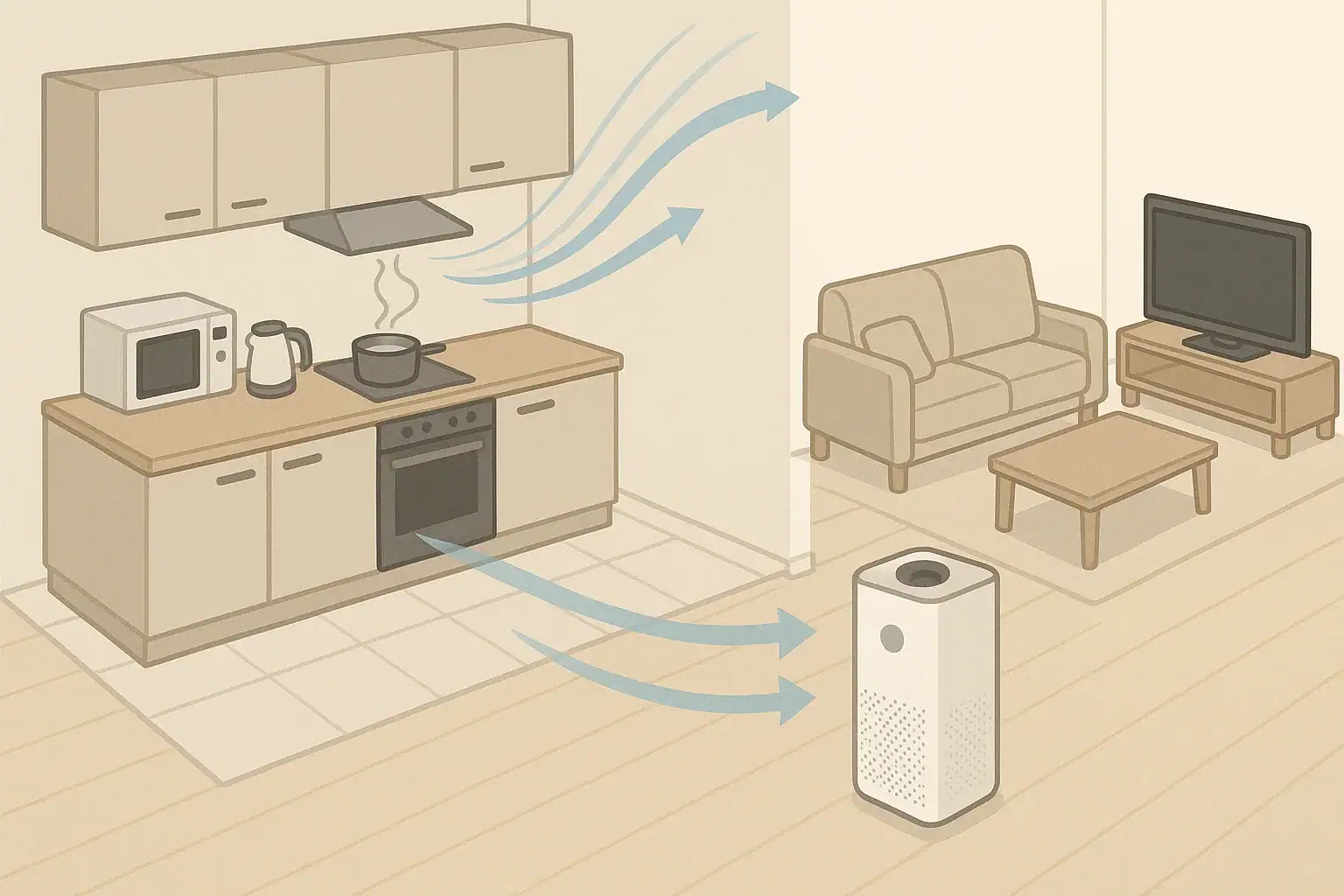
Cooking adds warmth and good smells to a home, but it also releases a mix of particles and gases into the air. In many homes, especially apartments and open-plan spaces, these can linger long after a meal.
When you cook, especially on high heat or with frying, three main byproducts enter your indoor air:
- Fine and ultrafine particles from browning, searing, toasting, or burning food
- Grease aerosols – tiny droplets of oil and fat that can travel with the air
- Gaseous byproducts and odors from heated oils, spices, and combustion (if using gas)
These byproducts can move far beyond the stove. In open layouts, cooking particles can spread into living rooms, hallways, and bedrooms, especially if there is limited exhaust ventilation.
Because cooking emissions often include very small particles, they contribute significantly to indoor particle levels. Many home air quality monitors show a jump in particle readings during and after cooking, especially when frying or using high-temperature methods.
How Cooking Smoke and Grease Affect Indoor Air
Cooking adds warmth and good smells to a home, but it also releases a mix of particles and gases into the air. In many homes, especially apartments and open-plan spaces, these can linger long after a meal.
When you cook, especially on high heat or with frying, three main byproducts enter your indoor air:
- Fine and ultrafine particles from browning, searing, toasting, or burning food
- Grease aerosols – tiny droplets of oil and fat that can travel with the air
- Gaseous byproducts and odors from heated oils, spices, and combustion (if using gas)
These byproducts can move far beyond the stove. In open layouts, cooking particles can spread into living rooms, hallways, and bedrooms, especially if there is limited exhaust ventilation.
Because cooking emissions often include very small particles, they contribute significantly to indoor particle levels. Many home air quality monitors show a jump in particle readings during and after cooking, especially when frying or using high-temperature methods.
What Air Purifiers Can and Cannot Do for Cooking Emissions
Air purifiers can be helpful for some aspects of cooking smoke, but they are not a full replacement for good kitchen ventilation. It helps to separate what they handle well from what they do not address.
What air purifiers handle well
Most well-designed purifiers with mechanical filters are effective at capturing airborne particles that eventually pass through the filter. For typical cooking emissions, that often includes:
- Fine particles from smoke, browning, and toasting
- Some ultrafine particles, depending on filter quality and how much air is processed
- Grease droplets suspended in the air that reach the purifier
In a real kitchen, this can translate to:
- Lower overall particle levels in nearby rooms during and after cooking
- Faster cleanup of lingering smoke haze after a cooking incident, like slightly burning food
- Less spread of cooking particles to bedrooms or offices if the purifier is placed strategically
Where purifiers are limited
There are also clear limits to what an air purifier can do for cooking-related air quality:
- Grease on surfaces: Once oil and grease settle on cabinets, walls, or counters, a purifier cannot remove them; they must be cleaned.
- Strong odors and gases: Standard particle-only filters do little for cooking smells or gases. Odor reduction typically requires an additional activated carbon or other gas-adsorbing media.
- Heavy smoke at the source: A purifier across the room will not protect you from intense smoke standing over a smoking pan. Source control and exhaust ventilation are key.
- Moisture and steam: Purifiers are not dehumidifiers; they do not remove humidity from boiling pots or dishwashing.
Because of these limits, air purifiers work best as part of a broader strategy that includes ventilation, good cooking practices, and regular cleaning.
Example values for illustration.
| Situation | Most helpful tool | Why |
|---|---|---|
| Light everyday cooking with some smoke | Range hood + air purifier | Hood removes emissions at the source, purifier lowers remaining particles in nearby rooms. |
| Frying and searing on high heat | Strong exhaust ventilation | High emission rate; exhausting outdoors is more effective than relying on a room purifier alone. |
| Lingering food smells in living room | Purifier with carbon filter | Adsorbs some odor-causing gases that drift away from the kitchen. |
| Grease build-up on cabinets and backsplash | Cleaning + better hood capture | Purifiers do not remove settled grease; improving capture at the stove reduces future deposits. |
| Apartment kitchen with weak or recirculating hood | Window ventilation + purifier | Opening windows increases air exchange; purifier helps reduce indoor particle load. |
| Open-plan layout with bedrooms nearby | Purifier near airflow path | Helps limit spread of particles from kitchen to sleeping and working areas. |
Choosing Filters for Cooking Smoke and Grease
Filter type matters when you expect to run a purifier near cooking activities. Cooking emissions include both particles and gases, so it helps to understand the main filter components you are likely to see.
Mechanical particle filters (HEPA and similar)
Many home purifiers rely on high-efficiency particle filters, often referred to as HEPA or HEPA-like. In general, these:
- Capture a wide range of particle sizes, including fine smoke particles
- Work best when air is recirculated through them multiple times per hour
- Gradually load up with dust, smoke, and grease, which increases resistance and eventually requires replacement
Filters marketed as true HEPA or higher-efficiency classes (such as H13 or H14 in some rating systems) are designed to capture very small particles efficiently when air passes through them. For cooking smoke, several factors still influence real-world performance:
- Airflow rate (how much air the purifier can move through the filter)
- Bypass and sealing quality (how well air is forced through the filter instead of leaking around it)
- Room mixing (how well room air circulates into the purifier’s intake)
Pre-filters for larger particles and grease
Some purifiers include a washable or replaceable pre-filter. This can capture larger dust and some grease droplets before they reach the main filter. In kitchens, that can be helpful because:
- Grease and larger particles are trapped in an easier-to-clean layer
- The primary filter may last longer before needing replacement
However, even with pre-filters, filters exposed to cooking grease often require more frequent maintenance than in other rooms.
Activated carbon and odor-focused filters
For cooking smells and some gaseous byproducts, mechanical filters alone are not enough. Many purifiers use:
- Activated carbon in granules or impregnated sheets
- Other gas-adsorbing media designed to trap certain volatile organic compounds (VOCs)
These materials can reduce some cooking odors as air passes through them, but their capacity is finite. Once saturated, odor reduction declines and replacement is needed. Performance depends on:
- Amount of carbon or media
- Contact time between air and the adsorbent
- Type and concentration of cooking odors present
Odor-focused filters are most helpful when combined with good ventilation, rather than relied on as the only odor-control method.
Sizing and Placement for Kitchen-Adjacent Air Cleaning
Where and how you use a purifier matters almost as much as which filter it uses. Kitchen emissions are often intense and localized, so placement and room size planning are especially important.
Think in terms of room size and airflow paths
For cooking-related use, many households place purifiers in:
- The open-plan living area that connects to the kitchen
- A nearby hallway that air naturally flows through
- Bedrooms, to protect sleeping spaces from lingering cooking particles
directly next to the stove is usually not ideal. Hot steam, splatter, and heavy grease can stress the device and clog filters quickly. Instead, consider:
- Keeping the purifier several feet away from active cooking zones
- Positioning it where air from the kitchen naturally drifts, such as the edge of the open area
- Avoiding blocking the intake or outlet with furniture, cabinets, or curtains
Air changes per hour (ACH) for mixed-use spaces
Cooking events create a short-term spike in particle levels. To bring those levels down, it often helps if the purifier can cycle the room air multiple times per hour. Many people look for several air changes per hour in the area they want to clean, especially when the space includes the kitchen and an attached living area.
If your living room and kitchen form one large space, you may need a purifier sized for the combined volume rather than the kitchen alone. Another approach is using:
- One larger purifier for the shared area, or
- Two smaller units in connected spaces to improve coverage and mixing
CADR and smoke-rated performance
Some purifiers list a Clean Air Delivery Rate (CADR) for smoke. This gives a rough idea of how quickly the device can reduce fine particles in a test setting. For cooking smoke:
- A higher smoke CADR generally means faster reduction of smoke-like particles in the tested room size.
- Real homes differ from test rooms, but CADR can still help compare relative performance between models.
When planning for kitchen-adjacent use, people often favor units with a smoke-oriented rating or clearly stated particle performance, then match it to the size of the main living area that receives cooking emissions.
Using Air Purifiers Alongside Kitchen Ventilation
Even a strong purifier cannot replace exhausting cooking emissions outdoors. The most effective approach is layering strategies so that each tool does what it does best.
Range hoods and exhaust fans first
If you have a vented range hood that sends air outside, using it consistently during cooking is one of the most impactful steps you can take. Basic practices include:
- Turning the hood on before starting to cook, not after smoke appears
- Using higher fan settings for frying, searing, or wok cooking
- Keeping filters in the hood clean according to the manufacturer’s instructions
In homes with recirculating hoods that pass air through a small filter and return it indoors, particle and odor control may be more limited. In these cases, an additional room purifier and periodic window opening can be especially helpful.
Window and door strategies
Simple ventilation steps can significantly reduce cooking-related pollutants:
- Opening a window near the stove to provide make-up air for the exhaust hood
- Creating a cross-breeze with another open window or door when conditions allow
- Using a bathroom or hallway exhaust fan to pull air in a direction away from bedrooms
In many situations, combining natural ventilation with a purifier running in the main living space can lower both particle and odor levels more quickly than using either approach alone.
Coordinating purifier run times with cooking
To get the most from a purifier for cooking-related emissions:
- Turn it to a higher fan speed shortly before you start cooking.
- Keep it running during cooking and for a period afterward to clear residual particles.
- If noise is an issue, you can lower the fan speed after the initial cleanup period.
Some people choose to leave a purifier on a low or moderate setting for much of the day in open-plan homes, then briefly boost it for cooking or other high-emission activities such as candle burning or indoor projects.
Example values for illustration.
| Scenario | ACH range example | What it means | Note |
|---|---|---|---|
| Small kitchen-dining area (about 150 sq ft) | 5–8 ACH | Air passes through the purifier roughly every 7–12 minutes. | Can help clear light cooking smoke after meals. |
| Open-plan living room + kitchen (about 400 sq ft) | 4–7 ACH | Larger volume; requires higher airflow or multiple units. | Useful when cooking frequently in an open layout. |
| Bedroom near kitchen door (about 120 sq ft) | 4–6 ACH | Helps limit buildup of drifting cooking particles. | Door gaps and airflow patterns still matter. |
| Occasional heavy frying days | Upper end of 6–10 ACH | Higher turnover to recover air quality after intense events. | Best if combined with strong exhaust ventilation. |
| Quiet background operation most days | 3–5 ACH | Gentle, steady cleanup of routine activities. | May be easier to tolerate for noise-sensitive households. |
Maintenance, Safety, and Long-Term Use Near Kitchens
Running a purifier near cooking areas changes how often you may need to maintain it and how you think about long-term operation.
Filter replacement and cleaning frequency
Cooking generates both particles and sticky residues. Over time, these can accumulate in filters:
- Pre-filters may darken faster and collect visible grease. Many are designed to be vacuumed or gently washed.
- Main particle filters can load more quickly than in a bedroom-only setup, especially if frying is frequent.
- Carbon or odor filters can saturate faster when exposed to regular cooking odors.
Using any built-in filter-change indicators, along with a visual inspection where possible, can help you adjust replacement schedules to your own cooking habits rather than relying solely on generic time intervals.
Safety considerations
When using purifiers around cooking areas:
- Keep devices away from direct heat sources, open flames, and potential splatter zones.
- Ensure cords do not cross walkways in busy kitchens.
- Avoid blocking household vents or emergency exits with purifier placement.
If your purifier includes optional features such as ionizers or UV-C, review the manual to understand how to enable or disable them. Many people prefer to rely primarily on mechanical filtration for predictable performance and to avoid additional byproducts.
Balancing noise, comfort, and energy use
Higher fan speeds increase particle removal but also raise noise and energy use. Over time, many households settle into patterns such as:
- Using higher speeds during or right after cooking
- Dropping to quieter settings for background cleaning
- Turning units down or off in certain rooms when not in use
This kind of schedule can support better air quality while keeping noise and electricity use manageable.
By understanding what air purifiers can and cannot do for cooking smoke and grease particles, and by pairing them with effective ventilation and good placement, you can make thoughtful decisions about how to keep your home’s air cleaner and more comfortable during everyday cooking.
Frequently asked questions
Can an air purifier remove grease that has settled on kitchen surfaces?
No. Air purifiers can capture airborne grease droplets while they’re suspended, but they cannot remove grease that has already settled on cabinets, walls, or cookware. Surface grease must be cleaned manually, and improving source capture at the stove helps reduce future deposits.
Do HEPA filters capture cooking smoke and ultrafine particles?
Yes, true HEPA and high-efficiency mechanical filters capture a wide range of fine particles, including many smoke particles, when air passes through them. Real-world effectiveness depends on airflow (CADR), sealing, and room mixing, so higher-rated filtration and adequate air changes per hour improve results.
Will an air purifier get rid of cooking odors and volatile gases (VOCs)?
Standard particle filters do not remove most odors or VOCs. Activated carbon or other gas-adsorbing media can reduce some cooking smells, but their capacity is finite and they work best when paired with ventilation rather than used alone.
Is it okay to place a purifier right next to the stove to catch smoke?
Placing a purifier directly next to active cooking is usually not ideal because heat, steam, splatter, and concentrated grease can damage the unit and clog filters quickly. Position the purifier several feet away along the airflow path so it treats room air from the kitchen without being exposed to direct splatter.
How often should I replace or clean purifier filters if the unit is used near the kitchen?
Filters used near cooking areas typically require more frequent cleaning or replacement than in bedroom-only use; pre-filters may be vacuumed or washed while particle and carbon filters will load faster. Use built-in indicators when available and inspect filters visually, then adjust schedules based on how often and what you cook.
Recommended next:
- Best Air Purifiers for Allergies: What to Look For (CADR, HEPA, Carbon)
- How to Choose the Right Air Purifier for Your Room Size
- Air Purifier Placement: Where to Put It for Best Results
- Do Air Purifiers Help With Smoke and Odors?
- Air Purifier Noise: What dB Levels Are Quiet Enough for Sleep?
- Best Air Purifiers for Pets: Dander, Odors, and Filter Costs
- More in Air Purifiers →
- Clear sizing logic (room size → CADR/ACH)
- HEPA vs carbon explained for real use-cases
- Humidity + ventilation basics to reduce mold risk





About this site
Home Air Quality Lab publishes practical, independent guides about indoor air quality—clear sizing, safer use, and real-world expectations.
Affiliate disclosure
Some links on this site may be affiliate links. If you buy through these links, we may earn a small commission at no extra cost to you. This helps support our content. Learn more.