
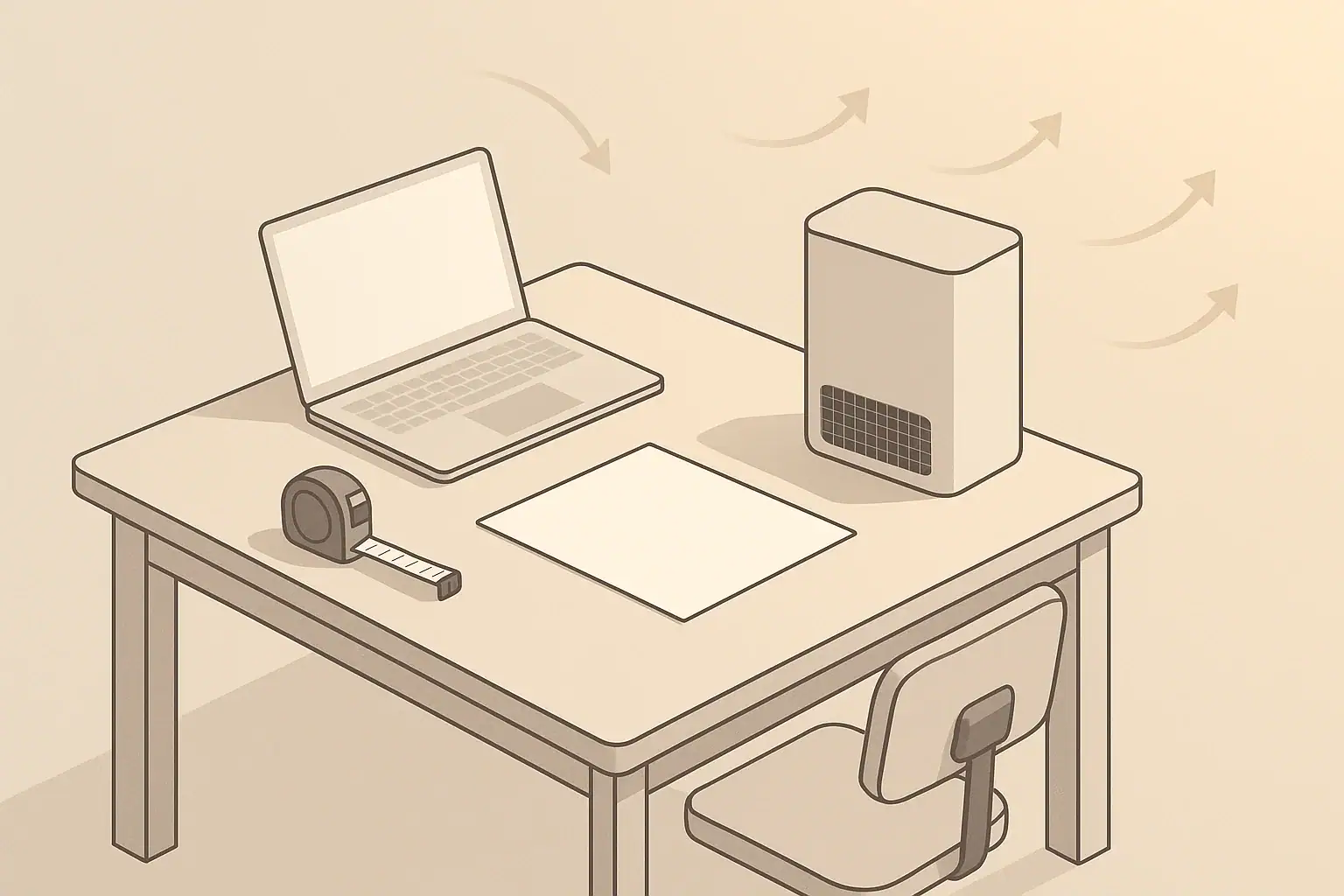
CADR vs room size comes down to one idea: the higher the CADR (in CFM), the larger the room an air purifier can handle at a given air change rate. If the CADR is too low for your room volume, the purifier will clean the air slowly; if it is higher than you need, you gain faster cleanup and more flexibility to run quieter fan speeds.
When you understand how Clean Air Delivery Rate (CADR), room size, and air changes per hour (ACH) fit together, you can quickly see whether a purifier is undersized, well matched, or comfortably strong for your space. This helps you avoid guesswork, especially in bedrooms, nurseries, and open-plan living areas where air quality and noise both matter.
This guide walks through the core concepts, gives practical CADR planning examples, highlights common mistakes, and finishes with a simple specs checklist you can use while comparing air purifiers online or in-store.
What CADR Means and Why Room Size Matters
CADR (Clean Air Delivery Rate) is a lab-tested measure that combines two things: how much air a purifier moves and how efficiently its filter removes particles from that air. In the United States, CADR is usually expressed in cubic feet per minute (CFM).
Most CADR labels include separate values for different particle sizes:
- Dust CADR – for fine dust-sized particles commonly found on surfaces and in the air.
- Pollen CADR – for larger particles that tend to settle more quickly.
- Smoke CADR – for very small particles that stay suspended longer; often used as a conservative reference.
Room size matters because the same CADR will behave very differently in a 120-square-foot bedroom than in a 450-square-foot living room with tall ceilings. A purifier that feels powerful in a small office can feel weak in an open-plan space because it has to process a much larger volume of air.
To connect CADR to room size in a useful way, it helps to think in terms of air changes per hour (ACH): how many times per hour the purifier could theoretically process the entire volume of air in the room. Higher ACH usually means faster reduction of airborne particles, while lower ACH means a slower cleanup rate.
Key Concepts: CADR, Room Volume, and ACH
Three basic measurements let you estimate whether a purifier is sized reasonably for your space:
- Room area in square feet (length × width).
- Ceiling height in feet.
- Target ACH (an example air changes per hour goal for planning).
From these, you can estimate the room volume and a theoretical CADR target.
Step 1: Estimate room volume
Room volume (cubic feet) ≈ floor area (sq ft) × ceiling height (ft).
For example, a 12 ft × 15 ft bedroom with an 8 ft ceiling has:
- Area = 12 × 15 = 180 sq ft
- Volume = 180 × 8 = 1,440 cubic feet
Step 2: Choose an example ACH target
ACH is not a strict rule at home, but people often use ranges like these for planning:
- Lower ACH (around 2–3) – slower turnover; sometimes used as a loose minimum.
- Moderate ACH (around 4–5) – more frequent air processing for general living spaces.
- Higher ACH (around 6–8) – more aggressive turnover that some people prefer for bedrooms or higher particle loads.
Step 3: Convert ACH and volume to an example CADR
A simple planning relationship often used is:
CADR (CFM) ≈ (Room volume × ACH) ÷ 60
This formula is a theoretical guide, not a guarantee. Real rooms have doors, leaks, furniture, and uneven airflow. However, it gives you a useful starting point to see whether a CADR number is in the right ballpark for your room.
| Approx. room area (sq ft) | Ceiling height note | Illustrative room volume (cu ft) | Example CADR for ~4 ACH (CFM) | Example CADR for ~6 ACH (CFM) |
|---|---|---|---|---|
| 100–150 | Standard ~8 ft | 800–1,200 | ≈55–80 | ≈80–120 |
| 150–250 | Standard ~8–9 ft | 1,200–2,250 | ≈80–150 | ≈120–225 |
| 250–350 | Standard to slightly tall | 2,000–3,150 | ≈135–210 | ≈200–315 |
| 350–500 | Taller or partial open-plan | 2,800–4,500 | ≈185–300 | ≈280–450 |
| 500–700 | High or open-plan section | 4,000–6,300 | ≈265–420 | ≈400–630 |
Use the table as a rough planning aid: if your room falls near the middle of a range, you can compare that example CADR with the smoke or dust CADR on purifier spec sheets. Choosing a purifier with CADR toward the higher end of the example range often gives more flexibility to run quieter speeds.
Real-World CADR vs Room Size Examples
Seeing specific room scenarios makes the CADR vs room size relationship easier to apply at home.
Example 1: Small bedroom or home office
Room: 10 ft × 12 ft bedroom, 8 ft ceiling.
- Area = 120 sq ft
- Volume = 120 × 8 = 960 cu ft
If you plan for a moderate example of 4 ACH:
- CADR ≈ (960 × 4) ÷ 60 ≈ 64 CFM
For a higher example of 6 ACH (often preferred in sleeping spaces):
- CADR ≈ (960 × 6) ÷ 60 ≈ 96 CFM
In practice, many people in this situation look for a purifier with a smoke or dust CADR somewhere around 90–130 CFM to allow for quieter nighttime operation and some real-world losses from furniture and door gaps.
Example 2: Medium living room
Room: 14 ft × 18 ft living room, 9 ft ceiling.
- Area = 252 sq ft
- Volume = 252 × 9 = 2,268 cu ft
Planning for about 4 ACH:
- CADR ≈ (2,268 × 4) ÷ 60 ≈ 151 CFM
Planning for about 6 ACH:
- CADR ≈ (2,268 × 6) ÷ 60 ≈ 226 CFM
A purifier with CADR in the 180–250 CFM range can often provide a good balance between performance and noise for this type of room, especially if you sometimes run the unit on a lower fan speed while watching TV.
Example 3: Open-plan living and dining area
Space: 20 ft × 25 ft combined area, 10 ft ceiling.
- Area = 500 sq ft
- Volume = 500 × 10 = 5,000 cu ft
Planning for about 4 ACH:
- CADR ≈ (5,000 × 4) ÷ 60 ≈ 333 CFM
Planning for about 6 ACH:
- CADR ≈ (5,000 × 6) ÷ 60 ≈ 500 CFM
In practice, it is often more realistic to treat open-plan spaces in zones. For example, you might prioritize the seating area where people spend the most time and place a purifier with a CADR in the 250–350 CFM range nearby, then optionally add a second unit near the dining or kitchen side if needed.
Example 4: High ceilings and loft spaces
High ceilings increase room volume without changing floor area, which can quietly push you into a higher CADR range than floor area alone would suggest.
Room: 15 ft × 15 ft loft, 14 ft ceiling.
- Area = 225 sq ft
- Volume = 225 × 14 = 3,150 cu ft
At 4 ACH, CADR ≈ (3,150 × 4) ÷ 60 ≈ 210 CFM. A purifier sized only for a typical 8 ft ceiling (around 1,800 cu ft) would feel underpowered here. When ceilings are significantly taller than standard, it often makes sense to step up at least one CADR “size” or consider multiple units.
Common CADR vs Room Size Mistakes and Troubleshooting
Even when the basic math is right, real-world performance can feel disappointing if a few practical details are overlooked. The list below can help you troubleshoot weak results and avoid common CADR vs room size mistakes.
| Issue | Typical sign at home | Likely cause | Practical adjustment |
|---|---|---|---|
| Room feels under-cleaned | Dust builds quickly; odors linger | CADR too low for room volume or ACH target | Check room volume; consider a higher CADR unit or second purifier |
| Good specs, poor results | Purifier runs, but nearby air feels stale | Blocked airflow or poor placement | Move unit away from corners; give several inches of clearance around vents |
| Clean near device, not across room | Air feels fresher close by only | Large or oddly shaped room | Reposition closer to main seating/sleeping area or add another unit |
| Too noisy at effective speed | High fan speed cleans well but is not tolerable | CADR adequate only at top speed | Choose a higher-CADR purifier so a lower speed still meets your ACH goal |
| Performance fades over time | Air felt cleaner when the purifier was new | Loaded or clogged filters | Inspect and replace filters on schedule; gently vacuum pre-filters if allowed |
Common sizing and setup mistakes
- Relying only on “maximum room size” labels. Manufacturers may use different ACH assumptions, so two purifiers both labeled for 300 sq ft can have very different CADR values. Always compare the actual smoke or dust CADR numbers.
- Ignoring ceiling height. Floor area alone can be misleading in rooms with vaulted or cathedral ceilings. Higher ceilings mean more volume and a need for higher CADR to reach the same ACH.
- Placing the purifier in a corner or behind furniture. Tight placement can trap clean air near the device and slow mixing with the rest of the room.
- Expecting one small purifier to handle an entire floor. It is usually more realistic to focus on the main rooms where people spend time, or to use multiple units in large or segmented spaces.
Quick troubleshooting cues
- If you run the purifier on high for an hour and notice only minor improvement, your CADR may be too low for the room volume or for your desired ACH.
- If the air feels cleaner near the device but not across the room, try moving it closer to the main activity zone and away from walls.
- If noise forces you to keep the fan on low all the time, consider that your effective CADR is closer to the low-speed rating, not the maximum rating.
Safety Basics When Matching CADR to Room Size
Air purifiers are generally straightforward to use, but a few safety basics are worth keeping in mind while you size and place a unit in your home.
- Electrical load and outlets: Larger, higher-CADR purifiers may draw more power than small desktop units. Plug them directly into a wall outlet, avoid overloading power strips, and keep cords out of walkways.
- Stable placement: Choose a flat, stable surface so the purifier cannot tip easily. This is especially important in homes with children or pets, or when using tall tower-style units.
- Clearance around air inlets and outlets: Leave space on all sides specified in the manual so the motor does not overheat and airflow is not restricted.
- Filter type awareness: Understand what your purifier is designed to handle. Particle-focused CADR ratings do not cover gases or chemicals, even if the unit contains a basic carbon filter.
- Ventilation and source control: A high CADR cannot compensate for strong ongoing pollution sources. Whenever practical, reduce smoke, heavy cooking fumes, or other emissions at the source and use ventilation in combination with filtration.
- Manufacturer instructions: Follow guidance for filter changes, cleaning, and safe operation. This helps keep performance closer to CADR expectations and supports electrical safety over time.
Long-Term Use, Maintenance, and Seasonal Storage
Even a well-sized purifier can lose effectiveness if filters are clogged or the device is not maintained. CADR ratings are based on new or properly maintained filters in lab conditions, so keeping up with maintenance helps your real-world performance stay closer to those numbers.
Filter care and replacement
- Pre-filters: Many purifiers use a washable or vacuumable pre-filter to catch larger particles. Cleaning this regularly can help maintain airflow and extend the life of the main filter.
- Main particle filters: These are usually replaced on a schedule based on hours of use or months of operation. If your indoor air has a lot of dust or other particles, you may need to replace them more often than the basic estimate.
- Gas or odor filters: Activated carbon and similar media can saturate over time, especially with strong or continuous odor sources. When they are spent, airflow may remain similar, but odor reduction will decline.
Operating patterns and CADR over the day
- Continuous low-to-moderate operation: Many people run purifiers continuously at a moderate fan speed to keep particle levels from building up.
- Boost periods: In some homes, it is helpful to run the purifier on a higher speed for a while after activities that generate more particles, such as cooking or cleaning.
- Night mode or quiet settings: In bedrooms, a higher-CADR purifier may allow you to use a quieter setting overnight while still meeting your approximate ACH goal.
Seasonal storage tips
- Before storing the purifier, wipe the exterior, clean or replace filters as recommended, and let the unit dry completely if any washable parts were rinsed.
- Store in a dry, temperature-stable area to avoid moisture damage to filters and internal components.
- When bringing the purifier back into service, inspect filters for dust, odor, or visible wear and replace them if needed so CADR performance is not compromised from the start of the season.
Practical Takeaways and Specs to Look For
Bringing CADR and room size together turns air purifier shopping into a simple planning exercise instead of guesswork. Once you know your room area, ceiling height, and a rough ACH goal, you can quickly narrow down which CADR range makes sense for your situation.
Use the steps and examples below as a quick reference while you compare models.
Key takeaways
- CADR tells you how much clean air a purifier can deliver; room volume tells you how much air needs to be processed.
- ACH is a helpful planning tool: higher ACH usually means faster cleanup but may require higher CADR or higher fan speeds.
- For many bedrooms and living rooms, example ACH targets between about 4 and 6 are common planning points, not strict rules.
- Open-plan spaces, high ceilings, and complex room shapes often benefit from higher CADR, multiple units, or zoning by activity area.
- Placement, filter condition, noise tolerance, and operating patterns all influence how close real-world performance comes to CADR expectations.
Specs to look for when comparing air purifiers
- Smoke and dust CADR (CFM): Check that at least one of these values lines up with the example CADR range for your room size and ACH goal.
- Recommended room size from the manufacturer: Use it as a reference, but confirm that the stated room size aligns with the CADR numbers, especially if you want higher ACH.
- Fan speed options and noise levels: Look for a purifier that still meets your approximate ACH target at a fan speed you can comfortably use for hours at a time.
- Filter types included: Note whether the unit has a dedicated fine particle filter, a pre-filter, and any odor or gas filter media, and how each is maintained or replaced.
- Filter replacement interval and cost: Estimate how often you will need new filters based on your expected run time and air quality, and factor that into long-term ownership.
- Energy use: For purifiers that will run continuously, compare power consumption at the fan speed you plan to use most often.
- Dimensions and placement flexibility: Confirm that the purifier will physically fit where you plan to place it while still leaving enough clearance for airflow.
By combining simple CADR vs room size estimates with these practical specs, you can choose an air purifier that fits your space, supports your comfort preferences, and remains effective over the long term.
Frequently asked questions
Which CADR and performance specs should I check when choosing a purifier for my room?
Check the smoke and dust CADR (CFM) because those values are most useful for sizing a purifier to your room volume and ACH goal. Also consider fan speed options and noise at the speeds you plan to use, filter types and replacement intervals, and energy use since these affect real-world performance and operating cost.
Why does the room still feel dusty even though my purifier’s CADR seems sufficient?
Common causes include poor placement, blocked airflow, large or oddly shaped rooms, or clogged filters, all of which reduce effective air mixing and lower real-world cleaning. Verify clearance around the unit, try moving it nearer the main activity zone, and inspect or replace filters as needed.
Are there safety concerns when running a high-CADR air purifier continuously?
Larger, high-CADR units can draw more power, so plug them into a wall outlet and avoid overloading power strips; ensure stable placement and required clearance to prevent overheating. Follow maintenance guidance and avoid devices that intentionally generate ozone or other byproducts unless specifically designed and certified for safe use.
How long should I run a purifier each day to reach my ACH goal?
To meet a target ACH, run the purifier continuously at the fan speed that provides the CADR needed for that ACH, because intermittent operation lowers average air changes. Many households use continuous low-to-moderate operation to keep particle levels steady and run short high-speed boosts after pollution events like cooking or cleaning.
Is it better to use multiple smaller purifiers or one large unit for an open-plan area?
Zoning with multiple units often works better for open-plan or segmented spaces because each unit can be placed near occupied areas to ensure even cleaning and reduce dead spots. A single large unit can suffice if its CADR is high enough and the room allows good air mixing, but multiple units usually add flexibility and more uniform coverage.
Do CADR values tell me how well a purifier removes gases, VOCs, or odors?
No—CADR ratings measure removal of particles such as smoke, dust, and pollen and do not quantify gas, VOC, or odor removal. For those contaminants, look for specified activated carbon or other adsorbent media and any manufacturer test data on gas-phase performance.
- Clear sizing logic (room size → CADR/ACH)
- HEPA vs carbon explained for real use-cases
- Humidity + ventilation basics to reduce mold risk