
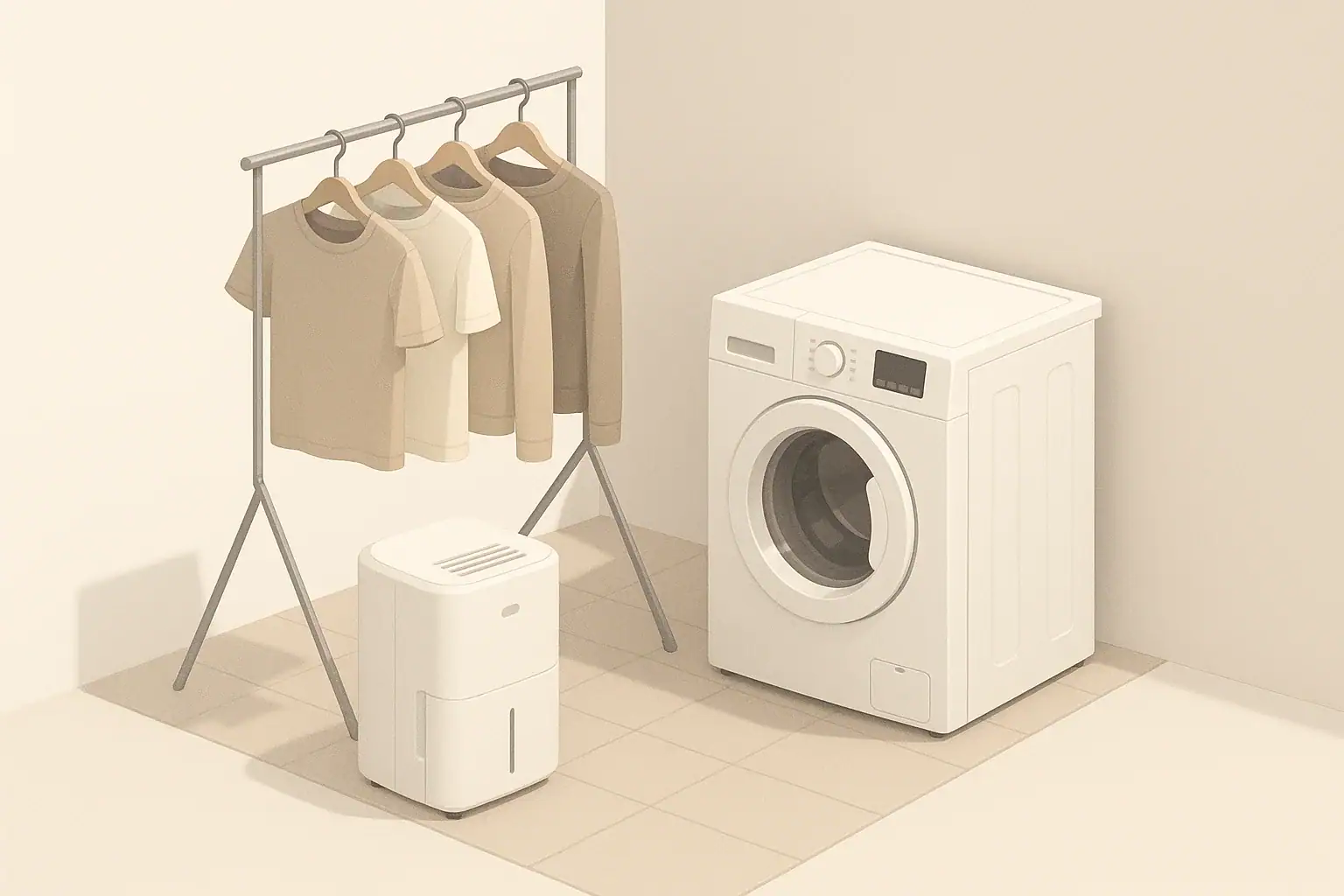
Using a dehumidifier in a laundry room helps clothes dry faster and reduces the musty mold smell by keeping humidity in a controlled range while air circulates around wet laundry.
Indoor drying adds a lot of moisture to the air, and laundry rooms are often small, enclosed, and already humid from washers and nearby bathrooms. A correctly sized and well-placed dehumidifier can keep relative humidity in a more comfortable range, limit mold growth on walls and fabrics, and shorten drying time for hanging clothes or items coming out of a dryer slightly damp.
- Aim to keep laundry room humidity roughly between 40–55% RH while drying.
- For a small laundry room (around 50–120 sq ft), a compact residential dehumidifier is usually sufficient.
- Run the dehumidifier during and 1–2 hours after drying cycles or hanging wet clothes.
- Place it where air can flow freely, away from walls and right under dripping laundry.
- Use exhaust fans or slightly open doors with the dehumidifier for better moisture removal.
- Empty the tank and clean filters and coils regularly to maintain performance.
Why Laundry Rooms Get Musty and How Dehumidifiers Help
Laundry rooms are one of the most moisture-loaded spaces in a home. Washers add humidity, dryers can leak warm moist air if vents are leaky or clogged, and hanging wet clothes turns the room into a small drying chamber. When moisture lingers, materials like drywall, wood trim, and fabrics can harbor mold and mildew, which often cause the classic musty laundry smell.
A dehumidifier removes some of that moisture from the air. As humid air passes over cold coils inside the unit, water condenses and drips into a tank or drain hose. Drier air leaving the dehumidifier can then pick up more moisture from your clothes and room surfaces, helping them dry faster and reducing conditions that favor mold growth.
Used together with basic ventilation—like an exhaust fan, open door, or nearby window—a dehumidifier can be an effective tool for keeping laundry areas more comfortable and less musty without needing any major renovations.
Key Concepts: Humidity Targets, Room Size, and Dehumidifier Capacity
A few simple concepts will help you choose and use a dehumidifier effectively in a laundry room: humidity range, room size, and capacity (how much moisture the unit can remove in a day under standard test conditions).
Comfortable and practical humidity ranges
- General indoor target: Many sources recommend keeping homes in roughly the 30–50% relative humidity (RH) range for comfort and mold prevention.
- For laundry rooms while drying: It is practical to aim to stay below about 55–60% RH most of the time, and avoid extended periods above roughly 60%.
- Too low? Constantly running a dehumidifier to push humidity much below about 30–35% RH indoors is usually unnecessary and can feel dry to some people and materials.
Estimating laundry room size
To get a rough sense of what size dehumidifier you need, first estimate room volume:
- Measure or estimate length × width × height in feet.
- Example: A 7 ft × 9 ft laundry room with an 8 ft ceiling is about 504 cubic feet.
- Smaller, closed-off rooms tend to build up humidity faster than open-plan spaces.
Dehumidifier capacity basics
Residential dehumidifiers are often described by how many pints or liters of water they can remove per day under standardized lab conditions. In a real laundry room the exact amount will differ, but capacity ranges still help with planning:
- Small units: Often used for small rooms or mild humidity loads.
- Medium units: Useful for typical laundry rooms with regular use and some hanging clothes.
- Larger units: More appropriate if the laundry shares space with a basement or if there are persistent dampness issues.
In many homes, a small to medium residential dehumidifier is adequate for a stand-alone laundry room, especially when combined with basic ventilation.
| Checklist item | Why it matters | Notes (example-based) |
|---|---|---|
| Room area (sq ft) | Helps choose a general capacity range | Small laundry rooms are often about 40–120 sq ft |
| Ceiling height | Affects total air volume | Higher ceilings increase moisture load per cycle |
| Drying style | Changes moisture added to air | Hanging clothes adds more moisture than fully vented dryers |
| Ventilation quality | Determines how quickly moist air is replaced | Strong exhaust fans can reduce dehumidifier runtime needed |
| Baseline humidity | Shows how damp the space is to begin with | Basement laundry rooms often start more humid than upstairs |
| Usage frequency | Influences daily moisture load | Multiple loads per day need more capacity than weekly use |
| Drain option | Affects convenience and tank emptying | Gravity drain or pump can help for heavy or frequent use |
Example values for illustration.
Common Problems: Musty Smell, Slow Drying, and Condensation
Many laundry rooms show similar warning signs before mold or odor becomes obvious. Recognizing them early makes it easier to use a dehumidifier and ventilation more effectively.
Signs that humidity is too high
- Persistent musty or “wet towel” odor that lingers even after laundry is done.
- Condensation on windows, metal dryer vents, or cold walls and pipes.
- Clothes that feel slightly damp or cool even after a full drying cycle or a day on the rack.
- Spots or streaks of discoloration on walls, ceilings, or caulk lines, which can indicate mold or mildew.
Missteps that reduce dehumidifier effectiveness
- Placing the dehumidifier in a corner with intake or exhaust pressed close to walls or appliances, restricting airflow.
- Running it with doors tightly sealed and no exhaust or makeup air in a very wet space, which can slow the overall drying process.
- Letting the water tank overfill so the unit shuts off frequently and does not run long enough during laundry cycles.
- Ignoring lint and dust buildup on air filters and coils, which lowers air movement and moisture removal.
When to consider more than just a dehumidifier
A dehumidifier is only one tool. If you see recurring problems such as visible mold growth on walls, frequent standing water, or a dryer vent that is clearly leaking moist air back into the room, you may also need to address ventilation or moisture sources:
- Check that dryer ducts are connected and not blocked.
- Use or install a bathroom-style exhaust fan if the laundry shares space with a bathroom.
- Reduce moisture at the source by spinning clothes on a high-speed washer cycle before drying or hanging.
Practical Setup: Where to Place the Dehumidifier and How to Use It
Placement and runtime can make as much difference as the device size itself. The goal is to move humid air from around the clothes and appliances through the dehumidifier and then out of the room when possible.
Placement tips for laundry rooms
- Allow space around the unit. Keep at least several inches of clearance on all sides so intake and exhaust are not blocked.
- Avoid direct drips. Do not place the dehumidifier directly under dripping clothes or near splashing sinks to protect the device and reduce safety risks.
- Consider airflow paths. If possible, place the dehumidifier where its airflow can pass across hanging clothes or between the washer/dryer and drying rack.
- Keep off thick rugs. A flat, stable surface helps air intake and drainage.
When and how long to run it
- During drying: Turn the dehumidifier on shortly before starting a wash/dry cycle or hanging wet clothes.
- After drying: Keep it running for 1–2 hours after you finish laundry, or until humidity readings drop back into your target range if you use a basic humidity monitor.
- Intermittent use: In drier seasons, you may only need it on laundry days; in humid climates or basements, you may run it more regularly.
Using ventilation with a dehumidifier
A dehumidifier recirculates room air; it does not bring in outdoor air. Ventilation helps carry moisture out of the home entirely.
- Use exhaust fans while the washer or dryer is running and while the dehumidifier is on.
- If possible, crack the laundry room door to allow drier air from other parts of the home to replace the moist air being exhausted.
- In mild weather, a slightly open window can also help move moisture out, especially in combination with a fan.
Real-World Scenarios: Matching Dehumidifier Use to Your Laundry Room
Every home is different, but some typical setups appear again and again. Here are a few simplified examples of how dehumidifier use might look in practice.
Small upstairs laundry closet
A stacked washer/dryer is tucked into a closet off a hallway. Clothes are usually dried in the dryer, with no hanging racks. Humidity spikes mainly while the washer and dryer are running.
- A small dehumidifier in the hallway outside the closet may be enough, especially if the dryer vent is well sealed.
- Keep the closet door open slightly during use to let humid air out to the dehumidifier.
- Run an exhaust fan nearby if the hallway connects to a bathroom with a fan.
Dedicated laundry room with drying rack
A mid-size room with side-by-side washer and dryer plus a wall-mounted drying rack. Clothes are hung to dry year-round, and the room sometimes smells musty.
- Use a small or medium dehumidifier placed so its airflow reaches the drying rack.
- Aim to keep humidity around 40–55% RH during typical drying days.
- Run the dehumidifier throughout drying and for at least an hour after.
- Check for any leaks or condensation around washer hoses and dryer vent.
Basement laundry with persistent dampness
The laundry is in an unfinished or partially finished basement that already tends to be humid. Clotheslines or racks are used often to avoid overusing the dryer.
- A medium to larger dehumidifier for the broader basement area may be appropriate, not just the laundry corner, depending on overall dampness.
- Consider running the dehumidifier more continuously in humid seasons, not only on laundry days.
- Use fans to move air across hanging clothes and toward the dehumidifier.
- Address other moisture sources like water seepage or uninsulated cold pipes that collect condensation.
Safety and Indoor Air Quality Considerations
Most home dehumidifiers are straightforward to use, but it is useful to keep basic safety and air quality points in mind, especially in tight laundry rooms.
Electrical and water safety
- Keep cords and outlets dry. Place the dehumidifier away from direct water sources and spills.
- Use grounded outlets. Follow the manufacturer’s instructions regarding power requirements and extension cords.
- Secure the drain hose if you use continuous drainage so it does not become a tripping hazard.
Heat and airflow
- Dehumidifiers release warm air as they operate. In a very small laundry room this can increase the temperature slightly, which may be noticeable but often helps drying.
- Ensure that dryer vents are sealed and exhausted outdoors rather than into the laundry room. A dehumidifier is not a substitute for proper venting.
Devices with additional air features
Some air treatment devices combine dehumidification with filtration or other technologies, such as ionizers or UV-C lamps. For laundry rooms, the core function you need is moisture control; anything else is optional.
- Filtration: A simple washable filter that catches dust and lint is often sufficient near laundry equipment.
- Ozone and strong oxidizers: If a device can intentionally generate ozone or similar oxidizing gases, it is generally advisable not to use those features in occupied spaces.
- UV-C lamps: If present, use them according to safety instructions and avoid staring into any UV light source.
Maintenance: Keeping Your Dehumidifier Effective and Odor-Free
Without regular care, a dehumidifier can itself develop unpleasant odors or lose effectiveness. Most maintenance tasks are simple and take only a few minutes.
Routine tasks
- Empty the tank as often as needed so the unit does not shut off in the middle of laundry cycles.
- Rinse the tank regularly with mild soap and water to minimize biofilm or slime buildup.
- Clean or replace air filters on the schedule recommended by the manufacturer, or more often in lint-heavy laundry areas.
- Visually inspect coils and intake grills for dust and lint, and gently clean them when accessible according to instructions.
Monitoring performance
- If you have a basic humidity meter (hygrometer), note how quickly humidity drops when the dehumidifier is on.
- If it takes much longer than it used to to reach the same humidity, check filters, coils, and airflow.
- Unusual noises, smells, or heat from the unit can be a cue to power it down and consult the manual or a professional.
FAQs: Everyday Decisions About Laundry Room Dehumidifiers
Do I need a separate dehumidifier if my dryer is vented?
A well-vented dryer removes a lot of moisture directly outdoors, but humidity can still spike from the washer, damp clothes, and any leaks or partial loads air-dried indoors. In many homes, a dehumidifier is useful if you notice musty odors, condensation, or slow-drying laundry, even when the dryer is vented.
Is it better to close or open the laundry room door?
If you are using only a dehumidifier, keeping the door mostly closed can help focus moisture removal in that room. However, if you have a good exhaust fan or want to share conditioned air with the rest of the home, leaving the door slightly open can help balance humidity. Observation works well: choose the position that leads to less condensation and faster-drying clothes.
Can a dehumidifier replace a bathroom-style exhaust fan?
No. A dehumidifier recirculates indoor air and removes moisture into a tank or drain, while an exhaust fan moves humid air outdoors and draws in replacement air from elsewhere. In a laundry room that doubles as a bathroom or has a shower nearby, an exhaust fan is still very helpful even if you use a dehumidifier.
Will a dehumidifier remove laundry odors from clothes?
A dehumidifier can reduce the damp, musty smell that comes from high humidity and slow drying, but it does not wash or deodorize fabrics. Proper washing, drying, and occasionally re-washing items that have already developed strong odors are still important.
| Goal | Simple actions | Tools | Note |
|---|---|---|---|
| Limit musty smell | Dry clothes promptly and avoid leaving wet loads in washer | Washer spin cycle, dryer, drying rack | Shortens time fabrics stay damp |
| Keep humidity near 40–55% RH | Run dehumidifier during and after laundry | Residential dehumidifier, basic hygrometer | Helps reduce mold-friendly conditions |
| Remove moisture from home | Use exhaust fans or open windows when practical | Bathroom-style fan, operable window, small fan | Moves moist air outdoors |
| Reduce condensation | Improve airflow around cold surfaces and insulate pipes if needed | Fan, basic pipe insulation | Less dripping on walls and floors |
| Prevent recurring damp spots | Check for leaks and repair or seal as needed | Visual inspection, basic tools or professional help | Stops constant moisture sources |
| Maintain dehumidifier performance | Clean filters, empty tank, check drainage | Manufacturer instructions, mild cleaning supplies | Keeps airflow and moisture removal more consistent |
Example values for illustration.
Related guides: Dehumidifier Running Cost: How Much Electricity Will It Use? • Drain Hose vs Bucket: Which Dehumidifier Setup Is Best? • Dehumidifier Sizing: Liters/Day, Room Type, and Dampness Levels
Key Takeaways: Using a Dehumidifier for Fresher Laundry Rooms
In a laundry room, the basic goal is to manage the moisture that naturally comes from washing and drying clothes. A reasonably sized dehumidifier, used during and shortly after laundry tasks, can help keep humidity in a moderate range, shorten drying times for hanging clothes, and reduce the musty smell often linked with damp, enclosed spaces.
Combining dehumidification with simple ventilation, correct dryer venting, and regular cleaning of both laundry equipment and the dehumidifier itself provides a practical, low-stress way to maintain more comfortable air in this busy part of the home.
Frequently asked questions
What humidity level should I target in a laundry room to prevent mold smell?
Aim for about 40–55% relative humidity while drying laundry; staying below roughly 60% RH reduces the likelihood of mold growth and the musty odor it produces. Use a hygrometer to monitor the room and run the dehumidifier during and for an hour or two after drying until readings return to the target range.
Can a dehumidifier remove existing mold smell from clothes and fabrics?
A dehumidifier helps by speeding drying and preventing further odor development, but it does not clean fabrics or remove odors already embedded in fibers. Items with strong, established smells often need rewashing, drying in warm air, or professional cleaning, and any mold on surfaces should be treated to stop recontamination.
Where is the best place to put a dehumidifier in a laundry room to reduce mold smell?
Place the dehumidifier with several inches of clearance so intake and exhaust are unobstructed and aim its airflow across hanging clothes or toward an exhaust path. Avoid putting it directly under dripping items or on thick rugs; if possible locate it between the drying rack and a door or vent to help move moist air out of the room.
How large a dehumidifier do I need for a basement laundry area prone to mold smell?
Basement laundry areas often need a medium to larger-capacity dehumidifier because baseline humidity and room volume are higher. Estimate the room size and moisture load (frequent hanging, leaks, or seepage increase demand) and choose a unit with a higher daily removal rate plus a continuous drain or pump for convenience.
Will running a dehumidifier while my dryer is vented outside cause any issues?
Generally it is safe and can be beneficial: the dryer removes most moisture outdoors, and the dehumidifier handles residual humidity from the washer and any indoor drying. Make sure the dryer vent is properly sealed and exhausting outdoors; if you suspect vent leaks into the room, address that first because the dehumidifier won’t replace proper venting.
Recommended next:
- How to Size a Dehumidifier (Sq Ft, Pints/Day, and Real-World Tips)
- Desiccant vs Compressor Dehumidifiers: Which Is Better for Cold Rooms?
- Basement Dehumidifier Guide: Targets, Drainage, and Energy Use
- Dehumidifier Running Cost: How Much Electricity Will It Use?
- Dehumidifier Sizing: Liters/Day, Room Type, and Dampness Levels
- Basement Dehumidifier Setup: Drainage, Placement, and RH Targets
- More in Dehumidifiers →
- Clear sizing logic (room size → CADR/ACH)
- HEPA vs carbon explained for real use-cases
- Humidity + ventilation basics to reduce mold risk