
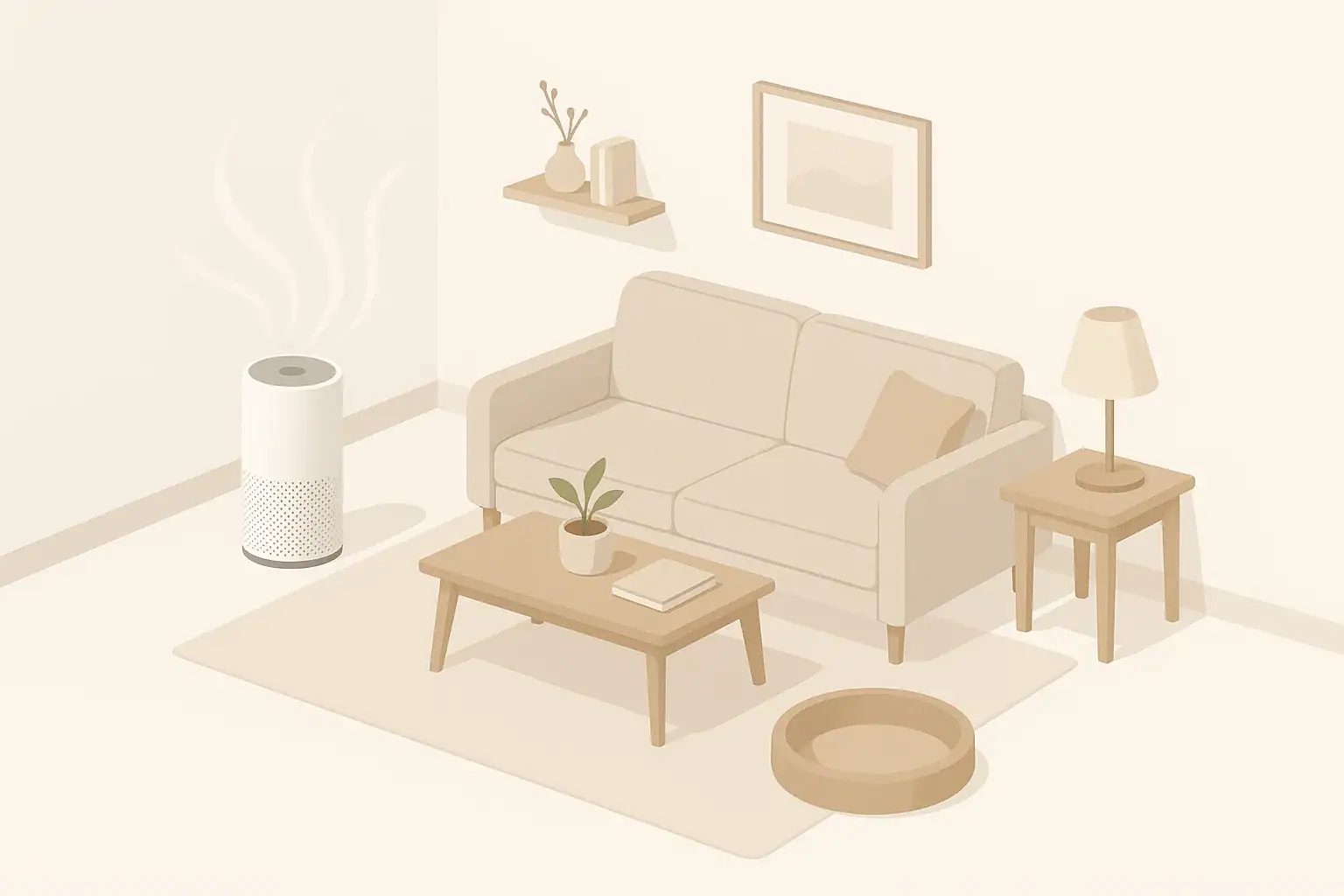
Living with pets adds warmth and personality to a home, but it also adds extra particles and odors to the air. Fur, dander, tracked-in dust, and litter box smells can build up, especially in tighter or less-ventilated spaces. An air purifier can help manage these indoor air concerns, alongside good cleaning and ventilation habits.
Air purifiers for pet households are mainly used for three goals:
- Reducing airborne pet dander and hair fragments to help keep surfaces and air fresher.
- Controlling pet-related odors, such as litter boxes, wet dog smell, or cage and bedding odors.
- Managing overall dust and fine particles that pets can stir up as they move around.
Choosing the best air purifier for pets is not only about picking a powerful machine. It is about matching the device to your room size, understanding filter types (especially HEPA and activated carbon), and planning for filter replacement costs over time.
Why Air Purifiers Matter in Homes With Pets
An air purifier can help manage these indoor air concerns, alongside good cleaning and ventilation habits.
Key Features for Pet Owners: Dander, Odors, and Safety
When comparing air purifiers for a home with pets, focus on how well the unit handles particles, odors, and long-term operation. The most helpful features tend to be filter-related and performance-related rather than cosmetic.
High-Efficiency Particle Filters for Dander
Pet dander consists of tiny skin flakes and other microscopic particles that can stay airborne for long periods. To reduce airborne dander, look for:
- True HEPA or equivalent filters that are rated to capture very small particles. Many products describe these as HEPA, H13, H14, or “medical-grade,” but naming alone does not guarantee performance. Look for clear claims about capturing fine particles, stated in general terms rather than marketing buzzwords.
- Good seals and low leakage around the filter. Even a strong filter can underperform if air leaks around the edges. Marketing terms like “sealed system” can be useful, but also pay attention to how the filter seats against gaskets or frames.
- Pre-filters that catch pet hair and larger dust. A washable or vacuumable pre-filter keeps the main HEPA media from clogging too quickly.
Pet hair itself is usually large enough to settle quickly onto surfaces. The purifier’s job is more about the smaller fragments and fine dust that remain airborne and contribute to that “constant shedding” feeling in a room.
Carbon Filters for Pet Odors
Odors from pets often come from volatile organic compounds (VOCs) and other gaseous molecules that HEPA filters alone cannot handle. For odor control, look for:
- Activated carbon filters with a reasonable amount of carbon media, not just a thin dusting. Thicker carbon beds generally last longer and adsorb more odor-causing compounds.
- Separate carbon and HEPA stages when possible. This lets you change the odor filter more frequently without wasting the particle filter.
- Placement near odor sources such as litter boxes or pet beds to give the carbon filter a better chance to capture smells before they spread.
Activated carbon does not destroy odors; it temporarily holds them. Over time, the media saturates and needs replacement to stay effective.
Safety: Ozone and Add-On Features
Many people prefer air purifiers that clean mechanically through filtration only. When evaluating extra features:
- Ozone-generating modes are best avoided for routine indoor use, especially around pets, because ozone is a lung irritant at elevated levels. Look for models that are described as ozone-free or that allow you to disable ionizers or other reactive features.
- Ionizers and UV-C lights are sometimes included as add-ons. Their actual contribution to cleaner air in homes is often modest compared with good filters and airflow. If present, it should be possible to turn them off.
- Pet safety also includes stable placement, chew-resistant cords, and avoiding units that blow strong air directly into cages or pet beds.
Example values for illustration.
| Filter type | Main job | Best for pet issues | Limitations |
|---|---|---|---|
| Pre-filter (mesh or fabric) | Catches large particles | Fur, hair, larger dust | Does not remove fine dander or odors |
| HEPA or similar fine filter | Traps very small particles | Pet dander, fine dust, some smoke | Does not target gases or smells |
| H13/H14-class style HEPA | Higher capture efficiency | Very fine particles in smaller rooms | May restrict airflow if area is too small |
| Activated carbon filter | Adsorbs gases and VOCs | Litter box odors, wet dog smell | Saturates over time, needs replacement |
| Specialty gas media blends | Targets broader range of gases | Homes with strong or chemical-like odors | Often more expensive, not always necessary |
| Filterless or electronic-only systems | Use ions or other reactions | Limited use; not primary for pet issues | May produce byproducts; check specs carefully |
Sizing an Air Purifier for Pet Dander and Hair
An undersized purifier will run constantly without noticeably improving the air, especially in homes with active pets that stir up dust and dander. Sizing is mainly about matching the purifier’s capacity to your room volume and your air change goals.
Room Size and CADR Basics
Two simple ideas help with sizing:
- Room area and volume: Multiply the room’s length by width to get square footage. If you want a rough sense of volume, multiply that by ceiling height.
- Clean Air Delivery Rate (CADR): CADR is a measure of how much clean air a purifier can deliver per minute for a given particle type. Higher CADR generally means the unit can handle larger rooms or provide more air changes per hour.
For most pet households, many people aim for multiple air changes per hour in the main living area where pets spend their time. An example approach is to size the purifier so it can turn over the room air several times per hour when set around a medium fan speed, to keep noise reasonable.
Open-Plan Spaces and Multiple Pets
Homes with open-plan layouts or several pets may need more than one purifier or a larger-capacity unit. Consider:
- Multiple zones instead of relying on one device to handle an entire floor. For example, one purifier in the main living area and another near bedrooms.
- Specific hotspots such as litter box areas, pet bedding, or rooms that stay closed for long periods.
- Airflow paths: if your purifier is in the corner behind furniture, its effective coverage shrinks. Place it where air can circulate freely.
For very large or open spaces, you may also want to use simple ventilation strategies, like opening windows when outdoor conditions are reasonable, to complement the purifier.
Placement Tips Around Pets
Where you put the purifier matters almost as much as which purifier you buy.
- Avoid obstructed corners. Leave space on at least two sides of the unit so air can flow in and out.
- Keep intakes above the busiest fur zones. If possible, avoid placing the intake directly on the floor where large clumps of fur can immediately clog the pre-filter.
- Consider pet behavior. Curious pets may paw at vents or chew cords, so choose stable locations and secure cables.
- Do not blow directly on cages or beds. Strong airflow can be uncomfortable for animals resting nearby.
Filter Types, Costs, and Maintenance in Pet Homes
Filter replacement is the main ongoing cost of running an air purifier, especially in homes with pets where hair and dander accumulate more quickly. Understanding the different filter stages helps you plan a realistic maintenance budget.
Typical Filter Stages in a Pet-Friendly Purifier
Most full-featured air purifiers use several layers:
- Pre-filter: Catches hair, fur, and large dust. Often washable or vacuumable.
- HEPA or fine particle filter: Traps small dander, dust, and other fine particles.
- Carbon or gas filter: Adsorbs odors from litter, bedding, and general pet smells.
Some units combine these into a single cartridge, while others use separate elements. Separate filters can make it easier to replace only what is worn out.
How Pets Affect Filter Lifespan
Manufacturers often estimate filter life based on average usage in non-pet homes. With pets, filters may need replacement more often. Key factors include:
- Number and type of pets: Several long-haired animals will shed more than a single short-haired pet.
- Cleaning habits: Regular vacuuming, washing pet bedding, and grooming can significantly reduce the load on your purifier.
- Operating speed and hours: Running the purifier on a higher setting or 24/7 will move more air and fill filters sooner.
- Indoor activities: Remodeling, frequent cooking, or heavy use of scented products can add to the particle and odor load.
Rather than relying only on calendar time (for example, “replace every 12 months”), many people use visual inspection and odor performance as guides: if the pre-filter looks heavily coated, or if odors linger longer than before, it may be time to replace or clean filters within the recommended schedule.
Budgeting for Filter Replacement
When comparing “best air purifiers for pets,” take a long-term view. A mid-priced purifier with affordable filters can cost less over several years than a cheaper unit with expensive replacement cartridges.
To estimate annual filter costs:
- Check how many filters the unit uses (pre-filter, HEPA, carbon).
- Note the suggested replacement interval for each filter type.
- Multiply the expected number of replacements per year by the approximate filter price.
Also consider time costs: cleaning reusable pre-filters monthly can stretch the life of more expensive filters and reduce the total number of replacements needed.
Noise, Energy Use, and Everyday Comfort
An air purifier may run many hours a day. For households with pets, choosing settings that balance performance, noise, and energy use is essential for everyday comfort.
Noise Levels With Skittish or Sensitive Pets
Pets may react to new sounds or sudden increases in fan speed. When evaluating purifiers:
- Check low-speed noise ratings if listed, or test in person when possible. Many people prefer a gentle fan sound that becomes part of the background.
- Use higher speeds when pets are outside or in another room to quickly clear the air, then drop back to a quieter setting for steady maintenance.
- Introduce the purifier gradually so nervous pets can get used to it. Start on the lowest setting and increase speed later.
Energy Use and Continuous Operation
Running a purifier continuously can help keep particles and odors more stable rather than letting them build up. To manage energy use:
- Look at power draw at low and medium speeds. These settings are often efficient, and moderate power usage can be acceptable for 24/7 operation.
- Use auto modes carefully. Some units adjust speed based on onboard particle sensors. Pet activity can cause frequent changes, which may be noisy but can help during busy times.
- Turn down or off when windows are wide open, since outdoor air exchange may be doing much of the work.
Cleaning and Basic Maintenance
Beyond filter changes, a little routine care keeps performance more consistent:
- Vacuum or wash pre-filters according to instructions to prevent heavy fur buildup.
- Wipe vents and grilles with a dry or slightly damp cloth to remove dust.
- Check for blockages caused by pet toys, beds, or furniture that may have shifted in front of the unit.
- Keep intake areas off the floor when possible to reduce direct hair clogs.
Using Air Purifiers Alongside Other Pet Air Quality Strategies
Air purifiers are most effective as part of a broader approach to indoor air quality. In pet homes, this often includes cleaning, ventilation, and basic humidity control.
Ventilation and Fresh Air
Even the best air purifier for pets works better when combined with simple ventilation habits. When outdoor air quality and weather allow, consider:
- Opening windows briefly to dilute indoor odors and CO2.
- Using exhaust fans in kitchens and bathrooms to remove moisture and smells at the source.
- Positioning purifiers so they are not working directly against strong drafts, which can short-circuit airflow.
Cleaning and Grooming Routines
Reducing what enters the air in the first place can be as important as filtering it:
- Regularly vacuum with a good floor tool to remove fur and dust before it becomes airborne.
- Wash pet bedding and soft surfaces on a regular schedule.
- Groom pets in a controlled area, ideally not in the room where you rely on your purifier the most.
- Maintain litter boxes with frequent scooping and proper ventilation to reduce odor spikes.
Humidity and Mold Considerations
While pets themselves do not cause mold, their bedding and blankets can stay damp if humidity is high. Keeping indoor humidity in a moderate range can help support overall comfort:
- Use bathroom and kitchen exhaust fans to remove moisture at the source.
- Consider a dehumidifier if your home tends to stay very humid.
- Avoid letting pet bedding stay wet for long periods, especially in basements or enclosed rooms.
Example values for illustration.
| Filter type | Typical interval range (example) | What shortens lifespan | Reminder |
|---|---|---|---|
| Pre-filter (washable) | Clean every 2–8 weeks | Multiple shedding pets, high fan speed | Mark a recurring calendar reminder |
| HEPA or fine particle filter | Replace every 6–18 months | Very dusty homes, infrequent vacuuming | Check for visible darkening or musty smell |
| Activated carbon filter | Replace every 3–12 months | Strong litter or pet odors, cooking fumes | If odors return quickly, change sooner |
| Combined HEPA + carbon cartridge | Replace every 6–12 months | 24/7 high-speed use, multiple animals | Compare cartridge cost vs. separate filters |
| Specialty gas filters | Replace based on odor changes | Frequent use of cleaners, fragrances | Track purchase dates to avoid forgetting |
| Onboard sensors (if present) | Check yearly | Heavy dust, smoke exposure | Clean vents gently according to manual |
Putting It All Together for Pet-Friendly Air Purification
Choosing the best air purifier for pets means balancing filter efficiency, odor control, noise, and ongoing filter costs for your specific home. Focus on strong particle filtration for dander, meaningful activated carbon for smells, and a CADR that matches your room size. Combine the purifier with regular cleaning, good ventilation, and filter maintenance, and you will have a practical, sustainable approach to keeping indoor air more comfortable for both people and animals.
Frequently asked questions
How often should I run an air purifier in a home with pets?
For best results, run the purifier continuously in rooms where pets spend most of their time to keep airborne dander and odors from building up. If noise or energy use is a concern, operate at higher speeds during active periods and lower speeds at night or when rooms are unoccupied.
Which filter types are most important for controlling pet dander and odors?
A true HEPA or equivalent filter is most important for capturing pet dander and fine particles, while a substantial activated carbon stage is needed to adsorb odors and many VOCs. A washable pre-filter helps trap hair and large debris to extend the life of HEPA and carbon media.
How do pets affect how often I should replace filters?
Pets—especially multiple or long-haired animals—increase particulate and odor loads, which typically shortens filter lifespans compared with non-pet homes. Inspect pre-filters frequently, clean reusable elements on schedule, and replace HEPA and carbon filters based on visible buildup, odor return, or the manufacturer recommendations adjusted for heavier use.
Can an air purifier eliminate strong litter box smells or ammonia?
Activated carbon can adsorb many odor-causing molecules but can become saturated and is less effective against high concentrations of ammonia; it will reduce but may not fully eliminate very strong smells on its own. Regular litter maintenance, increased ventilation, and using adequate carbon media or specialty gas media will improve odor control.
Are ionizers, UV, or ozone-producing purifiers safe to use around pets?
Ozone-generating devices should be avoided because ozone is a respiratory irritant for pets and people; ionizers and UV add-ons typically contribute less to particle removal than mechanical filtration and can produce byproducts in some cases. Prefer units that use mechanical HEPA and carbon filtration and allow disabling of reactive modes.
Recommended next:
- Best Air Purifiers for Allergies: What to Look For (CADR, HEPA, Carbon)
- How to Choose the Right Air Purifier for Your Room Size
- Air Purifier Placement: Where to Put It for Best Results
- Do Air Purifiers Help With Smoke and Odors?
- Air Purifier Noise: What dB Levels Are Quiet Enough for Sleep?
- More in Air Purifiers →
- Clear sizing logic (room size → CADR/ACH)
- HEPA vs carbon explained for real use-cases
- Humidity + ventilation basics to reduce mold risk


About this site
Home Air Quality Lab publishes practical, independent guides about indoor air quality—clear sizing, safer use, and real-world expectations.
Affiliate disclosure
Some links on this site may be affiliate links. If you buy through these links, we may earn a small commission at no extra cost to you. This helps support our content. Learn more.