
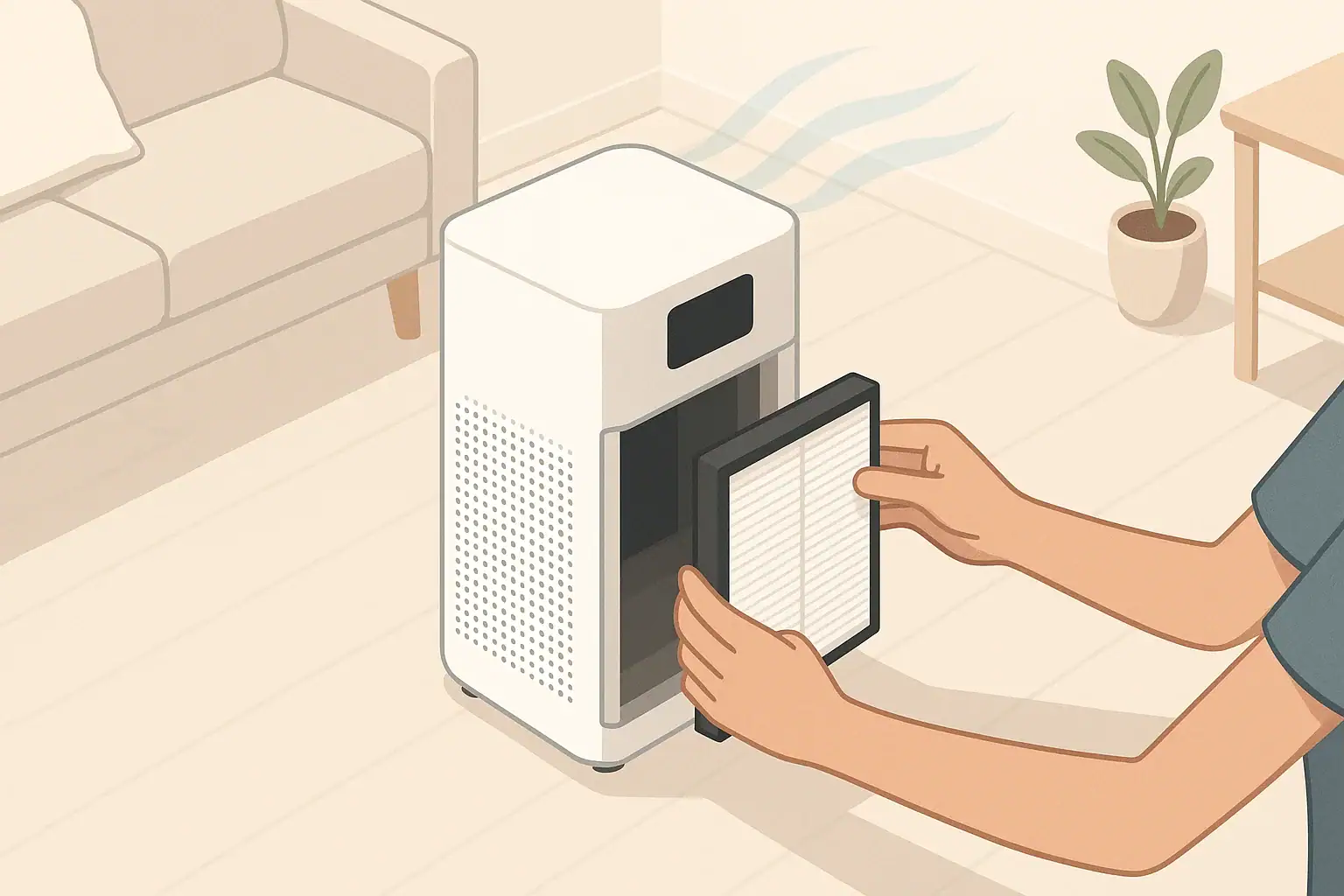
Most homes should replace HEPA filters about every 6–12 months, but heavy use, pets, smoke, or allergies can shorten that to 3–6 months. The right schedule depends on the type of device, how long it runs, and how dirty your indoor and outdoor air are. Watching for reduced airflow, darker filter media, and worsening allergy symptoms is just as important as counting months on a calendar.
This guide explains how often to change HEPA filters in air purifiers, HVAC systems, vacuums, and vehicles, and how to adjust those timelines for your situation. You will see real-world examples, common mistakes, and safety basics so you can keep filtration strong without replacing filters more often than you need to.
Whether you are managing asthma, dealing with wildfire smoke, or simply trying to reduce dust, a practical HEPA filter replacement plan helps keep indoor air cleaner and your equipment working efficiently.
What a HEPA Filter Does and Why Replacement Matters
A HEPA (high-efficiency particulate air) filter is a dense mat of fibers designed to capture very small airborne particles as air passes through. When it is new and correctly installed, a HEPA filter can remove a high percentage of:
- Fine dust and particulate (including many PM2.5 particles)
- Pollen and plant debris
- Pet dander and hair fragments
- Dust mite debris
- Some bacteria and other biological particles
- Smoke particles from cooking, wood burning, or tobacco
As these particles accumulate, the filter slowly clogs. Air becomes harder to push through, and the device’s clean air delivery rate drops even if the filter is still technically capturing particles. Replacing the filter on time helps maintain:
- Consistent filtration efficiency for allergens and fine particles
- Steady airflow, so rooms clear more quickly
- Lower fan noise and less strain on motors and blowers
- Reasonable energy use for both portable purifiers and central HVAC systems
There is no single universal answer to how often a HEPA filter should be replaced. Instead, you combine general timelines, manufacturer guidance, and real-world signs from your own home. Thinking of the filter as a consumable part, similar to a car’s oil or cabin filter, makes it easier to budget and plan ahead.
Key Concepts: How HEPA Filter Life Really Works
HEPA filter life is mostly about how much air passes through the filter and how dirty that air is. Several concepts help explain why replacement intervals vary so much from home to home.
Typical Replacement Ranges by Device Type
Most HEPA filters fall into a few broad ranges:
| Device type | Typical use conditions | Suggested replacement range | When to use the shorter end |
|---|---|---|---|
| Portable room air purifier | Runs many hours per day in average home | Every 6–12 months | Pets, smoke, or high outdoor pollution |
| Portable purifier in demanding conditions | Near kitchens, smokers, or wildfire smoke | Every 3–6 months | Continuous high-speed operation |
| Central HVAC with HEPA or HEPA-level filter | Heating/cooling used seasonally | Every 6–12 months | System runs almost nonstop or sensitive occupants |
| Vacuum cleaner HEPA exhaust filter | Weekly or biweekly vacuuming | Every 6–12 months | Vacuuming large homes or very dusty areas |
| Vehicle cabin HEPA or high-efficiency filter | Normal commuting and local driving | About every 12 months | Dusty roads, heavy traffic, or long daily drives |
These are starting points, not strict rules. A purifier that runs a few hours per week in a clean home may go longer, while the same model in a smoky or dusty environment may need more frequent changes.
Factors That Shorten or Extend Filter Life
Several conditions have a big impact on how often you should replace a HEPA filter:
- Particle load: Homes near busy roads, wildfire-prone areas, or construction zones send more pollution into filters.
- Indoor sources: Frying food, burning candles or incense, using fireplaces, or indoor smoking all add fine particles.
- Pets: Shedding fur, dander, and tracked-in dirt quickly load both pre-filters and HEPA media.
- Run time: A purifier running 24/7 processes far more air than one used only during allergy season.
- Fan speed: Higher speeds move more air and capture more pollutants, but fill the filter faster.
- Filter size and design: Larger, deeply pleated filters have more surface area and typically last longer.
- Pre-filters: Washable or replaceable pre-filters catch larger particles before they reach the HEPA layer, extending its life if maintained.
Calendar Time vs. Actual Use
Manufacturer guidance often lists a calendar interval such as “replace every 12 months.” In practice, two homes using the same purifier may need very different schedules. A more realistic way to think about it is:
- Calendar time is a convenient reminder.
- Actual run time and air quality determine how quickly the filter loads.
- Physical signs (airflow, noise, color, and symptoms) confirm whether it is time.
Using both the calendar and real-world signals gives you a balanced replacement plan that avoids both overuse and unnecessary early changes.
Real-World Replacement Examples and Scenarios
Putting the concepts into real situations makes it easier to decide how often to replace your own HEPA filters. The examples below assume true HEPA or HEPA-level filters, with average-quality pre-filters when applicable.
Example 1: Small Apartment with One Purifier
Conditions:
- One-bedroom apartment near a quiet residential street
- No pets and no indoor smoking
- Portable air purifier runs 8–10 hours most evenings on medium
Likely pattern:
- Filter looks lightly gray after 6 months
- Airflow feels similar to new, fan noise unchanged
- Allergy symptoms under control
In this case, replacing the HEPA filter around 9–12 months is often reasonable, with a quick visual check at the 6-month mark.
Example 2: Family Home with Pets and Allergies
Conditions:
- Three-bedroom house with two dogs that shed heavily
- One family member with dust and pollen allergies
- Two portable purifiers running 24/7 in living room and bedroom
Observed pattern:
- Pre-filters visibly coated with hair and lint after 3–4 weeks
- HEPA filters show clear darkening across most of the surface after 4–5 months
- Allergy symptoms start to creep back if filters are left longer than 6 months
Here, a practical schedule is:
- Clean or replace pre-filters every 2–4 weeks
- Replace HEPA filters every 4–6 months, leaning toward 4 months during peak allergy seasons
Example 3: Wildfire Smoke Season
Conditions:
- Home in a region with seasonal wildfire smoke lasting several weeks
- Purifier runs on high speed continuously during smoke events
- Windows mostly closed, but some odor still noticeable
Likely pattern:
- Filter turns noticeably darker within a few weeks of heavy smoke
- Airflow and odor reduction gradually worsen during the event
- By the end of the season, the filter may be near the end of its useful life, even if only a few months old
In this situation, it often makes sense to:
- Inspect filters before smoke season starts and replace if already partially loaded
- Plan for an extra replacement shortly after a severe smoke period
Example 4: Central HVAC with HEPA Box Filter
Conditions:
- Whole-house HEPA or HEPA-level filter installed in a dedicated box on the return side of the HVAC
- System runs heavily during hot summers and cold winters
- No indoor smoking, one cat, average dust levels
Realistic approach:
- Inspect the filter at the start of heating season and at the start of cooling season
- Replace roughly every 6–12 months, depending on how dirty it looks and whether airflow has dropped
- Shorten the interval if anyone in the home has asthma or severe allergies
Example 5: Vacuum Cleaner HEPA Filter
Conditions:
- Vacuum used weekly on carpeted floors and rugs
- Bagless or bagged design with a HEPA exhaust filter
- Some pet hair and tracked-in soil
Practical pattern:
- Check the HEPA filter every 2–3 months when emptying the dust bin or changing bags
- Lightly tap loose debris into a trash can only if allowed by the manufacturer
- Plan to replace the HEPA filter about every 6–12 months, or sooner if suction and air quality drop noticeably
| Scenario | Key conditions | Approximate HEPA replacement timing | Adjustment trigger |
|---|---|---|---|
| Quiet apartment | No pets, low outdoor pollution | Every 9–12 months | Airflow or odor change |
| Pet-heavy family home | Multiple pets, 24/7 purifier use | Every 4–6 months | Allergy symptoms or darker filter |
| Wildfire season | High smoke for several weeks | Before and/or after smoke season | Strong smoke odor or darkened media |
| Central HVAC with HEPA box | Seasonal heating and cooling | Every 6–12 months | Reduced airflow at vents |
| Vacuum cleaner | Weekly use, mixed flooring | Every 6–12 months | Loss of suction or more dust |
Common Mistakes and Troubleshooting Signs
Many people either stretch HEPA filters far beyond their effective life or replace them too early. Recognizing common mistakes and troubleshooting cues helps you avoid both extremes.
Mistake 1: Relying Only on the Calendar
Waiting exactly 12 months because the manual says so can be a problem if:
- You live in a high-pollution or smoky area
- You run the purifier on high speed most of the day
- You have multiple pets or frequent visitors
Troubleshooting cue: If airflow feels weak, fan noise seems strained, or dust builds quickly on surfaces before the calendar date, inspect and likely replace the filter sooner.
Mistake 2: Ignoring Physical Signs
On the other hand, some people replace filters strictly on schedule even if they still look and perform well.
- Filter surface is only lightly gray with no matted areas
- Airflow feels strong at the usual fan setting
- Allergy symptoms and odors are well controlled
Troubleshooting cue: If all performance signs are good, you may be able to safely extend the interval slightly, especially in cleaner environments.
Mistake 3: Washing Non-Washable HEPA Filters
Most consumer HEPA filters are not designed to be washed. Water and detergents can:
- Damage the delicate fibers that trap fine particles
- Change the structure of the filter media
- Leave behind residues that affect airflow and performance
Troubleshooting cue: If a filter has been washed but air quality seems worse or airflow is uneven, replace it with a new, dry filter that matches the device specifications.
Mistake 4: Skipping Pre-Filter Maintenance
Many purifiers and HVAC housings include a pre-filter to catch hair, lint, and larger dust. If this stage is neglected:
- The pre-filter clogs and restricts airflow before air reaches the HEPA media
- The HEPA filter may load quickly with fine dust that could have been intercepted earlier
Troubleshooting cue: If your HEPA filters seem to darken very quickly, check whether the pre-filter is overdue for cleaning or replacement.
Mistake 5: Poor Filter Seating or Gaps
Even a new HEPA filter cannot perform well if air slips around it instead of passing through it. This can happen when:
- The wrong size filter is used for the housing
- Gaskets or seals are missing, damaged, or compressed
- Access panels are not fully closed or latched
Troubleshooting cue: If dust accumulates near vents or purifier outlets despite recent filter changes, inspect for gaps around the filter frame and reseat or replace as needed.
Mistake 6: Ignoring Allergy or Asthma Feedback
For households with allergies or asthma, symptom changes can be an early warning that filters are past their prime.
- More sneezing or congestion in rooms where purifiers run
- Nighttime coughing or wheezing returning after a period of control
- Itchy eyes or throat when spending time indoors
Troubleshooting cue: If symptoms worsen and other factors (such as pollen season) have not changed, check the HEPA filter, pre-filter, and device settings. A timely replacement can restore performance.
Safety Basics When Handling and Replacing HEPA Filters
HEPA filters are designed to trap contaminants, so it makes sense to handle them carefully when inspecting, replacing, or disposing of them.
Before You Open the Device
- Turn off and unplug portable purifiers before opening panels.
- Shut down central HVAC systems at the thermostat and, if recommended, switch off power at the service switch.
- Let the device sit for a few minutes so particles settle inside the housing.
- If you are sensitive to dust or smoke, consider wearing a simple mask and disposable gloves.
During Filter Removal
- Open access panels slowly to avoid stirring up dust.
- Lift the filter straight out without bending or squeezing it.
- Avoid tapping, shaking, or brushing the filter, which can release trapped particles back into the room.
Bagging and Disposing of Used Filters
- Place the used HEPA filter directly into a sturdy trash bag.
- Seal the bag tightly before carrying it through living spaces.
- Dispose of it with regular household trash unless local rules specify otherwise.
Because HEPA filters contain mixed materials and captured contaminants, they are rarely suitable for standard recycling streams.
Installing the New Filter Safely
- Confirm that the replacement filter matches the size and type specified for your device.
- Check for airflow arrows or orientation marks and align them correctly.
- Press the filter gently into place so it sits flat and snug, with no visible gaps around the edges.
- Close and latch access panels fully before turning the device back on.
After installation, listen for any unusual rattling or whistling sounds that might indicate air bypass or a loose panel.
Long-Term Maintenance, Storage, and Scheduling
Creating a simple, repeatable routine makes HEPA filter maintenance easier and more consistent over time.
Building a Practical Replacement Schedule
- Start with the manual: Note the recommended interval for each device (for example, 12 months for the HEPA filter, 3 months for the pre-filter).
- Adjust for your environment: Shorten the interval if you have pets, smoke exposure, or high outdoor pollution; extend slightly if your air is very clean and run time is low.
- Use seasonal checkpoints: Tie filter checks to early spring, mid-summer, early fall, and mid-winter so they are easy to remember.
- Record what you see: Note filter color, airflow, and any symptom changes at each check.
Over a year or two, these notes help you dial in a schedule that fits your home rather than relying only on generic timelines.
Maintaining Pre-Filters and Other Stages
Pre-filters and other stages can significantly affect how long the HEPA layer lasts.
- Washable pre-filters: Rinse or vacuum every 2–4 weeks, then let them dry completely before reinstalling.
- Disposable pre-filters: Replace more frequently than the main HEPA filter, especially in homes with pets.
- Additional stages: Some systems include carbon layers or other media for odor control; these may have their own replacement schedule separate from the HEPA filter.
Keeping upstream stages in good shape protects the HEPA media and reduces how often you need to replace it.
Storing Spare HEPA Filters
If you like to keep spare filters on hand, proper storage helps them stay effective until you need them.
- Leave filters sealed in their original packaging until installation.
- Store them in a dry, clean area away from direct sunlight.
- Avoid damp basements or garages where moisture could affect the media.
- Keep them away from strong odors or chemicals that could be absorbed into the filter material.
Tracking Multiple Devices
Many homes have more than one HEPA-based device: a bedroom purifier, a living room purifier, a vacuum filter, and sometimes a central HVAC filter. To keep track:
- Label each device with a small note indicating the next planned filter check date.
- Use a digital calendar reminder for seasonal inspections.
- Write installation dates on filter frames if recommended and safe.
This simple tracking prevents surprise clogs and last-minute filter purchases when air quality suddenly feels worse.
Practical Takeaways and Specs to Look For
By this point, you can see that the best answer to “how often should you replace a HEPA filter?” blends manufacturer guidance with your home’s real conditions. A short summary can help you act on that information.
- For most portable purifiers, plan on changing HEPA filters every 6–12 months, or every 3–6 months in heavy-use or high-pollution situations.
- For central HVAC HEPA filters, inspect at least twice a year and replace about every 6–12 months, sooner if airflow drops or sensitivities are high.
- For vacuums and vehicle cabin filters, a 6–12 month interval is typical, adjusted for how often and where you use them.
- Use physical signs—filter color, airflow, noise, odors, and symptoms—to fine-tune your schedule.
Specs to Look For When Choosing HEPA Filters and Systems
When you are evaluating HEPA filters or devices that use them, certain specifications and design details can make maintenance easier and replacement intervals more predictable:
- Filter type and rating: Confirm that the filter is a true HEPA or HEPA-level filter, not just a generic “high-efficiency” label.
- Filter size and surface area: Larger, more deeply pleated filters usually last longer between changes.
- Clear replacement interval guidance: Look for straightforward recommendations (for example, “HEPA: up to 12 months, pre-filter: up to 3 months”).
- Pre-filter design: Washable or easily replaceable pre-filters can significantly extend HEPA life.
- Seal quality: Gaskets, foam edges, or other sealing features reduce air bypass and improve real-world performance.
- Filter access: Tool-free panels and simple housings make it more likely you will actually check and replace filters on time.
- Filter change indicators: Hour counters or sensor-based reminders are helpful prompts, even if you still verify with a visual check.
- Availability of replacement filters: Make sure compatible filters are easy to obtain so you can stick to your schedule.
Combining these specs with a realistic replacement plan helps you maintain cleaner indoor air, protect your equipment, and avoid both overusing and overspending on HEPA filters.
Frequently asked questions
Which HEPA filter specifications and features should I prioritize when choosing a filter?
Prioritize a true HEPA rating (not just marketing terms), sufficient surface area or pleating for longer life, and good sealing features to prevent air bypass. Also consider whether the unit has a washable or replaceable pre-filter, easy access for changes, and clear replacement guidance so maintenance is practical.
Can I just follow the manufacturer's calendar interval for HEPA filter replacement?
The manufacturer's calendar interval is a useful baseline, but you should adjust it for actual use and indoor air conditions. Homes with pets, smoke exposure, or continuous operation often need more frequent changes; check physical signs like airflow, filter darkening, and symptom changes to fine-tune timing.
What precautions should I take when removing and disposing of a used HEPA filter?
Turn the device off and unplug it, open panels slowly to avoid stirring dust, and lift the filter out gently without shaking. Place the used filter in a sturdy trash bag, seal it before carrying through living spaces, and wash your hands after disposal.
How can I tell when a HEPA filter actually needs replacing?
Common signs include noticeably reduced airflow, a darker or matted filter surface, increased fan noise, persistent odors, or a return of allergy/asthma symptoms. Use these physical cues alongside calendar reminders to decide when to replace a filter.
Is it safe to wash a consumer HEPA filter to extend its life?
Most consumer HEPA filters are not washable; water and detergents can damage the delicate fibers and reduce effectiveness. Only wash a filter if the manufacturer explicitly states it is washable; otherwise replace it when performance declines.
Do pre-filters really help extend the life of a HEPA filter?
Yes. Washable or replaceable pre-filters capture larger particles like hair and lint, reducing the load on the HEPA media and often significantly extending its useful life when the pre-filter is maintained regularly.
- Clear sizing logic (room size → CADR/ACH)
- HEPA vs carbon explained for real use-cases
- Humidity + ventilation basics to reduce mold risk