
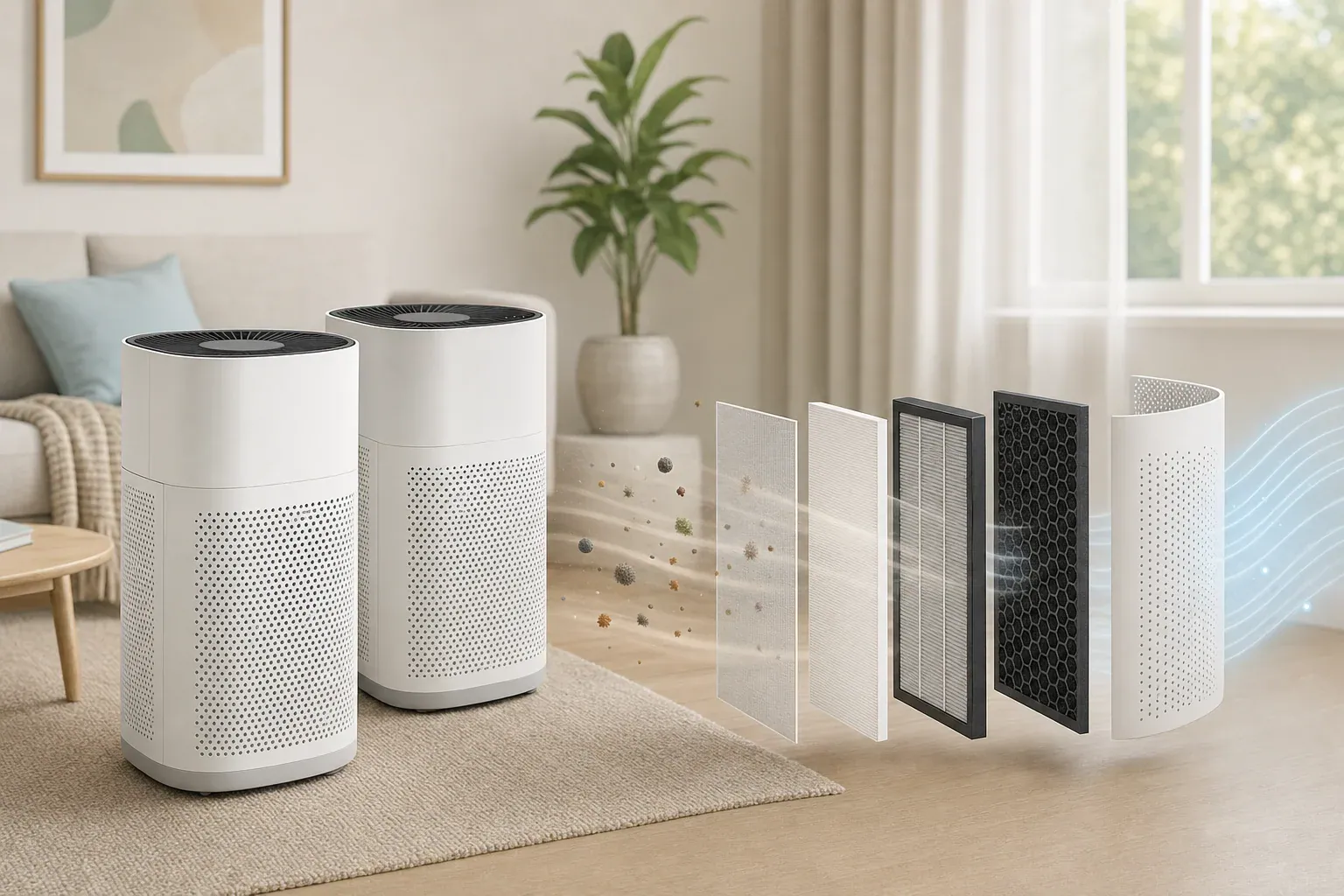
Quick answer: For portable home devices, “air cleaner” and “air purifier” are usually interchangeable labels rather than distinct performance categories. Neither name guarantees HEPA filtration, gas removal, quiet operation, or adequate room coverage. Compare CADR, filter stages, room-sizing assumptions, sound, ozone-related features, and replacement filters instead.
Air cleaner vs. air purifier: the label is usually not the difference
For portable residential products, the names are usually interchangeable. The U.S. Environmental Protection Agency (EPA) describes portable air cleaners as also being known as air purifiers or air sanitizers. The name on the box does not identify a separate, standardized level of particle removal, gas removal, noise, or ozone emissions.
That is why conflicting definitions appear online. One manufacturer may call a mechanical-filter unit an air cleaner, while another calls a similar unit an air purifier. Either product may also have carbon media, ionization, or another feature. Read the specifications for the complete unit rather than inferring performance from the noun.
Labels versus specifications that help you compare
| Label or claim | What it establishes | What to check next |
|---|---|---|
| Air cleaner or air purifier | How the manufacturer names the product | Particle ratings, filter stages, room assumptions, sound, and maintenance |
| HEPA | A claim about the filter medium or filter efficiency | Smoke and dust CADR for the assembled unit |
| Large room | A coverage claim without its full conditions | Stated room area, ceiling-height assumption, CADR, and fan speed |
| Odor or VOC filter | A gas-targeted stage is included | Identified sorbent media, relevant substance-specific test information, and replacement instructions |
| Quiet or sleep mode | A lower-speed setting may be available | Sound level and cleaning output at the setting you expect to use |
| Ionizer, plasma, or UV | An additional technology is present | Whether it can be disabled and any applicable ozone-emissions information |
| Washable or permanent | At least one component may be reusable | Which component is washable and which filters still require replacement |
Compare smoke and dust CADR
Clean air delivery rate (CADR) is a whole-unit particle-cleaning rating, not simply a filter-material rating. The Association of Home Appliance Manufacturers (AHAM) reports CADR separately for tobacco smoke, dust, and pollen. If you are comparing portable units for fine smoke particles, use smoke CADR; for dust, also review dust CADR.
AHAM’s Verifide directory lists ratings verified for participating models. A model that is not listed is not automatically ineffective, but a listing gives you a consistent rating to compare with another listed model. CADR does not rate gas removal. The EPA also notes that CADR is generally measured at the unit’s highest fan speed, which may be louder than a sleep setting.
Hypothetical room-sizing example
Assumptions: A closed bedroom measures 12 by 15 feet and has an approximately 8-foot ceiling.
- Calculate floor area: 12 × 15 = 180 square feet.
- Use AHAM’s general guideline: smoke CADR should be at least two-thirds of the room area.
- Calculate the minimum guideline: 180 × 2/3 = 120.
Under those assumptions, look for a smoke CADR of at least 120 cubic feet per minute. This is a general sizing guideline, not a guarantee of a particular indoor concentration. The two-thirds guideline assumes an approximately 8-foot ceiling; a taller room has more air volume and needs more cleaning capacity. See our guide to CADR for high ceilings for the volume adjustment.
Evaluate particle and gas stages separately
Particle filtration and gas removal are different jobs. EPA guidance explains that CADR applies to particle removal and that there is no widely used consumer gas-removal rating directly comparable to particle CADR.
For odors or gases, look for activated carbon or another identified sorbent medium. Its presence alone does not quantify capacity for a particular odor or chemical. More useful documentation identifies the medium, describes test conditions for the relevant substance when available, and tells you when to replace it. For more detail, see Activated Carbon Filters Explained: VOCs, Odors, and What They Can’t Do.
Check ozone-related features carefully
Identify whether a device has ionization, plasma, electrostatic charging, or another electronic stage. If so, check whether that stage can be turned off independently. EPA advises against devices that intentionally produce ozone.
California certification is not the same as a zero-ozone claim. Under its specified test procedure, California’s air-cleaning-device regulation limits certified devices to ozone emissions of 0.050 parts per million (50 parts per billion). That indicates compliance with an emissions limit under that procedure; it does not establish zero emissions or better particle-cleaning performance.
Compare sound at the speed you will use
A sound number is most useful when the fan setting and measurement conditions are disclosed. A product can promote a low sound level at its lowest setting while publishing CADR at its highest. Compare sound and cleaning information at the operating level you can realistically tolerate, especially for a bedroom.
If speed-specific CADR is unavailable, treat the published highest-speed CADR as an upper operating point. Do not assume sleep mode delivers the same cleaning rate. Our air purifier noise versus CADR guide explains this trade-off.
Read the filter manual before buying
There is no universal replacement interval. Actual filter life depends on the model, operating time, and pollutant loading. A manufacturer manual may specify separate schedules for a particle filter, carbon filter, and prefilter; those instructions apply to that model rather than every portable cleaner.
- Find the exact replacement-filter part number.
- Confirm which prefilters are washable, cleanable, or disposable.
- Check whether particle and carbon filters are sold separately or together.
- Record the manual’s inspection and replacement instructions.
- Check current filter availability before purchasing the unit.
- Estimate ongoing cost using the filter price and the model-specific replacement schedule, keeping any included first filter separate from later replacements.
Portable air-cleaner buying checklist
- Measure room length, width, and ceiling height.
- Compare smoke and dust CADR, preferably using an AHAM-verified rating when available.
- Separate particle-filtration claims from gas- or odor-removal claims.
- Check sound information at the fan speed you expect to run.
- Identify electronic features and whether they can be disabled.
- Interpret CARB certification correctly: it concerns an ozone-emissions limit under a specified test procedure, not zero ozone or superior cleaning.
- Locate the manual, replacement-filter part number, and maintenance instructions before purchase.
Bottom line
Choose a portable air cleaner or air purifier by documented specifications, not by the name on the box. Room-appropriate smoke and dust CADR, clearly described filter stages, usable-speed sound data, ozone-related details, and practical replacement filters provide more meaningful comparisons than either label.
Recommended next:
- HEPA vs Activated Carbon: Best Setup for Allergies, Odors, and Smoke
- Air Purifier vs Dehumidifier: Which One Solves Musty Air?
- Humidifier vs Dehumidifier: When to Add Moisture vs Remove It
- Air Purifier vs Ozone Generator: Safety, Effectiveness, and Myths
- HEPA vs Carbon Filters: When Each One Matters Most
- Air Purifier vs Ventilation: Which Fixes Stuffy Bedrooms Better?
- Clear sizing logic (room size → CADR/ACH)
- HEPA vs carbon explained for real use-cases
- Humidity + ventilation basics to reduce mold risk