
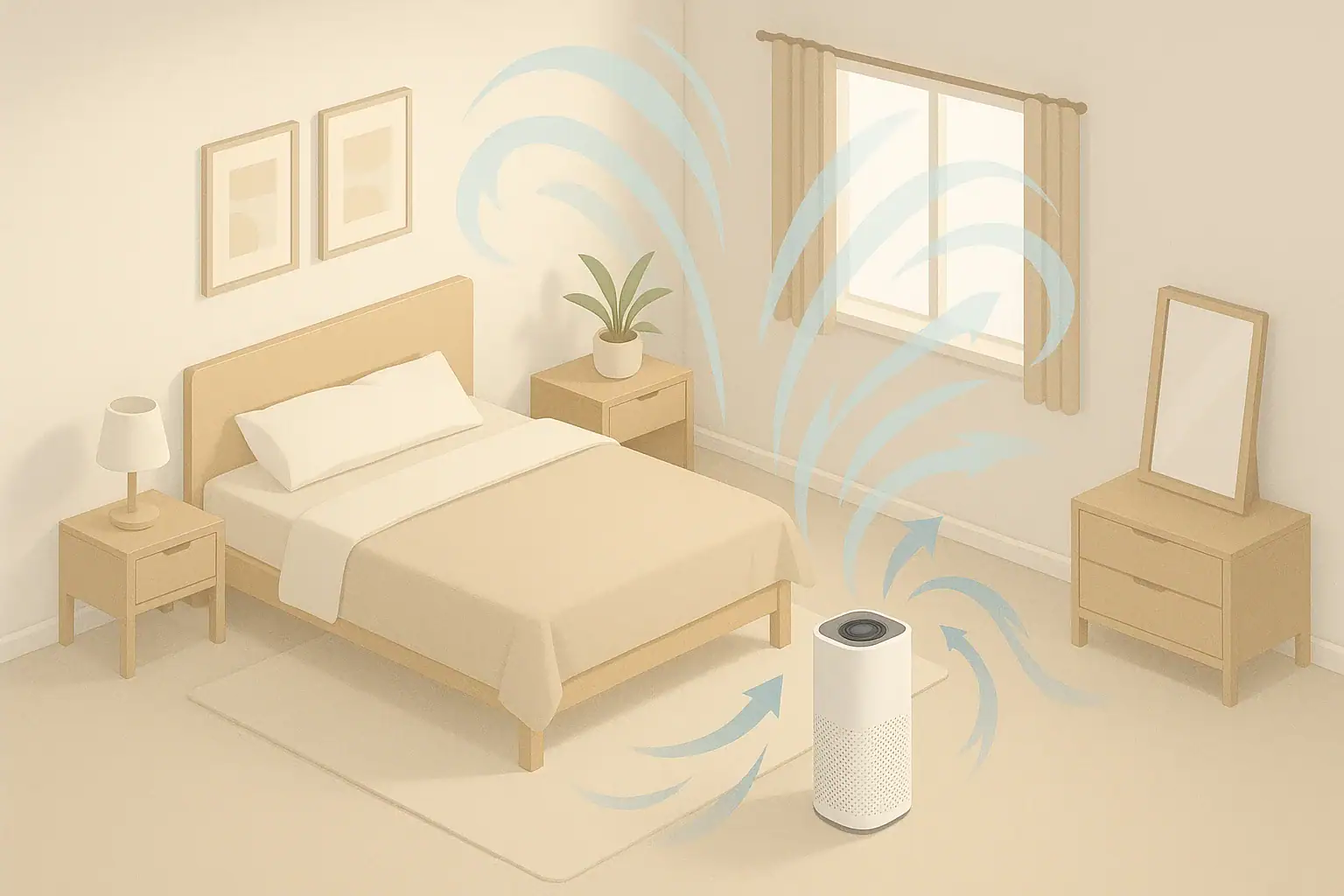
Air purifiers are often bought with care, then placed almost at random. Where you position a unit has a major effect on how much air it actually cleans. Even a strong purifier with a high Clean Air Delivery Rate (CADR) can perform poorly if it is hidden in a corner, pushed against a wall, or surrounded by furniture.
Most portable air purifiers rely on room air circulating toward the intake and back out through the outlet. That circulation is what helps you reach your target air changes per hour (ACH) in a space. When airflow is blocked, the purifier ends up re-cleaning the same small pocket of air instead of mixing with the whole room.
This article focuses on common placement mistakes at home in the United States and practical ways to avoid them. The goal is not perfection, but simple changes that help your purifier work closer to its potential, without complex equipment or major renovations.
Why Air Purifier Placement Matters More Than You Think
Air purifiers are often bought with care, then placed almost at random. Where you position a unit has a major effect on how much air it actually cleans. Even a strong purifier with a high Clean Air Delivery Rate (CADR) can perform poorly if it is hidden in a corner, pushed against a wall, or surrounded by furniture.
Most portable air purifiers rely on room air circulating toward the intake and back out through the outlet. That circulation is what helps you reach your target air changes per hour (ACH) in a space. When airflow is blocked, the purifier ends up re-cleaning the same small pocket of air instead of mixing with the whole room.
This article focuses on common placement mistakes at home in the United States and practical ways to avoid them. The goal is not perfection, but simple changes that help your purifier work closer to its potential, without complex equipment or major renovations.
Common Corner and Wall Placement Mistakes
Many people instinctively push air purifiers into corners or flush against walls to keep them out of the way. While this looks tidy, it often restricts airflow. Most units draw air in from one or more sides and blow it out from the top or front; when those paths are blocked, performance drops.
Problem: Stuffed Tight Into a Corner
Putting a purifier in the tightest corner of a room may trap it in a small circulation loop. The device can end up pulling in the same already-filtered air over and over, while stagnant air in the center of the room changes slowly.
Signs your corner placement is not working well include:
- The intake side is only a few inches from both walls.
- You feel little air movement outside that corner.
- Dust tends to settle in the middle of the room despite the purifier running.
In many cases, simply moving the unit a bit away from the corner improves mixing dramatically.
Problem: Pressed Directly Against a Wall
Placing the intake or outlet side directly against a wall restricts the volume of air the fan can move. This is especially an issue with units that pull air from the back or sides. When the intake does not have enough room, the purifier may run louder, move less air, and clean a smaller volume than it is capable of.
Common wall-related mistakes include:
- Back of the purifier touching the wall when the intake is in the rear.
- Side intake panels blocked by walls or bookcases.
- Outlet pointed straight at a wall only a short distance away, causing air to bounce back.
Most manufacturers recommend some clearance from walls on all sides. While specific numbers vary by design, leaving open space around the intake and outlet is a simple rule that fits almost all units.
Problem: Corner Placement in Open-Plan Rooms
In open-plan living areas, the purifier is often plugged in near the nearest outlet, which is frequently a corner. However, these large spaces rely on broad circulation. If the purifier sits in a distant corner behind furniture, it may mainly clean that local zone while the rest of the area sees only modest benefit.
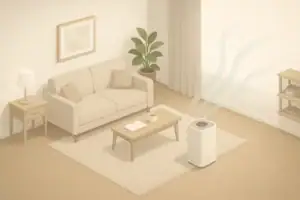
Instead of tucking the unit into the farthest corner, aim for a position that is still out of foot traffic but closer to the center of the zone you care about most, such as the seating area or sleeping area in a studio apartment.
Example values for illustration.
| Placement issue | Why it matters | Simple adjustment idea |
|---|---|---|
| Unit jammed into a tight corner | Encourages recirculating the same air pocket | Pull it 6–18 inches away from each wall |
| Intake panel against wall or furniture | Reduces airflow and effective CADR | Rotate the unit so intake faces open room |
| Outlet blowing directly at a wall | Short-circuits clean air back into intake | Angle outlet toward center of room |
| Hidden behind couch or chair | Obstructs both intake and outlet paths | Slide it beside furniture with clear air path |
| Buried under desk or table | Creates dead zones and uneven mixing | Place next to desk instead of underneath |
| Placed only for appearance | Aesthetics override airflow function | Balance visibility with performance zones |
Obstructed Airflow: Furniture, Curtains, and Clutter
Even when a purifier is not in a tight corner, surrounding objects can still choke its airflow. The device may look like it has room to “breathe,” but large surfaces nearby can redirect or block the flow of air, limiting coverage.
Furniture Blocking the Intake or Outlet
Large furniture pieces can act like walls. A purifier placed directly behind a couch, armchair, or dresser will struggle to interact with the larger room. The air may circulate in a small pocket behind the furniture instead of mixing into the breathing zone where people actually spend time.
Try to avoid placing a purifier:
- Directly behind the back of a sofa or chair.
- Inside tight shelving units or cabinets with doors.
- In narrow gaps less than a foot wide between tall furniture pieces.
Positioning the unit beside furniture, with its intake and outlet facing open space, usually helps significantly.
Curtains, Drapes, and Soft Fabrics
Heavy curtains and drapes can wrap around the air path. When an outlet blows toward long curtains, the fabric may move and partially block the stream of clean air. Likewise, if the intake faces billowing fabric, it may pull the curtain toward the grille and restrict flow.
To reduce curtain-related issues:
- Avoid placing the purifier directly behind hanging drapes.
- Keep some horizontal distance from windows with long curtains.
- Check that fabric is not being sucked against the intake when the fan runs on higher speeds.
Cluttered Floors and Storage Around the Unit
It is common to stack items around a purifier over time: boxes, laundry baskets, pet beds, or toys. These objects can form partial barriers that change how air flows around the device. Even if they do not fully cover the intake or outlet, they can shorten the path clean air travels before being pulled back into the machine.
Keeping a clear zone around the purifier is one of the lowest-effort ways to protect performance. Think of it as a small “no storage” circle where boxes and piles are not allowed.
Obstruction and Noise
sound profile of the purifier. When air is forced through narrow gaps or against large surfaces, turbulence can increase, making the unit sound louder or more “whistly” at a given fan setting. Reducing obstructions often lets you run the purifier on a lower, quieter setting while maintaining similar overall room cleaning.
Height and Orientation: Floor, Table, or Shelf?
Placement height affects which part of the room is cleaned most quickly. Many purifiers are designed for floor use, but that does not mean the floor is always ideal. Dust, smoke, and other particles can concentrate at different heights depending on room use and airflow patterns.
Floor Placement: Pros and Cons
Floor placement is common and usually safe, especially for units designed with stable bases and low centers of gravity. Advantages include:
- Good access to heavier particles that settle toward the ground, such as larger dust.
- Simple setup with no extra furniture needed.
- Less risk of falling compared with tall shelves.
However, strictly floor-level placement can be less effective in rooms where most breathing happens higher up, such as bedrooms with tall beds or areas where people spend time standing or seated at counters. Rugs or thick carpets can also slightly affect how air circulates near the intake.
Tabletop or Low Shelf Placement
Raising the purifier 1–3 feet off the floor on a sturdy surface can improve coverage of the main breathing zone, especially in bedrooms and home offices. This is often helpful when:
- The unit has a top outlet that spreads air horizontally.
- You want cleaner air around your head while sleeping or working.
- You have pets that shed heavily near the floor.
When elevating a purifier, ensure the surface is stable, flat, and large enough to support the footprint. Avoid high, narrow shelves where vibration could cause the unit to move or fall, and keep all intake and outlet vents fully exposed.
Orientation: Aiming the Outlet
The direction the outlet faces can influence how quickly clean air reaches key areas of the room. Generally, it helps to aim the outlet:
- Toward the center of the space, not at a wall.
- Toward the main seating or sleeping area for faster local improvement.
- Away from loose papers, light fabrics, or delicate items that could move in the airflow.
If the purifier has a 360-degree intake and a top outlet, orientation is often less critical, but keeping the top unobstructed remains essential.
Room Size, CADR, and Placement Working Together
Even perfect placement cannot make up for a purifier that is undersized for the room. CADR and ACH planning give a rough sense of whether your device can handle a given space, while placement helps you get closer to that theoretical performance.
Understanding Room Zones
Most rooms do not behave like perfectly mixed boxes. Air can linger in quieter corners or along walls, and obstacles create zones that exchange air more slowly. Placement that helps clean air sweep through these zones improves real-world performance.
Consider the most important zone in each room:
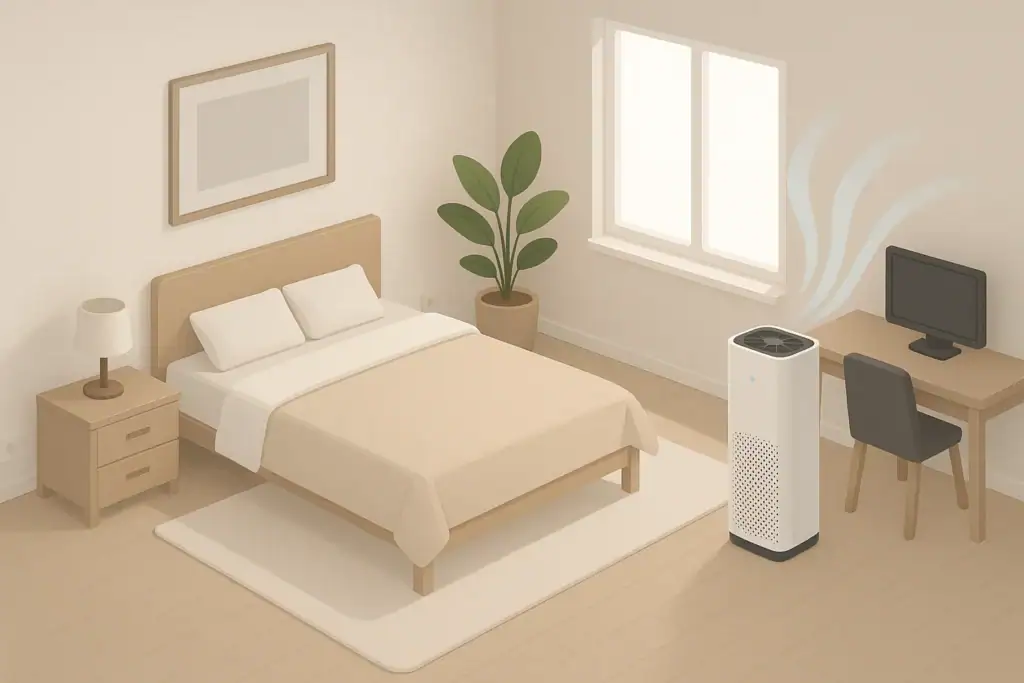
- Bedrooms: The area around the bed and headboard.
- Living rooms: Main seating zone near couches and chairs.
- Home offices: Desk and chair area.
Position the purifier where it can exchange air with these zones efficiently, not just where an outlet happens to be.
Placement in Open vs Enclosed Rooms
In enclosed rooms with doors mostly closed, a single purifier can often achieve a predictable ACH if suitably sized. Placement focuses on avoiding corners and obstructions.
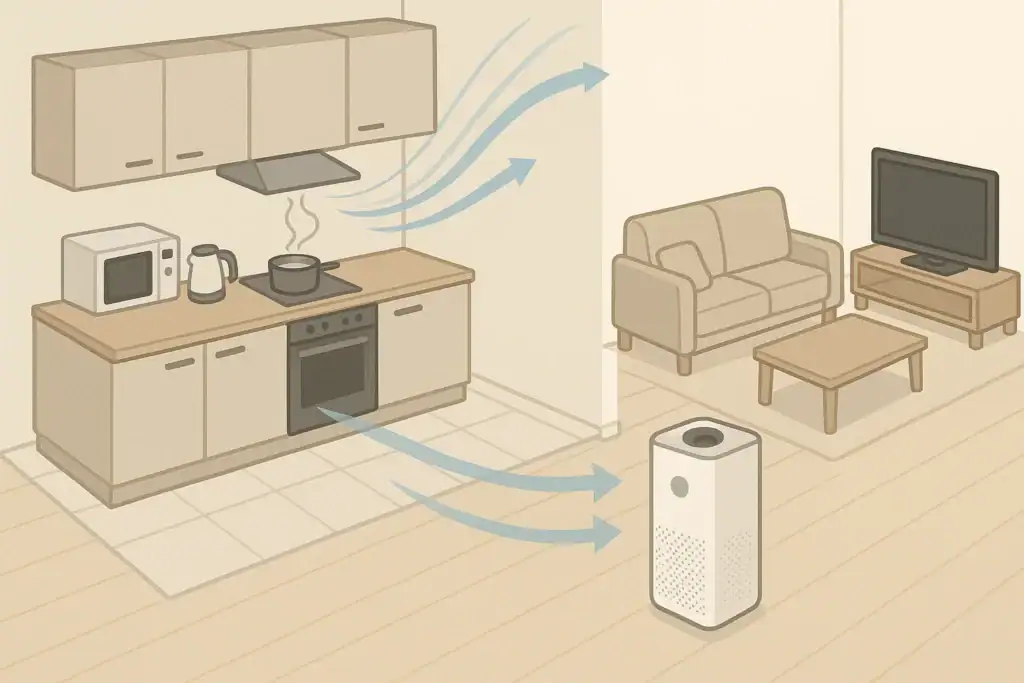
In open-plan spaces or areas connected by wide doorways, air moves more freely, but also mixes with adjacent zones. In these cases:
- Target the area where you spend the most time, not the literal room boundary.
- Consider multiple smaller units rather than one large unit far away.
- Use doors or partial partitions selectively if you want to concentrate cleaning in a specific room.
Interaction with Ventilation and HVAC
Central heating and cooling systems, ceiling fans, and open windows change how air circulates. A purifier can work with these flows rather than against them:
- Near, but not directly in front of, a supply vent to tap into general room circulation.
- In line with a ceiling fan set to a gentle, mixing speed.
- Away from open windows where outdoor air gusts might bypass the intake.
In homes where windows are occasionally opened for ventilation, you can keep the purifier running to help clean indoor air as it mixes with incoming outdoor air, but its effect will be diluted while large amounts of fresh air are coming in.
Example values for illustration.
| Approximate room size | Ceiling height note | CADR planning idea* | Placement note |
|---|---|---|---|
| Small bedroom (100–150 sq ft) | Standard 8 ft ceiling | Moderate CADR can reach several ACH | Place near bed area, away from corners |
| Medium bedroom (150–250 sq ft) | 8–9 ft, more total air volume | Higher CADR or longer run time | Consider center-side wall, not behind furniture |
| Living room (250–400 sq ft) | Vaulted or high ceilings increase volume | Larger CADR or more than one unit | Focus on main seating zone, clear airflow paths |
| Open-plan area (400+ sq ft) | Ceiling height varies by design | Plan by main occupied zone, not full area | Use multiple units for far corners if needed |
| Small office (80–120 sq ft) | Standard ceiling, many objects | Modest CADR but avoid cluttered layout | Place near desk, away from under-desk storage |
| Nursery or kids’ room | Often similar to small bedrooms | Choose CADR with some safety margin | Keep cords secure and device stable |
Practical Room-by-Room Placement Tips
Once you understand common mistakes, it helps to translate them into simple, room-specific habits you can apply around the house.
Bedroom
In bedrooms, people often prioritize quiet operation and comfort. For placement:
- Position the purifier so the outlet blows generally toward the bed, but not directly at your face if the airflow is strong.
- Keep at least some clearance from walls and large furniture; a bedside corner with 12–18 inches of space can work well.
- If you are sensitive to noise, place the unit a few feet from the head of the bed and run it on a lower speed continuously.
Living Room
Living rooms have more furniture and more varied seating positions, which increases the chance of blocked airflow.
- Aim for a location with a clear line of air to the main seating area.
- Avoid tucking the purifier completely behind entertainment centers or bookcases.
- If you use a ceiling fan, test different fan directions and speeds to see which setting seems to mix air without blowing directly into the purifier’s outlet.
Home Office
In a home office, the priority is typically the air around your desk and chair.
- Place the purifier beside your desk rather than under it, especially if there are many cables or storage boxes underneath.
- Leave the intake side facing open space, not the back of a filing cabinet.
- If printer or equipment emissions are a concern, positioning the purifier between that equipment and your seating area may help dilute and filter the air you breathe.
Rooms with Pets
Pet beds, litter boxes, and feeding areas can influence where you want the strongest cleaning effect.
- Keep the purifier near, but not directly next to, high-shedding areas, so fur and dander are pulled into the intake before spreading widely.
- Avoid placements where pets can easily tip the device over or block the intake with bedding.
- Check filters more frequently, as pet hair and dander can load pre-filters faster.
Simple Ways to Evaluate Your Placement
You do not need specialized instruments to get a basic sense of whether a placement is working reasonably well. A few simple checks include:
- Feel for a gentle but noticeable stream of air at a moderate distance from the outlet.
- Look for obvious obstructions and remove or relocate them if possible.
- If you own a basic indoor air quality monitor, you can loosely compare readings at different spots in the room with the purifier running to see if certain areas lag behind.
Over time, adjusting position, height, and orientation can become an easy part of keeping your home’s air cleaner and your purifier working closer to its intended capability.
Frequently asked questions
How far should I place an air purifier from walls or furniture to avoid common placement mistakes?
As a practical rule, leave at least several inches of clearance on all sides of the intake and outlet; many simple checklists suggest 6–18 inches where possible. Exact recommendations depend on the model, so consult the device guidance if available, but avoiding a tight fit is the most important step.
Is placing an air purifier in a room corner always a bad idea?
Corners often create small recirculating zones where the unit repeatedly cleans the same air pocket, so they are usually suboptimal. If a corner is the only practical spot, pull the purifier away from both walls and orient the intake/outlet toward the main occupied zone to improve mixing.
Will elevating a purifier on a table or shelf improve its effectiveness?
Raising a unit 1–3 feet can help it treat the breathing zone more directly, which is useful in bedrooms and offices. Ensure the surface is stable, vents remain unobstructed, and avoid very high or narrow shelves that could make the unit unstable.
How do curtains, carpets, and clutter impact purifier performance?
Soft fabrics like curtains can be drawn into intakes or block outlets, while clutter and stacked items create partial barriers that produce dead zones. Keep a clear “no storage” area around the purifier and avoid placing it directly behind long drapes or inside tight shelving.
Should I run my purifier directly in front of HVAC vents or open windows?
Positioning near—but not directly in front of—a supply vent can help the purifier tap into room circulation, but placing it directly in the stream can reduce efficiency or pull conditioned air away. Open windows bring in outdoor air that will dilute the purifier’s effect while they are open, so expect reduced relative performance during active ventilation.
Recommended next:
- Best Air Purifiers for Allergies: What to Look For (CADR, HEPA, Carbon)
- How to Choose the Right Air Purifier for Your Room Size
- Air Purifier Placement: Where to Put It for Best Results
- Do Air Purifiers Help With Smoke and Odors?
- Air Purifier Noise: What dB Levels Are Quiet Enough for Sleep?
- Best Air Purifiers for Pets: Dander, Odors, and Filter Costs
- More in Air Purifiers →
- Clear sizing logic (room size → CADR/ACH)
- HEPA vs carbon explained for real use-cases
- Humidity + ventilation basics to reduce mold risk


About this site
Home Air Quality Lab publishes practical, independent guides about indoor air quality—clear sizing, safer use, and real-world expectations.
Affiliate disclosure
Some links on this site may be affiliate links. If you buy through these links, we may earn a small commission at no extra cost to you. This helps support our content. Learn more.