
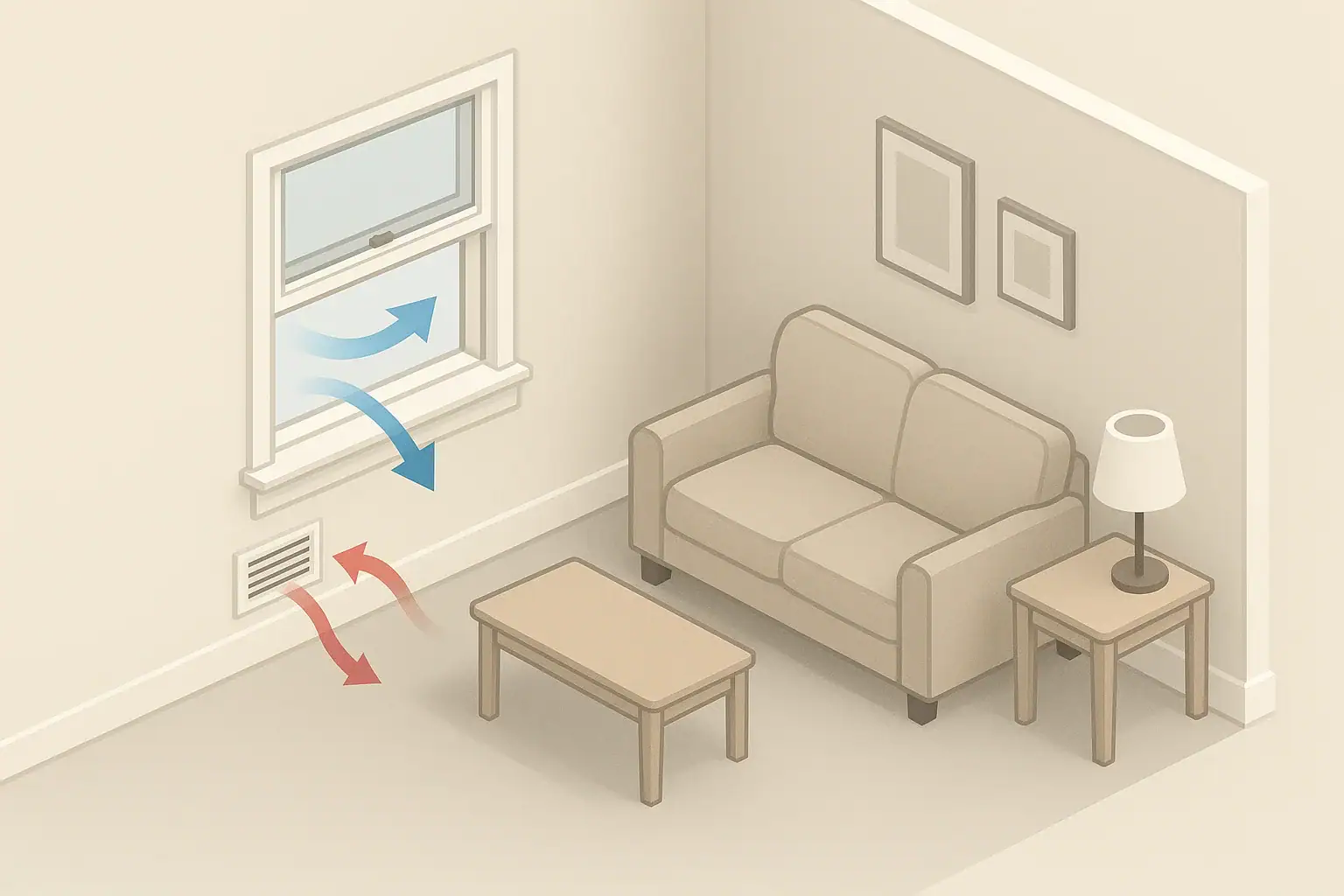
Air exchange is the process of replacing indoor air with outdoor air, and it explains why rooms can feel fresh, balanced, or stuffy depending on how quickly that exchange happens.
In homes, air exchange comes from a mix of intentional ventilation (fans, open windows, ducts), unintentional leaks (called infiltration), and sometimes air-cleaning devices that recirculate and filter the same air. Understanding a few basic concepts—air changes per hour (ACH), infiltration, and typical airflows—makes it easier to troubleshoot a stuffy room and choose practical fixes like ventilation, filtration, or both.
- For general comfort, many homes feel better around 0.35–0.5 air changes per hour (ACH) as a broad planning target, not a strict limit.
- “Stuffy” usually means low fresh air plus a buildup of human byproducts (moisture, CO₂, odors) or pollutants from indoor sources.
- Older, leakier homes rely heavily on infiltration (air leaking through cracks); newer tight homes often need mechanical ventilation.
- Air purifiers improve particle levels but do not add fresh outdoor air; they do not fix low-ventilation stuffiness by themselves.
- Simple checks—humidity, condensation, lingering odors, how you feel in the room—can flag low air exchange.
- Practical steps include using exhaust fans, opening windows when reasonable, balancing doors, and sizing filtration by room volume and target ACH.
What Air Exchange Means and Why It Matters
Air exchange describes how often the air in a room or building is replaced with air from outside. It is usually expressed as air changes per hour (ACH), meaning how many times in an hour the entire volume of air in a space is effectively replaced.
In a home, air exchange matters for three main reasons:
- Freshness and comfort – Replacing stale air dilutes carbon dioxide, odors, and moisture from breathing, cooking, and bathing.
- Moisture balance – Ventilation helps prevent persistent dampness that can contribute to condensation and mold risk.
- Pollutant dilution – Ventilation dilutes some indoor pollutants from activities and materials, while filtration can reduce particles circulating indoors.
When air exchange is too low for the way a room is used, people often describe it as “stuffy,” even if the temperature looks normal. That sensation usually reflects a mix of rising CO₂, humidity, and odors that are not being cleared quickly enough.
Key Concepts: ACH, Infiltration, and Ventilation
To understand why a space feels fresh versus stuffy, it helps to separate a few key ideas.
Air Changes per Hour (ACH)
ACH is a simple way to describe how quickly air is exchanged. The basic idea:
- Higher ACH = faster air turnover, more dilution of indoor-generated pollutants.
- Lower ACH = slower air turnover, more buildup of CO₂, odors, and humidity.
A rough planning example for a living space might be around 0.35–0.5 ACH of outdoor air as a comfort-oriented target, recognizing that actual needs vary with climate, occupancy, and how a home is built and operated. Some bedrooms, for example, may feel more comfortable at higher effective air exchange when heavily occupied at night.
Infiltration vs. Mechanical Ventilation
Infiltration is unintentional air leakage through cracks, gaps, and porous building materials. It is driven mainly by wind and temperature differences between indoors and outdoors.
Mechanical ventilation is intentional air exchange using fans or ducted systems. Common examples include:
- Bathroom and kitchen exhaust fans that remove moist or stale air.
- Whole-house ventilation systems that bring in filtered outdoor air and exhaust indoor air.
- Balanced systems that deliver and remove air in roughly equal amounts.
Older homes often get a surprising amount of air exchange from infiltration alone, especially in cold or windy weather. Newer, “tighter” homes can have very low infiltration, which may be helpful for energy use but often requires deliberate mechanical ventilation for comfort.
Air Purifiers and Recirculation ACH
Air purifiers do not bring in fresh outdoor air. They recirculate indoor air through filters to remove particles (and sometimes gases, depending on filter type). Even though this is not outdoor air exchange, people often talk about a purifier delivering a certain number of “air changes per hour” in a room.
This purifier ACH is different from ventilation ACH:
- Ventilation ACH – how often indoor air is replaced with outdoor air.
- Purifier ACH – how many room-volumes per hour are passed through the device’s filters.
Purifier ACH can greatly reduce particle levels (dust, smoke, etc.), but if the underlying ventilation ACH is low, the room can still feel stuffy because CO₂ and some gases are not reduced as effectively.
| Situation | Ventilation focus? | Filtration focus? | Notes (example thinking) |
|---|---|---|---|
| Room feels stuffy but looks clean | High | Low to medium | Increase outdoor air (fans, windows) to dilute CO₂ and odors. |
| Visible dust and allergy triggers | Medium | High | Use effective filtration plus reasonable ventilation. |
| Cooking odors linger for hours | High | Medium | Use exhaust fans and possibly carbon filtration. |
| Wildfire smoke outside | Low to medium | High | Limit outdoor intake when smoke is heavy; use strong filtration. |
| Humid bathroom after showers | High | Low | Run exhaust fan long enough to clear moisture. |
| New furnishings with noticeable smell | Medium to high | Medium | Increase fresh air; consider gas-adsorbing filters if needed. |
| Bedroom used by multiple people nightly | Medium | Medium to high | Combine steady ventilation with quiet filtration. |
Example values for illustration.
Why “Stuffy” Happens: Common Causes and Cues
A stuffy room usually does not have a single cause. It often reflects a combination of low ventilation, ongoing indoor emissions, and how the space is used.
Low Outdoor Air per Person
Each person in a room exhales carbon dioxide and water vapor and adds body odors. If fresh air coming in is low compared with the number of people and the time they spend there, levels build up. Common cues include:
- Room feels fine at first, then stuffy after an hour or two of occupancy.
- Air feels noticeably better quickly when a window is opened or an exhaust fan is used.
Closed Interior Doors and Poor Airflow Paths
Even if a home has central heating or cooling, closed doors can trap air in rooms without a clear path back to the main return. Signs include:
- Bedroom feels fresher with the door slightly open.
- Temperature is acceptable, but air feels stagnant or heavy.
Humidity and Odors that Linger
Moisture and odor behavior can signal low air exchange:
- Bathroom mirror stays foggy long after a shower.
- Cooking smells remain for many hours.
- Musty or “old” smell in closed rooms or basements.
These conditions suggest the space is not clearing moisture and gases quickly enough.
Seasonal and Weather Effects
Infiltration varies with weather. Some patterns:
- Winter in cold climates – Stack effect (warm air rising) can increase uncontrolled leakage, sometimes making homes less stuffy but more drafty.
- Mild seasons with closed windows – Heating or cooling may run less, fans cycle less, and air can become more stagnant.
- Hot, humid summers – People often seal up homes and rely on air conditioning. If outdoor air intake is low, rooms can feel closed-in despite cool temperatures.
Practical Steps to Improve Air Exchange and Comfort
Most homes can improve perceived freshness with a combination of simple ventilation habits and targeted filtration. The right mix depends on climate, building type, and any outdoor air quality concerns.
Use Existing Exhaust Fans Effectively
Bathroom and kitchen exhaust fans are straightforward tools for moving stale, humid, or odor-laden air outside.
- Run bathroom fans during showers and for 15–30 minutes afterward to help clear moisture.
- Use range hoods while cooking, especially for frying, searing, or heavy odor foods.
- If fans are noisy, people tend to avoid them; consider running them for shorter but more frequent periods if that is more acceptable.
Window and Cross-Ventilation Strategies
When outdoor conditions are reasonable (temperature and outdoor air quality both acceptable), opening windows can rapidly increase air exchange.
- Create cross-ventilation by opening windows on opposite sides of a home or room.
- Use interior doors strategically to let fresh air move through while maintaining privacy where possible.
- Even short “air-out” periods—5–15 minutes—can make a noticeable difference in stuffy rooms.
Balancing Doors and Returns
For homes with central HVAC, verify that air has a way to travel back to the main return:
- Leave bedroom doors slightly open when practical.
- Use undercut doors or transfer grilles where appropriate to help air move.
- Avoid blocking supply or return registers with furniture or large objects.
Pair Ventilation with Filtration
Ventilation dilutes indoor-generated gases and moisture; filtration reduces particles. Used together, they often produce better comfort than either alone.
- Use air purifiers or high-efficiency central filters to control dust and fine particles.
- Use activated carbon or similar media when odors or some gases are a concern, recognizing that these filters have finite capacity.
- During outdoor smoke or high-pollen events, adjust windows and outdoor intake to limit contaminants while maintaining enough air exchange for comfort, often leaning more on indoor filtration.
Real-World Home Scenarios
These example situations illustrate how ACH, infiltration, and usage patterns interact in everyday spaces.
Scenario 1: Stuffy Bedroom at Night
A small bedroom with one or two people sleeping and the door closed can quickly feel stuffy, especially in tighter homes.
Possible responses:
- Crack the door or window slightly if conditions allow.
- Run a quiet fan to improve mixing and movement between the room and the rest of the home.
- Use an air purifier to reduce particles; pair with ventilation changes to address CO₂ and odors.
Scenario 2: Odors in an Open-Plan Living Area
Cooking in an open-plan kitchen and living room can spread odors widely. If there is limited exhaust or window opening, smells may linger for hours.
Possible responses:
- Use the range hood or nearby exhaust fan during and after cooking.
- Open a window downwind and another across the room to encourage cross-flow if outdoor air is acceptable.
- Run filtration in the main space to reduce particles created during cooking.
Scenario 3: Finished Basement with Musty Smell
Basements often have lower natural air exchange and more moisture sources from soil and concrete surfaces.
Possible responses:
- Improve drainage and moisture control where needed to reduce persistent dampness.
- Use dehumidification to keep relative humidity in a generally comfortable range, often around 30–50% as a broad target.
- Add ventilation where feasible, and use filtration to address particles; consider gas-adsorbing media for musty odors.
Safety, Equipment Choices, and Neutral Technologies
When adding devices to manage air quality, it is useful to distinguish between approaches that physically remove pollutants and those that rely on chemical or electrical reactions.
Filtration and Ventilation First
Physical methods tend to be straightforward to understand:
- Mechanical filtration – HEPA and other high-efficiency filters capture fine particles by passing air through dense media.
- Activated carbon or similar media – Adsorb some gases and odors on surfaces within a porous material.
- Plain ventilation – Dilutes indoor air by mixing with outdoor air, sometimes with heat or energy recovery.
Ionizers, UV-C, and Ozone Considerations
Some devices use ionization, UV-C light, or related methods. These technologies may be marketed with various claims, but they can have complexities:
- Ionizers – Charge particles to help them settle or clump together. Some designs may generate small amounts of ozone as a byproduct.
- UV-C – Used inside ducts or devices mainly to act on microorganisms on coils or in passing air. Effectiveness depends on dose and exposure time.
- Ozone generators – Devices that intentionally produce ozone are not appropriate for occupied living spaces because ozone is a lung irritant.
For most homes, starting with simple, well-understood methods—ventilation, filtration, humidity control, and source management—is a practical baseline before considering more complex technologies.
Maintenance, Monitoring, and Ongoing Checks
Maintaining filters, fans, and basic monitoring habits helps keep air exchange effective over time.
Fans and Ducts
- Clean exhaust fan grilles periodically so dust buildup does not reduce airflow.
- Listen for changes in fan noise that might signal worn parts or obstructions.
- If a fan seems weak, its duct run or termination hood may need inspection by a qualified person.
Filters and Purifiers
- Replace filters on central HVAC systems and portable purifiers according to general manufacturer guidance, or more often in dusty or smoky conditions.
- Recognize that carbon and similar gas-phase filters saturate over time; odor control usually declines before airflow does.
- Keep intakes and outlets clear so devices can move their rated airflow.
Simple Observation and Basic Monitors
Even without advanced equipment, people can track a few helpful signals:
- How quickly humidity and odors clear after showers or cooking.
- Whether some rooms consistently feel heavy or stale compared with others.
- Condensation on windows during cold weather, which can signal excess moisture relative to the ventilation level.
Some low-cost monitors show approximate CO₂, particle levels (PM2.5), or overall VOC estimates. These can offer general trends, but readings should be viewed as guidance rather than precise medical or regulatory information.
| Scenario (home use) | Example ACH range | What it suggests | Notes (illustrative only) |
|---|---|---|---|
| Whole home, typical occupancy | ~0.35–0.5 ACH | Moderate fresh air for general comfort. | Often cited as a planning level, not a hard rule. |
| Bedroom with 1–2 sleepers | ~0.5–1 ACH effective | Helps reduce overnight stuffiness. | Can come from a mix of ventilation and recirculation. |
| Bathroom during and after showers | 1–5 ACH equivalent | Quickly removes moisture peaks. | Achieved mainly with exhaust fans while occupied. |
| Kitchen while cooking | Several ACH in zone | Captures moisture, particles, and odors. | Range hoods and local ventilation do most of the work. |
| Living room with many guests | ~1–3 ACH effective | Improves comfort during gatherings. | Open windows and fans can temporarily boost exchange. |
| Wildfire smoke outside | Lower outdoor ACH, higher filtered ACH | Limits smoke entry while cleaning indoor air. | More reliance on filtration during peak smoke events. |
Example values for illustration.
Related guides: Ventilation vs Air Purifier: When You Need One, the Other, or Both • ACH to CADR Conversion: A Simple Formula With Examples • How to Choose the Right Air Purifier for Your Room Size
Key Takeaways: Connecting ACH, Infiltration, and Stuffy Rooms
Air exchange in homes is shaped by three main elements: natural leakage (infiltration), mechanical ventilation, and any filtration devices that recirculate indoor air. Together, they determine how quickly CO₂, moisture, particles, and odors are diluted or removed.
“Stuffy” rooms generally reflect low effective outdoor air per person, limited airflow paths, or moisture and odors that are not clearing. Addressing this usually involves:
- Making better use of fans, windows, and doors to improve air movement and fresh air intake when feasible.
- Using filtration to manage particles, especially in bedrooms, living rooms, or during outdoor pollution events.
- Observing humidity, condensation, and odor behavior as simple indicators of whether existing air exchange is keeping up with daily life.
By understanding ACH and how infiltration and ventilation interact, homeowners can make calm, informed decisions about when to open windows, when to run fans, and how to pair those actions with air cleaning for a more comfortable indoor environment.
Frequently asked questions
How many ACH do I need to prevent a bedroom from feeling stuffy?
For a typical bedroom, a useful guideline is around 0.5–1 air changes per hour (ACH) effective, though exact needs vary with room size, number of occupants, and building tightness. That level can be achieved through a mix of mechanical ventilation, brief window airing, and recirculating filtration for particle control. If multiple people sleep in a small room, a higher effective exchange is often more comfortable.
Can an air purifier alone fix CO₂-related stuffiness?
No. Portable air purifiers remove particles and, if equipped, some gases and odors, but they do not bring in outdoor air and therefore do not lower CO₂ levels. To reduce CO₂ and the sensation of stuffiness you need ventilation such as opening windows, running exhaust fans, or a mechanical supply of outdoor air.
How can I tell if a room’s ventilation is insufficient without instruments?
Common cues include a room feeling fine at first then becoming stuffy after an hour, quick improvement when a window or fan is used, persistent condensation on mirrors or windows after showers, and lingering odors or musty smells. These observations suggest low effective outdoor air per person or poor airflow paths even when temperature seems normal.
What is the difference between infiltration and mechanical ventilation, and why does it matter?
Infiltration is unintentional air leakage through cracks and gaps driven by wind and temperature differences, while mechanical ventilation uses fans or duct systems to deliberately supply or exhaust air. The difference matters because older, leakier homes may get enough fresh air passively, whereas newer, tighter homes often require designed ventilation to maintain comfort and indoor air quality.
When should I reduce outdoor intake and rely more on filtration?
During periods of poor outdoor air quality such as heavy wildfire smoke, high pollen events, or nearby chemical releases, limit outdoor intake and use high-efficiency filtration or purifiers to avoid bringing contaminants indoors. Once outdoor air quality improves, restore some ventilation to control CO₂ and moisture while maintaining filtration as needed.
Recommended next:
- Ventilation vs Air Purifier: When You Need One, the Other, or Both
- CO2 in Bedrooms: What Levels Mean and How to Improve Air Exchange
- How to Ventilate in Winter Without Freezing: Practical Strategies
- Exhaust Fan Best Practices: Bathrooms and Kitchens That Actually Clear Air
- More in Ventilation & Air Exchange →
- Clear sizing logic (room size → CADR/ACH)
- HEPA vs carbon explained for real use-cases
- Humidity + ventilation basics to reduce mold risk