
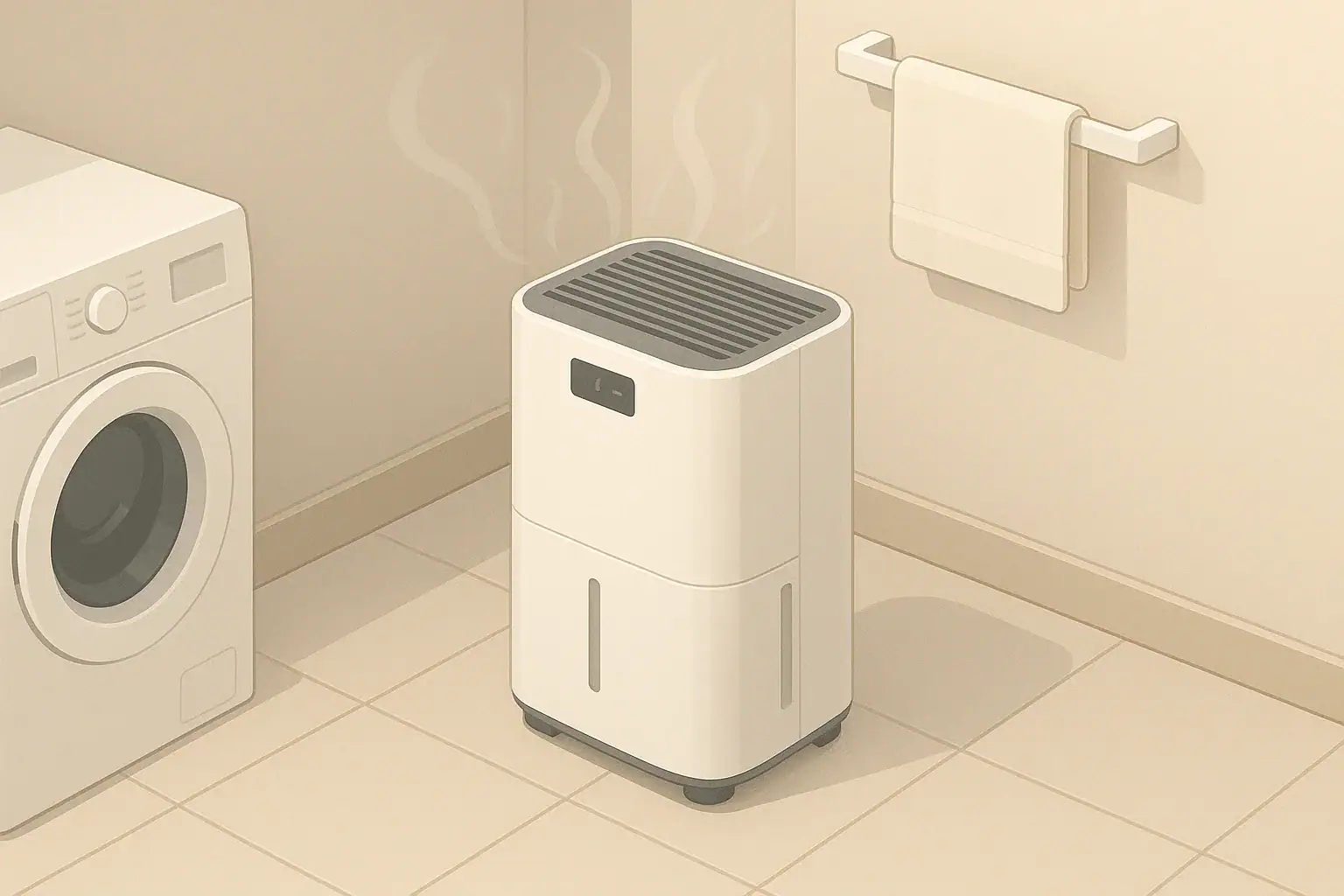
A typical home dehumidifier adds roughly $5–$30 per month to your electric bill, depending mainly on its wattage, runtime, and your local electricity rate.
Dehumidifiers can be helpful for comfort and moisture control, but they do use noticeable electricity if they run many hours a day. Understanding their power draw and how long they operate makes it easier to forecast costs, compare options, and decide when running one is worth it for your space and climate.
- Most portable dehumidifiers draw about 300–700 watts when running.
- At $0.15/kWh, 8 hours of daily use might cost around $5–$15 per month.
- Heavy use (24/7) can push monthly costs toward $20–$40 for a larger unit.
- Higher efficiency (higher pints per kWh) and humidistat controls reduce energy use.
- Lowering humidity only to about 45–50% instead of very dry levels can cut runtime.
- Good room sealing and airflow help your dehumidifier cycle off more often.
Why Dehumidifier Energy Cost Matters
Dehumidifiers remove moisture by running air over cold coils, which takes electrical power similar to a small air conditioner. While a single device rarely dominates a home’s electricity use, it can become a steady, background load—especially in humid climates or damp basements where it may run for many hours a day.
Energy cost matters for several reasons:
- Monthly budget: Knowing approximate costs helps you decide when to run, upgrade, or downsize a unit.
- Humidity targets: You can balance comfort and moisture control against electricity use.
- Equipment choices: Comparing efficiency and capacity helps avoid over- or under-sizing, both of which can waste energy.
- Whole-home strategy: Dehumidifiers are one part of moisture management alongside ventilation, insulation, and drainage.
Key Concepts: Watts, kWh, and Runtime
Estimating dehumidifier energy cost uses the same basic math as any electrical appliance. Three ideas matter most: wattage, run hours, and your electricity rate.
Wattage: How Much Power It Draws
Most portable residential dehumidifiers fall into these broad ranges:
- Small (under ~20 pints/day): about 200–400 watts
- Medium (~20–40 pints/day): about 300–600 watts
- Large (~40–70 pints/day): about 500–800+ watts
The exact number is printed on the unit label as watts (W) or amperes (A). If you see amperes, you can estimate watts by multiplying amps by voltage (in the U.S., usually about 120 V). For example, 4 A × 120 V ≈ 480 W.
kWh: How Utilities Bill for Energy
Electric bills use kilowatt-hours (kWh). One kWh is using 1000 watts for 1 hour. For a dehumidifier:
- Convert watts to kilowatts: 500 W → 0.5 kW.
- Multiply by hours of operation: 0.5 kW × 8 hours/day = 4 kWh/day.
- Multiply by your electricity rate: 4 kWh/day × $0.15/kWh = $0.60/day.
- Multiply by days per month: $0.60 × 30 ≈ $18/month.
This simple formula—kW × hours × rate—is the core of any cost estimate.
Runtime: How Many Hours It Actually Runs
Runtime is not the same as how many hours per day the dehumidifier is plugged in. Most units have a humidistat that turns the compressor on and off to maintain a set humidity level. In practice:
- Light duty: A unit might run only 2–4 hours/day in mild conditions.
- Moderate duty: 4–10 hours/day is common in a typical basement in humid weather.
- Heavy duty: In very damp spaces, it may run nearly continuously (16–24 hours/day).
The real energy cost is based on compressor-on hours, not clock time. A plug-in energy meter can show actual kWh if you want precise data for your device and conditions.
| Step | What to check | Why it matters |
|---|---|---|
| 1 | Rated watts or amps on the label | Base number for all cost estimates |
| 2 | Approximate daily runtime (hours) | Turns power draw into kWh used |
| 3 | Local electricity rate ($/kWh) | Connects energy use to real dollars |
| 4 | Humidity setting on the humidistat | Lower settings increase runtime and cost |
| 5 | Room size and leakage (doors, cracks) | Leaky or oversized areas require more work |
| 6 | Filter and coil cleanliness | Dirt reduces efficiency and raises energy use |
| 7 | Drain setup (tank vs hose) | Overflow shutoffs can cause unexpected cycling |
Example values for illustration.
Common Cost Ranges and Typical Mistakes
While actual bills vary, some patterns are common across U.S. homes. Understanding these helps you avoid overestimating or underestimating what your dehumidifier adds to your monthly bill.
Typical Monthly Cost Ranges
Assuming an electricity rate around $0.15/kWh, here are rough example ranges:
- Small unit, light use (300 W, 3 hours/day): about 0.9 kWh/day → around $4/month.
- Medium unit, moderate use (500 W, 8 hours/day): about 4 kWh/day → around $18/month.
- Large unit, heavy use (700 W, 16 hours/day): about 11.2 kWh/day → around $50/month.
These are examples only. Your home’s humidity, temperature, insulation, and setpoint can change runtime dramatically.
Costly Oversights Homeowners Often Make
- Running too dry: Trying to reach very low humidity (for example, below about 40%) makes the compressor work much longer than needed for typical comfort and moisture control.
- Oversizing without a plan: A large-capacity unit in a small room may short-cycle inefficiently, depending on controls and airflow, without major benefit.
- Ignoring air leaks: Open windows, unsealed gaps, or a door constantly left open can force the unit to treat essentially outdoor air.
- Poor placement: Tucking the unit into a tight corner can restrict airflow and reduce performance, increasing runtime.
- Dirty filters and coils: Dust buildup means the fan and compressor must work harder for the same moisture removal.
Misunderstanding Duty Cycle
Another common mistake is assuming that a dehumidifier uses its rated wattage 24/7. In reality, many units spend part of the time with the compressor off but fan on, or fully off once the set humidity is reached. This lowers average power use compared with a constant full-power assumption. However, in very damp conditions, duty cycle can approach continuous operation.
How to Estimate Your Dehumidifier’s Monthly Cost
You can get a useful cost estimate with a few minutes of observation and simple math. This helps you plan ahead or compare different humidity settings.
Step 1: Find the Power Draw
- Look at the back or side label for W (watts) or A (amps).
- If you see amps only, multiply by 120 to estimate watts (for a typical U.S. circuit).
- Divide watts by 1000 to get kilowatts. Example: 480 W → 0.48 kW.
Step 2: Estimate Daily Runtime
Over a few days of typical use, note roughly how often the compressor is actually running:
- Listen for the change in sound when the compressor starts and stops.
- Check how often the water tank fills (for tanked units) under steady conditions.
- Consider seasonality: peak summer humidity may double or triple runtime compared with drier seasons.
Use a reasonable average (for example, 4, 8, 12, or more hours per day) for your calculation. A plug-in energy monitor gives the most accurate number if you want to measure directly.
Step 3: Use Your Actual Electricity Rate
Your utility bill lists your energy charge per kWh. In many U.S. regions, this falls somewhere between about $0.10 and $0.30/kWh, though it can be outside this range. Use the full rate including delivery or distribution charges if they’re billed per kWh.
Step 4: Do the Math
Use the formula:
- Monthly cost ≈ kW × hours/day × days/month × $/kWh
Example: 0.5 kW unit, 6 hours/day, 30 days, at $0.15/kWh:
- 0.5 kW × 6 hours/day = 3 kWh/day
- 3 kWh/day × 30 days = 90 kWh/month
- 90 kWh × $0.15 = $13.50/month
Step 5: Compare Settings and Options
Once you have a baseline estimate, you can see how changes affect cost:
- Raising the humidity setpoint (for example, from 40% to 50%) may reduce runtime.
- Improving room sealing and drainage can reduce how long the unit must run.
- Upgrading to a more efficient unit (more moisture removed per kWh) can lower energy use for the same dryness level.
Real-World Usage Scenarios
Every home is different, but some typical situations show how costs add up in practice. These examples use $0.15/kWh as a reference rate and assume average conditions.
Example 1: Mildly Damp Basement
A medium dehumidifier (about 500 W) runs around 4 hours/day to keep a basement at about 50% relative humidity during spring and fall.
- 0.5 kW × 4 hours = 2 kWh/day.
- 2 kWh × 30 days = 60 kWh/month.
- 60 × $0.15 = $9/month (approximate).
For many homeowners, this level of cost is acceptable for added comfort and protection from dampness.
Example 2: Very Humid Summer in an Older Home
A larger unit (around 700 W) serves a partly finished basement in a humid climate. Poor insulation and air leaks mean it runs close to 12 hours/day during peak summer.
- 0.7 kW × 12 hours = 8.4 kWh/day.
- 8.4 × 30 = 252 kWh/month.
- 252 × $0.15 ≈ $38/month.
Improving air sealing, fixing gutters or drainage, or using targeted ventilation may reduce moisture load and runtime in this scenario.
Example 3: Seasonal Use in a Vacation Home
A small unit (about 350 W) runs 8 hours/day only during a particularly damp month.
- 0.35 kW × 8 = 2.8 kWh/day.
- 2.8 × 30 = 84 kWh/month.
- 84 × $0.15 ≈ $13/month.
This highlights how seasonal patterns can concentrate dehumidifier costs into a few months of the year.
Energy-Smart Operation and Moisture Control
Reducing dehumidifier energy cost is not only about the device itself; it also depends on how well your home manages moisture overall. A few habit and setup changes can significantly reduce runtime.
Set Realistic Humidity Targets
In many homes, keeping indoor relative humidity roughly in the 40–50% range is a reasonable balance between comfort, moisture control, and energy use. Trying to reach much lower humidity often leads to long compressor runs without clear added comfort.
Improve Room Tightness and Drainage
- Seal gaps: Weatherstrip doors, caulk cracks, and close unneeded vents around the area being dehumidified.
- Address water sources: Fix plumbing leaks, improve exterior drainage, and check gutters to reduce incoming moisture.
- Use exhaust fans: Bathroom and kitchen fans can remove moisture at the source, especially when showering or cooking.
Optimize Placement and Airflow
- Place the unit centrally in the area you want to treat, not wedged tightly against walls or furniture.
- Keep intake and exhaust grilles unobstructed for good circulation.
- Consider internal doors: slightly open ones can help circulate air around a basement or large room.
Consider Integration with Cooling
In some climates, central air conditioning already removes a significant amount of moisture while cooling. In those cases, running the thermostat fan setting correctly and maintaining the AC system can reduce the dehumidifier’s workload. However, in cooler but humid conditions (for example, a cool basement), standalone dehumidifiers often remain more practical.
Safety, Standards, and When to Rethink Use
Although dehumidifiers are common household appliances, they still require basic safety and code awareness, especially when they run many hours a day.
Electrical and Placement Considerations
- Plug directly into a properly grounded wall outlet; avoid long, undersized extension cords that can overheat.
- Keep clear of flammable materials and provide space around vents for airflow.
- In damp areas like basements, follow local electrical code recommendations for outlet type and placement.
- Ensure the power cord is routed to avoid tripping hazards or standing water.
Moisture and Drainage Safety
- Regularly empty the collection tank to prevent spills; standing water can encourage biological growth.
- If using a continuous drain hose, route it with a proper slope to a suitable drain and check for leaks.
- Avoid draining near foundation walls where water might seep back into the structure.
Signs You May Need a Different Approach
Some situations suggest that a dehumidifier alone may not be the most efficient or appropriate long-term solution:
- Unit runs nearly 24/7 for long periods and still struggles to maintain reasonable humidity.
- Visible moisture issues persist (such as recurring damp spots) despite continuous operation.
- Energy costs for dehumidification become a large share of your bill during certain seasons.
In these cases, broader building moisture strategies—like improving drainage, insulation, controlled ventilation, or other building-envelope work—may be worth exploring with appropriate professionals.
Maintenance, Lifespan, and Long-Term Cost Planning
Regular maintenance helps keep energy consumption closer to the original rating and can extend the useful life of the unit, limiting replacement costs over time.
Routine Tasks That Affect Energy Use
- Clean or replace the air filter: Many units have a washable filter at the air intake. Keeping it clean maintains airflow and efficiency.
- Vacuum dust around intake and exhaust grilles: Surface dust can restrict air movement.
- Check coils periodically: If the evaporator or condenser coils accumulate dirt, professional cleaning may restore performance.
- Inspect the drain system: A clogged hose or float switch can cause frequent cycling and inefficient operation.
Planning for Replacement
Dehumidifiers do not last indefinitely. Over time, refrigerant leaks, wear on the compressor, or control failures can reduce efficiency. Signs that energy use may be rising relative to performance include:
- Notably longer runtimes to achieve the same humidity level under similar weather conditions.
- Frequent icing of coils despite appropriate operating temperatures and airflow.
- Unusual noises or heat from the unit during operation.
When an older device begins to show these signs, comparing its measured kWh use (with an energy monitor) against a new, appropriately sized model can clarify whether replacement would reduce long-term operating cost.
Quick FAQ: Dehumidifiers and Energy Bills
These brief answers address common questions homeowners have when they first notice the impact of a dehumidifier on their energy bill.
Does a dehumidifier use more electricity than an air conditioner?
Many portable dehumidifiers use less power than central air conditioners but more than some window or portable AC units, depending on size. However, they are used for different purposes—dehumidifiers focus on moisture removal rather than temperature control—so direct comparisons can be misleading. The key is to look at each device’s wattage, runtime, and kWh use.
Is it cheaper to run a dehumidifier or just cool the space?
In hot, humid weather, air conditioning can remove moisture while cooling, which may reduce or eliminate the need for a separate dehumidifier in some spaces. In cooler but humid conditions (for example, a cool basement), running air conditioning may not be practical, and a dehumidifier is often more suitable despite its energy use.
Can a more efficient dehumidifier significantly cut my bill?
Higher-efficiency models remove more moisture per kWh. If your unit runs many hours per day for several months a year, improving efficiency and right-sizing the capacity can noticeably reduce electricity use over time. For light or occasional use, the difference in operating cost may be smaller.
| Goal | Simple actions | Tools | Note |
|---|---|---|---|
| Keep living areas around 40–50% RH | Use dehumidifier as needed; avoid overly low settings | Portable dehumidifier, humidity gauge | Moderate setpoints reduce runtime and energy cost |
| Limit basement dampness | Seal leaks, improve drainage, run dehumidifier | Weatherstripping, gutter maintenance, dehumidifier | Address water entry before relying solely on drying |
| Manage moisture after showers | Run exhaust fan during and after use | Bathroom exhaust fan, timer | Removes moisture at the source, reducing load |
| Reduce laundry-related humidity | Vent dryer outdoors, avoid indoor line-drying in small spaces | Proper dryer venting | Prevents large moisture spikes that drive runtime |
| Check for hidden moisture sources | Inspect plumbing, foundation, and window frames | Basic tools, visual checks | Fix leaks to cut long-term dehumidification needs |
| Track seasonal humidity changes | Log humidity readings by month | Simple hygrometer | Helps plan when dehumidifier use is most necessary |
Example values for illustration.
Related guides: Dehumidifier Running Cost: How Much Electricity Will It Use? • Desiccant vs Compressor Dehumidifiers: Which Is Better for Cold Rooms? • Humidifier vs Dehumidifier: Which One You Need (And How to Tell)
Summary: What a Dehumidifier Adds to Your Bill
In most U.S. homes, a typical portable dehumidifier adds somewhere between about $5 and $30 per month to the electric bill, with higher costs in very damp spaces or during peak humidity seasons. The main drivers are the unit’s wattage, the number of hours it actually runs each day, and your local electricity rate.
By checking the nameplate rating, estimating runtime, and applying simple kWh math, you can forecast your own costs with reasonable accuracy. Adjusting humidity setpoints to moderate levels, improving building moisture control, and maintaining the unit all help reduce energy use without giving up the comfort and protection that controlled humidity can provide.
Frequently asked questions
How much does a typical portable dehumidifier add to my monthly electricity bill?
A typical portable dehumidifier usually adds about $5–$30 per month, depending on the unit’s wattage, daily compressor-on hours, and your local electricity rate. Very damp conditions, longer runtimes, or higher utility rates can push that figure higher.
How can I calculate my dehumidifier’s monthly energy cost?
Use the formula: kW × hours/day × days/month × $/kWh. Convert the unit’s rated watts to kilowatts, estimate compressor-on hours per day (not just plugged-in hours), then multiply by days in the month and your utility rate; a plug-in energy monitor gives the most accurate measurement.
Will lowering the humidistat significantly increase my dehumidifier energy cost monthly bill?
Yes. Lowering the set humidity requires the compressor to run longer to remove more moisture, which increases monthly energy use. Small setpoint changes can materially lengthen the duty cycle, so balance comfort and energy savings by choosing moderate targets like 40–50% RH.
Is it more energy-efficient to run a dehumidifier continuously or only when humidity rises?
Running the unit only as needed via its humidistat is generally more energy-efficient than continuous operation. Continuous running raises energy use and wear without added benefit if humidity is already at an acceptable level; improving sealing and source control usually reduces required runtime more effectively.
Can replacing an old dehumidifier with a higher-efficiency model noticeably lower my monthly bill?
Possibly—if your dehumidifier runs many hours per day for extended periods, a newer, more efficient model (higher pints removed per kWh) can reduce operating costs enough to justify the purchase. Measure current kWh use and estimate annual savings to compare against replacement and installation costs; for light seasonal use, payback is typically longer.
Recommended next:
- How to Size a Dehumidifier (Sq Ft, Pints/Day, and Real-World Tips)
- Desiccant vs Compressor Dehumidifiers: Which Is Better for Cold Rooms?
- Basement Dehumidifier Guide: Targets, Drainage, and Energy Use
- Dehumidifier Running Cost: How Much Electricity Will It Use?
- Dehumidifier Sizing: Liters/Day, Room Type, and Dampness Levels
- Basement Dehumidifier Setup: Drainage, Placement, and RH Targets
- More in Dehumidifiers →
- Clear sizing logic (room size → CADR/ACH)
- HEPA vs carbon explained for real use-cases
- Humidity + ventilation basics to reduce mold risk