
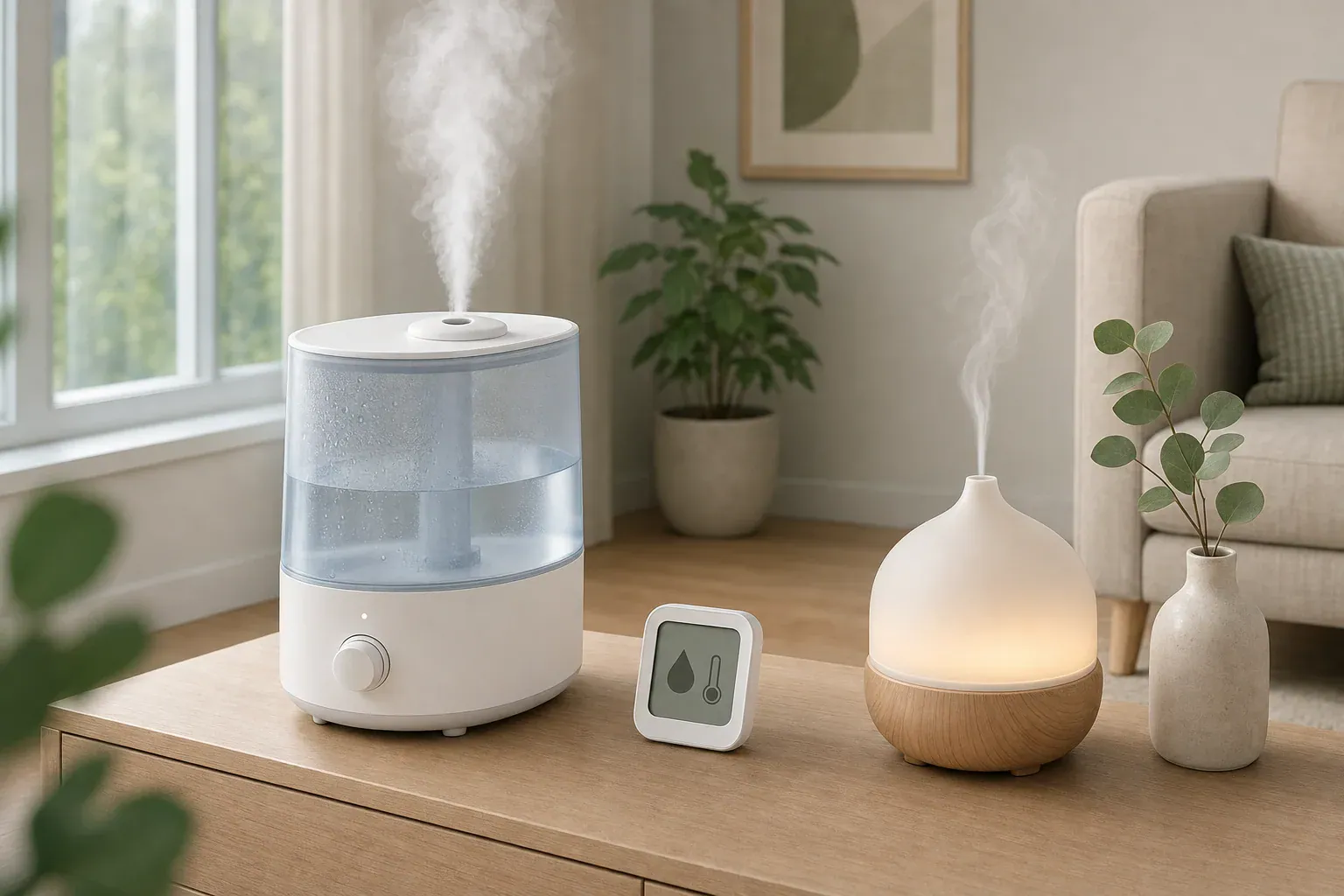
Is a humidifier the same as a diffuser?
No. The intended job is the key difference. A humidifier is made to add moisture to indoor air and help change room relative humidity (RH). A diffuser is made to disperse fragrance, often from essential oils or another approved fragrance material.
Some devices may look similar, especially when both create visible mist. But visible mist alone does not show that a device can meaningfully raise or regulate room humidity. Likewise, a water tank does not mean that oils are allowed in it. Use the product label and manual to determine its intended purpose, approved additives, filling method, and cleaning instructions.
Humidifier vs. diffuser comparison
| Factor | Humidifier | Diffuser |
|---|---|---|
| Primary purpose | Increase moisture in room air | Disperse scent or fragrance |
| Effect on room humidity | Designed for humidification; use a hygrometer to check the actual result | Usually not designed or specified for room-humidity control |
| Water use | Capacity and runtime are model-specific and intended for its humidification design | May use water, or may be waterless depending on the diffuser type |
| Output information | May list humidity controls, moisture output, room coverage, or runtime | Usually describes fragrance operation rather than humidity performance |
| Additives | Use only substances and locations the manual expressly permits | Use only fragrance or oil types specified by the manufacturer |
| Cleaning focus | Fresh water and routine reservoir cleaning are important | Water and fragrance residue must be removed as the manual directs |
| Best way to choose | Choose it when the goal is to manage measured room humidity | Choose it when the goal is scent, not humidity control |
Can a diffuser replace a humidifier?
Usually, no. A water-based diffuser releases some water while it runs, but that does not establish that it can raise or control RH in a room. Unless the manufacturer provides humidification specifications and instructions, do not treat it as a replacement for a humidifier.
Plume size is not a useful measure of whole-room humidification. Room volume, air exchange, temperature, operating time, and the amount of water released can all affect the result. If moisture is the goal, use a hygrometer rather than judging by how the mist looks.
Can essential oils go in a humidifier?
Only if the manual explicitly says they can—and only where it says to put them. Depending on the model, that may be a separate aroma tray, a specially designed reservoir, or nowhere at all. One manufacturer manual may permit oil use for a particular model, but that does not make oils compatible with other humidifiers.
Do not add oils, fragrance, cleaners, or other substances to a humidifier tank just because a different appliance permits them. For more detail on this separate question, see Can You Put Essential Oils in a Humidifier Safely?.
Similar technology does not mean identical performance
Humidifiers can use ultrasonic, evaporative, impeller, steam, or warm-mist designs. Diffusers may be ultrasonic, nebulizing, evaporative, heat-based, passive, or waterless. A shared mechanism in some products does not make their intended use, output, maintenance, or additive compatibility the same.
Fill-water instructions also matter. In a controlled experiment using one ultrasonic humidifier, airborne particle composition reflected minerals in the fill water; lower-mineral water produced fewer and smaller particles under those test conditions. The result does not apply automatically to every appliance or humidifier technology. See the peer-reviewed ultrasonic-humidifier experiment indexed by PubMed, and follow the water instructions for the specific device.
Goal-based decision checklist
- Define the desired effect. Do you want to change room humidity, add scent, or use a documented combination unit?
- Measure RH if moisture is the goal. Use a hygrometer and compare readings over time rather than relying on skin feel or visible mist.
- Read the product’s stated purpose. Look for humidification specifications, fragrance instructions, or an explicit dual-function description.
- Check additive compatibility. Confirm exactly what is allowed and whether it belongs in a tank, separate tray, or another component.
- Identify the technology. Water-based, waterless, heated, ultrasonic, and evaporative devices can have different operating and care instructions.
- Review cleaning requirements before buying. Ensure that tanks, wicks, trays, and fragrance components are accessible and maintainable as directed.
- Verify the outcome. For humidification, monitor RH and nearby surfaces. For fragrance, use the product only as instructed and stop if the scent is not wanted.
Worked hygrometer scenario
Hypothetical assumptions: A bedroom hygrometer reads 28% RH. The desired effect is less-dry room air, and fragrance is not wanted.
In this example, a humidifier intended for the room is the relevant device. Operate it according to its manual, then recheck the hygrometer during use. The EPA advises keeping indoor relative humidity at or below 50% and reducing humidifier output if condensation or dampness appears around the unit or on nearby surfaces. Read the EPA’s guidance for using and caring for home humidifiers.
If the same hypothetical room reads 42% RH and the only desired effect is scent, a compatible diffuser is the more direct choice. Neither example creates a universal RH setting, runtime, or room-size recommendation; conditions and product instructions vary.
Safe operation and cleaning
Before first use
- Read the complete manual, including placement, filling, water, additive, and cleaning directions.
- Confirm whether the appliance is a humidifier, a diffuser, or a documented combination unit.
- Check the tank, cap, seals, cord, and removable parts before filling.
During operation
- For a humidifier, monitor RH and watch for condensation, damp materials, or wet surfaces.
- Stay within the fill line and use only approved substances.
- Follow the device’s placement and clearance directions.
- Disconnect the appliance before filling or cleaning when the manufacturer directs. The CPSC’s portable-humidifier guidance also advises disconnecting portable humidifiers for filling and cleaning.
Routine maintenance
For portable humidifiers, the EPA recommends emptying, drying, and refilling the reservoir daily, and cleaning it every third day, while also following the manufacturer’s directions. Cleaning methods and permitted products can differ by model. See our guide to cleaning a humidifier properly for a practical overview.
Diffusers do not have one universal cleaning schedule. Empty water and clean fragrance residue according to the instructions, especially when changing fragrances or when residue is visible. Do not use a humidifier cleaning method on a diffuser unless its manufacturer permits it.
When a combination unit makes sense
A combination device can be practical if you want both humidification and fragrance, but the documentation should clearly support both functions. Check where fragrance is allowed, whether each function can operate independently, and how you will monitor room humidity.
Marketing words such as “mist” and “aroma” are not enough on their own. Base the decision on the stated purpose, approved additives, operating controls, and maintenance requirements.
Related guides: Best Indoor Humidity Level to Prevent Mold • Humidifier Output Calculator: mL/hour Needed for Your Room • Essential Oil Diffusers and Indoor Air Quality
Frequently asked questions
Do waterless diffusers add humidity to a room?
Waterless diffusers do not use a water reservoir, so they are not humidification devices. Choose one for fragrance unless its documentation describes a separate humidity function.
How can I tell whether a device is changing room humidity?
Use a hygrometer to compare RH readings during operation instead of judging by visible mist. A humidifier may also provide moisture-output, room-coverage, or humidistat information; a diffuser usually will not provide humidity-control specifications.
What should I check before buying a humidifier-diffuser combination unit?
Confirm that the manual documents both humidification and fragrance functions. Check where fragrance is allowed, whether the functions can operate independently, and how the device is cleaned and room humidity is monitored.
Bottom line
Choose a humidifier to manage room moisture and a diffuser to disperse scent. Treat them as interchangeable only when the specific product documentation supports both uses. For humidification, verify the result with a hygrometer and avoid excess moisture; for either device, follow the manual for filling, additives, operation, and cleaning.
Recommended next:
- HEPA vs Activated Carbon: Best Setup for Allergies, Odors, and Smoke
- Air Purifier vs Dehumidifier: Which One Solves Musty Air?
- Humidifier vs Dehumidifier: When to Add Moisture vs Remove It
- Air Purifier vs Ozone Generator: Safety, Effectiveness, and Myths
- HEPA vs Carbon Filters: When Each One Matters Most
- Air Purifier vs Ventilation: Which Fixes Stuffy Bedrooms Better?
- Clear sizing logic (room size → CADR/ACH)
- HEPA vs carbon explained for real use-cases
- Humidity + ventilation basics to reduce mold risk