ULPA vs HEPA filters: what matters in a home air cleaner
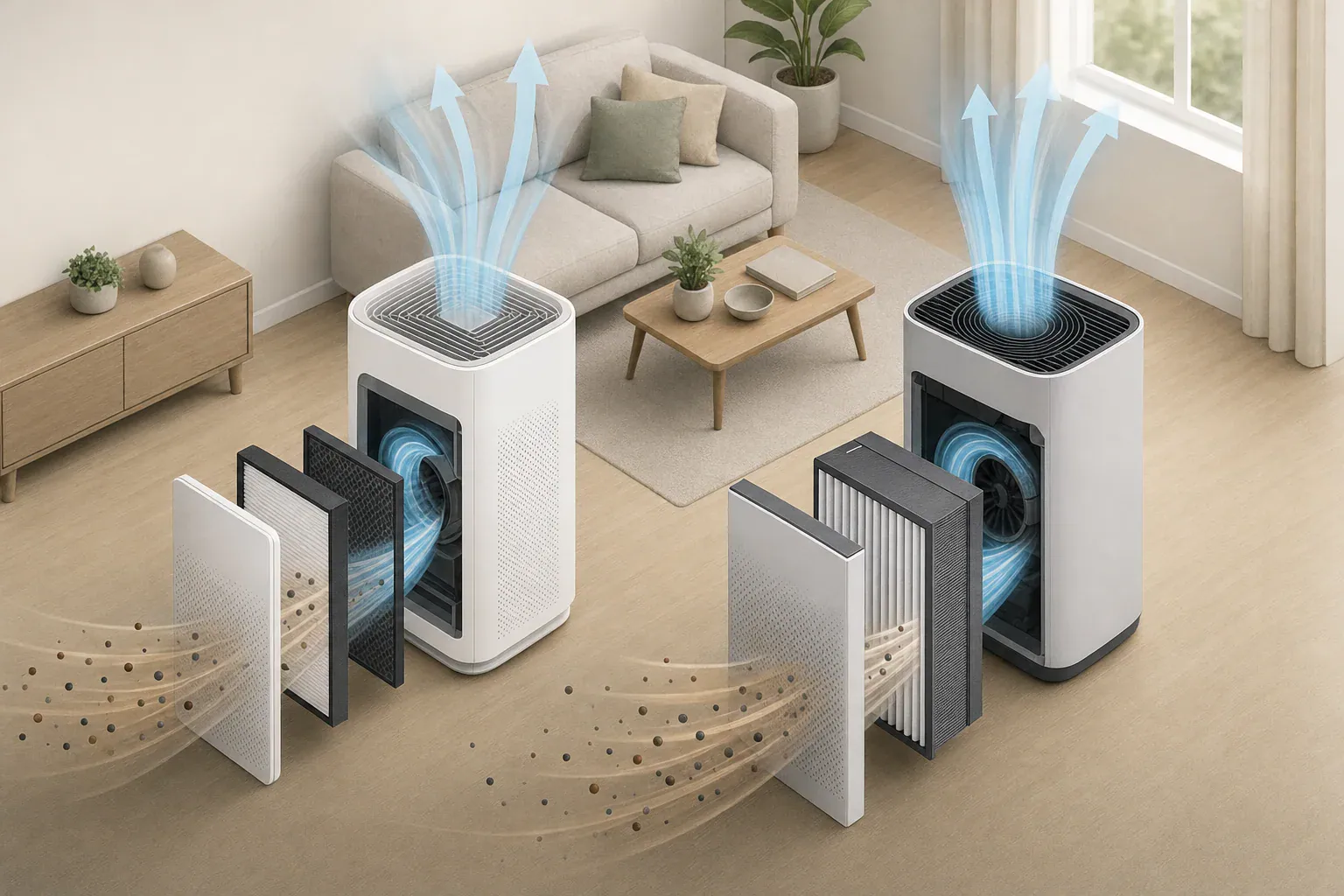
Higher filter-media efficiency does not automatically mean faster particle removal in a room. A portable air cleaner must move enough air through its filter, keep air from bypassing the filter, and operate at a speed you can reasonably use. For most home comparisons, the more useful starting point is the cleaner’s smoke CADR, not the media label alone.
CADR, or clean air delivery rate, reflects the performance of the assembled air cleaner. The U.S. Environmental Protection Agency (EPA) advises choosing a cleaner with sufficient CADR for the room and notes that higher fan speeds can filter more air but may increase noise. See the EPA’s Guide to Air Cleaners in the Home.
What HEPA and ULPA ratings do—and do not—tell you
HEPA and ULPA are classifications for filter performance under defined test conditions. They are not universal product descriptions, and a percentage stated under one classification is not automatically a direct comparison with a percentage from another test method.
For example, a U.S. Department of Energy technical handbook summarizes IEST Type A as at least 99.97% efficient at 0.3 micrometers and IEST Type F as at least 99.999% efficient at 0.1–0.2 micrometers. Those are examples of specific classifications and test conditions—not proof that every product marketed as HEPA or ULPA meets those classifications. The quoted particle sizes are test conditions, not hard cutoffs below which a filter captures nothing.
| Comparison point | HEPA example | ULPA example | What it means at home |
|---|---|---|---|
| Media-efficiency classification | IEST Type A: at least 99.97% at 0.3 µm | IEST Type F: at least 99.999% at 0.1–0.2 µm | These are different classifications and test conditions. Confirm the exact standard behind a product’s claim. |
| Whole-cleaner performance | Depends on airflow, media resistance, fan capability, filter fit, housing leakage, and selected speed. | Compare smoke CADR for fine-particle cleaning, rather than treating a media percentage as an appliance result. | |
| Resistance trade-off | Varies with media, filter area, depth, and construction. | Can be higher in a comparable design. | No universal residential pressure-drop difference can be assumed. A manufacturer’s fan-filter-unit data show this trade-off for its particular filter series, not for all home cleaners. |
| Best buying question | Can the complete unit deliver enough clean air at an acceptable noise level with available replacement filters? | The label is secondary to documented appliance performance. | |
Sources: DOE filtration handbook chapter for the IEST examples; ENERGY STAR room air cleaner specification for CADR as a complete-system measure; and Terra Universal engineering data for a product-specific resistance comparison.
Why smoke CADR is usually the better home comparison
For particles such as fine smoke, compare the smoke CADR. A higher CADR means the cleaner delivers more particle-cleaning capacity under the rating method. Dust and pollen CADR can also be useful, but smoke CADR is the relevant listed metric when fine-particle removal is the goal.
CADR is not simply fan airflow and is not simply filter efficiency. ENERGY STAR describes it as a complete-system performance measure and notes that it does not have a linear relationship with air movement or a removal technology alone. That is why a cleaner with a less extreme media claim can be the more useful home appliance if it provides higher verified smoke CADR at a setting you will run.
Room-size claims also need context. EPA’s portable-cleaner sizing guidance uses an 8-foot ceiling assumption. A room with a higher ceiling contains more air than the same floor area at 8 feet. For a room-specific estimate, use a CADR calculator that accounts for ceiling height.
Check the speed behind the CADR number
The AHAM portable air-cleaner testing FAQ says CADR testing is performed at the highest speed because product speed labels are not uniform. A published maximum CADR may therefore not represent performance in a quiet or overnight mode.
When manufacturers publish multiple settings, compare CADR or airflow and sound level from the same setting. Do not pair maximum-speed CADR with a lowest-speed noise figure and assume both apply at once. If matched specifications are absent, the trade-off at your preferred setting is unknown.
How a higher-efficiency filter can lose its practical advantage
Airflow and fan capability
More restrictive media can require a fan and filter area designed to maintain useful airflow. Filter resistance is affected by many design variables, including material, area, pleat geometry, depth, and loading over time. The available evidence does not support one universal ULPA-versus-HEPA pressure-drop, noise, or airflow penalty for residential cleaners.
A denser unofficial replacement filter is not automatically an upgrade. It may alter resistance or fit in ways the appliance was not designed for. Use the filter model specified in the manual unless the manufacturer documents compatibility and whole-unit performance with the alternative.
Sealing and bypass
Air that passes around the filter does not receive the filter medium’s stated treatment. Follow the manual’s orientation and fit instructions, and make sure the access panel closes fully. A damaged gasket, loose frame, or incorrect replacement can undermine the benefit of a highly efficient medium. For a closer look at this issue, see why air-cleaner filter bypass matters.
Noise, runtime, and replacements
A high rating has limited value if the required speed is too loud to use for long periods. Compare the sound specification at the same operating speed as the performance figure. EPA also notes that filters require regular replacement; follow the manufacturer’s stated replacement criterion rather than applying a universal schedule.
Before purchase, identify the exact filter part number, current availability, replacement instructions, and whether the cleaner has a filter-change indicator. Costs and service life are model-specific, so neither a HEPA nor ULPA label alone predicts ongoing expense.
Portable air-cleaner specification checklist
- Smoke CADR: Look for a complete-unit smoke CADR for fine-particle use.
- Test context: Check whether the CADR comes from AHAM verification or another clearly identified method.
- Operating speed: Find out which speed the CADR represents and whether the maker publishes performance at lower settings.
- Matched noise data: Compare sound level and CADR or airflow at the same speed.
- Room assumptions: Check the stated room size, ceiling-height assumption, and intended use.
- Filter claim: Look for the exact standard and classification behind “HEPA” or “ULPA.”
- Fit and sealing: Review the specified filter frame, gasket, orientation, and panel-closing instructions.
- Replacement plan: Confirm the exact replacement filter, availability, and manufacturer’s replacement criterion.
- Energy use: Compare rated power or an efficiency metric where available; do not infer energy use from filter class alone.
- Gases and odors: Neither particle-filter label establishes gas or odor removal. Look for separately specified sorbent media if gases or odors are part of the goal.
When ULPA is worth considering
An ULPA portable cleaner can be a reasonable choice when the manufacturer also provides credible whole-unit performance information and the unit supplies sufficient smoke CADR at an acceptable noise level. Its value comes from the complete appliance, not from the ULPA label in isolation.
A HEPA cleaner can be the better home choice when it has equal or higher verified smoke CADR at the setting you will actually use, fits the room, seals properly, and has practical replacement support. Available residential evidence does not establish that an ULPA label alone produces better health outcomes than a properly selected HEPA portable cleaner.
Bottom line
For a portable home air cleaner, compare smoke CADR first, then the test speed, noise, room assumptions, filter fit, and replacement plan. Higher-efficiency ULPA media matters only when the finished appliance still delivers more useful clean-air performance for your room.
Frequently asked questions
Is ULPA always better than HEPA for a portable home air cleaner?
No. ULPA media can have lower particle penetration under its specified test, but a portable cleaner’s practical result depends on complete-unit smoke CADR, airflow, sealing, noise, and the speed used. A HEPA unit with equal or higher verified smoke CADR can be the better choice.
Should I compare maximum CADR with the lowest noise rating?
No. AHAM says portable-cleaner CADR testing is performed at the highest speed. Compare performance and sound figures from the same setting. If the manufacturer does not provide matched figures, the quiet-setting performance trade-off is not known.
Can I improve a HEPA cleaner by installing a denser ULPA-style filter?
Not necessarily. A different filter may change airflow resistance or fit, and poor fit can allow air to bypass the medium. Use the specified replacement unless the appliance manufacturer documents compatibility and complete-unit performance with the alternative.
Does a HEPA rating at 0.3 micrometers mean it cannot capture smaller particles?
No. The stated particle size is a rating test condition, not a lower capture cutoff. HEPA and ULPA percentages from different classifications and test conditions should not be treated as a direct test of how quickly two complete air cleaners clean a room.
Recommended next:
- HEPA vs Activated Carbon: Best Setup for Allergies, Odors, and Smoke
- Air Purifier vs Dehumidifier: Which One Solves Musty Air?
- Humidifier vs Dehumidifier: When to Add Moisture vs Remove It
- Air Purifier vs Ozone Generator: Safety, Effectiveness, and Myths
- HEPA vs Carbon Filters: When Each One Matters Most
- Air Purifier vs Ventilation: Which Fixes Stuffy Bedrooms Better?
- Clear sizing logic (room size → CADR/ACH)
- HEPA vs carbon explained for real use-cases
- Humidity + ventilation basics to reduce mold risk