
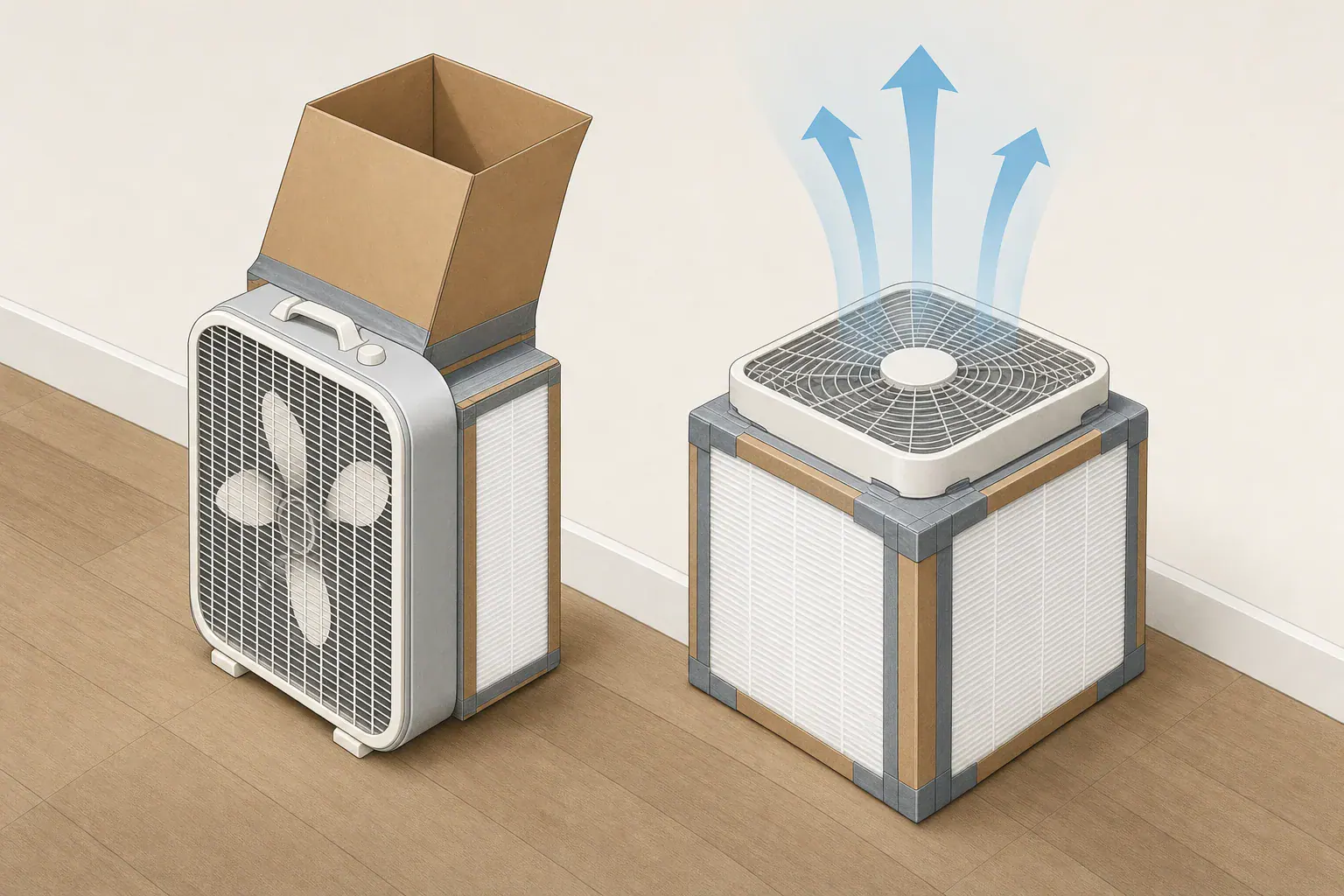
Corsi-Rosenthal box vs. box fan filter: the short decision
A single-filter box-fan cleaner is the simpler option: it uses one filter, has fewer seams to seal, and is usually less bulky to store or move. A four- or five-filter Corsi-Rosenthal box uses more materials and occupies more floor area, but it presents more filter surface to the incoming air.
The U.S. Environmental Protection Agency (EPA) describes the one-filter version as the simplest DIY air cleaner. It says multi-filter designs generally offer better performance, while also being harder to assemble, bulkier, and more difficult to move or re-filter. Those are design-level trade-offs, not a promise of a particular airflow, noise level, room size, or filter life for every fan and filter combination.
| Factor | Single-filter box fan | Four-filter Corsi-Rosenthal box |
|---|---|---|
| Assembly | Fewest parts and joints to seal | More filter-to-filter joints, plus a base and fan attachment |
| Footprint | Usually slimmer; depth includes the fan and filter | With nominal 20-by-20-inch components, the base is roughly 20 by 20 inches before allowing clearance |
| Nominal filter faces | One | Four; some EPA-described configurations use a fifth bottom filter |
| Inlet area and resistance | Less total inlet area | More parallel inlet area generally means less inlet restriction, but completed airflow is configuration-specific |
| Noise | Depends on the fan, speed, filter resistance, shroud, and vibration | Also configuration-specific; it is not automatically quieter |
| Filters at one replacement event | One | Four or five, depending on the build |
| Moving and stability | Usually easier to carry; inspect the filter attachment after moving | Bulkier; stability depends on the base, joints, and workmanship |
Why filter area changes the trade-off
More filter faces provide more nominal inlet area. With nominal 20-by-20-inch filters, the simple face-area comparison is:
- One filter: 20 × 20 = 400 square inches
- Four filters: 4 × 400 = 1,600 square inches
- Five filters: 5 × 400 = 2,000 square inches
These are outer face-area calculations, not measurements of pleated-media area or clean-air delivery. EPA reports that its multi-filter cube configuration had the most filter material and the highest clean air delivery rate among the DIY configurations it evaluated. That finding does not supply a universal rating for a different fan, filter depth, shroud, or build quality. See EPA’s DIY air-cleaner guidance for the configurations and conditions it describes.
Parts checklist
For either design
- A box fan that matches the filter dimensions and has a UL or ETL safety mark
- A filter sized to match the fan; EPA recommends MERV 13 or higher where available
- Cardboard for a discharge-side shroud
- Tape to seal air gaps around the filter and at joints
- A level, stable location with the intake and discharge unobstructed
Additional parts for a multi-filter box
- Four matching side filters
- A sturdy base, or a fifth filter for a bottom-filter configuration
- Enough tape to seal filter-to-filter, filter-to-base, and fan-to-filter joints
EPA’s illustrated instructions use matching 20-by-20-inch components and filters 1 to 4 inches deep. Other dimensions may be workable, but they are outside those specific instructions. A MERV rating is not the same thing as a HEPA designation.
Assembly and airflow direction
For a single-filter build, put the filter on the fan’s intake side and orient the filter’s airflow arrow toward the fan. Seal the perimeter to reduce air bypass, then add a cardboard shroud on the discharge side without interfering with the blades or controls.
For a four-filter box, arrange the filters as the walls of a square with their airflow arrows pointing inward, toward the fan mounted at the top. Seal every vertical joint, secure the walls to the base, then seal the fan-to-filter connection and fit the discharge-side shroud. EPA advises sealing filters to prevent air from bypassing them.
Fan selection and safe operation
EPA specifies a UL- or ETL-marked box fan manufactured in 2012 or later for its DIY cleaner instructions. This is a selection criterion, not a safety guarantee for every fan, homemade attachment, or operating condition. Follow the fan manufacturer’s instructions and do not operate a damaged fan, cord, or plug.
- Place the unit on a level surface where it is unlikely to be knocked over.
- Keep the intended filter inlets and fan discharge clear.
- Make sure cardboard and tape cannot contact moving blades or block controls.
- Unplug the fan before changing filters or repairing seals.
- Inspect the base, attachments, and seams after moving the unit.
Noise, replacement cost, and maintenance
Filter count alone cannot predict noise. Fan model, fan speed, filter resistance, shroud geometry, assembly quality, and vibration can all change what a listener hears. Without matched measurements, neither design should be assumed quieter.
A single-filter build requires one filter at each replacement event; a standard four-filter box requires four. That does not prove annual filter cost is four times higher. EPA notes that cube configurations can perform longer before filters need replacement, while also advising replacement when filters are dirty. Runtime, indoor particle levels, filter selection, and the completed build determine actual service life.
Worked room-volume example: calculate the clean-air need, not DIY fan output
Hypothetical assumptions: Consider a room 12 feet long, 15 feet wide, and 8 feet high. Assume a target of five equivalent air changes per hour and assume the cleaner must supply the entire calculated clean-air amount.
- Room volume: 12 × 15 × 8 = 1,440 cubic feet.
- Clean-air amount: 1,440 × 5 ÷ 60 = 120 cubic feet per minute.
So, under those assumptions, the room would need 120 cfm of clean air. CDC/NIOSH presents five air changes per hour as a workplace-oriented goal, not as a universal residential prescription; see its 5-ACH guidance and calculation. The DIY cleaner’s actual contribution is unknown unless the completed configuration has a credible clean-air delivery measurement. Do not use an uncovered fan’s advertised airflow as the cleaner’s delivered clean airflow, because filters and shrouds change the system.
For the calculation itself, see how ACH converts to clean-air flow.
Bottom line
Choose the single-filter cleaner when speed of assembly, a slimmer profile, easier moving, and one-filter replacement events matter most. Choose a Corsi-Rosenthal box when you can accommodate a larger build and more assembly in exchange for much more nominal filter-face area. In either case, use compatible components, seal bypass gaps, follow the fan instructions, and treat airflow, noise, stability, and filter life as build-specific rather than guaranteed.
Frequently asked questions
Does a Corsi-Rosenthal box cost four times as much to maintain?
At one replacement event, a standard four-filter box uses four filters and a single-filter build uses one. That does not establish a fourfold annual cost, because replacement timing depends on runtime, particle loading, filter choice, and the completed build. EPA notes that cube configurations can perform longer before filters need replacement.
Can I use the box fan’s advertised CFM to size a DIY air cleaner?
No. An uncovered fan’s advertised airflow does not represent airflow after filters, seals, and a shroud are added. Use a credible clean-air delivery measurement for the completed configuration when one is available; otherwise, regard its delivered clean airflow as unknown.
Which direction should the filter arrows face?
For a single-filter setup, the airflow arrow points toward the fan on its intake side. For a four-filter Corsi-Rosenthal box, each side filter’s arrow points inward, toward the fan on top.
Recommended next:
- HEPA vs Activated Carbon: Best Setup for Allergies, Odors, and Smoke
- Air Purifier vs Dehumidifier: Which One Solves Musty Air?
- Humidifier vs Dehumidifier: When to Add Moisture vs Remove It
- Air Purifier vs Ozone Generator: Safety, Effectiveness, and Myths
- HEPA vs Carbon Filters: When Each One Matters Most
- Air Purifier vs Ventilation: Which Fixes Stuffy Bedrooms Better?
- Clear sizing logic (room size → CADR/ACH)
- HEPA vs carbon explained for real use-cases
- Humidity + ventilation basics to reduce mold risk