
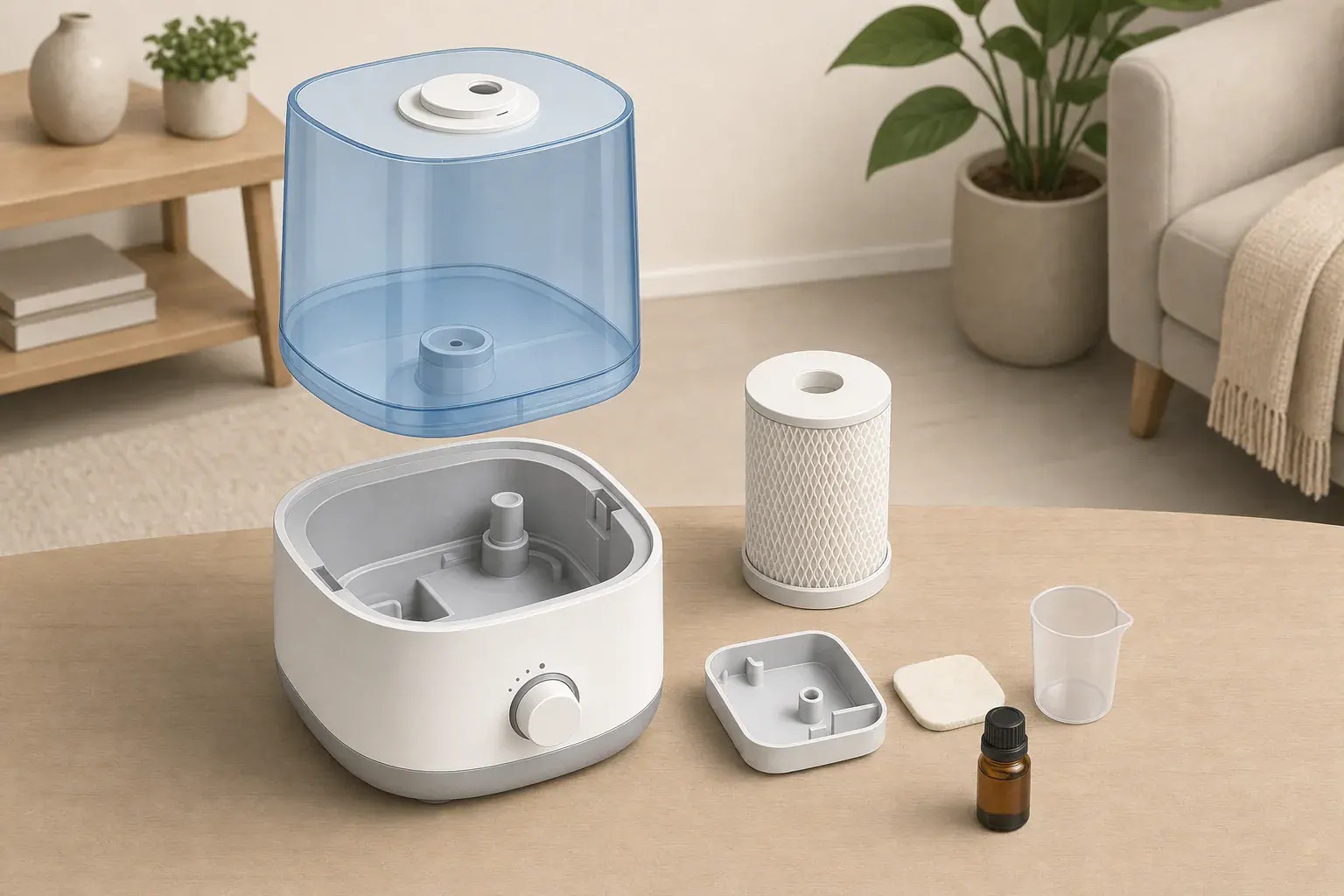
Quick answer: Do not put essential oils in a humidifier’s tank, reservoir, or base unless the manual for that exact model explicitly permits it. Some aroma-equipped humidifiers allow oil only on a separate pad, tray, or medicine cup. If the instructions are unavailable or unclear, use water only and contact the manufacturer.
Can you put essential oils in a humidifier’s water?
Usually, no. Use only the water and additives specified by the manufacturer for your exact humidifier. Do not assume that a small amount of oil, a similar-looking model, or an “aroma” label makes the water tank safe for essential oils.
Some products separate fragrance use from humidifying water with an aroma pad, slide-out tray, or medicine cup. In those designs, oil belongs only in the designated component and only in the amount the manual permits.
This distinction matters because the EPA explains that ultrasonic and impeller humidifiers can disperse materials from their tanks. EPA also advises users to follow manufacturer instructions for operation, cleaning, and maintenance.
Humidifier and diffuser compatibility
| Device design | Oil in the water? | Where oil may go |
|---|---|---|
| Standard humidifier | No, unless the exact manual expressly permits it | Nowhere if the manual documents no oil feature |
| Humidifier with an aroma tray or pad | Usually no; verify the manual | Only on the designated pad or in the separate tray |
| Warm-mist model with a medicine cup | No, unless specifically authorized | Only in the designated cup, using approved products and amounts |
| Essential-oil diffuser | Follow the diffuser manual | Its oil-rated reservoir, pad, or other designated area |
For example, one HoMedics ultrasonic humidifier manual says never to add essential oils to its tank or water reservoir, while allowing oil on a pad in its separate oil tray. A Vicks warm-mist manual likewise keeps oil out of the water while describing use of a separate medicine cup. These are model-specific examples, not universal rules for every humidifier.
Why the humidifier design matters
Evaporative wicks
Evaporative humidifiers move water through a replaceable wick. Manufacturer guidance from AIRCARE warns that oil can become trapped in an evaporative wick and damage it. Whether a wick must be replaced after an accidental exposure depends on the unit and the manufacturer’s instructions.
Plastic parts and seals
Some manufacturers specifically warn that unauthorized oil may harm plastic parts or seals. For example, the Vicks manual warns against putting oils in its water, and AIRCARE documentation warns of possible seal damage in applicable models. These warnings do not prove that every oil damages every plastic, but they are a practical reason not to infer compatibility from a tank’s material or appearance.
Ultrasonic membranes
An ultrasonic humidifier uses a vibrating membrane to create mist. The HoMedics manual cited above instructs users not to touch its membrane because skin oils can damage its surface and links a dirty membrane with reduced mist output. That does not establish a universal essential-oil failure mechanism, but it reinforces the need to keep unauthorized substances out of the water system.
Warm-mist heating systems
A warm-mist humidifier may have a medicine cup near its warm air or steam path. That separate feature is not permission to pour oil into the tank. Follow the manual’s instructions for the cup and keep the humidifying water free of oil unless the manual clearly says otherwise.
Manual-check checklist before using oil
- Match the exact model number. Instructions for a similar unit may cover a different tank, tray, wick, or heating system.
- Search the manual. Look for “essential oil,” “aroma,” “oil pad,” “medicine cup,” “additives,” and “do not add.”
- Identify the permitted location. Confirm whether instructions refer to a tank, base reservoir, separate tray, pad, or cup.
- Check product and quantity limits. Do not substitute a general online dilution ratio or drop count for the manufacturer’s directions.
- Read cleaning and replacement instructions. Check whether a pad, cup, wick, filter, or cartridge is reusable after exposure.
- Review warnings and warranty terms. A compatibility statement may apply only to specified accessories or materials.
- Ask the manufacturer if wording is unclear. Until you receive model-specific guidance, operate the humidifier with water only.
Using an approved aroma feature
Keep the tank water and aroma component separate unless the manual expressly directs otherwise. Put oil only on or in the identified component, do not exceed the stated amount, and clean or replace that component as directed.
An approved aroma tray addresses the equipment’s intended use; it does not establish that airborne exposure is appropriate for every person or animal. The ASPCA advises avoiding diffusers around birds, taking extra care around pets with breathing problems, preventing spills or ingestion, and allowing pets to leave the room.
What to do after accidental use
- Turn off and unplug the humidifier. Do not keep operating it to empty or flush the tank.
- Drain the tank and base. Follow the manual’s handling instructions so liquid does not enter controls or other dry areas.
- Set aside exposed consumable parts. This may include a wick, aroma pad, filter, or cartridge that contacted oily water.
- Use the model’s cleaning procedure. Follow only cleaners, disassembly steps, and methods permitted by the manual. There is no universally validated household method for removing oil from all humidifier materials and internal passages.
- Rinse as instructed. EPA advises thoroughly rinsing portable humidifier surfaces after chemical cleaning so cleaning agents are not dispersed during use.
- Contact the manufacturer about hidden water paths. Ask whether a wick, seal, membrane assembly, or another part requires inspection or replacement.
- Inspect before reuse. Do not operate a unit with visible cracks, leaks, loose seals, persistent residue, reduced output, or an ongoing oil odor until the manufacturer provides model-specific troubleshooting.
If a person or pet may have swallowed a product or had a concerning exposure, use the product label and seek case-specific advice from a poison center or veterinary professional. Poison Control notes that fresh air may help after brief irritation from a small airborne exposure, while suspected exposures warrant professional guidance.
A purpose-built essential-oil diffuser can avoid the compatibility question posed by a humidifier water tank, but it must still be used according to its own instructions. For broader indoor-air and pet considerations, see Essential Oil Diffusers and Indoor Air Quality.
Related guides: How to Clean a Humidifier Properly (And How Often) • Humidifier Water Choices: Tap vs Filtered vs Distilled • Humidifier Safety: Bacteria Risk, Cleaning, and Safe Humidity Limits
Frequently asked questions
Can I add just a few drops of essential oil to a humidifier?
No—not as a workaround when the manual does not authorize oil in the water. The relevant question is whether the exact model permits oil in its tank or reservoir, not the number of drops used.
How do I know whether an aroma tray is separate from the water system?
Check the parts diagram and instructions. If directions say to put oil on a pad or in a separate cup, that does not authorize oil in the tank, base reservoir, or humidifying water.
What if I cannot find my humidifier manual?
Use water only until you can confirm instructions for the exact model number. The manufacturer can clarify whether there is an approved oil location and identify compatible accessories, products, and amounts.
Does an approved aroma tray make essential-oil use appropriate around pets?
No. An aroma tray addresses equipment compatibility, not suitability for every animal. Avoid diffusers around birds, take extra care with pets that have breathing problems, prevent spills and ingestion, and let pets leave the room.
Summary
Treat the tank, base reservoir, aroma tray, medicine cup, wick, and ultrasonic membrane as different parts with different rules. Unless the exact manual authorizes oil in the water, use water only. A separate aroma feature permits oil only in that designated location; resolve unclear instructions with the manufacturer before use.
Recommended next:
- Best Humidity Level for Winter: Comfort vs Health vs Mold Risk
- Ultrasonic vs Evaporative Humidifiers: Pros, Cons, and Which to Buy
- Humidifier White Dust: Causes, Health Concerns, and Fixes
- How to Clean a Humidifier Properly (And How Often)
- Ideal Indoor Humidity in Winter: Comfort vs Mold Risk
- Humidifier Cleaning Routine: How to Prevent Slime and Odors
- Clear sizing logic (room size → CADR/ACH)
- HEPA vs carbon explained for real use-cases
- Humidity + ventilation basics to reduce mold risk