
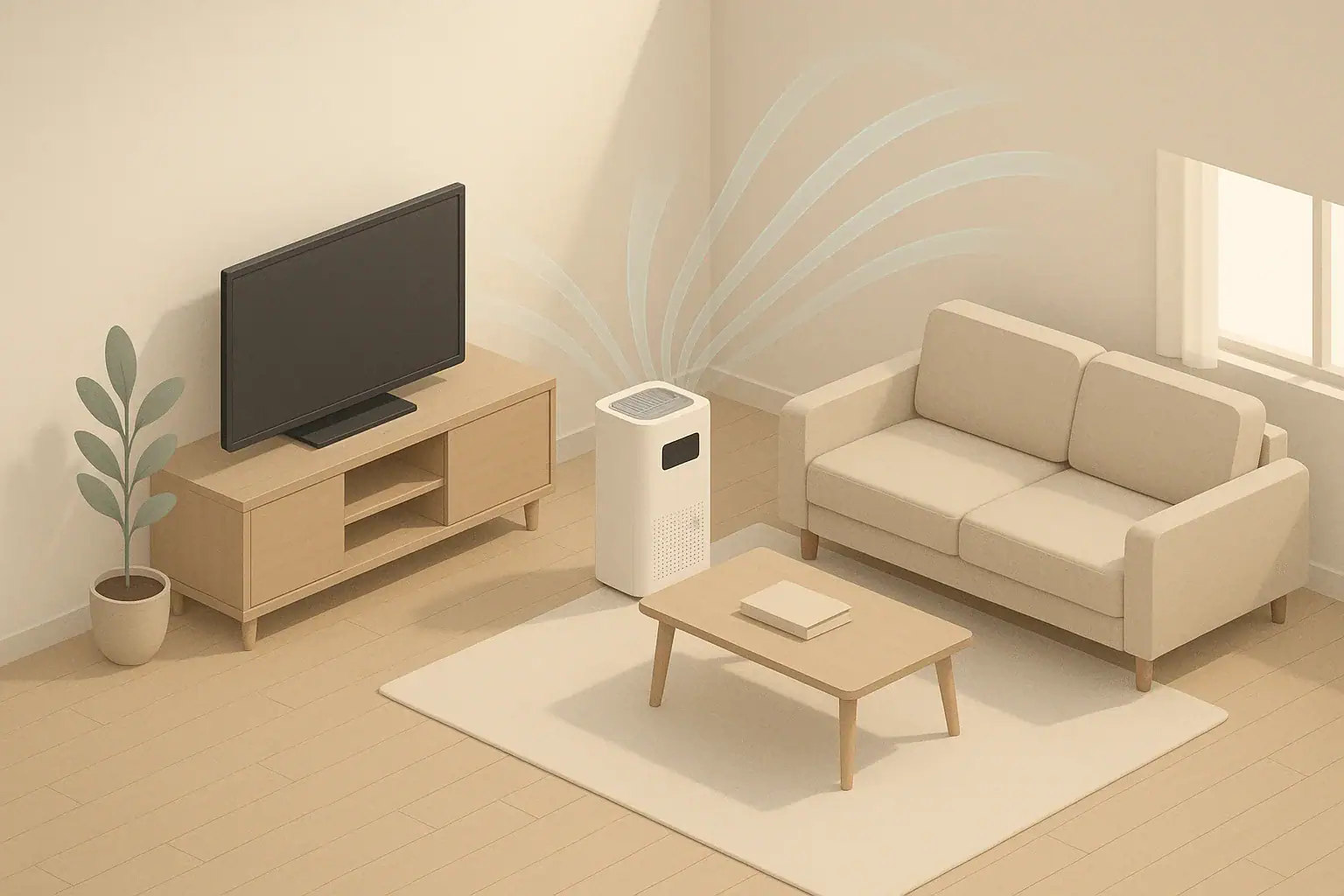
Why Air Purifier Size Matters
Choosing an air purifier that matches your room size is essential for effective air cleaning. A device that is too small may run constantly without ever reducing particle levels enough. One that is oversized can waste energy and money, and may be noisier than you need.
Room size affects how quickly an air purifier can remove particles such as dust, pollen, pet dander, smoke, and fine particulate matter (PM2.5). To get reliable performance, you need to look beyond marketing terms and focus on a few key technical concepts: room area, ceiling height, clean air delivery rate (CADR), and air changes per hour (ACH).
Step 1: Measure Your Room Size
The first step is to understand the volume of air in the space you want to treat.
Calculate Room Area in Square Feet
For most air purifier sizing guidelines, you start with square footage. If your room is a simple rectangle:
- Room area (sq ft) = length (ft) × width (ft)
Example: a bedroom that is 12 feet by 15 feet has an area of 180 square feet.
Account for Irregular Shapes and Openings
Real rooms are often not perfect rectangles. To get a better estimate:
- Break the room into smaller rectangles, calculate each area, then add them together.
- If the room opens widely into another area (for example, a living room that opens to a dining room), treat it as one larger combined space.
- Small doorways that are usually closed (bedroom doors, office doors) can typically be ignored when sizing for a single room.
Consider Ceiling Height
Most air purifier recommendations assume a standard ceiling height, commonly around 8 feet. If your ceilings are higher, the room holds more air, so the purifier needs more capacity.
To include ceiling height, calculate room volume:
- Room volume (cubic feet) = area (sq ft) × ceiling height (ft)
Example: a 180-square-foot room with 9-foot ceilings has a volume of 1,620 cubic feet.
If your ceilings are significantly higher than average (for example, 10–12 feet or vaulted ceilings), you may need to choose a purifier rated for a larger area than your floor space alone would suggest.
Step 2: Understand CADR and ACH
Once you know your room size, the next step is to understand the performance metrics that connect room volume to purifier capacity.
What Is CADR?
CADR stands for Clean Air Delivery Rate. It is a standardized measure of how much clean air an air purifier can deliver in a given time, usually in cubic feet per minute (CFM). Some products list separate CADR values for different pollutants, commonly for:
- Smoke (fine particles)
- Dust
- Pollen
Higher CADR values mean the purifier can filter more air per minute. For room sizing, the smoke or dust CADR is often the most relevant, because it reflects performance on fine particles that stay airborne longer.
What Are Air Changes per Hour (ACH)?
Air Changes per Hour (ACH) describes how many times per hour the purifier can theoretically filter a room’s full air volume. It links CADR to room size:
- ACH = (CADR × 60) ÷ room volume
This formula uses CADR in cubic feet per minute, multiplies by 60 to convert to cubic feet per hour, and divides by room volume.
Recommended ACH Levels
The ideal ACH depends on your air quality needs and how sensitive you are to pollutants:
- 2–3 ACH: Basic air freshness for general use in relatively clean environments.
- 4–5 ACH: Better for people with allergies, urban pollution, or higher dust levels.
- 5–8 ACH: Often recommended for more serious concerns such as asthma, wildfire smoke periods, or high outdoor pollution episodes.
More air changes per hour generally means faster reduction of airborne particles, especially when the purifier runs continuously.
Step 3: Match CADR to Your Room Size
You can approach sizing in two ways: by starting with your room size and desired ACH to find a target CADR, or by using the purifier’s CADR to find the maximum room size it can serve effectively.
From Room Size to CADR Target
First calculate your room volume, then rearrange the ACH formula to solve for CADR:
- CADR = (ACH × room volume) ÷ 60
Example for illustration:
- Room area: 200 sq ft
- Ceiling height: 8 ft
- Room volume: 1,600 cubic ft
- Desired ACH: 5
- CADR = (5 × 1,600) ÷ 60 ≈ 133 CFM
In this example, you would look for a purifier with a smoke or dust CADR around 130 CFM or higher to achieve about 5 air changes per hour.
From CADR to Maximum Room Size
If you already know a purifier’s CADR, you can estimate the largest room volume it can reasonably handle at your desired ACH:
- Room volume = (CADR × 60) ÷ ACH
Example for illustration:
- CADR: 200 CFM
- Desired ACH: 5
- Room volume = (200 × 60) ÷ 5 = 2,400 cubic ft
- With 8-foot ceilings, area ≈ 2,400 ÷ 8 = 300 sq ft
This purifier could provide about 5 air changes per hour in a 300-square-foot room with typical ceiling height.
Why Manufacturer “Maximum Room Size” Can Be Confusing
Many manufacturers list a single maximum room size number. This figure often assumes a relatively low ACH (sometimes around 2 ACH) suitable for general odor control or basic particle reduction.
If you have allergies, asthma, or live in an area with frequent smoke or heavy pollution, that listed maximum room size may be too optimistic. Using the CADR and ACH relationship gives you a clearer understanding of real performance in your specific room.
Step 4: Consider Room Type and Layout
Two rooms with the same floor area may need different purifier capacities, depending on use and layout.
Small Bedrooms and Home Offices
Smaller rooms (often under about 200 square feet) are common places to use air purifiers, especially for sleeping and working. For these spaces:
- Prioritize quieter units, since the purifier may run near your bed or desk.
- Aim for at least 4 ACH, and higher if you have allergies or asthma.
- Check that the purifier’s footprint fits comfortably without blocking walkways.
Medium-Sized Living Areas
Living rooms and larger bedrooms may fall in the 200–400 square foot range. For these rooms:
- Check CADR carefully; medium rooms often require a noticeable step up in capacity.
- Think about where people spend most of their time (seating areas, reading corners) and place the purifier where airflow will reach them.
- Consider the noise level at higher fan speeds, since a higher CADR usually means a more powerful fan.
Large Rooms and Open-Plan Spaces
Large or open-plan spaces can be challenging. Air can move between zones, and the actual volume may be hard to define. Options include:
- Using multiple smaller purifiers in different zones (for example, one near the seating area and another near a workspace).
- Choosing one higher-capacity purifier rated for the full combined area, positioned centrally with clear airflow paths.
- Focusing on the areas where occupants spend the most time rather than trying to purify every corner equally.
For open-plan layouts, it is often more realistic to aim for strong purification in the primary seating or sleeping zones and accept some variation in air quality further away from the unit.
Step 5: Adjust for Ceiling Height and Room Obstacles
Even with correct floor area, two rooms can behave very differently depending on vertical volume and obstruction.
High and Vaulted Ceilings
In rooms with high or vaulted ceilings, the total air volume is significantly larger. Since ACH is based on volume, the same purifier will provide fewer air changes per hour than in a room with standard-height ceilings.
To compensate:
- Use the room volume in your calculations rather than floor area alone.
- Consider moving up to a purifier with higher CADR, or using more than one unit.
- If safe and appropriate for your home, ceiling fans or gentle air circulation can help mix the air so the purifier treats the entire volume more evenly.
Furniture, Walls, and Airflow Paths
Air purifiers work best when air can move freely to and from the intake and outlet. Large furniture, room dividers, and alcoves can reduce effective coverage.
For better performance:
- Place the purifier away from corners when possible, while still keeping it out of the way of foot traffic.
- Avoid pushing the unit directly against walls or furniture that block the intake or exhaust.
- Leave several inches of free space around the purifier, or follow the clearance guidance in the product manual.
Step 6: Balance Capacity with Noise and Energy Use
Matching a purifier to your room size is not only about cleaning power. Noise and energy consumption also increase with fan speed and capacity.
Noise at Realistic Operating Speeds
Most purifiers have multiple fan settings. The maximum speed often delivers the published CADR, but you may not want to run on maximum all the time, especially in bedrooms or quiet offices.
When comparing models:
- Check how loud the purifier is at medium or typical use speeds, not just at the quietest or highest setting.
- Consider choosing a slightly oversized purifier for the room so it can achieve your target ACH at a lower, quieter fan speed.
- Look for features such as a sleep mode or automatic dimming if you plan to use it in a bedroom.
Energy Consumption vs. Runtime
Air purifiers are often most effective when run continuously or for long periods, especially in areas with persistent pollution sources. Because of this, even moderate differences in power draw can add up over time.
To manage energy use while still matching your room size:
- Start with a purifier sized to achieve your desired ACH on a mid-level fan setting.
- Use auto or sensor modes, where available and reliable, to reduce speed when pollution levels are lower.
- Experiment with running the purifier at higher speeds when the room is unoccupied, then dropping to lower speeds when you are present.
Step 7: Factor in Pollutant Sources and Sensitivities
Two identical rooms may require different purifier sizes depending on how much pollution enters or is generated inside.
Indoor Sources that Increase Demand
Consider upsizing your purifier or targeting higher ACH if the room has:
- Frequent cooking nearby, especially frying or high-heat methods.
- Indoor smoking or frequent incense or candle use.
- Multiple shedding pets or litter boxes.
- High outdoor pollution entering through open windows or leaky building envelopes.
- Activities generating dust or fine particles, such as hobbies involving sanding or textiles.
Health Conditions and Comfort Levels
People with respiratory conditions or heightened sensitivities may need more intensive filtration even in relatively clean environments. In these cases, you might:
- Choose a purifier that can provide higher ACH than general-use recommendations.
- Use additional units in sleeping areas where you spend the most continuous time.
- Combine air purification with other measures, such as source control and improved ventilation, rather than relying on a purifier alone.
Practical Room Size Examples
The following illustrative examples show how room size and ACH interact. These are general scenarios, not product-specific recommendations.
Example 1: Small Bedroom
- Area: 120 sq ft
- Ceiling height: 8 ft
- Volume: 960 cubic ft
- Target ACH: 5 (for allergy support)
- Required CADR ≈ (5 × 960) ÷ 60 = 80 CFM
A modest-capacity purifier with a CADR around 80 CFM can be sufficient here, and may run quietly on lower speeds.
Example 2: Medium Living Room
- Area: 250 sq ft
- Ceiling height: 9 ft
- Volume: 2,250 cubic ft
- Target ACH: 4
- Required CADR ≈ (4 × 2,250) ÷ 60 = 150 CFM
Because of higher ceilings and volume, this room needs a higher CADR than a same-area room with standard ceilings. If the living room is connected to a dining area, the effective volume may be larger, increasing the CADR needed.
Example 3: Large Open-Plan Area
- Area: 500 sq ft (combined kitchen, dining, and living space)
- Ceiling height: 9 ft
- Volume: 4,500 cubic ft
- Target ACH: 5 (due to cooking and smoke from outdoors)
- Required CADR ≈ (5 × 4,500) ÷ 60 = 375 CFM
In this scenario, a single very high-capacity purifier or two smaller units placed in different zones may be more practical. Multiple units also help distribute airflow more evenly in larger or L-shaped spaces.
Key Takeaways for Matching Air Purifiers to Room Size
Choosing the right air purifier for your room size is mainly about matching three elements: room volume, desired air changes per hour, and the purifier’s clean air delivery rate. By measuring your room, understanding CADR and ACH, and considering layout, ceiling height, and pollutant sources, you can select a purifier that works efficiently and quietly for your specific space.
Once you have a good size match, proper placement, filter maintenance, and consistent operation will help you get the most from your air purifier over the long term.
Frequently asked questions
How do I calculate the right CADR for my room size?
Calculate room volume by multiplying floor area by ceiling height, choose a target ACH based on your needs, then use CADR = (ACH × room volume) ÷ 60 to find the required clean air delivery rate. This ensures the purifier’s reported CADR matches the air changes per hour you want in that specific room.
What ACH should I choose if I have allergies or asthma?
For general allergy support aim for about 4–5 ACH, and for asthma, wildfire smoke, or high pollution episodes consider 5–8 ACH. Lower values (2–3 ACH) are usually only sufficient for basic freshness or light odor control.
Can one purifier handle an open-plan space or should I use multiple units?
For large or open-plan areas you can either use a single high-capacity purifier rated for the combined volume or place multiple smaller purifiers in the main zones where people spend time. Multiple units often provide more even airflow and better coverage around furniture and room dividers.
How do ceiling height and furniture affect the purifier I need for my room size?
Ceiling height increases room volume, so always use volume (area × height) when calculating CADR; taller or vaulted ceilings require more capacity than floor area alone suggests. Large furniture, walls, and alcoves can reduce effective coverage, so place units with clear intake and exhaust paths or add capacity to compensate.
How can I balance noise and energy use while meeting my room-size requirements?
Choose a purifier with a CADR high enough to reach your desired ACH at mid or low fan speeds to keep noise and energy use down, and use automatic or sensor modes to reduce runtime when air quality is good. Running a slightly oversized unit at lower speed often gives better comfort and lower energy use than running a smaller unit at maximum.
Recommended next:
- Clear sizing logic (room size → CADR/ACH)
- HEPA vs carbon explained for real use-cases
- Humidity + ventilation basics to reduce mold risk




About this site
Home Air Quality Lab publishes practical, independent guides about indoor air quality—clear sizing, safer use, and real-world expectations.
Affiliate disclosure
Some links on this site may be affiliate links. If you buy through these links, we may earn a small commission at no extra cost to you. This helps support our content. Learn more.