
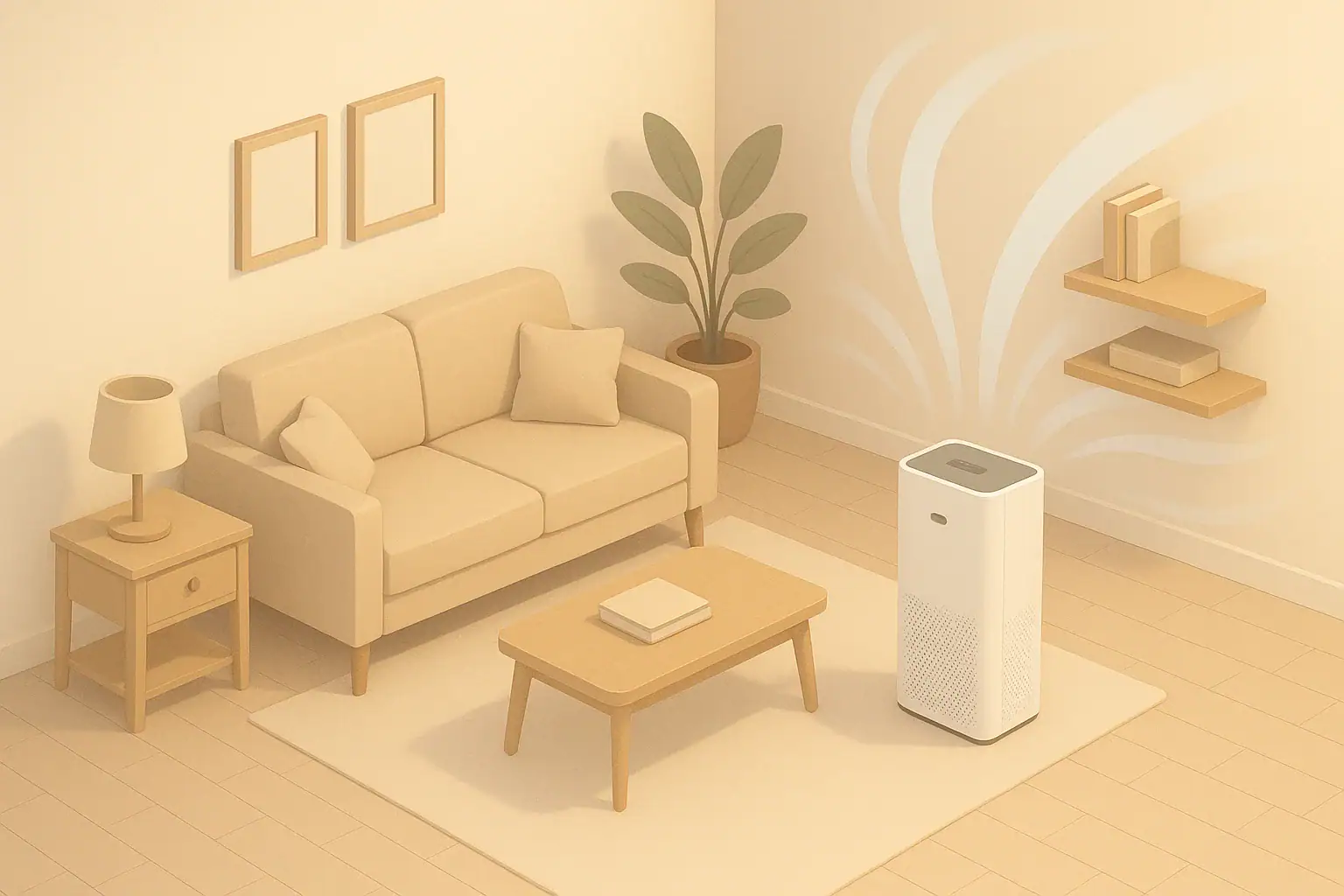
Why Wildfire Smoke Needs Special Attention Indoors
Wildfire smoke behaves differently from regular household dust. It carries a mix of very fine particles and gases that can travel long distances and seep into homes, even when fires are far away. During smoke events, outdoor air can be much worse than usual, so indoor air often becomes the main refuge.
Air purifiers can help reduce the amount of smoke particles and some odors indoors, but not every device is equally effective. Marketing terms can be confusing, and some features matter much more than others when the air outside is visibly hazy. Understanding the key specifications makes it easier to choose a practical, cost-aware solution for your home.
This guide focuses on what to look for in air purifiers specifically for wildfire smoke, how to size them for your rooms, and how to use them alongside other strategies like closing gaps and managing ventilation.
The Two Most Important Specs: HEPA Filtration and CADR
For wildfire smoke, two specifications stand out above the rest: the type of particle filter and the Clean Air Delivery Rate (CADR). These determine how well and how quickly a purifier can reduce smoke particles in a room.
HEPA or Equivalent Fine Particle Filtration
Wildfire smoke is dominated by very small particles, often in the PM2.5 range (particles with a diameter of 2.5 micrometers or smaller). These are much smaller than typical visible dust. To capture them effectively, you want a high-efficiency particle filter.
Key concepts:
- HEPA or “true HEPA” filters are designed to capture a high percentage of tiny particles, including smoke, pollen, and fine dust.
- H13 and H14 HEPA are higher-efficiency classes often discussed in technical specs; in practice, any genuinely high-efficiency HEPA filter is generally suitable for wildfire smoke in homes.
- Filter integrity matters: even a good filter will underperform if air leaks around it. Look for designs that emphasize a good seal to reduce bypass around the filter media.
Be cautious with vague language. Terms like “HEPA-type” or “HEPA-like” may indicate lower performance than true HEPA. For wildfire smoke, prioritize devices that clearly state they use a high-efficiency particle filter and emphasize sealed filter frames or gaskets.
CADR: How Fast the Purifier Can Clean the Air
CADR (Clean Air Delivery Rate) is a lab-tested measure of how much clean air an air purifier can deliver per minute. It is usually given for smoke, dust, and pollen. For wildfire smoke, the smoke CADR is the most relevant.
In simple terms, CADR combines filtration efficiency and airflow into one number. A high-efficiency filter with very low airflow may not clean a room fast enough, especially when outdoor smoke levels are high. A higher smoke CADR means the purifier can reduce indoor smoke levels more quickly and keep them lower over time.
When comparing units:
- Focus on the smoke CADR number (often in cubic feet per minute).
- Match CADR to room size; a small purifier with a low CADR will struggle in a large open-plan space.
- Expect to run the purifier on a higher fan speed during heavy smoke days for better performance.
In real homes, doors, open hallways, and leaks around windows all affect performance. CADR is not a guarantee, but it is one of the best standardized specs available for comparing particle-cleaning power.
Example values for illustration.
| Feature | What It Targets | Why It Matters for Smoke | Typical Use Case |
|---|---|---|---|
| True HEPA filter | Fine particles (PM2.5, dust, smoke) | Core defense against wildfire smoke particles | Main filter for most rooms |
| H13/H14 HEPA | Very high fraction of ultrafine particles | More margin for very small particles | Priority rooms or sensitive users |
| Basic pre-filter | Hair, lint, larger dust | Protects HEPA from clogging quickly | All purifiers, easy to clean |
| Activated carbon filter | Some gases, smoke odors | Helps reduce smell, not particles | When odor is a significant concern |
| Thicker carbon bed | Greater odor and gas capacity | May last longer before saturation | Areas with frequent smoke seasons |
| Good filter sealing | Leakage and bypass | Ensures air passes through filter media | Any room where performance is critical |
Filter Types for Wildfire Smoke: Particles vs Odors
Wildfire smoke contains both solid particles and gases. No single filter handles everything perfectly, so most purifiers use at least two stages: one for particles and one for gases or odors. Knowing what each stage does helps set realistic expectations.
Particle Filters: HEPA and Pre-Filters
The particle filter is the main line of defense against visible haze and measured PM2.5 indoors.
- HEPA filter: captures a very high percentage of small particles. This is the most important filter for wildfire smoke.
- Pre-filter: usually a coarse mesh that catches hair, lint, and large dust before air reaches the HEPA filter. Many pre-filters are washable or vacuumable.
During extended smoke events, HEPA filters may load faster than usual. Increased resistance can reduce airflow and effectiveness over time, which is why regular checks and timely replacement are important.
Gas and Odor Filters: Activated Carbon
Even when particle levels are reduced, smoke smell can linger. Odors are primarily due to volatile organic compounds (VOCs) and other gases. HEPA filters do not capture these; that is the role of activated carbon or other sorbent media.
Consider the following when evaluating carbon filters:
- Carbon quantity: a thin, lightweight layer has limited capacity and may saturate quickly during heavy smoke days.
- Exposure history: once carbon is saturated, it becomes less effective at removing odors and gases, even if the HEPA filter is still working.
- Expectations: carbon can reduce many odors but may not eliminate all smoke smell, especially when outdoor levels are very high or when the home has significant air leaks.
Other gas-phase technologies exist, but for most home users, a purifier with a decent amount of activated carbon is a practical starting point for odor reduction during wildfire season.
What Air Purifiers Do Not Do
It is important to recognize limits. Air purifiers:
- Do not supply fresh outdoor air; they clean the air already inside the room.
- Do not remove all gases or all VOCs; even thick carbon filters have finite capacity.
- Do not seal leaks in windows, doors, or building envelopes.
They are most effective when combined with basic building-tightening steps and sensible ventilation choices during smoke events.
Room Size, CADR, and Air Changes per Hour (ACH)
Even an excellent filter cannot compensate for a purifier that is undersized for the room. Matching CADR to room size is essential, especially when outdoor smoke is severe and you want to keep indoor levels more stable.
Estimating Room Size Needs
To estimate whether a purifier is sized appropriately, you can consider both CADR and air changes per hour (ACH). ACH is how many times per hour the purifier can theoretically clean the full volume of air in the room.
Basic steps to think about sizing:
- Measure or estimate the room’s floor area (length × width).
- Multiply by a typical ceiling height (for example, 8–9 feet) to get an approximate room volume.
- Use a target ACH range. For wildfire smoke, many people aim for higher ACH than they would for regular dust control, often in the single digits up to around 8–10 ACH as a planning idea.
- Relate CADR to the ACH you are trying to achieve, recognizing that real-world conditions (doors, leaks, furniture) will reduce ideal performance.
Online calculators and simple rules of thumb can help, but the general pattern is clear: larger rooms and open-plan spaces need higher CADR or multiple units to approximate the same level of control you get in a small bedroom.
Open-Plan vs Closed Rooms
In an open-plan home, air moves between areas more freely. This can be helpful for mixing, but it also means one purifier must handle more volume than its CADR might suggest if you are thinking in terms of a single closed room.
Some practical strategies include:
- Using a dedicated unit in bedrooms where people spend many hours sleeping.
- Placing a larger unit in the main living space rather than relying on a small device to treat multiple connected rooms.
- Closing doors during the worst smoke periods to create smaller, easier-to-manage zones.
Placement, Airflow, and Using Purifiers with Ventilation
Even with good specs, poor placement can limit how well a purifier handles wildfire smoke. Airflow paths, obstacles, and ventilation all influence performance.
Where to Place an Air Purifier for Smoke
General placement tips include:
- Off the wall a bit: leave space around air inlets and outlets so air can circulate freely.
- Away from tight corners: corners can trap airflow and reduce effective mixing with the room air.
- Near main breathing zones: for bedrooms, near the bed; for living areas, where people sit or spend extended time.
- Clear of major obstructions: avoid placing directly behind sofas, heavy curtains, or large furniture.
It is usually not necessary to place a purifier in the center of a room; a practical spot along a wall with reasonable clearance often works fine.
Balancing Purifiers with Windows and Ventilation
Ventilation brings in outdoor air, which is usually positive for indoor air quality. But during intense wildfire smoke events, outdoor air can be significantly worse than indoor air.
Consider the following approaches:
- During heavy smoke peaks: many people keep windows and doors closed as much as practical and rely on air purifiers to clean the indoor air volume.
- When outdoor air improves: opening windows strategically can help flush out accumulated indoor pollutants, then close again if conditions worsen.
- Central HVAC systems: using higher-efficiency filters (within the limits of your system) and setting the fan to “on” or recirculate can help distribute cleaner air when combined with room purifiers. Do not modify HVAC systems beyond manufacturer or professional guidance.
Each home is different, and there is a balance between controlling smoke infiltration and avoiding stuffy indoor conditions. Simple changes, like closing obvious gaps around windows and doors and using door sweeps, can reduce how much outdoor smoke enters, making purifiers more effective.
Supplementing with Basic Monitoring
Indoor air quality monitors can help show trends during smoke events, such as changes in PM2.5 when you open a window or turn on a purifier. Many basic monitors display approximate PM2.5 levels and sometimes TVOC or CO2. These readings are not medical tools, but they can give you insight into how your home responds to different actions.
Noise, Energy Use, and Maintenance During Smoke Season
An air purifier for wildfire smoke may need to run for long periods, sometimes around the clock. This makes noise, energy use, and filter maintenance especially important.
Fan Speeds, Noise, and Sleep
Higher fan speeds improve smoke removal but increase sound. For bedrooms, people often compromise between comfort and cleaning speed.
- Daytime: higher speeds can quickly reduce indoor smoke, especially when you first close windows or after outdoor peaks.
- Nighttime: many people use a medium or low setting that still turns over the air several times per hour but is quiet enough for sleep.
- Placement for noise: positioning the purifier a bit farther from the bed or seating area, while still in the same room, can soften perceived noise.
Energy Use Considerations
Modern purifiers vary widely in power draw. Key points:
- Higher speeds use more power, but shorter high-speed runs can sometimes be more efficient than long, low-speed runs when trying to quickly reduce a spike in smoke.
- Continuous low to medium operation is common during multi-day smoke events to keep indoor levels more stable.
- Energy cost planning can be done by multiplying approximate wattage by expected hours per day and local electricity rates.
Filter Replacement and Cleaning During Wildfires
Wildfire smoke can load filters faster than everyday use. This affects both performance and operating cost.
- Pre-filters: clean or vacuum them regularly during smoke season to keep airflow up and extend the life of the HEPA filter.
- HEPA filters: expect shorter intervals between replacements when running purifiers heavily during smoke events.
- Carbon filters: odors may return before the HEPA filter is visibly dirty, indicating the carbon is saturated and may need replacement.
Always follow manufacturer instructions for filter changes and cleaning. Avoid washing filters that are not designed to be washed, as this can damage their performance.
Example values for illustration.
| Filter Type | Example Interval Range | What Changes It | Reminder |
|---|---|---|---|
| Washable pre-filter | Every 2–4 weeks in smoke season | Amount of visible dust and pet hair | Rinse or vacuum as directed |
| HEPA filter | About 6–12 months in normal use | Hours of daily operation and smoke intensity | Check more often during extended smoke |
| HEPA filter in heavy smoke | Possibly shorter than 6 months | Multiple severe smoke days or weeks | Watch for airflow drop or indicator lights |
| Thin carbon pad | Every 3–6 months | Continuous odor exposure from smoke | Replace if odor control fades |
| Thicker carbon cartridge | About 6–12 months | Frequency and duration of smoke events | Follow product-specific guidance |
| Combined HEPA + carbon unit | As specified, often 6–12 months | Overall pollutant load and runtime | Plan ahead before fire season |
Safety Features and Technologies to Consider Carefully
When choosing an air purifier for wildfire smoke, it is helpful to distinguish between essential features and add-ons that may not be necessary for most homes.
Ozone and Reactive Technologies
For smoke-specific use, focus on mechanical filtration (HEPA and carbon) and avoid any device whose primary function is generating ozone. Ozone can be an irritant indoors and is not needed to remove wildfire smoke particles.
Some purifiers include ionizers or UV-C lamps. These can be neutral or modestly helpful in some contexts, but for wildfire smoke, the most reliable and broadly accepted tools remain:
- High-efficiency particle filters (HEPA or equivalent)
- Activated carbon or similar media for odors
- A cabinet and fan design that minimize air leakage around filters
If a purifier includes optional ionization or similar features, many users choose to focus on the filtration function and use add-ons only when they clearly understand what they do and how they are controlled.
Build Quality, Seals, and Long-Term Ownership
For households that experience regular wildfire seasons, long-term considerations include:
- Cabinet sealing: look for designs that emphasize tight filter fit to reduce bypass.
- Access for filter changes: easier access encourages regular maintenance.
- Availability of replacement filters: stocking at least one extra set before fire season can prevent shortages during peak demand.
- Noise profile: a smoother sound at higher speeds can make it easier to use powerful settings when needed.
Viewed this way, the “best” air purifier for wildfire smoke is not just one with strong specs, but one that you are willing and able to run, maintain, and keep supplied with filters throughout multiple seasons.
Frequently asked questions
How many air changes per hour (ACH) should I aim for during wildfire smoke?
For wildfire smoke, many people aim for higher ACH than for routine use — commonly in the range of 4–10 ACH depending on exposure severity and room use. Higher ACH reduces indoor PM2.5 more quickly, but real-world factors like leaks and open doors will lower effective performance compared with ideal calculations.
Do I need an activated carbon filter to remove smoke smell?
Yes, activated carbon or other sorbent media are generally needed to reduce smoke odors and many VOCs; HEPA filters do not capture gases. Keep in mind carbon has finite capacity and thin pads may saturate quickly during heavy smoke, so thicker carbon beds or more frequent replacement improve odor control.
Can my central HVAC system replace room air purifiers during smoke events?
A central HVAC with a high-efficiency filter and recirculation can help distribute cleaner air, but it may not match the CADR of a dedicated room purifier for rapid particle removal. Also, central systems can introduce outdoor air when running ventilation modes, so set them to recirculate when outdoor smoke is worst and follow professional guidance on filter upgrades.
How often should I change filters when running purifiers for wildfire smoke?
Filter change intervals depend on runtime and smoke intensity: pre-filters may need cleaning every 2–4 weeks, HEPA filters often require replacement sooner than normal use (sometimes under 6 months in heavy smoke), and carbon filters can lose odor capacity even earlier. Monitor airflow, odor return, and any filter-change indicators and follow manufacturer guidance.
Are ionizers or ozone-generating devices effective for wildfire smoke?
Devices that generate ozone should be avoided because ozone is a respiratory irritant and is unnecessary for particle removal. Ionizers and other reactive technologies offer mixed or limited benefit for smoke particles compared with mechanical HEPA filtration and do not address gases and odors as reliably as activated carbon.
Recommended next:
- Best Air Purifiers for Allergies: What to Look For (CADR, HEPA, Carbon)
- How to Choose the Right Air Purifier for Your Room Size
- Air Purifier Placement: Where to Put It for Best Results
- Do Air Purifiers Help With Smoke and Odors?
- Air Purifier Noise: What dB Levels Are Quiet Enough for Sleep?
- Best Air Purifiers for Pets: Dander, Odors, and Filter Costs
- More in Air Purifiers →
- Clear sizing logic (room size → CADR/ACH)
- HEPA vs carbon explained for real use-cases
- Humidity + ventilation basics to reduce mold risk






About this site
Home Air Quality Lab publishes practical, independent guides about indoor air quality—clear sizing, safer use, and real-world expectations.
Affiliate disclosure
Some links on this site may be affiliate links. If you buy through these links, we may earn a small commission at no extra cost to you. This helps support our content. Learn more.