
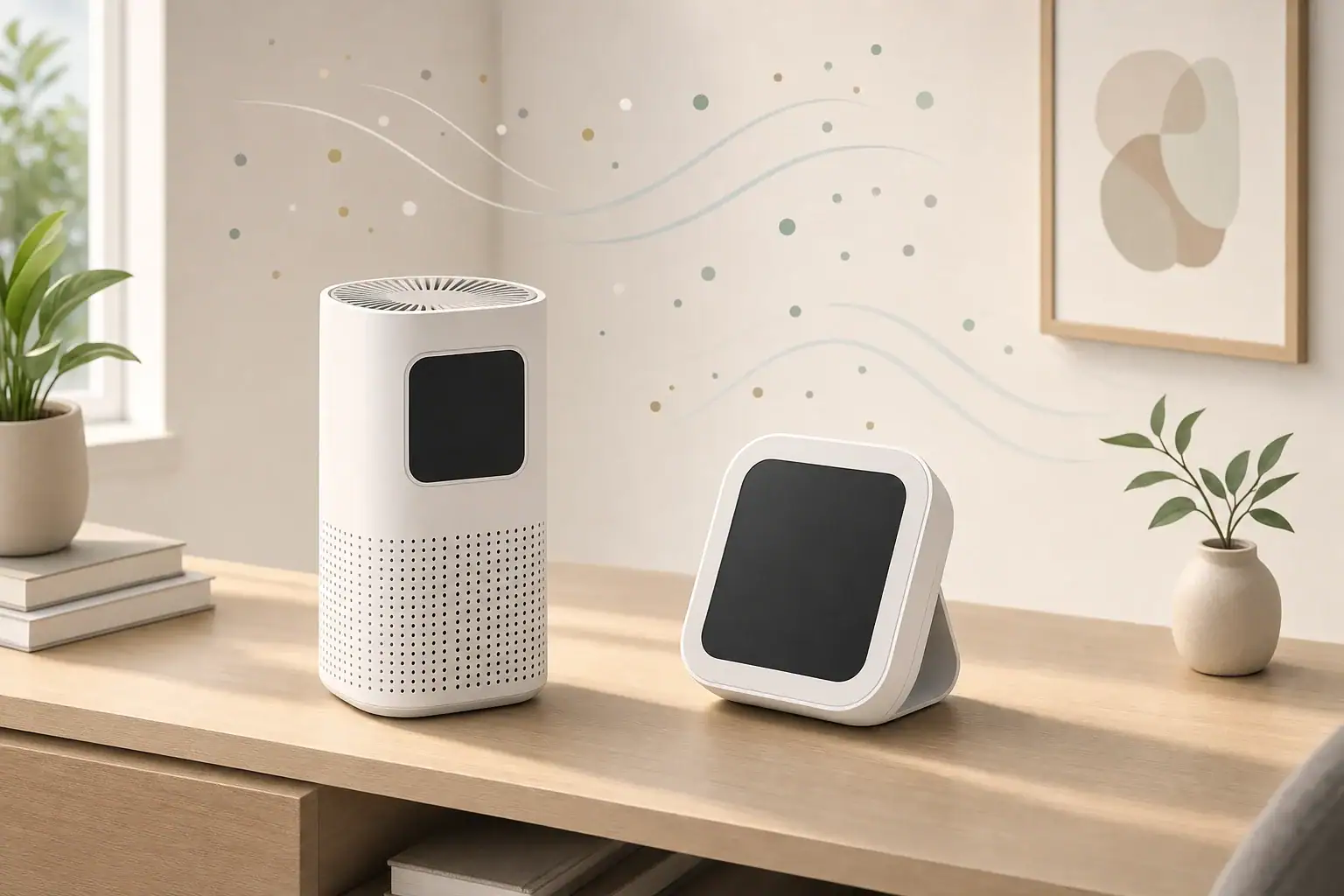
A radon monitor measures radioactive radon gas, while a general air quality monitor typically measures particles, carbon dioxide, volatile organic compounds, temperature, and humidity.
The devices answer different questions and are not interchangeable unless a model explicitly includes both sensor types. Radon monitoring focuses on exposure over days, months, or longer, while most air quality monitoring helps identify shorter-term changes caused by occupancy, cooking, ventilation, smoke, moisture, and household products.
Quick answer
- Use a radon-specific monitor or test to measure radon in picocuries per liter, abbreviated pCi/L.
- The EPA recommends taking action at 4 pCi/L or higher and considering action between 2 and 4 pCi/L.
- For a representative radon average, testing for more than 90 days is generally more informative than relying on a single-day result.
- Use a general air quality monitor for trends in PM2.5, CO2, TVOC, temperature, and relative humidity, depending on its sensors.
- A sustained occupied-room CO2 reading above roughly 1,000 ppm can be a practical ventilation cue, not a universal safety limit.
- A general indoor humidity range of about 30% to 50% is commonly used for comfort and moisture management; prolonged levels above 60% can signal a need for better moisture control.
Radon Monitors and Air Quality Monitors Serve Different Purposes
Radon is a naturally occurring radioactive gas that can enter a building from the soil beneath and around it. It is colorless and odorless, so a dedicated test or sensor is needed to detect it. A continuous radon monitor records measurements over time and may display short-term and long-term averages.
A general indoor air quality monitor is usually a collection of several different sensors. Depending on the device, it may track airborne particles, carbon dioxide, relative humidity, temperature, or a broad estimate of volatile organic compounds. These readings can help connect changing indoor conditions with activities such as frying food, cleaning, showering, opening windows, or filling a room with people.
The term “air quality monitor” does not guarantee a standard sensor package. Some devices measure only particles, while others measure several metrics. Radon is usually absent unless it is clearly listed as a dedicated measurement.
What Each Type of Monitor Measures and How It Works
What a radon monitor measures
A radon monitor detects radiation associated with the decay of radon and its decay products. Residential results in the United States are normally reported in pCi/L. The device collects readings continuously and calculates averages over specified periods.
Radon concentrations naturally change with weather, soil moisture, heating patterns, ventilation, and pressure differences between indoors and outdoors. For that reason, a longer average usually gives a more representative picture of typical exposure than one unusually high or low hourly reading.
What a general air quality monitor measures
Common sensors include:
- PM2.5: An estimate of particles up to 2.5 micrometers in aerodynamic diameter, commonly reported in micrograms per cubic meter.
- PM10: An estimate of larger inhalable particles, although some monitors calculate this from the same optical signal used for PM2.5.
- CO2: Carbon dioxide, usually reported in parts per million and commonly used as an indicator of ventilation relative to occupancy.
- TVOC: A broad sensor response to certain volatile organic compounds. Results may be reported as an index or estimated concentration.
- Relative humidity: The percentage of moisture in the air relative to what the air can hold at that temperature.
- Temperature: A useful companion measurement because temperature affects comfort, relative humidity, and sensor behavior.
Optical particle sensors estimate particle levels by detecting light scattered from airborne material. Many CO2 monitors use nondispersive infrared sensing. Consumer TVOC sensors often use metal-oxide technology and are most useful for identifying changes from the normal indoor baseline rather than identifying individual chemicals.
| Feature | Radon monitor | General air quality monitor |
|---|---|---|
| Primary purpose | Measure radon concentration over time | Track common indoor air and comfort indicators |
| Typical metrics | Radon in pCi/L | PM2.5, CO2, TVOC, humidity, and temperature |
| Useful time scale | Days to months or longer | Minutes to days, plus longer trends |
| Common source clues | Soil entry and building pressure effects | Cooking, smoke, occupancy, products, and ventilation |
| Typical response | Confirm results and evaluate radon reduction when appropriate | Ventilate, control a source, filter particles, or manage moisture |
| Interchangeable | No, unless other sensors are explicitly included | No, unless a dedicated radon sensor is explicitly included |
How to Interpret Readings, Ranges, and Trends
Radon decisions should be based on an appropriate average rather than minute-to-minute movement. The EPA action level is 4 pCi/L, and the agency also advises considering mitigation when the result is between 2 and 4 pCi/L. A follow-up test may be appropriate after an elevated short-term result, while a qualified radon professional can advise on mitigation and post-mitigation testing.
Short-term radon testing generally lasts from 2 to 90 days. Long-term testing lasts more than 90 days and better accounts for seasonal and daily variation. Real estate transactions may use specific short-term protocols, so ordinary household trend monitoring should not be substituted for required transaction procedures.
General air quality readings need more context. A brief PM2.5 spike while cooking may point to a known source, while a persistent elevation could justify checking outdoor smoke conditions, filtration, monitor cleanliness, and nearby indoor sources.
CO2 is mainly a ventilation indicator in typical homes. Outdoor air is often around the low 400 ppm range, though it varies by location. Occupied indoor rooms commonly rise above that level. A sustained reading near or above 1,000 ppm can suggest that outdoor-air ventilation is not keeping pace with occupancy, but it is not a universal health or building-code limit.
TVOC readings are less standardized across consumer devices. Different sensor designs can respond differently to alcohol, cleaners, fragrances, cooking vapors, and humidity. Look for repeatable changes from the room’s usual baseline instead of treating one displayed value as a precise chemical analysis.
Common Monitoring Mistakes and Troubleshooting Cues
A frequent mistake is assuming that a multi-sensor air quality device automatically detects radon, carbon monoxide, or every pollutant shown in air quality reports. Check the documented sensor list and measurement units. A calculated score is not the same as a direct measurement of each possible pollutant.
Other common problems include:
- Reacting to one radon spike: Review longer averages and follow recognized testing procedures.
- Placing a sensor beside a window or supply vent: Direct outdoor air may make the reading less representative of the room.
- Monitoring PM beside a stove all day: This is useful for source testing but may not represent normal exposure elsewhere in the home.
- Using TVOC as a chemical identifier: A broad VOC sensor cannot normally tell which compound caused the response.
- Ignoring humidity effects: High humidity can affect some low-cost particle and VOC sensors.
- Comparing unlike devices too closely: Two consumer sensors may use different algorithms, calibration methods, and averaging periods.
- Treating a monitor as a control device: Measurement alone does not ventilate, filter, dehumidify, or mitigate radon.
If a reading appears implausible, inspect the monitor for dust, review its location, allow the recommended warm-up period, and compare trends over several days. Restarting or recalibrating should be done only as directed by the device instructions.
How to Choose and Place the Right Monitor
Choose based on the question you need to answer
Select a radon monitor or recognized radon test if the goal is to determine the radon level. Choose a particle monitor to evaluate smoke, cooking emissions, or filtration trends. Choose a monitor with a true CO2 sensor when the goal is to understand ventilation in occupied rooms.
A device with humidity and temperature sensing can help with moisture management. TVOC sensing may be useful for finding patterns associated with products or activities, but it does not replace targeted sampling when a specific compound must be identified.
Use placement that matches the measurement
For radon, test the lowest level of the home that is regularly occupied or could be occupied. Follow the test instructions for height and clearance. A common approach is to place the device at least 20 inches above the floor, away from exterior walls, direct drafts, heat, high humidity, and enclosed cabinets.
For general air quality trends, place the monitor in the occupied area, often around breathing-zone height. Keep it away from open windows, doors, supply vents, direct sunlight, humidifier mist, and the immediate path of cooking emissions unless you are intentionally testing those sources.
One monitor cannot represent every room. Closed bedrooms, finished basements, open-plan living areas, and rooms with portable air cleaners can develop different conditions. Move a general monitor temporarily between rooms for comparison, but leave a radon device in one compliant location for the full test period.
Real-World Examples of Using Both Devices
A finished basement
A radon monitor belongs in the basement if it is the lowest regularly used level. A separate general monitor can track basement humidity, particles, and ventilation. If humidity remains above roughly 60%, moisture control deserves attention, but that reading does not explain or predict the radon level.
A bedroom with the door closed overnight
A CO2-equipped monitor may show a gradual overnight increase because people exhale carbon dioxide and the closed room has limited air exchange. The same device might show stable PM2.5 and humidity. A radon monitor in that room would answer a different question and should be judged by its longer average.
A kitchen and open-plan living room
Cooking may cause rapid PM2.5 and TVOC increases. A general monitor can show how quickly exhaust ventilation, outdoor air, and particle filtration reduce the readings. Radon typically changes more slowly and should not be evaluated as a cooking-related metric.
A home during a smoke event
An optical PM2.5 monitor can help compare indoor particle trends with outdoor conditions and show the effect of closing windows or operating suitable particle filtration. A radon monitor does not measure smoke. Changes in ventilation strategy can sometimes influence radon, however, so its longer-term trend should still be interpreted separately.
Safety, Maintenance, and Follow-Up Testing
Neither type of monitor replaces required smoke alarms or listed carbon monoxide alarms. A general air quality device should be treated as a carbon monoxide alarm only if it is specifically certified and labeled for that safety function.
Radon reduction commonly involves a dedicated mitigation system designed to prevent soil gas from entering occupied areas. Installation and follow-up testing are generally handled according to current federal, state, and professional guidance. A monitor can verify trends, but it does not remove radon.
For general air quality, responses depend on the metric. Source control and kitchen exhaust can address activity-related pollutants. Outdoor-air ventilation can help with occupancy-related CO2 and some indoor-generated contaminants when outdoor conditions are suitable. Particle filtration can reduce airborne particles but does not remove radon or meaningfully lower CO2.
Ionizers and some electronic air-cleaning technologies may generate ozone as a byproduct. Ozone is not needed for routine home monitoring or air cleaning, and intentionally generating it in occupied spaces should be avoided. UV-C components also do not replace particle, gas, or radon sensors.
Keep monitor openings free of dust, avoid spraying cleaners near sensors, and follow any calibration or service schedule. Review batteries, power connections, clock settings, data storage, and averaging periods periodically. When comparing readings, use the same location and similar operating conditions whenever possible.
| Metric | What it indicates | Common pitfall | Practical action idea |
|---|---|---|---|
| Radon | Longer-term radon concentration in pCi/L | Reacting to an hourly spike | Use the proper average; follow up at 4 pCi/L or higher and consider action from 2 to 4 pCi/L |
| PM2.5 | Fine-particle trends | Humidity or dust affecting the sensor | Check sources, outdoor conditions, exhaust, and filtration |
| CO2 | Ventilation relative to occupancy | Treating 1,000 ppm as a universal limit | Increase suitable outdoor-air ventilation when occupied levels remain elevated |
| TVOC | Broad response to certain gases | Assuming it identifies a chemical | Compare with the normal baseline and recent activities |
| Relative humidity | Indoor moisture conditions | Ignoring temperature and local damp areas | Aim generally for 30% to 50% and investigate prolonged readings above 60% |
| Temperature | Comfort and context for other sensors | Assuming one room represents the house | Compare occupied rooms and different times of day |
| Carbon monoxide | CO only when directly measured | Relying on a non-certified air monitor for alarms | Maintain separate listed carbon monoxide alarms as required |
Related guides: Indoor Air Quality Monitors: What to Measure (PM2.5, CO2, VOCs, Humidity) • Wildfire Smoke Indoors: Step-by-Step Plan to Lower PM2.5 Fast • Best Indoor Humidity Level to Prevent Mold (With Seasonal Targets) • Ventilation vs Air Purifier: When You Need One, the Other, or Both
Summary: Which Monitor Do You Need?
Choose a radon monitor when you need a direct measurement of radon and a reliable average over an appropriate testing period. Choose a general air quality monitor when you want to track particles, ventilation, humidity, temperature, or broad VOC trends.
Many homes can benefit from using both because the measurements do not overlap in a dependable way. Before buying or placing a device, confirm its actual sensors, units, averaging periods, and calibration requirements. Then match each reading with the appropriate response: radon testing and mitigation for radon, ventilation for occupancy-related CO2, source control and filtration for particles, and moisture management for persistently high humidity.
Frequently asked questions
Can an air quality monitor detect radon?
Usually not. A general air quality monitor measures radon only when its specifications explicitly list a dedicated radon sensor and radon results in pCi/L. Sensors for PM2.5, CO2, TVOC, temperature, or humidity cannot measure radon.
Do I need both a radon monitor and an air quality monitor?
You may need both if you want to track radon exposure as well as everyday indoor conditions such as particles, ventilation, and humidity. A radon monitor answers whether radon is present over time, while a general air quality monitor can help identify changes related to cooking, smoke, occupancy, or moisture. One device can serve both roles only if it includes dedicated sensors for each measurement needed.
How long should a radon monitor run before I trust the result?
Radon levels fluctuate, so longer averages are generally more representative than a single reading or short spike. Short-term tests commonly run from 2 to 90 days, while testing for more than 90 days better reflects seasonal and daily variation. Follow the device instructions and applicable testing requirements, especially for a real estate transaction.
Where should I place a radon monitor compared with an air quality monitor?
Place a radon monitor on the lowest level that is regularly occupied or could be occupied, following the test instructions for height, clearance, and location. A general air quality monitor is usually best placed in an occupied area around breathing-zone height. Keep both away from direct drafts, open windows, supply vents, direct sunlight, and unusual local sources unless you are deliberately investigating those sources.
Can a high CO2 reading tell me that radon is high?
No. CO2 and radon come from different sources and require separate sensors. CO2 in homes is mainly used as a cue about ventilation relative to occupancy, while radon commonly enters from soil gas and should be evaluated using an appropriate radon average.
Recommended next:
- Indoor Air Quality Monitors: What to Measure (PM2.5, CO2, VOCs, Humidity)
- CO2 Monitors for Homes: What Good Numbers Look Like and Why They Matter
- VOC Sensors Explained: Why Readings Vary and How to Use Them Safely
- Where to Place an Air Quality Monitor: Height, Distance, and Rooms
- PM2.5 Sensor Accuracy: Why Readings Differ Between Devices
- CO2 Monitor Buying Guide: What to Look For (NDIR vs “eCO2”)
- Clear sizing logic (room size → CADR/ACH)
- HEPA vs carbon explained for real use-cases
- Humidity + ventilation basics to reduce mold risk