
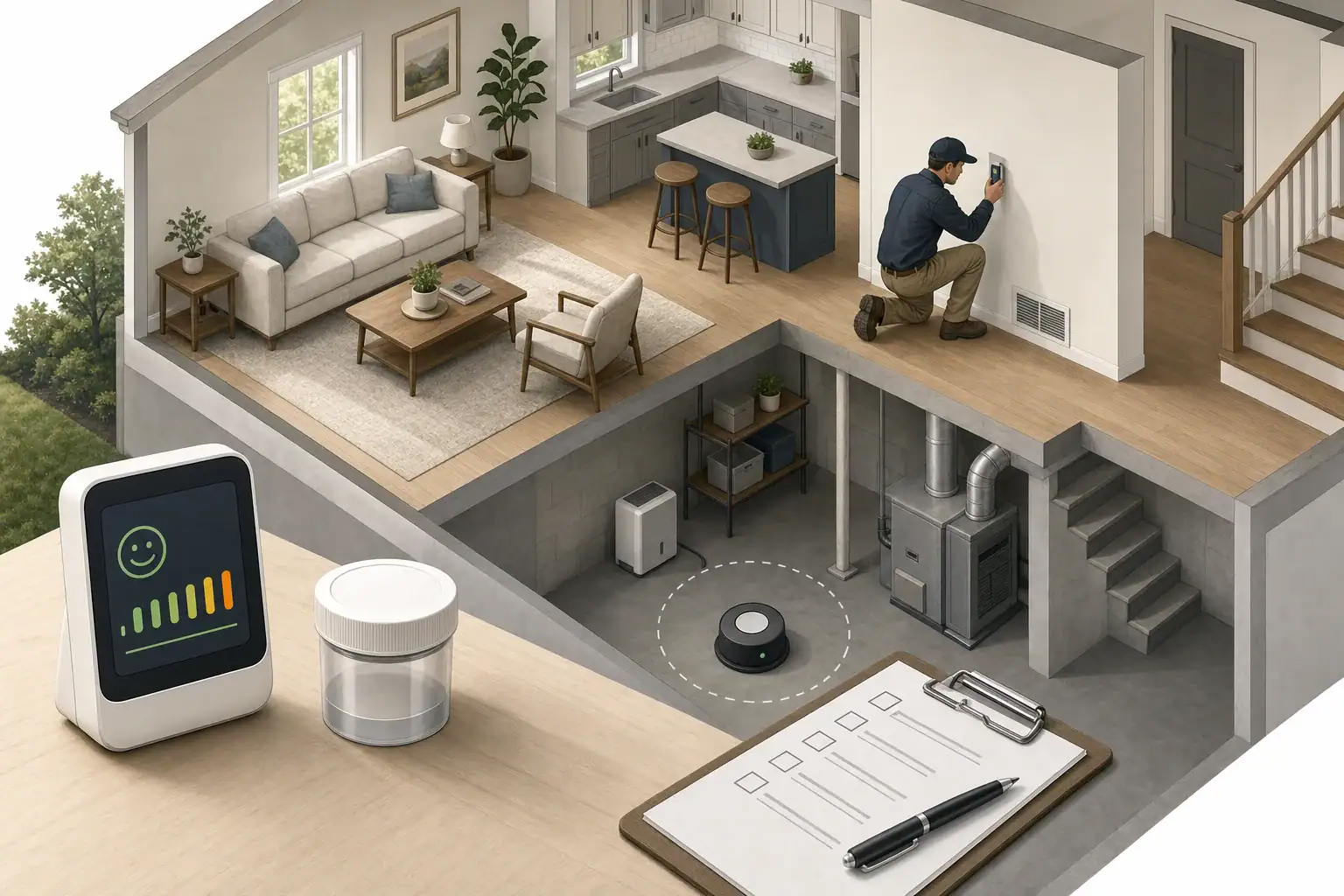
Quick answer: Choose indoor air quality testing by the question and decision at hand. Use a consumer monitor for repeatable trends, a targeted test for a defined pollutant such as radon, and qualified professional help when inspection, sampling design, or interpretation is needed. Treat a sounding carbon monoxide alarm as an emergency.
Match indoor air quality testing to the decision
There is no single test that measures every aspect of air in a home. Start with a specific question: What seems to be happening, where and when does it occur, and what would you do differently if the result confirmed a pattern? A continuous monitor, pollutant-specific test, laboratory analysis, and onsite investigation each answer different questions.
For example, a particle monitor can show whether readings change during cooking, but it cannot identify every particle present or prove that all indoor pollutants are absent. A laboratory may analyze a sample for a defined compound, but its result may not establish the source. An onsite assessment can examine moisture, ventilation, HVAC operation, and building conditions, while any sampling should still have a defined purpose.
| Concern | Useful first path | When laboratory or professional help adds value | Main limitation |
|---|---|---|---|
| Particles from cooking, cleaning, smoke, or outdoor air | Continuous PM monitor with an activity log | Persistent unexplained patterns, source questions, or ventilation assessment | Lower-cost sensors can respond differently to particle types and conditions |
| Carbon dioxide or humidity patterns | Consumer monitor for time and room comparisons | HVAC, ventilation, or building-envelope assessment when patterns remain unexplained | Neither measurement represents overall air quality |
| Intermittent chemical odor | Event log, product inventory, and nonspecific VOC trends | Targeted sampling for a defined compound or an onsite source investigation | A TVOC reading does not identify the chemical responsible |
| Radon | Radon-specific test used according to its instructions | Qualified radon services for follow-up testing or mitigation planning | Results depend on test duration, location, and required building conditions |
| Musty odor, staining, or damp materials | Visual and moisture-focused investigation | Concealed-moisture investigation or evaluation of a complex building condition | One air sample cannot replace finding and correcting the moisture source |
| Sounding carbon monoxide alarm | Emergency response, not an air-quality experiment | Qualified inspection of relevant fuel-burning equipment after re-entry is permitted | A general IAQ monitor is not a substitute for a CO alarm or emergency response |
What a DIY monitor can answer
A consumer monitor is most useful for observing timing, relative changes, and repeated patterns. It can help compare readings before, during, and after a recurring activity, or show whether changes coincide with cooking, cleaning, open windows, HVAC operation, or occupancy.
EPA explains that low-cost air pollution monitors detect only the contaminants or environmental factors for which they are designed. EPA also notes that placement, device age, temperature, humidity, and interfering contaminants can affect readings, and that monitor data alone cannot provide a complete representation of indoor air quality.
Use consistent placement and documented conditions
For an occupied-room trend measurement, EPA advises placing a monitor where airflow is unobstructed and at a typical breathing-zone height. Its general guidance describes approximately 3 to 6 feet for a typical adult and advises avoiding immediate proximity to stoves, vents, open windows, doors, drafts, or products unless investigating that specific source. Follow the manufacturer’s instructions and any pollutant-specific protocol first.
Keep the device in one documented location while establishing a baseline. Moving it frequently makes time and room comparisons harder to interpret. Record the device model, warm-up or stabilization instructions, maintenance history, and any available raw readings. For more placement detail, see where to place an air quality monitor.
Use TVOC readings as clues, not chemical identification
EPA’s Enhanced Air Sensor Guidebook explains that TVOC sensors do not measure every VOC, may respond differently to different compounds, and cannot assign a reported TVOC concentration to a particular chemical. Temperature, humidity, and other gases may also affect a sensor response.
A repeatable rise around a product or activity can be useful for documenting timing. It does not establish which chemical is present. When a decision requires identifying or quantifying a specific compound, choose a defined sampling and analytical method rather than assigning a chemical identity to a TVOC trend. See also why TVOC readings can mislead.
When a targeted test is the better choice
Choose a targeted test when the suspected pollutant is defined and the result will answer a clear question. Before ordering a kit or arranging a sample, identify the analyte, collection method, sampling duration, laboratory method, and the basis that will be used to interpret the result.
Radon follows its own testing protocol
Radon testing is not interchangeable with general monitor placement. EPA’s Home Buyer’s and Seller’s Guide to Radon describes a short-term test of at least 48 hours. For a 2- to 4-day test, the guide calls for closed-house conditions for at least 12 hours before the test and throughout it, normal operation of heating and cooling systems, and avoiding disturbance of the device.
Record the device location and start and stop times. EPA recommends fixing a home when a confirmed radon level is at or above 4 picocuries per liter (pCi/L). These setup conditions and action guidance are specific to radon, not universal instructions for every indoor-air sample. A radon monitor and a general air-quality monitor measure different things.
Named VOCs and laboratory analysis
If the concern is a named compound or chemical group, ask whether the proposed method is suitable for that analyte and the expected concentration range. Clarify who collects the sample, how long collection lasts, what room conditions must be documented, how samples are stored and shipped, and what conclusions the final report can support.
Professional sampling can be especially useful when an event is intermittent, several possible sources exist, specialized equipment is needed, or the result could influence remediation, a property dispute, or another consequential decision. A laboratory result is strongest when the sampling plan matches the actual question.
Inspect dampness and systems before broad sampling
Visible growth, water staining, condensation, wet materials, or a musty odor generally call for locating the moisture source before broad mold air sampling. EPA’s mold testing guidance says sampling is generally unnecessary when visible mold is present and notes that there are no federal limits for airborne mold.
The Minnesota Department of Health similarly explains that mold sampling is only a partial estimate and cannot replace visual inspection and moisture-source investigation. Depending on the situation, inspection may include plumbing, exterior water entry, condensation, HVAC components, and concealed building assemblies. An odor, symptoms, or one air sample should not be used to diagnose a mold species, toxicity, or medical effect.
Pre-test measurement checklist
- Define one question. State the suspected pollutant or event and the decision the result should inform.
- Select a matching method. Distinguish continuous trend monitoring, time-limited sampling, laboratory analysis, and building inspection.
- Record the location. Note the room, floor, approximate height, nearby sources, and connections to garages or utility areas.
- Establish a baseline. Collect observations under typical conditions before making deliberate changes to ventilation, products, or activities.
- Log relevant events. Record cooking, cleaning, hobbies, candles, windows, HVAC operation, occupancy, and unusual odors.
- Record outdoor and building conditions. Note weather, recent rain, construction, smoke events, and other changes that could affect results.
- Follow method-specific instructions. Observe required setup, warm-up, sampling duration, storage, shipping, and device-location requirements.
- Keep placement consistent. Do not move or disturb a device during a defined test unless the applicable protocol calls for it.
- Preserve the evidence. Save raw readings, photographs, device details, sample identifiers, start and stop times, and deviations from the plan.
- Plan interpretation in advance. Decide what comparison, action level, or follow-up will be used; do not invent a universal indoor pass/fail threshold.
When to bring in professional help
An onsite assessment is appropriate when the source is unknown, readings vary substantially by room or time, moisture or HVAC systems require inspection, or the sampling design and interpretation could materially affect the decision. Different concerns can require different skills: a laboratory analyzes samples, an investigator designs and interprets an assessment, and an HVAC or combustion technician evaluates applicable equipment.
Questions to ask before hiring
- What specific question will the assessment answer?
- Will inspection occur before sampling?
- Which analytes, collection methods, and analytical methods are proposed?
- Why are those methods suitable for this concern?
- What room conditions, blanks, controls, or comparison samples are needed?
- Which laboratory will be used, and does its current scope include the exact analyte and method?
- What criteria will be used to interpret the result?
- Will the report separate observations, measurements, assumptions, and recommendations?
- Does the assessor also sell remediation, and if so, how will that potential conflict be handled?
For microbiological analysis, the AIHA Environmental Microbiology Laboratory Accreditation Program covers laboratories analyzing microorganisms in air, surface, and bulk samples. Accreditation is tied to specified activities, so ask for the laboratory’s current certificate and scope for the exact method rather than relying on a logo alone. A2LA explains laboratory accreditation as recognition of competence for defined testing activities.
A Certified Industrial Hygienist credential includes competencies related to exposure assessment and air sampling, as described by the Board for Global EHS Credentialing. It does not, by itself, demonstrate specialization in every residential issue. Ask about relevant experience and check applicable state or local requirements.
Worked indoor air quality testing scenarios
These are hypothetical examples. They assume no medical emergency and, except for the final example, no sounding life-safety alarm. They illustrate how to choose a method, not what a result will be or what condition it proves.
| Scenario | First path | Escalation |
|---|---|---|
| An intermittent chemical odor occurs in one room | Log timing, products, garage activity, windows, and HVAC operation. Use monitor trends only to look for timing patterns. | If the source remains unknown, seek an onsite investigator. Use targeted analysis only when a compound or chemical group and sampling plan can be defined. |
| Particle readings rise during cooking | Compare the same monitor location before, during, and after similar cooking activities while documenting appliance and ventilation use. | Seek a ventilation or source assessment if the pattern persists and the corrective action remains unclear. |
| A wall smells musty and appears damp | Inspect for water entry, condensation, plumbing issues, and damaged materials. Document moisture conditions and visible changes. | Use a skilled building or moisture investigator when damage may be concealed or the source cannot be located. |
| A carbon monoxide alarm sounds | Leave the home and follow emergency instructions rather than collecting monitor data. | After responders permit re-entry, have relevant fuel-burning equipment checked by qualified personnel. |
A sounding carbon monoxide alarm is an emergency signal
Do not use general indoor air quality testing to investigate while a carbon monoxide alarm is sounding. The U.S. Consumer Product Safety Commission says in its carbon monoxide safety guidance to go outside, call 911 or the fire department, and not re-enter until emergency responders permit it. Relevant fuel-burning equipment should then be checked by qualified personnel.
EPA also states that low-cost air pollution monitors are not substitutes for carbon monoxide alarms or smoke alarms. Do not use a general IAQ reading to override an alarm or delay emergency action.
Summary
Use a consumer monitor for repeatable trends, a pollutant-specific test for a defined analyte, and qualified onsite help when inspection, sampling design, or interpretation is central to the decision. Document conditions, follow the applicable method instead of a universal room protocol, and interpret each result according to what the instrument or analysis can actually establish.
Related guides: Air Quality Monitor Calibration: What Home Users Can and Cannot Do • PM2.5 Sensor Accuracy: Why Readings Differ Between Devices • Indoor Air Quality Monitors: What to Measure
Frequently asked questions
Can one indoor air quality monitor test for everything in a home?
No. A consumer monitor detects only the pollutants or environmental factors it is designed to measure, and placement and conditions can affect readings. Use it for repeatable trends and activity comparisons, not as proof that all indoor pollutants are absent.
What should I do if a TVOC reading rises?
Record the timing and nearby activities, products, windows, and HVAC operation to look for a repeatable pattern. A TVOC value does not identify the chemical responsible. Use a defined sampling and analytical method if identifying or quantifying a particular compound is necessary.
Is a mold air sample the first step for a musty odor or damp wall?
Usually not. Start by looking for water entry, condensation, damaged materials, and other moisture conditions, because sampling cannot replace locating the moisture source. Professional investigation may help when damage may be concealed or the source cannot be found.
When is professional indoor air quality testing worth considering?
Professional help adds value when the source is unknown, patterns vary substantially by room or time, or moisture, HVAC, or combustion systems need inspection. It is also useful when the sampling plan or result could affect remediation, a property dispute, or another consequential decision.
Recommended next:
- Indoor Air Quality Monitors: What to Measure (PM2.5, CO2, VOCs, Humidity)
- CO2 Monitors for Homes: What Good Numbers Look Like and Why They Matter
- VOC Sensors Explained: Why Readings Vary and How to Use Them Safely
- Where to Place an Air Quality Monitor: Height, Distance, and Rooms
- PM2.5 Sensor Accuracy: Why Readings Differ Between Devices
- CO2 Monitor Buying Guide: What to Look For (NDIR vs “eCO2”)
- Clear sizing logic (room size → CADR/ACH)
- HEPA vs carbon explained for real use-cases
- Humidity + ventilation basics to reduce mold risk