
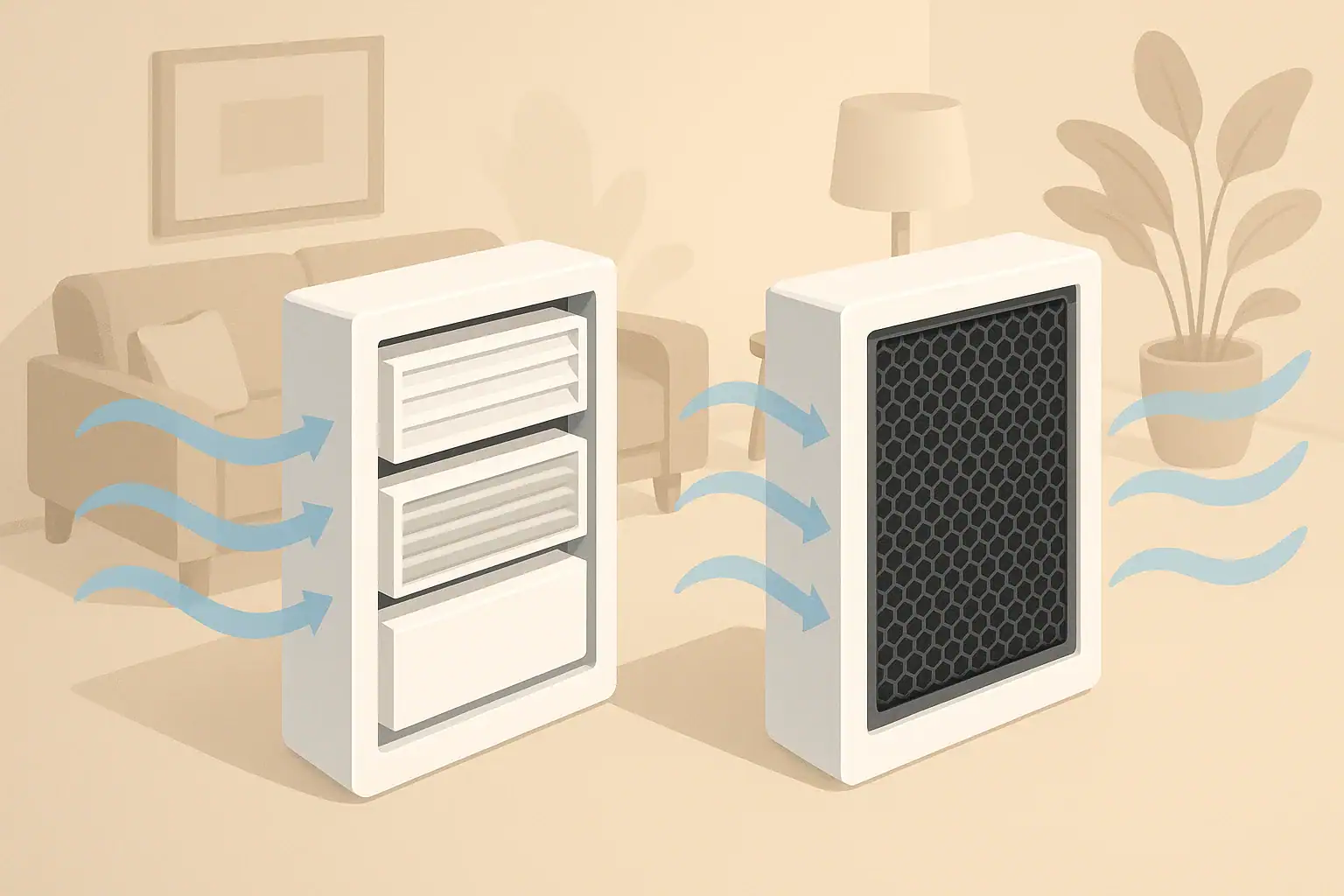
When people look into air purifiers for their homes, they quickly run into two terms: HEPA filters and activated carbon filters. They often appear in the same device, but they do very different jobs. Understanding what each one can and cannot do helps you choose the right setup for your rooms and your priorities.
In simple terms:
- HEPA filters are for solid particles in the air.
- Carbon filters are for many gases, odors, and some chemicals.
Most indoor air concerns fall into one or more of these categories:
- Dust, pet dander, pollen, smoke particles, and fine particles like PM2.5
- Cooking and household odors
- Volatile organic compounds (VOCs) from paints, cleaning products, and furnishings
- Moisture and mold risks (which filters alone do not solve)
Each filter type contributes differently to these issues. In many homes, the ideal solution is a combination of HEPA and carbon, supported by ventilation and humidity control, rather than relying on a single filter to do everything.
Why HEPA and Carbon Filters Are Often Mentioned Together
When people look into air purifiers for their homes, they quickly run into two terms: HEPA filters and activated carbon filters. They often appear in the same device, but they do very different jobs. Understanding what each one can and cannot do helps you choose the right setup for your rooms and your priorities.
In simple terms:
- HEPA filters are for solid particles in the air.
- Carbon filters are for many gases, odors, and some chemicals.
Most indoor air concerns fall into one or more of these categories:
- Dust, pet dander, pollen, smoke particles, and fine particles like PM2.5
- Cooking and household odors
- Volatile organic compounds (VOCs) from paints, cleaning products, and furnishings
- Moisture and mold risks (which filters alone do not solve)
Each filter type contributes differently to these issues. In many homes, the ideal solution is a combination of HEPA and carbon, supported by ventilation and humidity control, rather than relying on a single filter to do everything.
How HEPA Filters Work and When They Matter Most
HEPA (High Efficiency Particulate Air) filters are dense mats of fibers designed to capture airborne particles as air passes through them. They do this through several mechanisms: intercepting particles that follow the airstream, diffusing smaller particles as they move randomly, and impaction of larger particles that cannot follow the air flow around the fibers.
What HEPA Filters Are Good At
HEPA filters are focused on particles, not gases. They are especially useful when your main concerns involve:
- Fine particles (PM2.5) from outdoor pollution that leak indoors
- Smoke particles from nearby fires, cooking, candles, or fireplaces
- Dust and dust mite debris that settle on surfaces and get stirred up
- Pet dander and hair fragments
- Pollen that enters through doors, windows, or clothing
True HEPA filters are usually rated to capture a very high percentage of particles down to a given size. In consumer purifiers, you may also see ratings like H13 or H14, which are based on a European classification system used to describe even higher efficiency levels under lab conditions. These ratings are helpful as general indicators of how fine the filtration is, but overall purifier performance also depends on the fan, housing design, and how well air is forced through the filter instead of around it.
When HEPA Is the Priority
HEPA filtration is typically the top priority when:
- You are focused on particle reduction for comfort or cleanliness.
- You live in an area with seasonal wildfires or frequent outdoor smoke.
- Someone in the home has allergy or asthma sensitivity triggered by dust, pollen, or pet dander.
- You notice dust accumulation quickly and want to reduce airborne dust load.
In these situations, particle capture efficiency and clean air delivery rate (CADR) matter more than odor removal. A strong HEPA-based purifier with the right room sizing and placement will usually deliver the most noticeable improvement in clarity of the air and visible dust levels.
Limits of HEPA Filters
Despite their strength with particles, HEPA filters have clear limits:
- They do not remove most gases or odors, including many VOCs.
- They do not control humidity or stop mold growth on damp surfaces.
- They can become clogged with particles over time, reducing airflow and performance if not replaced as recommended.
- If the device is poorly sealed, air can leak around the filter, reducing real-world effectiveness.
For many homes, HEPA is necessary but not sufficient, especially where odors, VOCs, or chemical sensitivities are important concerns.
| Filter type | Main target | Helps most with | Not designed for | When to prioritize |
|---|---|---|---|---|
| HEPA or high-efficiency particulate filter | Solid particles | Dust, pollen, pet dander, smoke particles, PM2.5 | Most gases, VOCs, odors, humidity | Allergy-friendly setups, wildfire smoke, dusty homes |
| Activated carbon filter | Gases and many VOCs | Cooking odors, some chemical fumes, residual smoke smells | Coarse dust, pollen, pet hair | Strong odor complaints, recent painting or new furnishings |
| Combined HEPA + carbon | Particles + some gases | General indoor air quality, mixed concerns | Moisture control, structural mold problems | Most living rooms, open-plan spaces, bedrooms |
| Pre-filter (coarse) | Larger debris | Pet hair, larger dust, visible lint | Fine particles, gases, VOCs | Homes with pets or heavy visible dust |
| No filter (ventilation only) | Air exchange | Diluting indoor pollutants when outdoor air is clean | Fine filtration, odors when outside air also smells | Mild climates, low outdoor pollution periods |
Example values for illustration.
How Carbon Filters Work and When They Matter Most
Activated carbon filters are packed with highly porous carbon granules or blocks. The large internal surface area of the carbon allows many gas molecules to adsorb onto it. Instead of trapping solid particles like HEPA, carbon targets certain gases, odors, and VOCs that HEPA cannot capture effectively.
What Carbon Filters Are Good At
Carbon filters are especially useful when your main concerns involve smells or gaseous pollutants, such as:
- Cooking odors that linger in an open kitchen or combined living space
- Smoke smells from cigarettes, cigars, or past events like wildfires
- Household product fumes from cleaning, adhesives, or air fresheners
- Off-gassing from new furniture, flooring, or paint
Carbon works best when there is enough carbon mass and contact time for the air to interact with the media. Thin, lightweight carbon filters can provide some odor relief, but they typically saturate faster than heavier carbon beds.
When Carbon Is the Priority
Activated carbon filtration should be a priority when:
- Your main complaint is odor even if the air looks clear.
- You are dealing with recent renovation or painting and want to reduce VOC buildup indoors.
- You cook often in a space that does not have strong kitchen exhaust.
- There are residual smoke smells in a room even after cleaning surfaces and textiles.
In these situations, adding or upgrading the carbon filtering component matters more than squeezing out slightly higher HEPA efficiency. However, because odors often travel along with fine particles, pairing carbon with HEPA is usually more effective than carbon alone.
Limits of Carbon Filters
Carbon filters are not universal solutions. Important limitations include:
- They do not capture particles like dust or pollen; they should not replace a HEPA or fine particulate filter when particles are an issue.
- They have a finite capacity; once saturated, they stop adsorbing gases and can slowly release previously captured substances.
- Performance varies with airflow speed, temperature, humidity, and the specific gases involved.
- Some gases and very low-weight molecules are poorly captured by typical household carbon filters.
Carbon works best as one layer in a broader indoor air strategy that also includes ventilation, moisture control, and source reduction (for example, choosing low-VOC products where practical).
Using HEPA and Carbon Together in Real Homes
Because indoor air problems rarely fit a single category, many home air purifiers combine a HEPA or HEPA-like filter with an activated carbon stage. Thinking in terms of scenarios can help you decide how much emphasis to place on each component.
Common Household Scenarios
- Busy kitchen and living room combination: Cooking particles, oil mist, and odors move easily into the seating area. A purifier with both HEPA and a substantial carbon filter near the main airflow path can help supplement the range hood and open windows.
- Bedroom near a busy road: Outdoor traffic contributes PM2.5 and some odors. A strong HEPA filter and high CADR are key for particles; a carbon stage can help with exhaust smells, though ventilation and sealing gaps around windows also matter.
- Home office with fresh paint or new furniture: VOCs can be a concern. A carbon-heavy filter plus regular ventilation (when outdoor air is acceptable) is often more useful than ultra-high HEPA efficiency alone.
- Apartment affected by neighboring smoke: Fine smoke particles and odors can travel between units. Combined HEPA and carbon filtration, along with sealing gaps and managing door/window openings, can reduce both particles and smells.
Placement and Airflow Considerations
Regardless of filter type, placement and airflow are crucial:
- Size the purifier’s CADR to the room volume and desired air changes per hour (ACH).
- Place the unit where air can circulate freely around it, not behind curtains or furniture.
- Avoid placing it directly in corners with stagnant air unless the room layout leaves no alternative.
Filters can only affect the air that actually passes through them. Even an excellent HEPA or carbon filter underperforms if the device is undersized or poorly located.
What HEPA and Carbon Filters Cannot Do
To build realistic expectations, it helps to separate the strengths of filters from other aspects of indoor air quality management.
Moisture and Mold Concerns
Neither HEPA nor carbon filters control humidity or repair moisture problems. They can:
- Capture some airborne mold spores (especially HEPA), reducing what circulates in the air.
- Reduce musty odors to a degree (especially carbon) in certain conditions.
But they cannot dry out wet materials or stop mold from growing on damp surfaces. For that, you may need:
- Fixing leaks and water intrusion
- Using exhaust fans in bathrooms and kitchens
- Dehumidifiers in basements or humid climates
- Maintaining indoor humidity in a general comfort range that discourages mold growth
Ventilation and CO2
Filters recirculate and clean indoor air; they do not replace it with fresh outdoor air. They also do not remove CO2 produced by breathing. Even with excellent HEPA and carbon filtration, you still benefit from:
- Opening windows when outdoor conditions are acceptable
- Using mechanical ventilation systems where available
- Running kitchen and bathroom exhausts to remove moisture and pollutants at the source
In some situations, a combination of filtration and ventilation is the most practical way to balance indoor comfort, noise, and energy use.
| Filter type | Typical replacement interval (example range) | What changes the interval | Reminder |
|---|---|---|---|
| HEPA or main particulate filter | 6–18 months | Dust load, run time, fan speed, indoor smoking | Watch for reduced airflow or visible discoloration. |
| Activated carbon filter | 3–12 months | Odor intensity, VOC sources, continuous vs occasional use | If odors return quickly, carbon may be saturated. |
| Pre-filter (washable mesh or foam) | Clean every 2–8 weeks | Pets, visible dust, location near doors or vents | Rinse or vacuum regularly to protect main filters. |
| Whole-home HVAC filter (high-MERV) | 1–6 months | System runtime, fan mode, season, construction dust | Check more often during heavy heating or cooling use. |
| Specialty gas or VOC cartridges | As specified by manufacturer | Specific contaminants, industrial or home workshop use | Follow device guidance; performance drop may be subtle. |
Example values for illustration.
Practical Steps to Decide What You Need
To decide between HEPA, carbon, or a combination, start by listing your main concerns and how you use each room.
Step 1: Identify Your Primary Air Issues
- Mostly particles? Notice dust, visible haze, or smoke events. Prioritize HEPA and adequate CADR.
- Mostly odors or VOCs? Persistent smells, recent painting, or heavy cooking. Prioritize carbon capacity and ventilation.
- Mixed issues? Typical in most homes. A combined HEPA + carbon purifier sized correctly for the room often makes sense.
Step 2: Match Room Size and Layout
Check the purifier’s clean air delivery rate and match it to your room volume and desired air changes per hour. Open-plan rooms or spaces with many doorways and hallways may need more than one unit or a more powerful one. Bedrooms typically benefit from quieter settings, so consider running the purifier on higher speed during the day and a lower but continuous speed at night.
Step 3: Plan for Maintenance and Cost
Filter costs add up over time. Before buying, estimate how often you are willing to replace filters and what that cost looks like annually. Washable pre-filters can help extend the life of HEPA and carbon filters by catching larger debris. Mark replacement dates on a calendar or set reminders, since performance declines gradually and can be easy to overlook.
Step 4: Combine Filtration with Other Basics
Finally, remember that filters are only one part of managing indoor air quality. Simple habits support both HEPA and carbon performance:
- Use exhaust fans when cooking or showering.
- Air out new furniture or carpets where possible.
- Keep relative humidity in a comfortable range to reduce condensation and dampness risks.
- Vacuum with a high-efficiency or sealed system to remove settled dust.
With a clear picture of what HEPA and carbon filters do, and what they do not do, you can build a balanced setup tailored to your home, instead of relying on a single device or feature to solve every air concern.
Frequently asked questions
Can a HEPA filter remove volatile organic compounds (VOCs)?
No — HEPA filters are designed to capture solid particles, not most gases or VOCs. To reduce VOCs you need an activated carbon stage or other gas-specific media, combined with ventilation and source control.
How often should HEPA and activated carbon filters be replaced?
Typical intervals are roughly 6–18 months for HEPA filters and 3–12 months for activated carbon cartridges, but actual life depends on dust load, odor intensity, and run time. Follow manufacturer guidance and watch for reduced airflow or returning odors as signs it’s time to replace filters.
Is a combined HEPA and carbon purifier necessary for allergy sufferers?
If allergies are driven by particles like pollen, dust, or pet dander, HEPA filtration is the priority because carbon does not remove particles. A combined unit is useful if chemical sensitivities or persistent odors are also a concern, since it addresses both particles and many gases.
Will HEPA or carbon filters stop mold growth in my home?
No; filters can reduce airborne mold spores (HEPA) and help with musty odors (carbon), but they do not solve moisture problems or dry out damp materials. Preventing mold requires fixing leaks, using ventilation and exhaust fans, and controlling indoor humidity with dehumidifiers when needed.
How do I size an air purifier for a room to handle smoke or heavy particles?
Match the purifier’s CADR to your room volume and aim for several air changes per hour; higher CADR is recommended for smoke or wildfire events. For open-plan areas consider multiple units and place purifiers where airflow is unobstructed for best performance.
Recommended next:
- Clear sizing logic (room size → CADR/ACH)
- HEPA vs carbon explained for real use-cases
- Humidity + ventilation basics to reduce mold risk