
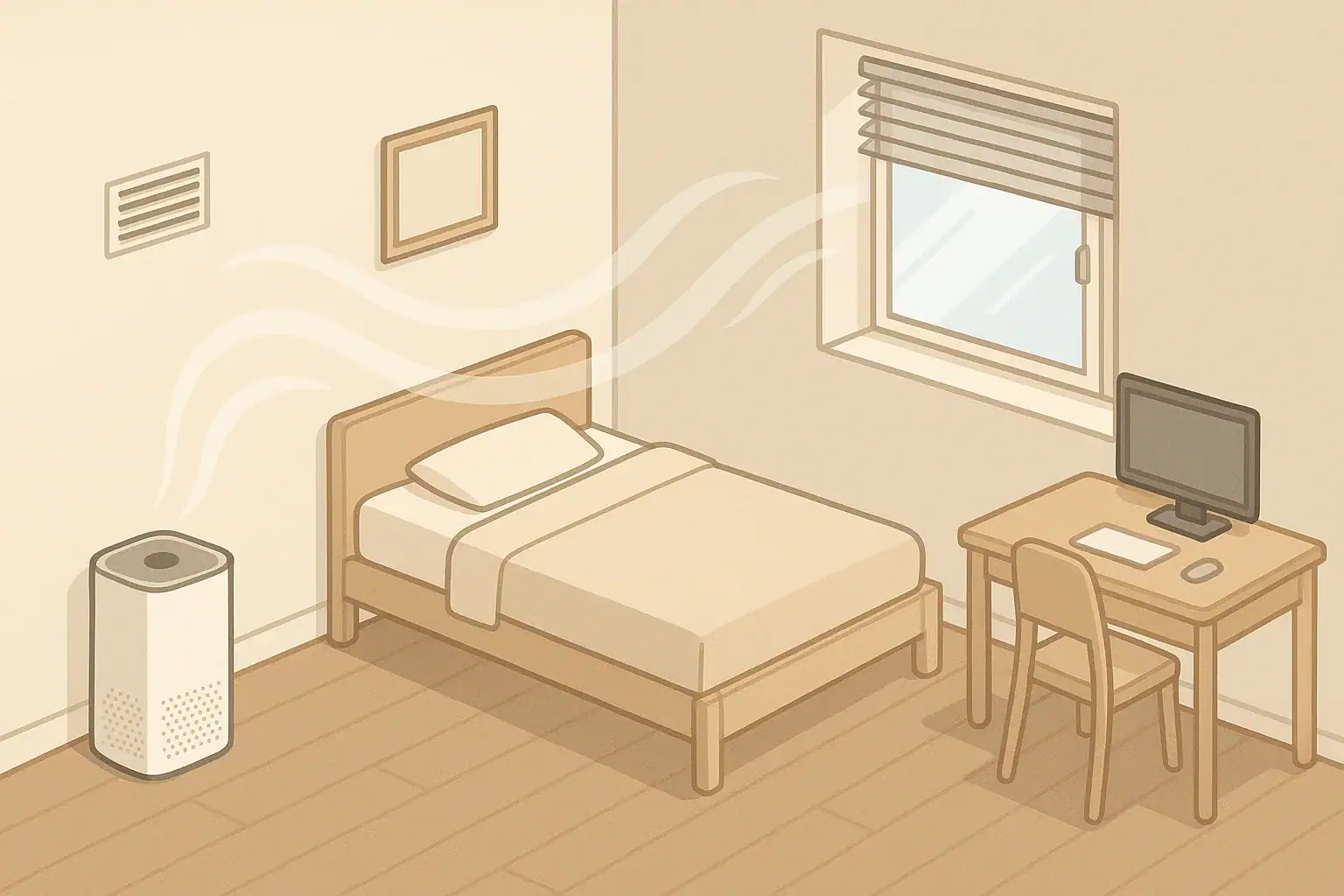
Why Bedrooms Feel Stuffy in the First Place
Before choosing between an air purifier and ventilation, it helps to understand what “stuffy” really means in a bedroom. People often use the word for a mix of issues:
- Warm, stagnant air that feels heavy or stale
- Rising carbon dioxide (CO2) from breathing in a closed room
- Indoor pollutants building up like dust, pet dander, and fine particles (PM2.5)
- Odors from people, pets, laundry, or nearby kitchens
- Too much or too little humidity, which can make air feel muggy or dry and scratchy
Most stuffy-bedroom complaints come from poor air exchange plus some combination of particles, CO2, and humidity. Air purifiers and ventilation tackle different parts of this problem:
- Air purifiers mainly remove particles and sometimes odors and gases.
- Ventilation brings in fresher air and exhausts stale air, reducing CO2 and many indoor pollutants.
In practice, you often get the best results by combining both. But depending on your bedroom and climate, one may deserve priority.
What Air Purifiers Actually Do in a Stuffy Bedroom
In a bedroom, a well-sized air purifier can significantly change how the air feels, even though it does not add fresh outdoor air. Its main tools are filtration and air mixing.
Particle removal with HEPA-style filters
Most bedroom purifiers use a HEPA or HEPA-style filter to capture airborne particles such as:
- Dust and dust mite debris
- Pet dander and hair fragments
- Pollen that drifts indoors
- Fine particles (PM2.5) from outdoor pollution or cooking smoke that spread through the home
True HEPA and higher-grade filters (sometimes labeled H13 or H14) are designed to capture a high percentage of very fine particles. For many people, reducing particle levels makes air feel cleaner and more comfortable, especially near the bed.
Odor and gas reduction with activated carbon
Some purifiers also include an activated carbon or other gas-phase filter. These are designed to adsorb:
- Everyday household odors (cooking, sweat, mild pet smells)
- Volatile organic compounds (VOCs) from cleaners, paints, or furniture
Carbon filters do not last indefinitely; they gradually saturate and need replacement to stay effective. They do not remove CO2, but reducing odors alone can make a bedroom feel less “stale.”
Air mixing and drafts
Even when CO2 is not changing, the purifier’s fan helps mix air around the room. This can:
- Break up warm or cool pockets
- Reduce that “dead corner” feeling around the bed
- Create a gentle background airflow that some people find more comfortable for sleep
However, the purifier is still recirculating the same indoor air. It may feel fresher because it is cleaner and better mixed, but the overall amount of oxygen and CO2 in the room does not change much.
Air purifier limits in stuffy rooms
In a typical bedroom, an air purifier cannot:
- Lower CO2 meaningfully (it does not remove gases like that)
- Fix strong odors that keep entering from outside the room
- Balance humidity on its own (unless it also includes a humidifier or dehumidifier function)
- Make up for zero ventilation in a fully sealed space
This is why some rooms still feel stuffy even with an excellent purifier running: the air is cleaner but not fresher.
Example values for illustration.
| Situation you notice | Priority tool | Secondary tools | Notes |
|---|---|---|---|
| Air feels dusty, light on surfaces | Air purifier with HEPA-style filter | Regular cleaning, sealed vacuum bags | Helps reduce airborne dust and settlement rate. |
| Stale, heavy air after sleeping | Ventilation (window, vent, fan exhausting) | Air purifier for particles | Fresh air exchange addresses CO2 and overall stuffiness. |
| Lingering mild odors at night | Ventilation | Purifier with carbon filter | Carbon helps with odors that remain after airing out. |
| Damp, clammy feeling and musty smell | Dehumidifier or better moisture control | Ventilation and purifier | Lowering humidity often changes comfort more than filtering. |
| Dry, scratchy air in winter | Humidifier | Purifier for winter dust and particles | Moisture adjustment can reduce dry-air discomfort. |
| All of the above to some degree | Ventilation plus air purifier | Moisture control as needed | Combining tools often works best in real bedrooms. |
How Ventilation Changes a Stuffy Bedroom
Ventilation is about exchanging indoor air with outdoor air. It directly affects the “stuffy” feeling by diluting what builds up inside.
Reducing CO2 and “breath” buildup
People exhale CO2 continuously while sleeping. In a closed bedroom with the door and windows shut, CO2 can gradually climb overnight. Many people report that high CO2 levels make air feel:
- Flat or heavy
- Sleepier or less refreshing
- Stale, especially in the morning
Opening a window, undercutting the bedroom door, or improving mechanical supply and return can bring in outdoor air and keep CO2 closer to typical indoor background levels.
Exhausting odors, VOCs, and moisture
Ventilation helps remove air that contains:
- Everyday body and bedding odors
- VOCs from cleaning products, new furniture, or finishes
- Excess humidity from people, nearby bathrooms, or humidifiers
With steady air exchange, pollutants and moisture are less likely to accumulate. This is especially important in smaller bedrooms, or in homes with tight construction where natural leakage is low.
Sources of ventilation in typical homes
In U.S. homes, bedroom ventilation usually comes from one or more of these:
- Window opening (even a small crack can help in mild weather)
- Central HVAC system supplying and returning air when the fan is running
- Bathroom or whole-house exhaust fans that pull air from bedrooms under doors and out of the home
- Dedicated fresh air systems, such as energy recovery ventilators (ERVs) or heat recovery ventilators (HRVs)
Not all homes have dedicated systems, but even basic measures, like ensuring the HVAC fan runs periodically or installing a quiet exhaust fan on a timer, can improve bedroom freshness.
Limits of ventilation alone
Ventilation does not filter particles very much on its own. Depending on your outdoor air quality, bringing in outside air can sometimes increase indoor levels of:
- Pollen during high-pollen seasons
- Fine particles (PM2.5) from traffic or wildfire smoke
Ventilation also does not directly remove settled dust on surfaces or bedding. It is mainly about diluting what is airborne and replacing it with outdoor air.
Air Purifier vs Ventilation: Which Should You Prioritize?
Both tools can make a bedroom more comfortable, but their benefits are different. The best choice depends on your main complaint, your building, and your outdoor environment.
When an air purifier helps more
Consider making a purifier your first step if:
- You notice visible dust on furniture soon after cleaning.
- You share the bedroom with a shedding pet.
- You live near a busy road or have concerns about smoke or fine particles.
- You prefer to sleep with windows closed for noise, temperature, or outdoor odor reasons.
- You want a steady, controllable fan noise that also cleans the air.
In these cases, a properly sized purifier with a good particle filter—ideally a HEPA-style filter—can significantly reduce airborne particle levels overnight and make air feel clearer.
When ventilation helps more
Ventilation is often the bigger factor if:
- Air feels oppressive or heavy by morning, even with a purifier running.
- You wake up feeling that the bedroom is stale or stuffy but not necessarily dusty.
- You use products or activities that release odors or VOCs in or near the bedroom.
- Your home is newer or weatherized and likely has low natural air leakage.
In these situations, slightly opening a window (where outdoor conditions and safety allow), making sure interior doors are not tightly sealed, or running a central fan more can improve the sense of freshness.
What if you can only change one thing?
If you must choose, a practical rule of thumb for many U.S. bedrooms is:
- Start with ventilation if the air feels heavy, humid, or stale but not particularly dusty.
- Start with a purifier if you clearly see or feel dust, pet dander, or are concerned about fine particles.
Over time, many people find that combining the two—some form of nightly or daily ventilation plus a right-sized purifier—provides the most consistent comfort.
Getting the Most from a Bedroom Air Purifier
If you decide an air purifier should be part of your strategy, setup matters as much as the device itself. A poorly placed or undersized purifier may do little for a stuffy bedroom.
Size and CADR basics
Purifiers are often rated with a Clean Air Delivery Rate (CADR) for smoke, dust, and pollen. CADR is essentially how much clean air the purifier can supply per minute. For bedrooms, a common planning approach is:
- Estimate room volume (length × width × height).
- Decide on a target air change rate, such as around 4–6 air changes per hour (ACH) as an example planning range for many bedrooms.
- Select a unit whose CADR, at a quiet-enough speed, roughly matches that goal.
Because bedrooms are used for long stretches of time, especially at night, many people run purifiers continuously on a lower, quieter setting that still offers meaningful filtration.
Placement and airflow
For best bedroom coverage:
- Place the purifier where air can circulate freely around it, not jammed into a corner or under heavy furniture.
- Aim for a spot with line-of-sight to the bed area, but not blowing directly into your face if you dislike drafts.
- Keep intake and outlet grills unobstructed by bedding, curtains, or walls.
- Avoid placing it directly behind large furniture that blocks airflow completely.
In a small bedroom, sometimes placing the purifier near the side of the bed or across from it gives a good balance of comfort and coverage.
Filters, seals, and maintenance
Filter performance depends on both the filter material and how well the purifier is sealed so air does not leak around the filter. To keep performance closer to its design:
- Install filters exactly as instructed to avoid bypass around the edges.
- Replace HEPA-style filters on the suggested schedule, or sooner if visibly dirty or airflow drops noticeably.
- Replace carbon filters regularly if you rely on them for odor reduction.
- Vacuum or wipe pre-filters gently to remove large dust, so the main filter lasts longer.
Simple upkeep can make the difference between a purifier that quietly improves bedroom air and one that draws power but does little.
Practical Bedroom Ventilation Strategies
Improving ventilation does not always require a major renovation. Many bedrooms can be made less stuffy with small, practical changes.
Use windows strategically
Where outdoor air quality is acceptable and security allows, windows are the simplest tool:
- Crack a window an inch or two at night during mild seasons.
- Open windows on opposite sides of the home for cross-ventilation when conditions permit.
- In colder climates, you might air out the bedroom for a short period (for example, 5–15 minutes) during the day instead of leaving a window open all night.
During high-pollen periods or smoke events, you may need to keep windows closed and rely more on mechanical ventilation and filtration instead.
Encourage air movement through the door
If your home has a central HVAC system or exhaust fans:
- Make sure the bedroom door is not sealed so tightly that air cannot move under or around it.
- Check that supply vents are open and not blocked by furniture or rugs.
- Run the HVAC fan in circulate mode for part of the night to move and mix air.
Even simple steps like trimming a too-long door sweep that fully seals to thick carpet can improve airflow between your bedroom and the rest of the house.
Consider exhaust and balanced systems
Where feasible, mechanical ventilation can provide more consistent results:
- A quiet bathroom exhaust fan on a timer can pull stale air from nearby bedrooms, drawing in fresher air from elsewhere in the home.
- A balanced system such as an ERV or HRV can supply filtered outdoor air while exhausting indoor air, useful in tighter homes and colder or hotter climates.
These systems are usually installed and sized by professionals, but routine homeowner actions like cleaning exhaust fan grilles and using existing fans regularly also help.
Outdoor air quality considerations
When outdoor air includes high pollen, traffic pollution, or regional smoke, more ventilation is not always better. In such periods, many people:
- Keep windows closed most of the time.
- Use air filtration (room purifiers or higher-efficiency central filters) more heavily.
- Ventilate during shorter windows of cleaner outdoor air, when available.
The right balance changes seasonally; your strategy for spring pollen may differ from your approach in winter or during wildfire season.
Example values for illustration.
| Bedroom size example | Ceiling height note | ACH planning idea (example) | Approximate CADR planning idea |
|---|---|---|---|
| Small room ~100 sq ft | Standard 8 ft ceiling | 4–6 air changes per hour | About 70–100 cfm of clean air |
| Medium room ~150 sq ft | Standard 8 ft ceiling | 4–6 air changes per hour | About 100–150 cfm of clean air |
| Larger room ~200 sq ft | Standard 8 ft ceiling | 4–6 air changes per hour | About 140–200 cfm of clean air |
| Larger room ~200 sq ft | Taller 9–10 ft ceiling | 4–6 air changes per hour | Increase CADR by roughly 10–25% |
| Combined suite or open plan ~300 sq ft | Standard 8–9 ft ceiling | 4–6 air changes per hour | Often 200+ cfm of clean air |
| Any room with doors often open | Shared air with hallway | Consider whole-zone volume | May need higher CADR or multiple units |
Putting It All Together for Less Stuffy Bedrooms
Making a bedroom feel less stuffy is usually about combining three elements:
- Fresh air from ventilation to reduce CO2, odors, and buildup of indoor pollutants.
- Filtration from an air purifier or central system to reduce dust, pet dander, and fine particles.
- Moisture control to keep humidity in a generally comfortable range and avoid damp or overly dry air.
For many homes in the U.S., a sensible path is to first make basic ventilation work reliably—doors that allow airflow, vents unblocked, fans used regularly—and then add a properly sized, well-placed purifier to keep particles down. Small adjustments, rather than a single dramatic change, often lead to a noticeably fresher bedroom over time.
Frequently asked questions
Will an air purifier reduce CO2 levels in a closed bedroom?
No. Standard air purifiers remove particles and, in some cases, certain gases or odors, but they do not remove carbon dioxide. To lower CO2 you need ventilation or an air-exchange system that brings in outdoor air to dilute exhaled gases.
How do I size an air purifier to reduce stuffiness in my bedroom?
Estimate the room volume (length × width × height) and aim for a unit whose CADR supports roughly 4–6 air changes per hour for that volume. Check CADR or recommended room size guidance and choose a model that can run quietly at the needed output overnight. Continuous low-speed operation often balances comfort and meaningful filtration.
Is it better to open a window or run a purifier at night if outdoor air quality is poor?
If outdoor air has high pollen, traffic pollution, or smoke, keep windows closed and rely on a HEPA-style purifier and an activated carbon stage if odors or gases are a concern. Open windows briefly when outdoor air is cleaner to dilute CO2 and lingering odors. In short, prioritize filtration during pollution events and short ventilation windows when outdoor conditions allow.
Can combining ventilation and an air purifier improve sleep quality?
Yes. Ventilation reduces CO2, odors, and moisture while a purifier removes particles, pet dander, and many airborne contaminants, so using both addresses different causes of stuffiness. Combined, they often deliver a more consistently comfortable and restorative sleeping environment.
How often should I replace HEPA and carbon filters to keep my bedroom from feeling stuffy?
Follow manufacturer recommendations, but as a general guide HEPA-style filters often need replacement every 6–12 months depending on use and visible dirt, while activated carbon filters may require replacement every 3–6 months if used heavily for odors. Watch for reduced airflow or persistent odors as signs it’s time to change filters, and clean pre-filters regularly to extend main filter life.
Recommended next:
- HEPA vs Activated Carbon: Best Setup for Allergies, Odors, and Smoke
- Air Purifier vs Dehumidifier: Which One Solves Musty Air?
- Humidifier vs Dehumidifier: When to Add Moisture vs Remove It
- Air Purifier vs Ozone Generator: Safety, Effectiveness, and Myths
- HEPA vs Carbon Filters: When Each One Matters Most
- More in Comparisons →
- Clear sizing logic (room size → CADR/ACH)
- HEPA vs carbon explained for real use-cases
- Humidity + ventilation basics to reduce mold risk