
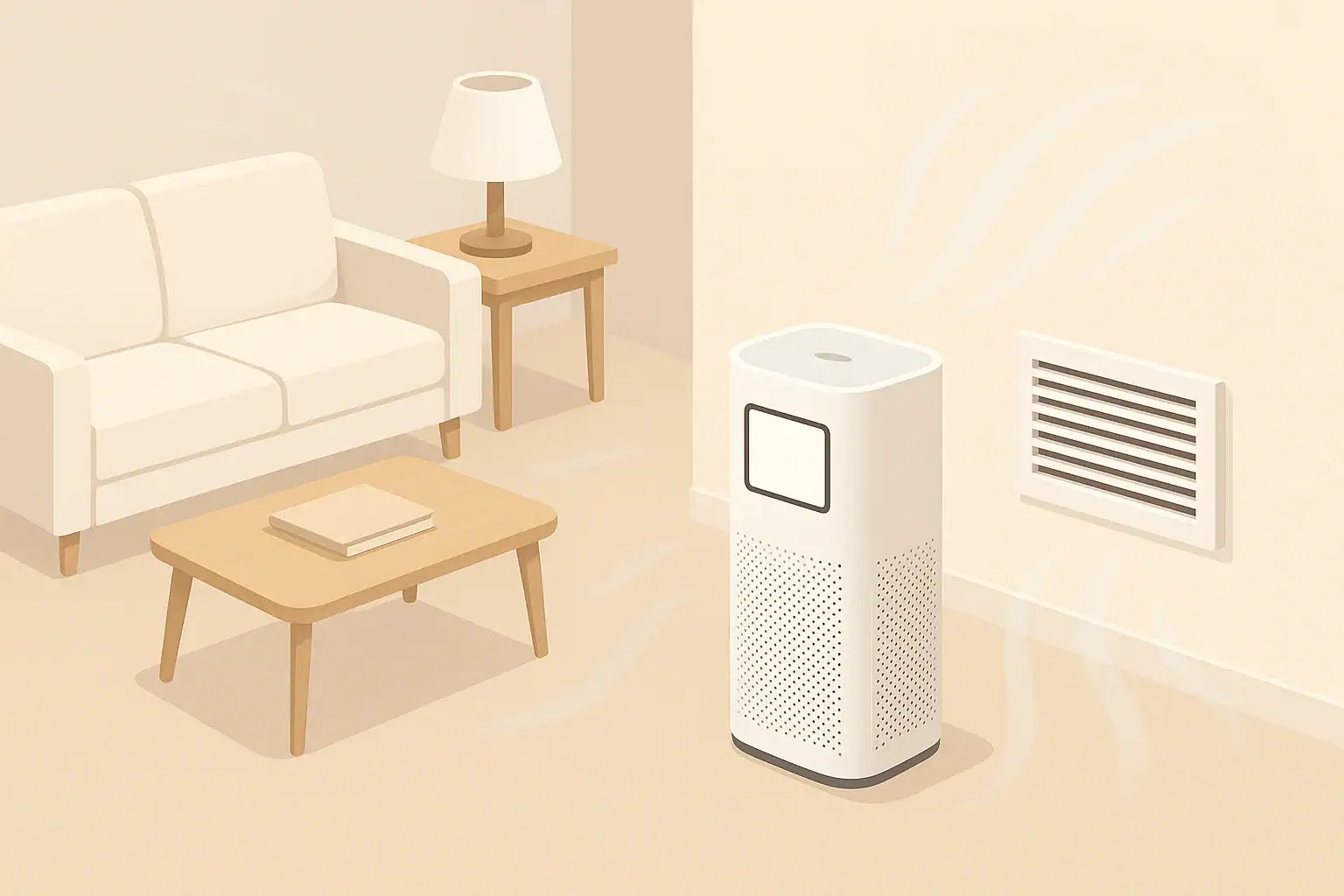
Many homes in the United States already have a central heating and cooling system, so it is natural to ask whether a portable air purifier is even necessary. Both portable air purifiers and HVAC filters affect indoor air quality, but they do it in very different ways.
Deciding what helps more in your home depends on:
- What kinds of pollutants you care about (dust, smoke, odors, basic particles)
- How your home is laid out (open plan vs many small rooms)
- How often your HVAC fan runs
- Your noise and energy preferences
- Your budget for equipment and filter changes
This guide explains how each option works, what each is good at, and when a combination makes sense.
Why Compare Portable Air Purifiers and HVAC Filtration?
Many homes in the United States already have a central heating and cooling system, so it is natural to ask whether a portable air purifier is even necessary. Both portable air purifiers and HVAC filters affect indoor air quality, but they do it in very different ways.
Deciding what helps more in your home depends on:
- What kinds of pollutants you care about (dust, smoke, odors, basic particles)
- How your home is laid out (open plan vs many small rooms)
- How often your HVAC fan runs
- Your noise and energy preferences
- Your budget for equipment and filter changes
This guide explains how each option works, what each is good at, and when a combination makes sense.
How Portable Air Purifiers Work
Portable air purifiers are standalone units that draw room air through filters and then recirculate it back into the same space. They do not heat or cool the air, but they can significantly increase air filtration in one area.
Key components and filter types
Most portable purifiers use a combination of filters:
- Prefilter: Captures larger dust, hair, and lint; often washable.
- Particle filter (HEPA or similar): Designed to remove fine particles such as dust, pet dander, pollen, and smoke particles.
- Activated carbon filter: Uses porous carbon media to help reduce odors and some volatile organic compounds (VOCs).
You may see terms like “true HEPA” or “H13/H14” in product descriptions. These refer to filter efficiency standards. In general, higher-grade filters capture a higher percentage of very small particles, but they also increase air resistance and can reduce airflow if the purifier is not sized appropriately.
CADR and ACH: Matching a purifier to the room
Two basic concepts help compare portable purifiers:
- CADR (Clean Air Delivery Rate): An estimate of how much filtered air a purifier delivers for particles like dust, pollen, or smoke. Higher CADR usually means faster cleaning for a given room size.
- ACH (Air Changes per Hour): How many times per hour the purifier can theoretically filter a room’s volume of air.
As a simple planning approach, many people aim for around 4 to 8 ACH in the main room where they spend the most time. That typically means selecting a purifier with a CADR that aligns with the room’s floor area and typical ceiling height.
Strengths of portable air purifiers
Portable purifiers offer several advantages:
- Targeted cleaning: You can focus on bedrooms, nurseries, or living rooms where you spend the most time.
- Consistent filtration: They work independently of heating or cooling seasons.
- Flexible placement: You can move a unit between rooms as needs change (for example, during wildfire smoke or renovation dust).
- High-efficiency particle capture: Quality HEPA-type filters can remove a large share of fine particulate matter, including PM2.5 from dust and smoke.
Limitations of portable units
Portable purifiers also have trade-offs:
- Room-limited: One unit only affects the space it can effectively circulate, usually a single room or connected area.
- Noise: Higher fan speeds, which give more filtration, typically create more noise.
- Floor space and airflow: Units work best when placed away from walls and obstructions, which can be challenging in small rooms.
- Filter cost: Replacement filters (particle and carbon) add ongoing expense.
Because performance depends on the right size and placement, it is important to consider room dimensions and where people actually spend time, rather than just the purifier’s maximum advertised coverage.
Example values for illustration.
| Aspect | Portable Air Purifier | HVAC Filtration |
|---|---|---|
| Coverage focus | Single room or zone | Whole house where ducts reach |
| Works when | Any time it is powered on | When HVAC fan runs (heat, cool, or fan-only) |
| Particle removal potential | High in targeted rooms with HEPA-type filter | Moderate to high, depends on filter rating and fan runtime |
| Odors and basic VOCs | Often includes activated carbon | May need separate carbon filter add-on |
| Upfront equipment cost | Per room purchase | Filter upgrade only, if system is compatible |
| Energy use impact | Additional plug-in device | More fan runtime and higher resistance filters |
| Best for | Bedrooms, high-use rooms, localized issues | Baseline whole-home filtration and dust control |
How HVAC Filtration Works in Homes
Central HVAC systems pull air from return grilles, pass it through a filter, condition it (heating or cooling), and then distribute it through supply vents. The filter in this system primarily protects the equipment, but it can also improve indoor air quality, depending on the filter type and fan runtime.
Filter ratings and what they mean
Residential HVAC filters are commonly rated by a scale such as MERV (Minimum Efficiency Reporting Value). Higher numbers generally mean better fine particle capture, but also more resistance to airflow.
In many homes, stock filters are basic and focus on large dust and lint. Upgrading to a higher performance filter can improve capture of smaller particles, including a portion of PM2.5. However, going too high in resistance without system design considerations can reduce airflow, affect comfort, and stress equipment.
Whole-house advantages
When set up well, HVAC filtration has strengths that portable units cannot match alone:
- Whole-home coverage: Any room with supply and return airflow benefits when the fan runs.
- Integrated solution: One filter location to service, rather than multiple units.
- Hidden equipment: No extra devices taking floor space.
- Baseline dust control: Helpful for reducing recirculated dust and large particles.
Limitations of HVAC filtration
At the same time, HVAC filters have inherent limits:
- Fan runtime dependence: Filtration only happens when the system fan is on. Many homes run the fan mainly during heating and cooling.
- Filter resistance: Very high-efficiency filters can be too restrictive for some systems, potentially impacting airflow if not matched correctly.
- Odors and VOCs: Standard HVAC filters do little for odors; specialized carbon media is required and is not always installed.
- Duct and room layout: Rooms with weak airflow or closed doors may see less benefit.
For many homes, upgrading the HVAC filter and adjusting fan usage can provide a strong baseline of whole-home filtration, but it may not fully address all localized or high-load situations.
Particles, Odors, and What Each System Handles Best
Portable purifiers and HVAC systems interact with different types of indoor pollutants in different ways. Understanding the basics can help you choose where to focus.
Dust, pet dander, and everyday particles
Both systems can help control common household particles:
- HVAC filtration: Good for capturing recirculated dust and dander from the whole home, especially with a well-chosen higher-efficiency filter.
- Portable purifiers: Strong at quickly reducing dust and dander levels in specific rooms where they run continuously at suitable fan speeds.
For many households, an upgraded HVAC filter provides a foundation for dust control, while portable units focus on high-priority rooms such as bedrooms.
Fine particles and PM2.5 (including smoke)
Fine particles, often summarized as PM2.5, come from cooking, outdoor smoke, and other combustion sources. These very small particles stay suspended in the air longer and can travel throughout the home.
- Portable purifiers with HEPA-type filters: Often provide higher local removal rates of fine particles, especially when sized for 4–8 ACH in the room.
- HVAC filtration: With an appropriately efficient filter and sufficient fan runtime, the HVAC system can gradually reduce whole-home PM2.5, but the response may be slower, especially if the fan cycles on and off.
During events like wildfire smoke, many households rely on portable purifiers in key rooms, sometimes combined with running the HVAC fan in “on” or “circulate” mode through an upgraded filter.
Odors and simple VOC considerations
Odors from cooking, pets, and everyday products are usually best handled by ventilation (bringing in fresher air) plus source control. Filtration can complement this:
- Activated carbon filters in purifiers: Can help reduce some odors and a portion of VOCs by adsorption, especially when filters are fresh.
- HVAC systems: Some can be fitted with carbon media, but many are not, and odor control is limited with standard filters.
Because regular replacement is needed as carbon media saturates over time, maintaining odor reduction requires timely filter changes. Filtration alone cannot eliminate VOCs from strong or ongoing sources; reducing emissions and improving ventilation remain important.
Room Layout, Doors, and Airflow Patterns
How air moves through your home matters almost as much as the filters themselves. Even a powerful purifier cannot help much if clean air is trapped in one corner and never mixes with the rest of the room.
Where portable purifiers work best
Placement and room use patterns are crucial:
- Place units where people spend the most time (for example, near the bed in a bedroom or within the occupied zone of a living room).
- Allow space around air intakes and outlets—avoid pushing purifiers into tight corners or behind furniture.
- In closed-door bedrooms, a portable unit can dominate filtration, because HVAC airflow may be limited.
Open-plan areas may require a higher-CADR purifier or more than one unit if the space is large or irregularly shaped.
How HVAC airflow interacts with rooms
HVAC filtration depends on effective circulation:
- Rooms with both supply and return vents typically see better filtration.
- Closed interior doors can reduce airflow and delay how quickly filtered air reaches a space.
- Furniture blocking returns or supplies can reduce both comfort and filtration effectiveness.
In homes with limited ductwork to certain rooms, portable purifiers can fill in gaps where central airflow is weak.
Noise, Energy Use, and Operating Costs
Filtration works only when fans run. The trade-off is noise and energy use, so it is worth thinking about how much runtime you can tolerate.
Noise considerations
Portable purifiers and HVAC fans produce different types of noise:
- Portable purifiers: Noise depends on fan speed. Many people use lower speeds at night for sleep and higher speeds when away or during the day.
- HVAC systems: Noise comes from the central blower and air rushing through vents. Some systems are relatively quiet; others are more noticeable, especially at higher fan speeds.
In bedrooms, some people prefer a steady, low “fan” sound for masking other noises, while others need a very quiet environment. Having adjustable fan settings on purifiers or a “circulate” mode on HVAC systems can help tailor this.
Energy and filter replacement costs
Ongoing costs include both electricity and replacement filters:
- Portable purifiers: Use electricity continuously when operating. High-ACH targets in large rooms mean higher airflow and energy. Filters (HEPA-type and carbon) typically need replacement on a schedule based on hours of use and air quality.
- HVAC filtration: Running the fan more often for filtration increases energy use. Higher-efficiency filters can load with dust more quickly and may require more frequent changes.
Planning ahead for filter expenses—both purifier cartridges and HVAC filters—helps avoid stretching filters far beyond their effective life, which can reduce performance and increase resistance.
Example values for illustration.
| Approx. room size | Ceiling height note | Example CADR range | Notes |
|---|---|---|---|
| Small bedroom (~100 sq ft) | Standard 8 ft | Low to moderate CADR | Often adequate at mid fan speed for 4–6 ACH |
| Medium bedroom (~150 sq ft) | Standard 8–9 ft | Moderate CADR | May need higher speed or slightly larger unit |
| Home office (~200 sq ft) | 9 ft or higher | Moderate to higher CADR | Extra height increases volume; size up accordingly |
| Living room (~300 sq ft) | Standard 8-9 ft | Higher CADR | Open-plan layouts may require multiple units |
| Large open area (~500 sq ft) | High or vaulted | Very high CADR | Often more practical to focus on main seating zones |
| Studio apartment (~400 sq ft) | Standard 8-9 ft | Higher CADR | One well-placed unit can cover sleeping and living area |
When to Prioritize Portable Purifiers, HVAC Filtration, or Both
Most homes benefit from some level of both portable purification and HVAC filtration. The right mix depends on your situation and goals.
Scenarios favoring portable air purifiers
Portable purifiers tend to be especially helpful when:
- You rent or cannot modify the HVAC system.
- Your home has electric baseboard heaters, window units, or no central ductwork.
- You want strong filtration specifically in bedrooms or a nursery.
- You are dealing with localized sources such as a pet sleeping in one room or a hobby that generates dust.
- You need extra protection during events like wildfire smoke or nearby construction.
Scenarios favoring upgraded HVAC filtration
Focusing on HVAC filtration may be more practical when:
- You already have a central system with good duct coverage to most rooms.
- You prefer not to have multiple devices around the home.
- You want a baseline reduction in dust and particles throughout the whole house.
- You are comfortable running the HVAC fan more often or in circulate mode.
In these cases, working with an appropriate filter rating for your system and replacing it on schedule can significantly improve everyday particle control.
Why a combined approach often works best
For many households, the most practical strategy is:
- Use the HVAC filter as a whole-home “backbone” for dust and recirculated particles.
- Add portable purifiers in key rooms where you want consistently cleaner air or where HVAC airflow is limited.
This layered approach spreads filtration effort throughout the home while concentrating higher rates where people sleep and spend the most time.
Maintenance, Safety, and Practical Tips
Regardless of which option you lean on more, maintenance and safe operation strongly influence real-world performance.
Filter replacement and cleaning basics
Some simple habits help keep both portable purifiers and HVAC filters effective:
- Follow manufacturer guidance for filter replacement intervals, adjusting for heavy use or dusty environments.
- Check filters visually for heavy loading; dark, caked filters usually need changing.
- Clean or vacuum prefilters if they are designed for that purpose.
- Keep intakes and vents free of obstructions and dust buildup.
Ozone and additional technologies
Some air cleaning technologies intentionally produce ozone or rely on ionization or UV-C lamps. While they may be marketed for additional benefits, they also introduce complexity and potential byproducts.
For most homes, focusing on mechanical filtration (particle filters and, when desired, activated carbon) offers a straightforward, low-risk approach. If a device includes add-on technologies, review independent information on byproducts and avoid any setting that intentionally generates noticeable ozone.
Simple monitoring and adjustment
Basic indoor air quality monitors that display metrics such as PM2.5 and CO2 can help you see patterns, though they are not diagnostic medical tools. They can, however, provide useful feedback:
- Rising PM2.5 during cooking may suggest the need for better kitchen ventilation plus filtration.
- Consistently elevated CO2 can indicate that additional ventilation (fresh air) would be helpful.
Using these observations, you can adjust fan speeds, run times, and even window opening habits to balance comfort, energy use, and cleaner air.
Putting It All Together
Portable air purifiers and HVAC filtration are complementary tools rather than strict rivals. The portable air purifier vs HVAC filtration question is less about choosing one forever and more about deciding where each offers the greatest benefit in your specific home.
By understanding how each system handles particles, odors, airflow, and costs, you can create a practical plan: a solid whole-home filtration baseline, well-placed room purifiers where they matter most, regular filter maintenance, and simple ventilation habits. Over time, small consistent steps often add up to noticeably cleaner, more comfortable indoor air.
Frequently asked questions
Can a single portable air purifier replace upgraded HVAC filtration for whole-house protection?
No. A single portable purifier can effectively clean the room where it circulates air but cannot treat the entire house. For whole-home protection, an upgraded HVAC filter combined with adequate fan runtime is needed; portable units are best as a supplement in high-use rooms.
How should I size a portable purifier to match my bedroom’s needs (CADR and ACH)?
A common target for bedrooms is about 4–8 ACH. You can estimate required CADR using the room volume and desired ACH (CADR in cfm ≈ room volume in ft³ × ACH ÷ 60) and then pick a purifier whose published CADR meets that value at the intended fan speed.
Will upgrading my HVAC filter to a high MERV rating harm my system?
Very high-MERV filters increase airflow resistance and can reduce system performance if the HVAC blower isn’t designed for them. Check system compatibility or consult an HVAC professional before selecting a high-resistance filter, and balance filtration gains with proper airflow and fan runtime.
Do activated carbon filters in purifiers and HVAC systems remove all household odors and VOCs?
Activated carbon can adsorb many common odors and some VOCs but does not remove all chemicals and will become saturated over time. For persistent or strong sources, pair carbon filtration with source control and increased ventilation for better results.
What is the best setup during wildfire smoke events?
Close windows, run portable HEPA-type purifiers in occupied rooms sized for higher ACH, and run the HVAC fan on “on” or “circulate” with an appropriately rated filter if the system can handle it. Monitor indoor PM2.5 and prioritize bedrooms and main living areas to reduce exposure.
Recommended next:
- HEPA vs Activated Carbon: Best Setup for Allergies, Odors, and Smoke
- Air Purifier vs Dehumidifier: Which One Solves Musty Air?
- Humidifier vs Dehumidifier: When to Add Moisture vs Remove It
- Air Purifier vs Ozone Generator: Safety, Effectiveness, and Myths
- HEPA vs Carbon Filters: When Each One Matters Most
- Air Purifier vs Ventilation: Which Fixes Stuffy Bedrooms Better?
- More in Comparisons →
- Clear sizing logic (room size → CADR/ACH)
- HEPA vs carbon explained for real use-cases
- Humidity + ventilation basics to reduce mold risk