
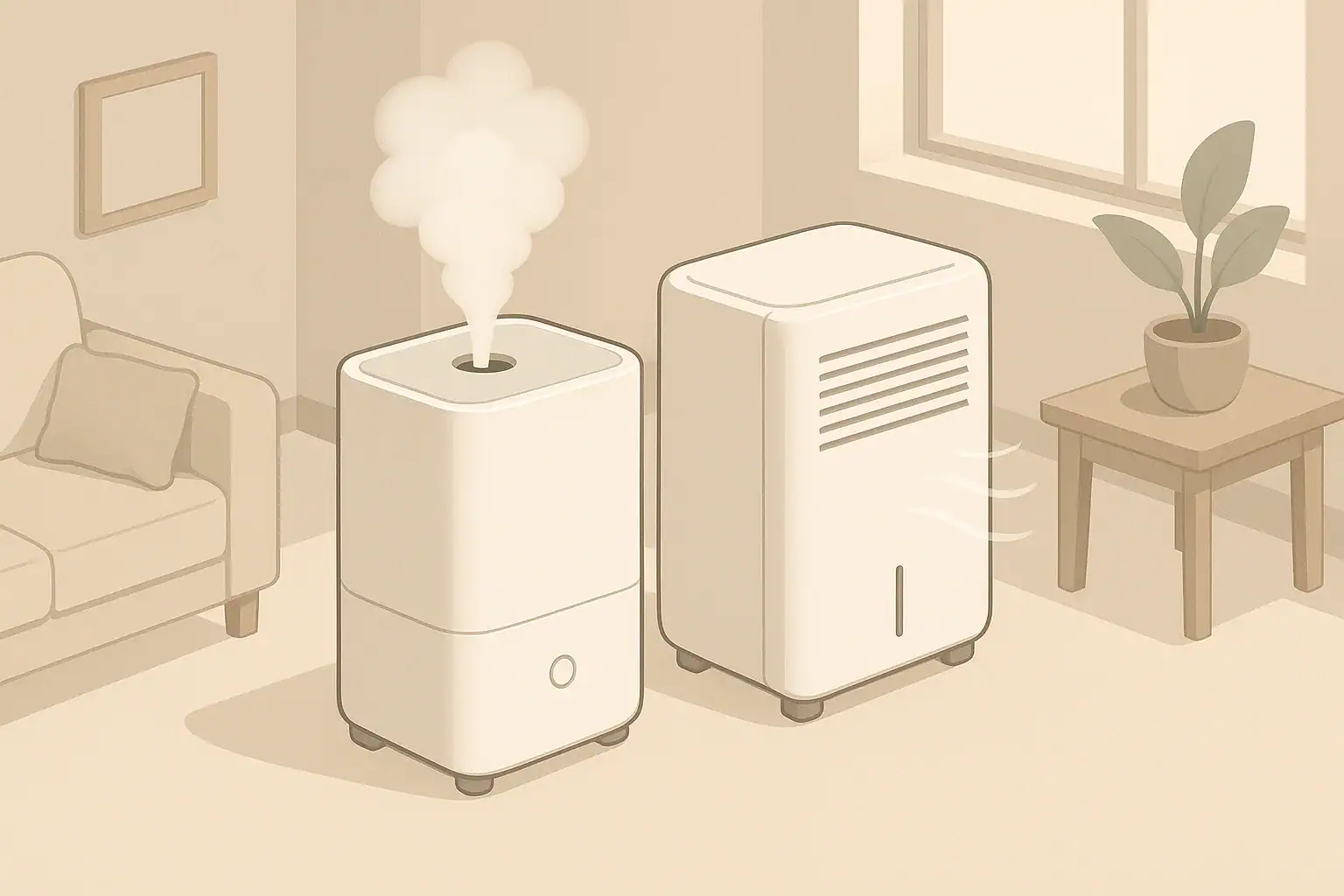
You use a humidifier when your indoor air is consistently too dry and a dehumidifier when it is consistently too damp, and the easiest way to know which you need is to measure your room’s relative humidity with a hygrometer. If readings sit mostly below about 30%, you typically add moisture; if they sit above about 55–60%, you usually remove it.
This guide walks through how humidifiers and dehumidifiers work, what indoor humidity range to aim for, and how to match the right tool to real rooms in your home. You will see practical examples for bedrooms, basements, bathrooms, and open living spaces, plus simple checks you can do before buying anything.
Whether you are dealing with static shocks and dry air in winter or musty, clammy rooms in summer, the goal is the same: keep humidity in a moderate band that supports comfort, protects your home, and reduces moisture-related risks without overcorrecting in either direction.
What Humidifiers and Dehumidifiers Do and Why Humidity Matters
Humidity is the amount of water vapor in the air. Indoors, that moisture level has a direct impact on comfort, how warm or cool a room feels, and how easily surfaces stay dry. Too little moisture feels harsh and drying; too much can make spaces feel heavy, sticky, and slow to dry out.
Most homes are most comfortable and manageable somewhere around 30–50% relative humidity (RH). The exact number is less important than avoiding long stretches at the extremes:
- Below about 30% RH: air is considered very dry. Static shocks are common, wood can shrink, and some people notice dry skin, throat, or eyes.
- Above about 55–60% RH: air is considered damp. Rooms can feel clammy, condensation may appear on windows or cold walls, and damp spots can stay wet longer than they should.
Humidifiers and dehumidifiers are tools for nudging indoor humidity back toward the middle when your heating, cooling, and building design are not enough on their own. A humidifier adds water vapor to dry air; a dehumidifier removes water vapor from damp air.
Because humidity changes with weather, season, and daily habits like showering or cooking, the most reliable way to decide between a humidifier vs dehumidifier is to measure humidity over time in the rooms you actually use.
Key Concepts: How Humidifiers and Dehumidifiers Work
Both devices are designed to move moisture between air and water, just in opposite directions. Understanding the basics helps you choose the right type and size for your space.
How a Humidifier Works
A humidifier adds moisture to indoor air. Common designs include:
- Evaporative units: a fan blows air across a wet wick or filter so water evaporates naturally into the room.
- Ultrasonic units: a vibrating plate turns water into a fine mist that is released into the air.
- Warm mist units: water is heated to create steam or warm vapor before it mixes with room air.
All types draw water from a tank or reservoir and release it into the air until the room’s humidity rises. Many have built-in humidistats that cycle the unit on and off around a target RH.
How a Dehumidifier Works
A dehumidifier pulls moist air in, removes water, and sends drier air back into the room. Two common approaches are:
- Refrigerant (compressor) units: air passes over cold coils, water condenses and drips into a tank or drain hose, and slightly warmed, drier air is returned to the room.
- Desiccant units: air passes over or through a moisture-absorbing material that is periodically dried out, releasing collected water to a tank or drain.
Dehumidifiers are usually rated by how many pints or liters of water they can remove from the air per day under specific test conditions. In practice, performance depends on how damp and how warm the room is, plus airflow around the unit.
Deciding Direction: Add Moisture or Remove It?
Instead of guessing based on how a room feels, use a hygrometer to measure RH over several days. Then use those readings, plus simple comfort clues, to decide which direction you need to go.
| Measured RH pattern | Typical room feel | More suitable device | What to check first |
|---|---|---|---|
| Often below 25–30% for many hours | Dry, cool, frequent static shocks | Humidifier | Look for over-ventilation or gaps letting in very cold outdoor air. |
| Mostly 30–50% with short swings | Generally comfortable | Usually none | Focus on normal cleaning and ventilation; monitor during season changes. |
| Frequently 55–65% | Slightly clammy, slow-drying towels | Dehumidifier | Check for weak exhaust fans and high-moisture habits like indoor drying. |
| Often above 65–70% | Very muggy, musty smells, condensation | Dehumidifier (plus source fixes) | Inspect for leaks, seepage, or standing water before relying on a device. |
| Switches between very dry in winter and damp in summer | Dry during heating season, muggy in warm months | Humidifier in winter, dehumidifier in summer | Use the same hygrometer year-round to time when to switch tools. |
Real-World Examples: Matching Tools to Rooms
Most homes have a mix of dry and damp areas. Instead of treating the whole house the same way, it often works better to match humidity tools to specific rooms or zones.
Dry-Air Examples Where a Humidifier Helps
- Heated bedroom in a cold climate: In mid-winter, a small bedroom with forced-air heat might sit at 20–25% RH for days. You notice dry lips, static shocks when touching metal, and creaking wood floors. A small room humidifier, run with a hygrometer nearby and adjusted to stay around 35–40% RH, can smooth out that dryness.
- Home office with electronics and paper: In a well-insulated house, a home office can still get very dry in winter. Paper files feel brittle and you get tiny shocks when touching your computer case. A modest evaporative humidifier can raise humidity into the low 30s, which often reduces static while still staying comfortably dry.
- Rooms with wood furniture or instruments: Display cabinets, wood floors, and musical instruments can shrink or crack over repeated dry seasons. Keeping those rooms from dropping below the low-30% range for long stretches with a controlled humidifier can help limit seasonal movement.
Damp-Air Examples Where a Dehumidifier Helps
- Basement in a humid summer: The basement smells musty, cardboard boxes feel soft, and a hygrometer reads 65–70% RH most afternoons. A basement dehumidifier set to about 50% RH, combined with better drainage and airflow, can bring readings down and help stored items stay drier.
- Bathroom without strong exhaust: After showers, mirrors stay fogged and walls feel damp for hours. Even with the door open, RH stays above 60% much of the day. Improving exhaust and using a small dehumidifier just outside the bathroom door can help moisture clear faster.
- Laundry or utility room: Indoor drying racks, unvented dryers, or frequent washing can push RH well above 60%. A dehumidifier placed where air can circulate, plus habits like running a fan until clothes are dry, can prevent persistent dampness.
Rooms That May Need Both Over the Year
- Open-plan living area: In winter, heating can bring RH down below 30%, so you might use a larger-capacity humidifier to keep the main area in the mid-30s. In summer, if the same space tends to hover above 60% RH despite air conditioning, a dehumidifier can help keep things closer to 45–50%.
- Spare bedroom or guest room: Little-used rooms sometimes become either very dry (if supply vents blast heated air) or very damp (if doors stay closed and air is still). Periodically checking humidity and running a humidifier or dehumidifier as needed helps keep the room ready for use and protects stored items.
| Room and symptom | Typical RH readings | Probable issue | Likely tool or action |
|---|---|---|---|
| Bedroom: static shocks, dry nose | 22–28% in winter evenings | Air too dry | Humidifier plus sealing drafts to reduce over-drying. |
| Basement: musty smell, damp boxes | 60–70% most afternoons | Chronic dampness | Dehumidifier plus checking for seepage and improving drainage. |
| Bathroom: fogged mirror for an hour after shower | Spikes to 75% then slowly drops | Moisture not vented quickly | Stronger exhaust, door open after use, dehumidifier if RH stays high. |
| Living room: comfortable most of the year | 35–45% with short swings | Stable humidity | No device needed; keep monitoring during extreme weather. |
| Closet on exterior wall: musty clothes | Not measured, but room next door at 60% | Trapped humid air | Increase airflow, avoid overstuffing, consider whole-room dehumidification. |
Common Mistakes and Troubleshooting Humidity Problems
Even when you choose the right type of device, a few common missteps can keep humidity from improving or can create new problems. Watching for these issues early can save time and frustration.
Common Humidifier Mistakes
- Running without measuring: Using a humidifier based only on how air feels can easily lead to over-humidifying. If windows start to fog or nearby surfaces feel damp, reduce output or run the unit for fewer hours and confirm with a hygrometer.
- Placing the unit in a corner: Tucking a humidifier into a tight corner can cause local condensation while the rest of the room stays dry. Move it toward the center of the room, on a stable surface with some space around it, and keep it away from delicate electronics.
- Ignoring mineral buildup: Hard water can leave white dust or scale inside the unit. If you see visible deposits, clean according to the manual and consider using cleaner water sources to reduce buildup.
Common Dehumidifier Mistakes
- Trying to dry a space with active leaks: A dehumidifier cannot keep up with ongoing roof, wall, or plumbing leaks. If the tank fills rapidly and humidity barely drops, inspect for water intrusion and fix those sources first.
- Blocking airflow: Placing a dehumidifier tight against a wall or furniture can choke its air intake and exhaust. Leave several inches of clearance on all sides so air can circulate freely.
- Leaving windows open: In humid weather, an open window can supply more moisture than the dehumidifier can remove. Keep doors and windows mostly closed in the area you are trying to dry.
Troubleshooting Clues to Watch For
- Humidity not changing: If RH readings stay almost the same after hours of running a device, check for undersized capacity, open windows, or nearby rooms feeding in very dry or very humid air.
- Uneven readings in different spots: Large rooms and multi-level spaces can have pockets of different humidity. Take readings in multiple locations and consider using more than one device or improving airflow with fans.
- Short cycling: If a unit turns on and off rapidly, the built-in sensor may be too close to the moisture source or blocked by furniture. Reposition the device and make sure vents are clear.
Safety Basics for Humidifiers and Dehumidifiers
Humidifiers and dehumidifiers are everyday appliances, but they combine water and electricity, so basic safety habits matter. Good placement, wiring, and use can reduce risk and help the devices last longer.
Electrical and Placement Safety
- Use appropriate outlets: Plug units directly into properly grounded wall outlets. Avoid daisy-chaining power strips or using light-duty extension cords that are not rated for the device’s load.
- Keep cords out of traffic paths: Route power cords where they will not be tripped over or pinched under doors, furniture, or rugs.
- Protect from splashes: For humidifiers, keep the base and cord away from sinks, tubs, and other sources of accidental splashing. For dehumidifiers, avoid placing them where they can be sprayed directly with water.
Water Handling and Spill Prevention
- Fill and empty carefully: Carry water tanks with two hands and avoid overfilling. Wipe up spills promptly so floors do not become slippery.
- Secure drain hoses: If using a continuous drain on a dehumidifier, route the hose so it slopes steadily downward into a suitable drain and is not kinked or easily dislodged.
- Avoid standing water: Do not let water sit in tanks for long periods when the unit is off. Empty and dry tanks if you will not use the device for several days.
Operating Within Reasonable Ranges
- Do not chase extreme targets: Trying to maintain very low humidity (below about 30%) or very high humidity (above about 50–55%) for long periods typically offers little benefit and can create new problems.
- Respect temperature limits: Many dehumidifiers are designed for use in spaces above a certain temperature. Running them in very cold rooms can cause frost buildup on coils and reduce performance.
- Follow manufacturer instructions: Always read and follow the specific safety guidelines, including placement, maximum extension cord length if allowed, and recommended room types.
Maintenance and Long-Term Use
Regular maintenance keeps both humidifiers and dehumidifiers working reliably and helps you avoid unwanted side effects like mineral deposits, odors, or reduced performance. Most tasks are simple and take only a few minutes when done consistently.
Humidifier Care and Storage
- Daily or frequent tasks: Refill the tank with clean water, empty any leftover water before refilling, and quickly inspect for visible buildup or film.
- Weekly or periodic cleaning: Follow the cleaning schedule in your manual, which often includes rinsing or wiping the tank, cleaning the base, and checking wicks or filters for discoloration or deposits.
- Seasonal storage: At the end of the dry season, empty all water, let the unit dry thoroughly, clean removable parts, and store it in a dry location where dust will not clog vents.
Dehumidifier Care and Storage
- Tank and drain maintenance: Empty and rinse the water tank regularly. If using a drain hose, check occasionally for clogs, kinks, or buildup at the drain point.
- Filter and coil care: Many dehumidifiers have washable or replaceable air filters. Clean or replace them as recommended so airflow stays strong. If the unit has accessible intake grilles, gently remove dust buildup.
- Off-season storage: When the damp season ends, turn the unit off, let any remaining ice or condensation clear, empty the tank, wipe surfaces dry, and store it upright in a cool, dry place.
Signs It May Be Time to Replace or Upsize
- Persistent high or low RH despite regular use: If your hygrometer still shows out-of-range readings after trying different settings and placements, your device may be undersized for the space.
- Unusual noises or smells: Grinding, rattling, or burning odors are cues to unplug the unit and inspect or consider replacing it.
- Very old units with poor efficiency: Older devices may use more energy and deliver less moisture control than newer designs. If your unit runs constantly without much impact, an upgrade in capacity or efficiency may help.
Practical Takeaways and Specs to Look For
Choosing between a humidifier vs dehumidifier becomes much easier when you focus on measured humidity, not just how a room feels. Measure first, fix obvious moisture sources or drafts, then use the right tool in the right room.
In many homes, a simple strategy works well: use a humidifier in dry winter bedrooms or offices, a dehumidifier in damp basements or laundry rooms, and rely on good ventilation in kitchens and bathrooms to handle short moisture spikes.
Quick Takeaways
- Use a hygrometer to track RH in key rooms for several days before buying devices.
- Aim to keep most rooms roughly in the 30–50% RH range over time.
- Choose a humidifier when readings are consistently low; choose a dehumidifier when readings are consistently high.
- Address leaks, poor drainage, and weak exhaust fans before relying on a dehumidifier alone.
- Place devices where air can circulate and adjust settings gradually while watching for condensation or persistent dampness.
Specs to Look For When Comparing Devices
- Capacity matched to room size: For humidifiers, check the recommended room area or volume. For dehumidifiers, look at pints or liters per day and match it to room size and how damp the space tends to be.
- Built-in humidity control: A digital humidistat or adjustable dial lets the device cycle around a target RH instead of running at full power constantly.
- Noise level: For bedrooms and living areas, consider models with lower sound output or multiple fan speeds so you can run them comfortably at night.
- Tank size and drainage options: Larger tanks or continuous drain connections reduce how often you need to empty water, especially for dehumidifiers in very damp spaces.
- Filter or wick type and replacement cost: Check whether the unit uses disposable or washable parts and how often they need attention.
- Power use: Compare wattage or estimated energy use, especially for devices that will run many hours a day in basements or main living areas.
- Operating temperature range: Make sure the device is rated for the conditions in your space, particularly for basements, garages, or unheated rooms.
With clear measurements, realistic expectations, and attention to a few key specifications, you can choose and use humidifiers or dehumidifiers in a way that keeps your indoor air more stable and your home more comfortable across the seasons.
Frequently asked questions
What specs or features should I look for when choosing between a humidifier and a dehumidifier?
Match capacity to the room (humidifiers list room size; dehumidifiers list pints or liters removed per day), and look for a built-in humidistat so the unit cycles around a target RH. Consider noise level, tank size or continuous-drain options, filter or wick maintenance needs, operating temperature range, and estimated power use when comparing models.
Is it a mistake to operate a humidifier or dehumidifier without measuring room humidity?
Yes. Running a device without a hygrometer can lead to over- or under-correcting humidity; measure RH over several days to confirm patterns and adjust settings accordingly. A small sensor is inexpensive and helps avoid condensation, mold risk, or wasted energy.
Are humidifiers and dehumidifiers safe to use around children and pets?
Generally they are safe if used per the manufacturer’s instructions and with basic precautions: plug into grounded outlets, keep cords and units out of reach, place devices on stable surfaces, and clean tanks regularly to prevent microbial growth. Avoid placing humidifiers where hot steam could scald and keep dehumidifier drain hoses secured so pets cannot chew or dislodge them.
How often should I clean or maintain my unit to avoid odors and buildup?
For humidifiers, refill daily or as recommended, and follow a weekly cleaning schedule to remove mineral film and biofilm; empty tanks when not in use. For dehumidifiers, empty and rinse the water tank regularly, clean or replace air filters per the manual, and check drain hoses for clogs before storing the unit for the season.
Can I use a dehumidifier to fix leaks or standing water?
No. A dehumidifier can help dry air and reduce dampness but cannot keep up with active leaks or standing water; repair the source of intrusion and improve drainage before relying on a dehumidifier alone. If water appears faster than the unit can remove it, investigate and fix plumbing, roof, or foundation issues.
Will a single unit control humidity for an open-plan home, or do I need multiple units?
It depends on the space and how uniform humidity is; a single, appropriately sized unit may manage an open-plan area, but very large or multi-zone homes often need multiple devices or a whole-house solution. Take multiple hygrometer readings and consider airflow and occupancy patterns when deciding whether one unit is enough.
- Clear sizing logic (room size → CADR/ACH)
- HEPA vs carbon explained for real use-cases
- Humidity + ventilation basics to reduce mold risk