
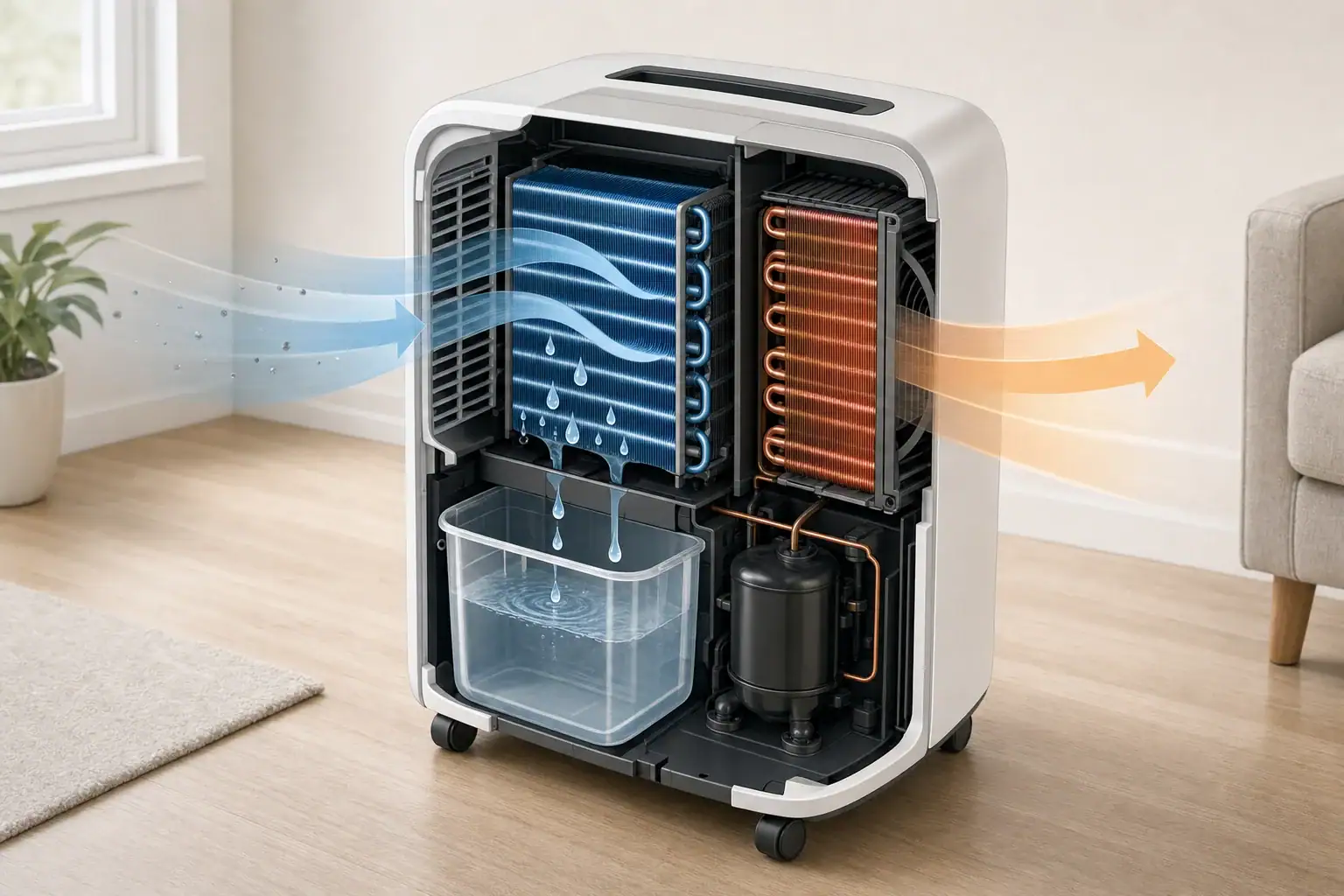
How does a dehumidifier work step by step?
Most portable residential dehumidifiers use a fan and a refrigeration system. The fan draws room air into the appliance. A cold coil removes some of the air’s water vapor as liquid water, and a warm coil reheats the drier air before the fan returns it to the room.
The appliance does not make water. It changes water vapor already present in room air into liquid that can be collected or drained.
| Process stage | What happens in a compressor unit | What you may notice |
|---|---|---|
| Intake | A fan draws room air through the intake grille and any fitted filter. | Airflow and fan noise at the intake |
| Cooling | The evaporator coil cools incoming air toward or below its dew point. | A cold coil; frost can develop in some conditions |
| Water separation | Some water vapor condenses on the cold coil as droplets. | Water moving into an internal collection channel |
| Collection | Condensate goes to a bucket or, where supported and correctly installed, a drain hose or pump. | A rising bucket level or drain flow |
| Reheating | The drier air passes over the warm condenser coil. | Outlet air feels warmer than intake air |
| Exhaust | The fan returns drier air to the room. | Room RH may change gradually |
| Control | A humidistat cycles moisture removal around the selected setting. | The compressor starts and stops |
| Defrost | Some units pause the compressor so frost can melt. | A temporary pause in water collection |
Why liquid water appears in the bucket
Air contains invisible water vapor. When humid air contacts a sufficiently cold evaporator coil, it cools. As the air temperature falls, its relative humidity rises; once the air is cooled below its dew point, some vapor changes into liquid on the coil.
This is the same basic process that produces droplets on the outside of a cold glass. The U.S. Environmental Protection Agency explains that condensation can form when warm, humid air contacts a cold surface.
Gravity carries the droplets into the appliance’s collection system. Portable units commonly use a removable bucket; some can use gravity drainage, while a pump arrangement is available on certain products. ENERGY STAR notes these collection and drainage options. Follow the manual for the particular unit’s approved hose route, pump use, and bucket installation.
Why the outlet air feels warmer
In a compressor unit, the evaporator first cools the incoming air. The refrigerant then carries heat to the condenser, which releases that heat into the same air stream before it leaves the unit. Heat associated with operating the compressor also remains indoors.
That is why a portable compressor dehumidifier generally discharges air that is drier and somewhat warmer than the air it took in. The amount of warming is not fixed: it varies with room conditions, airflow, operating stage, and appliance design. ENERGY STAR similarly notes that air around an operating dehumidifier may become warmer.
A standard portable dehumidifier is therefore not a room air conditioner. An air conditioner sends condenser heat outdoors; a portable dehumidifier keeps both coils in the room.
How humidistat cycling and defrost work
A humidistat measures relative humidity near the appliance and compares the reading with the selected setting. Once the room reaches the desired RH level, a dehumidifier can cycle off and later restart as the measured humidity rises again, as described in ENERGY STAR’s consumer guidance.
This does not mean every point in a room stays at one exact humidity. Air mixing, appliance location, temperature shifts, open doors, and moisture entering from nearby spaces can all change readings. Fan behavior after the compressor stops also varies by model.
A full bucket can stop dehumidification until it is emptied and reinstalled. Consult the appliance manual for its float-switch and restart behavior.
Frost can form on a cold evaporator in some operating conditions. Frost reduces the coil’s contact with moving air and can impair moisture removal. Some models use an anti-frost control or defrost mode. For example, the Honeywell TPFIT 25/32 Series manual says its compressor turns off while the fan continues to run until frost melts. That sequence is specific to those models, not a rule for every dehumidifier.
Compressor and desiccant mechanisms
Compressor dehumidifiers
Compressor systems use refrigeration. They cool air below its dew point so water can condense on an evaporator coil, then reheat the drier air at a condenser coil. This is the mechanism used by many portable consumer dehumidifiers.
Desiccant dehumidifiers
Desiccant systems remove vapor by adsorption: water molecules bind to the surface of a moisture-attracting material. The material must be regenerated so it can continue taking up moisture. In a desiccant rotor system, part of the rotating wheel passes through a heated reactivation air stream that releases the captured moisture. Munters’ rotor-technology explanation describes this surface-binding and regeneration process.
Drainage and exhaust arrangements differ among desiccant products, especially between portable and commercial equipment. Use the product documentation rather than assuming a particular setup.
Measurement checklist for observing a dehumidifier
A short log can help show what one appliance is doing in one room without assuming a universal removal rate.
- Record starting conditions: Note room relative humidity and temperature using a separate humidity meter. Keep it away from the unit’s direct discharge air.
- Document the setup: Note the appliance location, unobstructed intake and outlet areas, and whether doors and windows remain in the same position.
- Check collection: Start with a known bucket level, or verify that an approved drain arrangement is unobstructed and set up as the manual directs.
- Confirm airflow: Check for noticeable intake and outlet airflow without opening the appliance or reaching through its grille.
- Use fixed intervals: Record RH and temperature at the start and at consistent intervals, such as 30, 60, and 120 minutes.
- Note operating states: Separate compressor operation, fan-only or defrost periods, full-bucket shutoff, and complete off periods in the log.
- Measure water only when practical: Use bucket markings or a suitable measuring container instead of estimating by appearance.
- Repeat under similar conditions: Keep meter placement, room access, and starting conditions as consistent as practical when comparing runs.
Interpret the record cautiously. Temperature changes affect relative-humidity readings, while outdoor air, damp materials, people, laundry, and other moisture sources can add water vapor during the observation. One timed check describes that particular room and setup, not a universal water-removal rate.
Frequently asked questions
Does a dehumidifier cool a room?
A standard portable compressor dehumidifier is not a room air conditioner. Its evaporator cools air briefly, but its condenser releases heat back into the room. The discharged air is therefore usually drier and somewhat warmer.
Why is my dehumidifier running but not collecting water?
Collection can slow or stop when the room is near the selected humidity setting, the bucket is full, or the appliance is defrosting. Current room moisture, temperature, airflow, and moisture entering from other spaces also affect how much water reaches the bucket.
Can open doors or windows affect dehumidification?
Yes. Air entering from outdoors or adjacent spaces can bring in additional moisture and change both humidity readings and drying time. Keep door and window positions consistent when comparing observations.
Summary
A compressor dehumidifier moves room air over a cold evaporator coil, where some water vapor condenses and drains into a bucket or approved drainage system. It then passes the drier air over a warm condenser coil and returns it to the room. Humidistat, full-bucket, and defrost controls can temporarily change or stop collection.
Related guides: How to Size a Dehumidifier · Drain Hose vs Bucket · Dehumidifier Ice Build-Up
Recommended next:
- How to Size a Dehumidifier (Sq Ft, Pints/Day, and Real-World Tips)
- Desiccant vs Compressor Dehumidifiers: Which Is Better for Cold Rooms?
- Basement Dehumidifier Guide: Targets, Drainage, and Energy Use
- Dehumidifier Running Cost: How Much Electricity Will It Use?
- Dehumidifier Sizing: Liters/Day, Room Type, and Dampness Levels
- Basement Dehumidifier Setup: Drainage, Placement, and RH Targets
- Clear sizing logic (room size → CADR/ACH)
- HEPA vs carbon explained for real use-cases
- Humidity + ventilation basics to reduce mold risk