
Can you drink dehumidifier water safely?
No. Ordinary household dehumidifier condensate is not potable water. Use an approved potable supply for drinking, cooking, ice, infant formula, and pet bowls.
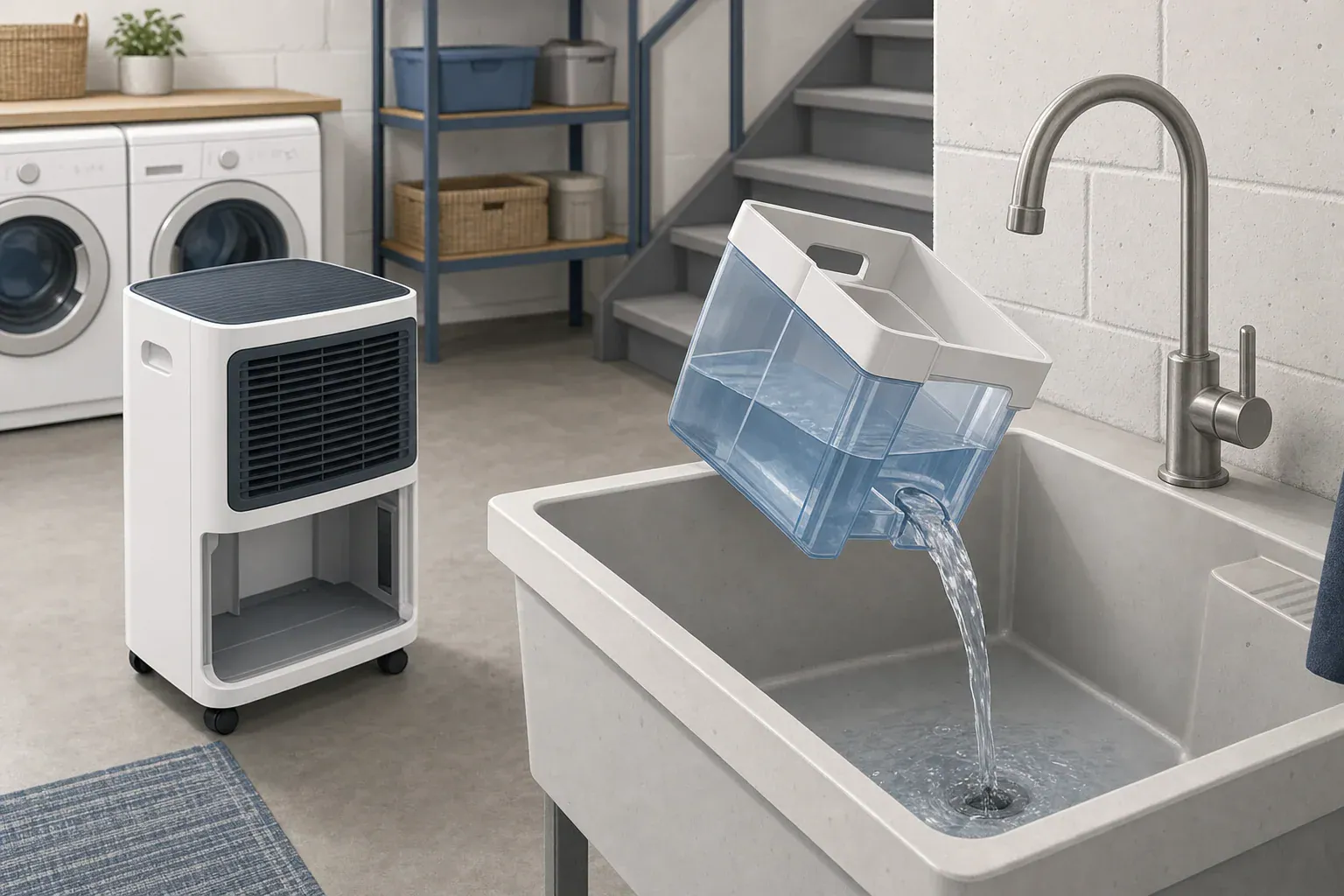
Although instructions vary by model, a Hisense manual for models DH10020KP1WG and DH10019TP1WG explicitly says, “Do not drink water collected in the water bucket.” The manual directs users to empty the bucket into a sink or tub.
Why dehumidifier condensate is not distilled drinking water
A compressor dehumidifier condenses moisture from room air on a cold coil. That water then passes over internal surfaces and through a drain path into the bucket. It is not produced, collected, or stored under a drinking-water standard.
Along that route, water can acquire airborne debris and residue from the coil, drain path, and collection bucket. Storage in a wet reservoir can also allow microbial growth. An EPA research record on air-conditioning condensate describes microbial instability and detections of microorganisms and metals in samples from air-handling units.
That EPA work was not a representative survey of portable residential dehumidifiers, so it cannot identify what is in any particular home bucket. It does show why clear-looking condensate should not automatically be treated as clean drinking water.
Will boiling or filtering make it drinkable?
Do not rely on boiling or an ordinary household filter to make dehumidifier water potable. The CDC explains that boiling can kill disease-causing germs, but it does not make water containing harmful chemicals safe to drink. A pitcher or faucet filter is designed for specific contaminants and does not establish that water of unknown quality is safe for consumption.
For drinking, use water from an approved potable source rather than trying to treat collected condensate at home.
Dehumidifier water reuse: a conservative decision table
The lowest-risk default is prompt disposal. Reuse rules can vary by jurisdiction, and an appliance manual may give more specific instructions for a model.
| Proposed use | Recommendation | Why |
|---|---|---|
| Drinking, cooking, ice, or pet bowls | No | The water is nonpotable. Do not depend on boiling or a basic household filter to make it suitable for consumption. |
| Toilet flushing | Conditional; not a blanket approval | An EPA guide for engineered laboratory condensate systems calls for filtration and disinfection before toilet or urinal flushing. That does not approve untreated water from a household bucket. |
| General cleaning | Prefer disposal; limited reuse only if locally allowed | Do not use it on dishes, food-contact surfaces, toys, personal-care items, or in spray-cleaning tasks. Avoid splashing and skin contact. |
| Outdoor use | Conditional; avoid consumption pathways | Do not assume it is suitable for plants. Avoid edible crops and spray irrigation. Follow applicable local requirements and the product manual. |
| Sink or tub disposal | Preferred default | Empty promptly where local rules allow. The cited Hisense manual directs its covered-model users to a sink or tub. |
Do not put dehumidifier water in humidifiers, aquariums, batteries, steam appliances, or medical equipment. Those uses can have water-quality requirements that ordinary condensate does not meet. For humidifier-specific water choices, see Tap, Filtered, or Distilled Water for Humidifiers.
Handling checklist
- Empty the bucket promptly. Do not collect and combine batches unnecessarily. There is no universal household dehumidifier-water storage limit established by the sources reviewed here.
- Pour slowly and avoid splashing. Keep the bucket away from your face and do not spray the water.
- Wear gloves when warranted. Gloves are sensible if the bucket is slimy, visibly moldy, unusually dirty, or if you are protecting cuts or irritated skin.
- Label any temporary reuse container. Mark it NONPOTABLE—DO NOT DRINK and keep it away from children and pets.
- Discard questionable water. Do not reuse water with visible debris, slime, discoloration, or an unusual odor.
- Clean the reservoir as instructed. Follow your model’s manual. The cited Hisense manual specifies weekly bucket cleaning during use for its covered models; schedules differ by appliance.
Regular bucket emptying also helps keep the appliance manageable. See how often to empty a dehumidifier bucket for practical emptying guidance.
Bottom line
Dehumidifier water is appliance condensate, not distilled drinking water. Dispose of it promptly by default. If a local rule and your appliance instructions allow reuse, keep it nonpotable and low-contact, and keep it away from food, pets, edible plants, sprays, and equipment with specified water requirements.
Frequently asked questions
If dehumidifier water looks clear, is it safe to drink?
No. Clear water can still contain contaminants or microorganisms that are not visible. Treat ordinary household dehumidifier condensate as nonpotable.
Can boiling dehumidifier water make it safe to drink?
No. Boiling can kill disease-causing germs, but it does not address every possible contaminant. CDC guidance says boiling does not make water containing harmful chemicals safe to drink.
Can I give dehumidifier water to my dog or cat?
No. Pets can ingest the water, so provide an approved potable water source instead.
Recommended next:
- How to Size a Dehumidifier (Sq Ft, Pints/Day, and Real-World Tips)
- Desiccant vs Compressor Dehumidifiers: Which Is Better for Cold Rooms?
- Basement Dehumidifier Guide: Targets, Drainage, and Energy Use
- Dehumidifier Running Cost: How Much Electricity Will It Use?
- Dehumidifier Sizing: Liters/Day, Room Type, and Dampness Levels
- Basement Dehumidifier Setup: Drainage, Placement, and RH Targets
- Clear sizing logic (room size → CADR/ACH)
- HEPA vs carbon explained for real use-cases
- Humidity + ventilation basics to reduce mold risk