
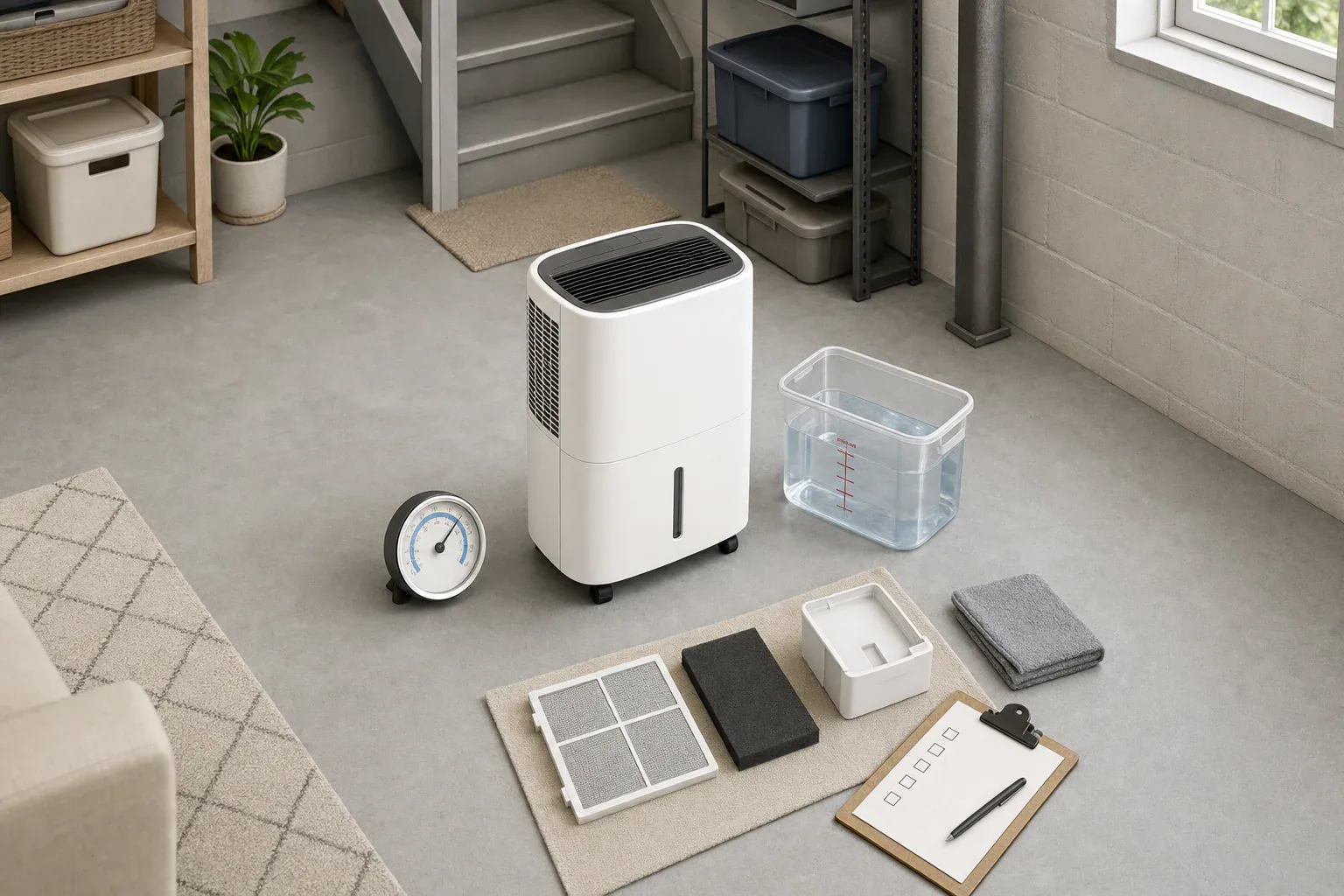
How long does a dehumidifier last?
No single service-life figure applies to every portable or whole-home dehumidifier. Operating load, room conditions, maintenance, installation, design, and availability of replacement parts can all affect how long a unit remains useful. Age is useful context, but it cannot diagnose a fault or predict how many years remain.
A warranty is also not a lifespan estimate. It states the manufacturer’s covered remedy and coverage period under its terms. Warranty coverage varies by model and equipment type, so check the documents for the exact unit before authorizing paid service.
Compare performance under similar conditions
Less water in the bucket does not automatically mean a dehumidifier is worn out. A cooler room, lower starting relative humidity (RH), shorter operating period, or less moisture entering the room can all reduce collection.
Temperature matters particularly for compressor-type units. ENERGY STAR notes that frost can form when air temperature drops below 65°F, which can reduce performance through repeated compressor cycling. That does not establish that every cold-room problem is normal; it means a cold-weather observation alone is a poor basis for judging service life. For more context, see Dehumidifier in Winter: Does It Work in Cold Basements?.
The U.S. Department of Energy’s portable-dehumidifier rating procedure uses a controlled two-hour test at 65°F ±2°F and 60% RH ±2%. Those are laboratory rating conditions, not a home durability test or a target for troubleshooting. They do show why meaningful before-and-after comparisons need similar temperature, humidity, and runtime.
Comparable-condition checklist
- Room and placement: Use the same room and keep the unit in a similar position, with the manual’s required clearance around its air inlet and outlet.
- Temperature and RH: Record room temperature and starting and ending RH. Use the same hygrometer in the same position each time.
- Moisture conditions: Note open doors or windows, laundry drying, showers, water intrusion, weather changes, and other moisture sources.
- Observation period: Compare equal periods, rather than a partial day with a full day.
- Runtime: Record how long the unit was switched on and, where the controls indicate it, when dehumidification was active.
- Water collected: Measure collection consistently. Do not compare a measured bucket with an unmeasured continuous drain.
- Maintenance history: Note filter, airflow-path, bucket, and drain maintenance performed according to the owner’s manual.
- Age and faults: Record purchase date, earlier repairs, and recurring displayed error codes.
- Coverage: Check the exact model’s warranty, serial-number requirements, and recall status.
One observation cannot estimate remaining life. A repeatable decline under meaningfully similar conditions is more useful information when deciding whether to seek service.
When maintenance, service, or replacement makes sense
Start with the tasks the owner’s manual specifically assigns to the user. Depending on the model, that may include cleaning or replacing an accessible filter, removing external airflow obstructions, reseating the bucket, or checking an accessible drain connection. Do not open electrical or sealed refrigerant-containing components.
If manual-approved maintenance is current but moisture removal remains lower under comparable conditions, the unit runs longer for the same result, a new noise persists, or a fault returns, a qualified service provider can identify the fault and provide an itemized estimate. Reduced collection alone cannot establish a compressor, sensor, or refrigerant problem.
| Finding | What it may mean | Practical next step |
|---|---|---|
| Collection fell when the room became cooler or less humid | Changed conditions may explain the difference. | Repeat the comparison while documenting temperature, starting RH, runtime, and water collected. |
| Filter, airflow path, bucket, or accessible drain maintenance is overdue | A correctable user-maintenance issue may be affecting operation. | Perform only maintenance allowed by the manual, then repeat the comparison. |
| The reported defect may be covered by warranty | The manufacturer may provide a repair or replacement remedy under its terms. | Contact the manufacturer before approving paid work. |
| Performance remains worse under comparable conditions | An internal problem is possible, but cannot be confirmed from water collection alone. | Request a diagnosis and an itemized written estimate. |
| A new noise or displayed fault returns after approved maintenance | Parts or internal service may be needed. | Document the symptom and ask what parts, labor, and repair warranty the quote includes. |
| Parts are available and the complete repair cost compares favorably with an equivalent replacement | Repair may be a reasonable way to continue using the unit. | Compare the complete quote with replacement, installation, drainage, and disposal costs. |
| Major faults recur, parts are unavailable, or the quote is close to complete replacement cost | Further repair may offer limited value. | Replacement is often the more practical option; there is no universal cost percentage that decides every case. |
| The exact model and date code are included in a recall | Recall instructions override ordinary repair economics. | Stop using the affected unit and follow the official recall remedy. |
Check warranty and recall status before paying for service
Find the model and serial number, purchase date, and warranty document. Check covered components, labor coverage, registration conditions, and any installation requirements. Do not use the warranty period as an expected-life prediction.
Also check the U.S. Consumer Product Safety Commission’s dehumidifier recall page. CPSC instructs owners of affected recalled dehumidifiers to stop using them. Verify the exact model and date code: a matching brand name or a similar appearance is not enough to show that a unit is included.
What to request in a repair quote
Ask for a written estimate identifying the diagnosed fault, proposed parts, labor, service-call charges, warranty on the repair, and whether further work may be needed. Compare the full total with a suitably sized replacement that has the drainage and installation features you need. Our dehumidifier sizing guide can help when comparing replacement options.
Also weigh fault history and parts availability. A covered, first-time repair is a different decision from an expired-warranty unit with repeat faults and limited parts support. No evidence-based repair-cost percentage works for every model or household.
Dispose of a replaced dehumidifier responsibly
A dehumidifier may contain refrigerant, so disposal rules and services vary by location. The EPA advises checking municipal, retailer, and utility programs; some programs require refrigerant recovery before accepting an appliance. Do not assume the unit belongs with ordinary household trash. See also How to Dispose of a Dehumidifier Safely.
Bottom line
You cannot tell how many years a dehumidifier has left from age or one low bucket reading. First compare performance under similar temperature, RH, and runtime conditions, then complete manual-approved maintenance and check warranty and recall status. If the decline persists, use a written diagnosis and quote to make a repair-or-replace decision.
Recommended next:
- How to Size a Dehumidifier (Sq Ft, Pints/Day, and Real-World Tips)
- Desiccant vs Compressor Dehumidifiers: Which Is Better for Cold Rooms?
- Basement Dehumidifier Guide: Targets, Drainage, and Energy Use
- Dehumidifier Running Cost: How Much Electricity Will It Use?
- Dehumidifier Sizing: Liters/Day, Room Type, and Dampness Levels
- Basement Dehumidifier Setup: Drainage, Placement, and RH Targets
- Clear sizing logic (room size → CADR/ACH)
- HEPA vs carbon explained for real use-cases
- Humidity + ventilation basics to reduce mold risk