
How to dehumidify a room without a dehumidifier
The practical goal is to remove water from the room or stop it from being added—not merely make the humidity number look lower by warming the air. Start with a hygrometer. ENERGY STAR describes 30% to 50% relative humidity (RH) as generally optimal, while the CDC advises keeping indoor humidity no higher than 50% to help prevent mold. In cold weather, a lower RH may be necessary if windows or other surfaces are condensing moisture.
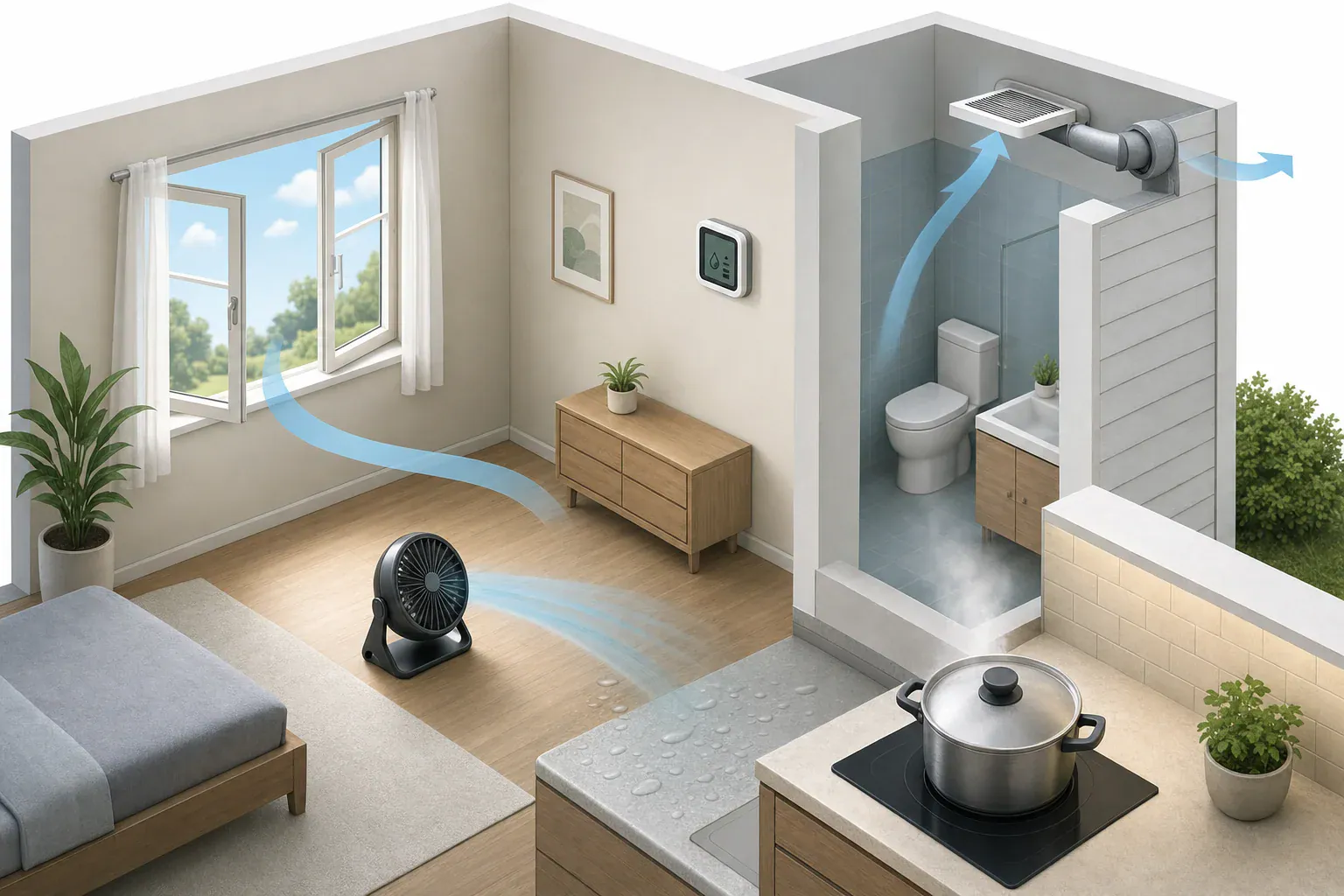
- Stop the moisture source. Fix leaks, move wet items out of the room, cover simmering pots, and avoid drying laundry indoors where possible. Close the door to a moisture-producing room until its moisture can be exhausted.
- Exhaust moisture outdoors. Run a bathroom fan that vents outdoors while showering, and use a range hood that vents outdoors while cooking. EPA recommends outdoor-vented bathroom and kitchen exhaust for moisture control.
- Ventilate only when outside air is drier. Compare dew points, not just outdoor and indoor RH percentages. Open windows only when outdoor dew point is lower than indoor dew point and outdoor air quality is acceptable.
- Use a fan for surface drying, with an exit path for moisture. A circulating fan can reduce stagnant air and help a clean damp surface evaporate. The added vapor still needs to leave through exhaust or favorable ventilation.
- Recheck the trend. Record room temperature and RH at consistent times. A meaningful result is a sustained RH improvement after source control or ventilation, not a brief shift caused by a temperature change.
Which actions remove moisture, and which do not?
| Action | Best conditions | Main limitation | What to check |
|---|---|---|---|
| Stop leaks, boiling, indoor laundry, and other moisture sources | Any room with elevated RH | Moisture already stored in wet materials may remain | Compare RH before and after the activity stops |
| Use an outdoor-vented bath fan or range hood | During showers and cooking | Replacement outdoor air can be humid | Watch the RH peak and subsequent recovery |
| Open windows or use window ventilation | Outdoor dew point is below indoor dew point; outdoor air is acceptable | Can add moisture when outdoor dew point is higher | Confirm that RH trends downward rather than upward |
| Use a portable or ceiling fan | Clean damp surfaces, cold corners, or stagnant air | Moves moisture; it does not export or capture it | Check surface dryness as well as room RH |
| Warm a cold room or surface moderately | Condensation is forming on a cold surface | Can lower RH without reducing the water vapor present | Check whether condensation returns when temperatures fall |
| Use a labeled passive moisture absorber | Small enclosed cupboards or closets | Finite capacity; room-scale performance depends on product and moisture load | Do not rely on it if room RH does not change |
When opening windows helps
Outdoor RH can be misleading because relative humidity changes with temperature. The National Weather Service explains that dew point reflects the amount of moisture in air, whereas RH is temperature-dependent.
The useful comparison is dew point: EPA moisture-control guidance states that ventilation dehumidifies only when outdoor air has a lower dew point than indoor air. Also consider smoke, pollution, pollen, and extreme humidity. EPA advises avoiding outdoor ventilation when those conditions make outside air unsuitable.
Worked dew-point decision example
This is a hypothetical example, not a drying-time forecast. Assume a reasonably well-mixed room is 75°F at 65% RH, with no active shower, leak, or other moisture source during the comparison. The indoor dew point is approximately 62°F.
- If the outdoor dew point is 55°F, the incoming outdoor air contains less water vapor than the indoor air. Once warmed to 75°F, it would be about 50% RH before accounting for moisture released from furnishings or surfaces. Ventilation can help lower room moisture.
- If the outdoor dew point is 68°F, the incoming air contains more water vapor than the indoor air. Opening windows would work against the drying goal, even if the outdoor RH percentage appears lower.
Actual results depend on airflow, room volume, wet materials, and continuing moisture sources. Use the room’s RH trend to verify whether the choice is helping.
Why fans, heat, salt, and rice have limits
Fans
A recirculating fan does not dehumidify a room. It can speed evaporation from a clean damp surface, but that evaporated water enters the room air. Without outdoor exhaust, drainage through an existing cooling system, or favorable ventilation, the room has not lost that water.
Heat
Warming air generally lowers its RH reading and can warm condensation-prone surfaces. Heating alone does not remove water vapor. If the room cools later, RH can rise again.
Passive absorbents
Loose rice, baking soda, and bowls of ordinary salt should not be relied on for room-scale humidity control. Reliable room-scale performance data for these household materials are not established, and any absorbent has finite capacity. They cannot substitute for correcting a leak or controlling recurring shower, cooking, laundry, or humid-outdoor-air moisture.
A commercial passive absorber may be useful in a small enclosed space if used according to its label. Judge it by the humidity reading and the condition of the space, not by whether liquid appears in its container.
Reassess and escalate
- Log room temperature and RH at consistent times, including after showering or cooking.
- Keep the hygrometer away from direct steam, open windows, supply vents, and cold exterior surfaces that can distort a room-level reading.
- Inspect plumbing, roofing, window edges, exterior walls, and HVAC drainage for ongoing water entry.
- Verify that bathroom and kitchen fans discharge outdoors rather than into an attic, wall cavity, or another indoor space.
- Look for repeated condensation, wet materials, visible mold, or a persistent musty odor.
- Seek building, maintenance, or HVAC help if RH repeatedly remains above 60%, if materials stay wet, or if source control and favorable ventilation do not improve the readings. EPA identifies persistent humidity above 60% as a situation needing a specific dehumidification strategy.
- Address water intrusion and mold rather than masking odors. For flood- or water-damaged materials, the CDC recommends repairing leaks and drying wet items within 24 to 48 hours. That water-damage guidance is not a promise for how quickly ordinary room RH will fall.
Related guides: Best Indoor Humidity Level to Prevent Mold · Exhaust Fan Best Practices · Why Cheap Hygrometers Disagree
Frequently asked questions
Can a fan dehumidify a room?
No. A recirculating fan moves air but does not remove water from the room. It can help a clean damp surface evaporate, but the resulting water vapor must still be exhausted outdoors, drained by an existing cooling system, or replaced with drier outdoor air.
Should I open windows when room humidity is high?
Open windows for drying only when outdoor dew point is lower than indoor dew point and outdoor air conditions are suitable. Outdoor RH by itself can mislead because it changes with temperature.
Will heating a room lower humidity?
Heating usually lowers the RH reading because warmer air can hold more water vapor. It does not remove water vapor, so RH may rise again when the room cools unless moisture is exhausted, drained, or captured.
Do bowls of salt, rice, or baking soda work for a humid room?
They should not be relied on for room-scale moisture control. Their room-scale performance is not established, and any absorbent has limited capacity. A labeled commercial absorber may be more suitable for a small enclosed closet or cupboard.
Bottom line
The most effective approach without a dehumidifier is to stop moisture at its source, exhaust showering and cooking moisture outdoors, and ventilate only when the outside dew point is lower. A fan and moderate warmth can help manage damp surfaces and condensation, but neither removes water from a room on its own.
Recommended next:
- How to Size a Dehumidifier (Sq Ft, Pints/Day, and Real-World Tips)
- Desiccant vs Compressor Dehumidifiers: Which Is Better for Cold Rooms?
- Basement Dehumidifier Guide: Targets, Drainage, and Energy Use
- Dehumidifier Running Cost: How Much Electricity Will It Use?
- Dehumidifier Sizing: Liters/Day, Room Type, and Dampness Levels
- Basement Dehumidifier Setup: Drainage, Placement, and RH Targets
- Clear sizing logic (room size → CADR/ACH)
- HEPA vs carbon explained for real use-cases
- Humidity + ventilation basics to reduce mold risk