
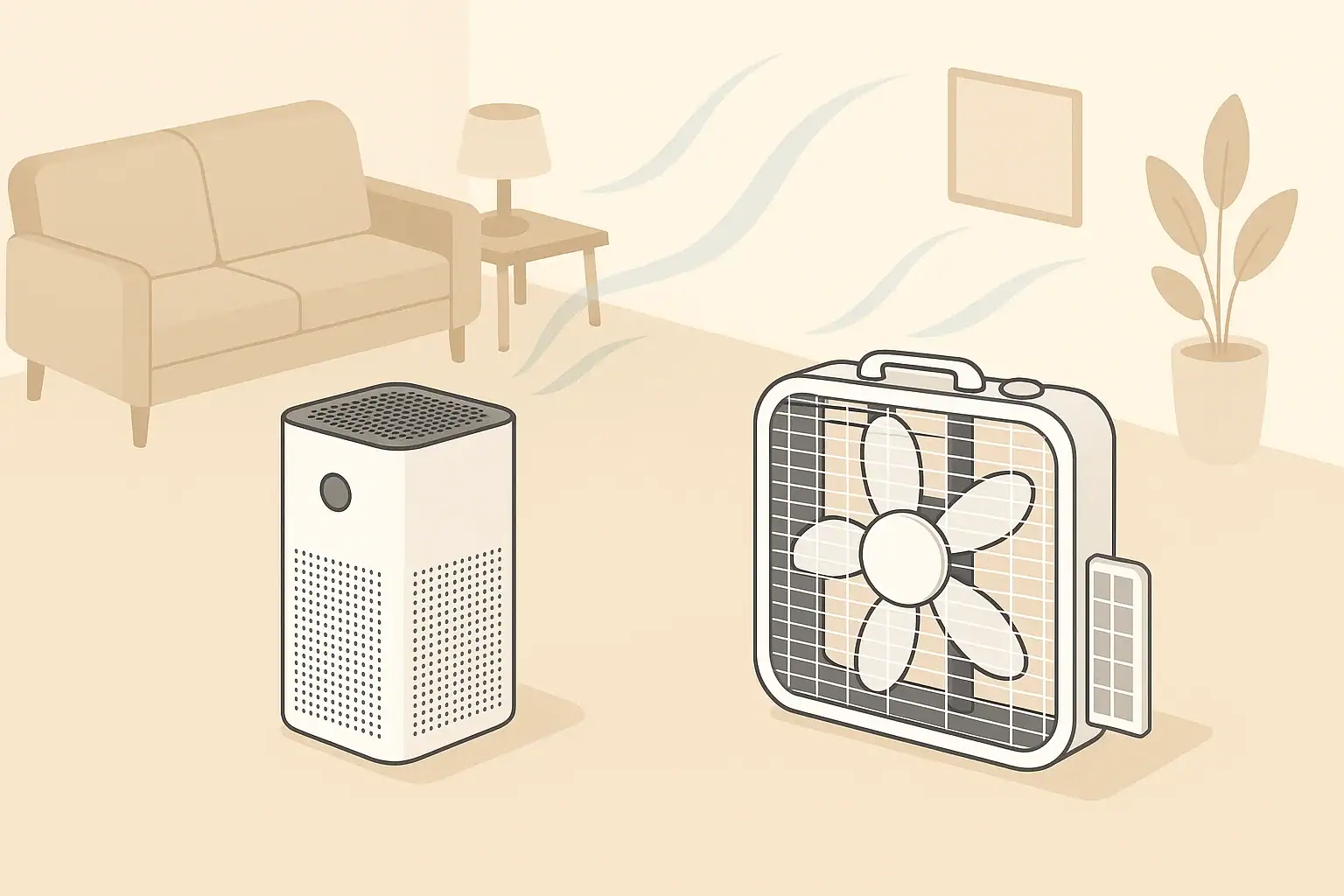
Many households consider two main options for improving indoor air: a portable air purifier or a box fan fitted with a high-efficiency furnace filter. Both can move air through a filter and reduce airborne particles like dust and smoke. However, they differ in cost, filtration quality, noise, and safety features.
This article compares a typical consumer air purifier to a box fan plus MERV filter setup, focusing on:
- Initial and ongoing costs
- Filtration efficiency (MERV vs HEPA concepts)
- Airflow, CADR, and room coverage
- Noise, energy use, and usability
- Safety and when each option makes the most sense
The main difference between an air purifier and a box fan with a filter is the type of filtration and how tightly air is forced through it.
MERV (Minimum Efficiency Reporting Value) is a rating for HVAC-style filters. Higher MERV numbers generally mean better capture of smaller particles.
On a box fan, common high-efficiency choices are around MERV 13. These filters can capture a substantial portion of fine particles, but their performance depends heavily on fit, airflow, and leaks around the edges.
Overview: Two Common Ways to Clean Indoor Air
Many households consider two main options for improving indoor air: a portable air purifier or a box fan fitted with a high-efficiency furnace filter. Both can move air through a filter and reduce airborne particles like dust and smoke. However, they differ in cost, filtration quality, noise, and safety features.
This article compares a typical consumer air purifier to a box fan plus MERV filter setup, focusing on:
- Initial and ongoing costs
- Filtration efficiency (MERV vs HEPA concepts)
- Airflow, CADR, and room coverage
- Noise, energy use, and usability
- Safety and when each option makes the most sense
Filtration Basics: MERV vs HEPA in Simple Terms
The main difference between an air purifier and a box fan with a filter is the type of filtration and how tightly air is forced through it.
What a MERV Filter Does
MERV (Minimum Efficiency Reporting Value) is a rating for HVAC-style filters. Higher MERV numbers generally mean better capture of smaller particles.
- MERV 8–11: Good for larger dust and some pollen.
- MERV 13–14: Often recommended for finer particles, including many smoke-size particles and smaller allergens.
- Above MERV 14 is usually found in specialized or commercial systems.
On a box fan, common high-efficiency choices are around MERV 13. These filters can capture a substantial portion of fine particles, but their performance depends heavily on fit, airflow, and leaks around the edges.
What a HEPA Filter Does
Many portable air purifiers use HEPA-type filters. A true HEPA filter is defined to capture a high percentage of very small particles at a specified test size under standardized conditions. In practice, that means:
- Capture of a large fraction of smoke, fine dust, and many allergen-sized particles
- Dense filter media that requires a fan specifically designed to push air through it
- Careful seals to reduce bypass around the filter
Some purifiers also include an activated carbon stage to help with odors and some gases. MERV filters in a box fan are generally focused on particles, not gases or odors.
Example values for illustration.
| Aspect | Portable air purifier | Box fan + MERV filter |
|---|---|---|
| Typical filter type | HEPA-style + optional carbon | MERV 11–13 furnace filter |
| Filtration focus | Fine particles; some units add odor/gas media | Particles only; limited odor/gas reduction |
| Airflow design | Optimized for dense filters and sealed paths | General-purpose fan, possible air leaks around filter |
| Safety features | Designed as an integrated appliance | Depends on build; must avoid blocking or tipping |
| Noise control | Multiple speed settings, often quieter on low | Can be noisy at higher speeds |
| Odor/VOC handling | Sometimes includes carbon filter stage | Generally not addressed |
| Ease of placement | Compact, designed for rooms and corners | Bulkier footprint, often placed on floor |
Cost Comparison: Upfront and Ongoing
One of the main reasons people consider a box fan with a MERV filter is cost. It can be inexpensive to get started, but long-term costs depend on electricity use and filter replacement schedules.
Upfront Costs
For rough planning, consider these example ranges (not tied to specific models):
- Portable air purifier: A unit sized for a medium room typically costs more up front than a basic box fan and single filter.
- Box fan + MERV filter: A basic fan plus one high-MERV filter usually costs less initially than a full-featured purifier.
Larger rooms often require multiple purifiers or more than one fan-plus-filter unit, so consider total system cost, not just the cost per device.
Filter Replacement Costs
Both approaches need new filters regularly. How often depends on use, air quality, and how dusty or smoky the environment is.
- Purifier filters: Many HEPA cartridges are designed to last several months to a year under typical use. Some units combine HEPA and carbon in one cartridge; others separate them.
- MERV filters: A single high-MERV furnace filter on a box fan may load up faster, especially during smoke events or in dusty homes, and could need replacement more frequently when run hard.
When comparing, estimate how many filters per year each setup might use based on expected hours of operation. A simple way is to assume a higher replacement rate during seasonal smoke or pollen peaks.
Electricity Costs
Energy use depends on fan speed and motor efficiency.
- A typical small-to-medium purifier on a low setting can use modest power, sometimes less than a bright light bulb.
- A box fan on high may use more power than a purifier on low or medium, but it can move a lot of air.
To estimate costs, multiply power (watts) by hours run and your local electricity rate. If you plan to run equipment all day during a smoke season, even a small difference in wattage can add up.
Performance: CADR, Airflow, and Room Coverage
Performance is not just about the filter type; it is also about how much clean air the device delivers. For purifiers, this is often expressed as Clean Air Delivery Rate (CADR). Box fans do not usually list CADR, so comparisons rely on airflow estimates and filtration assumptions.
CADR and Air Changes per Hour (ACH)
CADR combines filter efficiency and airflow. Higher CADR means more filtered air per minute. To plan coverage, people often think in terms of air changes per hour (ACH): how many times per hour the room’s air volume passes through the filter.
- Higher ACH provides faster particle reduction, which can be helpful for smoke or heavy dust situations.
- For everyday use in a bedroom or living room, many people aim for several air changes per hour, depending on comfort goals.
Most consumer air purifiers list CADR values, making it easier to estimate ACH for a known room size. With a box fan, you may only know the fan’s approximate airflow without a filter, and real-world airflow with a dense MERV filter will be lower.
Box Fan + MERV Filter Performance Considerations
A well-built box fan plus a high-MERV filter can significantly reduce particle levels in a room, especially during events like wildfire smoke. However, real performance depends on details:
- Seal and fit: Gaps between the filter and fan can allow air to bypass the filter.
- Filter loading: As the filter fills with dust and smoke particles, airflow drops and cleaning speed decreases.
- Fan strength: Some fans struggle to push air through high-MERV filters at higher resistance.
Because these systems are not standardized, performance can vary more than between commercial purifiers that have been tested under standard conditions.
Air Purifier Performance Considerations
Portable purifiers are engineered as integrated systems:
- Sealed filter compartments: Reduce bypass around the filter edges.
- Fan curves tailored to dense filters: Maintain airflow even as the filter loads up to a point.
- CADR ratings: Provide a common way to compare particle removal across devices.
Performance still depends on correct sizing, placement, and running the unit at a suitable speed for the room.
Noise, Comfort, and Everyday Use
Noise levels and usability matter if the device will run for hours in bedrooms, offices, or living spaces.
Noise Levels
Both options make sound because they rely on moving air with a fan.
- Air purifiers: Often designed with multiple fan speeds and noise in mind. Lower settings can be quiet enough for sleep for many people, while higher settings are louder but provide more cleaning.
- Box fans: Frequently louder at medium or high speeds and may produce more turbulent noise as air passes through the filter.
Some people appreciate fan noise as a form of white noise, while others find it disruptive. If quiet operation is a priority, a purifier with a low-speed mode may be more comfortable than a fan-based setup running on high.
Size, Weight, and Placement
How easily you can move and place the device affects how consistently you will use it.
- Purifiers: Typically have a compact footprint and handles, making them easier to move between rooms.
- Box fan + filter: Can be bulkier and may need more floor space or a stable surface.
Whichever option you use, placement tips are similar: avoid blocking airflow, do not push the unit directly into walls or large furniture, and keep intake and outlet sides clear so air can circulate through the room.
Safety and Reliability Considerations
Any device that uses electricity and moves air should be used with safety in mind. While both approaches can be operated safely, purpose-built air purifiers come with some built-in advantages.
Electrical and Mechanical Safety
Portable air purifiers are designed as complete appliances. They typically include:
- Enclosures that prevent access to moving fan blades
- Stable bases or housings to reduce tipping risk
- Instructions for clearances around intakes and outlets
Box fans are designed to move air without added resistance. Attaching a dense filter changes how they operate. Care is needed to avoid blocking vents or operating them in unstable positions. Always follow manufacturer instructions for the fan itself and avoid altering safety features.
Heat and Motor Load
Pulling air through a high-MERV filter increases resistance. This can make some fan motors work harder. Points to keep in mind:
- Check that the fan is not getting unusually hot during extended use.
- Do not cover motor housings or air inlets that are not intended to be blocked.
- Use only in dry indoor locations as intended for the fan.
If the fan or cord shows any signs of damage or overheating, stop using it and address the issue before continued operation.
Maintenance: Keeping Either Option Working Well
Regardless of which approach you choose, maintenance determines long-term performance and cost.
Filter Replacement and Cleaning
Filters gradually load with particles and become less effective at passing air. Key practices include:
- Follow the manufacturer’s replacement guidance for purifier filters, adjusting for very dusty or smoky conditions.
- For box fans, check the MERV filter visually and by airflow. A dark, heavily loaded filter or noticeably reduced airflow may indicate it is time to replace.
- Avoid washing filters unless they are specifically labeled as washable and the instructions are clear. Many high-efficiency filters are not intended to be washed.
Monitoring Performance
Some people use basic particle monitors or PM2.5 sensors to see how quickly a device reduces particle levels. Without instruments, you can still watch for practical signs:
- Dust accumulation on surfaces over time
- Visible haze during smoke events
- Airflow from the purifier or fan outlet
These are not precise measurements, but they can help you notice when filters may need attention.
Example values for illustration.
| Filter type | Typical interval range | What changes it | Reminder |
|---|---|---|---|
| HEPA filter in purifier | 6–12 months of regular use | Smoke events, pets, high fan speed | Check manufacturer guidance and adjust for heavy seasons |
| Carbon filter in purifier | 3–6 months for odor control | Cooking habits, smoking nearby, VOC sources | Replace when odors persist despite running the unit |
| MERV 11–13 filter on box fan | 1–3 months in active use | Wildfire smoke, pollen peaks, dust load | Inspect monthly; replace when visibly loaded or airflow drops |
| Pre-filter screen on purifier | Every few weeks | Pet hair, visible lint, large dust | Vacuum or gently clean as directed to protect main filter |
| Seasonal heavy-smoke use | Filters may need early replacement | Duration and intensity of smoke episodes | Plan ahead with spare filters before smoke season |
Which Option Fits Your Situation?
Choosing between an air purifier and a box fan with a MERV filter depends on your priorities, budget, and how you plan to use it.
An air purifier often suits people who want a quieter, more compact, and more predictable appliance with standardized performance ratings and integrated safety features. A box fan plus MERV filter can be a cost-conscious way to reduce particles, especially during temporary events, if used thoughtfully and safely.
In practice, some households use both: a dedicated purifier for everyday comfort in bedrooms or main living areas, and a box fan plus MERV filter as an additional tool for short-term smoke or dust episodes.
Frequently asked questions
Can a box fan with a MERV 13 filter remove wildfire smoke as well as a HEPA air purifier?
A properly sealed box fan with a MERV 13 filter can capture many smoke-size particles and reduce indoor particle levels, but it may not match a certified HEPA purifier for the smallest particles or for consistent performance because of potential bypass and reduced airflow. HEPA purifiers provide standardized CADR ratings and tight seals, which often make their effectiveness more predictable. In short, a box fan setup can help a lot, but a HEPA purifier is generally more reliable for consistent smoke removal.
How often should I replace a MERV filter used on a box fan compared to a HEPA cartridge?
MERV filters on box fans often need replacement more frequently—commonly 1–3 months under active or smoke-heavy use—because they can load up faster and reduce airflow. HEPA cartridges in purifiers typically last longer, often 6–12 months under normal use, though heavy use or smoke events shorten that interval. Always inspect filters visually and replace when airflow or appearance indicates loading.
Is it safe to run a box fan with a high-MERV filter continuously indoors?
Running a box fan with a MERV filter can be safe if the fan is designed for continuous operation, does not overheat, and is used in a stable, dry location without blocking motor vents. However, adding a dense filter increases motor load and heat; monitor the fan for unusual heat or noise and follow the fan manufacturer’s safety guidance. If the fan gets hot or shows signs of stress, stop use and reassess the setup.
Will a box fan plus MERV filter reduce odors and volatile organic compounds (VOCs)?
No, standard MERV filters are designed to capture particles and do not effectively remove gases, odors, or VOCs. Air purifiers that include an activated carbon or other gas-phase media are better suited to reduce many odors and some VOCs. If odors or gases are a concern, look for a purifier with a dedicated gas/odor stage.
How can I estimate whether a purifier or a fan-plus-filter will provide enough clean air for my room?
For purifiers, use the device’s CADR and your room volume to calculate expected air changes per hour (ACH) and compare that to your target ACH. For a box fan, estimate the fan’s airflow with a filter attached (real-world airflow will be lower than the fan’s free-air rating) and divide by room volume to approximate ACH. Using a particle monitor or PM2.5 sensor during operation is a practical way to verify real-world performance.
Recommended next:
- HEPA vs Activated Carbon: Best Setup for Allergies, Odors, and Smoke
- Air Purifier vs Dehumidifier: Which One Solves Musty Air?
- Humidifier vs Dehumidifier: When to Add Moisture vs Remove It
- Air Purifier vs Ozone Generator: Safety, Effectiveness, and Myths
- HEPA vs Carbon Filters: When Each One Matters Most
- Air Purifier vs Ventilation: Which Fixes Stuffy Bedrooms Better?
- More in Comparisons →
- Clear sizing logic (room size → CADR/ACH)
- HEPA vs carbon explained for real use-cases
- Humidity + ventilation basics to reduce mold risk

About this site
Home Air Quality Lab publishes practical, independent guides about indoor air quality—clear sizing, safer use, and real-world expectations.
Affiliate disclosure
Some links on this site may be affiliate links. If you buy through these links, we may earn a small commission at no extra cost to you. This helps support our content. Learn more.