
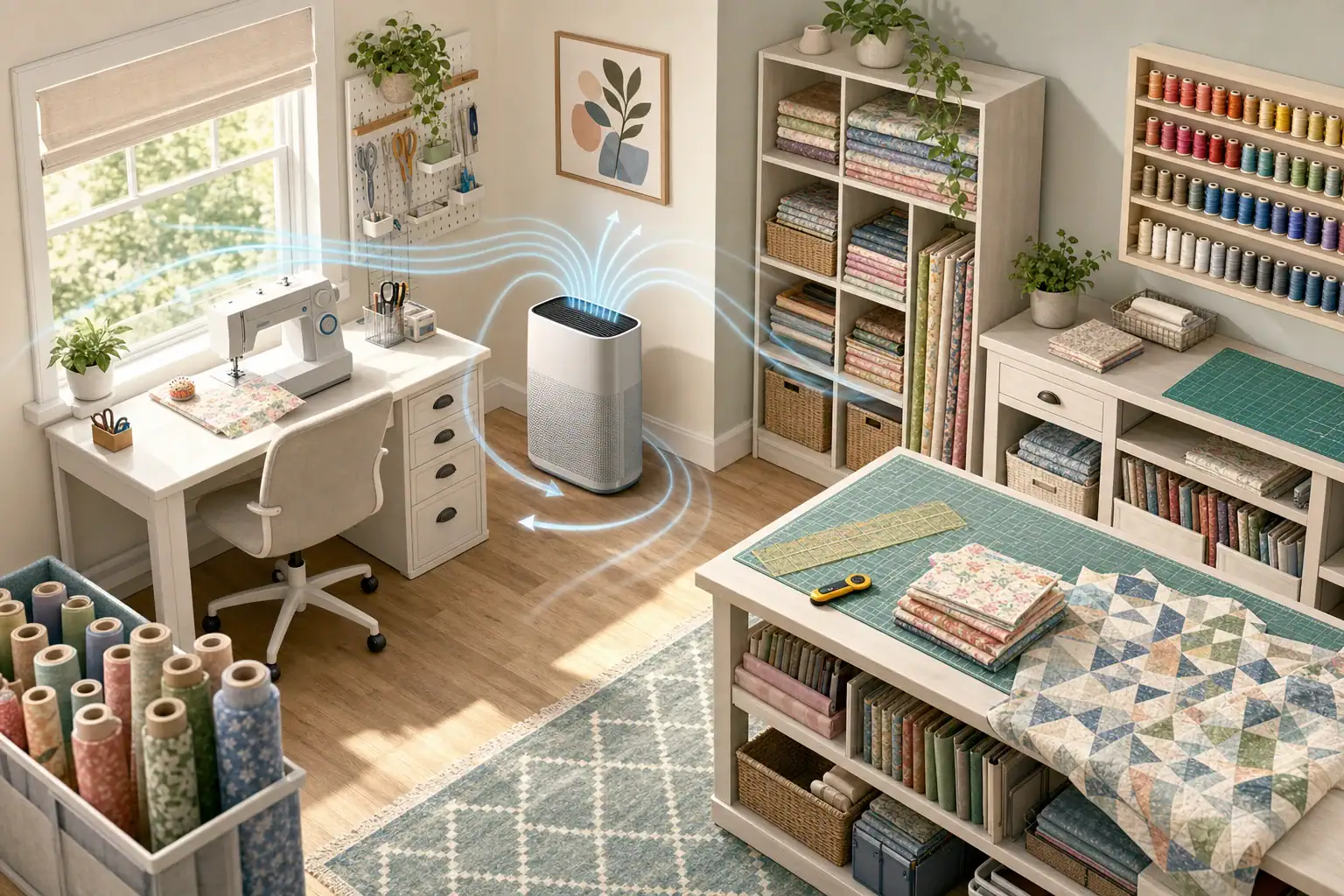
Choose for particles, then plan the airflow
For a sewing room, choose an air purifier with mechanical particle filtration, a prefilter that is easy to clean, and a clean air delivery rate suited to the room. Place it near the cutting or sewing area without blocking its intake or directing strong airflow across fabric, patterns, or loose thread. It should supplement regular surface cleaning rather than replace it.
Match filtration to sewing-room debris
Cutting, handling, and sewing fabric can release a mixture of visible lint and smaller airborne particles. These require slightly different filter features:
- Prefilter: Captures larger fibers and lint before they reach the main filter. A removable prefilter is particularly useful in rooms that process fleece, batting, felt, or other materials that shed readily.
- Main particle filter: Look for a clearly identified high-efficiency mechanical filter, such as a HEPA filter. Verify that replacement filters are available and that the manufacturer specifies the filter type.
- Activated carbon: May help with some odors, but a thin carbon layer has limited capacity. Particle filtration does not substitute for ventilation when using adhesives, sprays, solvents, or heated materials.
Avoid models that intentionally produce ozone. The EPA explains the limitations and potential concerns of ozone generators sold as air cleaners.
Size the purifier for the room
Use the unit’s clean air delivery rate, or CADR, rather than relying only on a maximum-room-size claim. CADR indicates how quickly a purifier supplies filtered air for a particular particle category. For fine textile dust, the smoke CADR is a useful particle-size reference when that rating is provided.
Compare ratings at a fan speed you are willing to use while working. A high rating available only at an uncomfortably loud speed may be less practical than a unit that can run continuously at a moderate setting. Large rooms, high ceilings, open doors, and connected spaces increase the amount of air that must be treated. The EPA’s guidance on residential air cleaners and filters provides additional context on sizing and filtration limits.
Place it where lint enters the air
- Start near the main activity zone. Position the purifier near the sewing machine, serger, or cutting table, but not where fabric can drape over it.
- Keep the intake open. Follow the manufacturer’s required clearance from walls, curtains, storage bins, and furniture.
- Avoid blowing across the work surface. Aim the outlet so it does not scatter pattern pieces, thread, or lightweight fabric.
- Use the room’s circulation pattern. If possible, place the unit where its filtered-air outlet can circulate air through the room rather than directly into a wall or corner.
- Keep it stable and dry. Use a firm floor or approved stand, route the cord away from walkways, and keep the unit clear of irons, heat presses, and water containers.
If one purifier cannot draw air effectively from both a cutting area and a machine station, moving it between tasks or using separate appropriately sized units may work better than relying on a single unit in a distant corner.
Coordinate purification with source control
| Task | Primary control | Purifier’s role |
|---|---|---|
| Cutting or trimming | Collect scraps and wipe the table | Capture particles that remain airborne |
| Serging or sewing shedding fabrics | Remove lint around the machine as its manual directs | Reduce recirculating airborne lint |
| Floor and upholstery cleaning | Use careful vacuuming or damp dusting as appropriate | Run during and after cleaning if dust becomes airborne |
| Using adhesives or sprays | Follow the product label and provide suitable ventilation | Particle filtration alone may not remove vapors |
Do not blow compressed air around the room to clean machines or surfaces. It can redistribute settled lint. Follow the sewing-machine manufacturer’s instructions for internal cleaning and lubrication.
Prevent lint from overwhelming the filters
- Inspect the prefilter frequently at first; sewing-room lint can load it faster than ordinary household dust.
- Clean or replace each filter only as directed by the purifier manufacturer.
- Do not wash, brush, or vacuum the main filter unless its instructions explicitly allow that method.
- Check the intake grille for fibers and clean the exterior with the unit switched off and unplugged, following its manual.
- Replace the main filter when indicated or when persistent loading reduces airflow. A filter indicator is a reminder, not a substitute for visual inspection.
A noticeable drop in airflow, lint collecting rapidly on the intake, or increased operating noise can indicate an obstructed prefilter, blocked placement, or a filter that needs attention.
Related guides: Air Purifier for Printer and Craft Rooms: Particles, VOCs, and Placement • CADR Calculator: Room Size + Ceiling Height + ACH Target • Pre-Filter Cleaning Schedule: How Often to Vacuum or Wash the First Layer
Frequently asked questions
Should I run an air purifier while sewing or only after finishing?
Running it during sewing, serging, cutting, or trimming can help capture particles that become airborne during those tasks. It can also be useful after dust-producing cleaning, provided the intake and outlet remain unobstructed.
How often should I clean the prefilter in a sewing room?
Inspect the prefilter frequently when first using the purifier, because textile lint may load it faster than typical household dust. Clean or replace it only by the method and schedule specified in the purifier manual.
Can an air purifier handle odors or vapors from fabric sprays and adhesives?
A mechanical particle filter is intended primarily for airborne particles such as lint and textile dust. Carbon may have limited odor capacity, but suitable ventilation and the product label directions remain important when using sprays, adhesives, solvents, or heated materials.
Practical setup summary
Prioritize mechanical particle filtration, an accessible prefilter, and enough CADR for the sewing room. Keep the purifier close to the work zone with clear intake and outlet paths, but direct airflow away from loose materials. Combine continuous or task-based operation with regular lint removal, and use ventilation or other source controls for contaminants that particle filters are not designed to capture.
- Clear sizing logic (room size → CADR/ACH)
- HEPA vs carbon explained for real use-cases
- Humidity + ventilation basics to reduce mold risk