
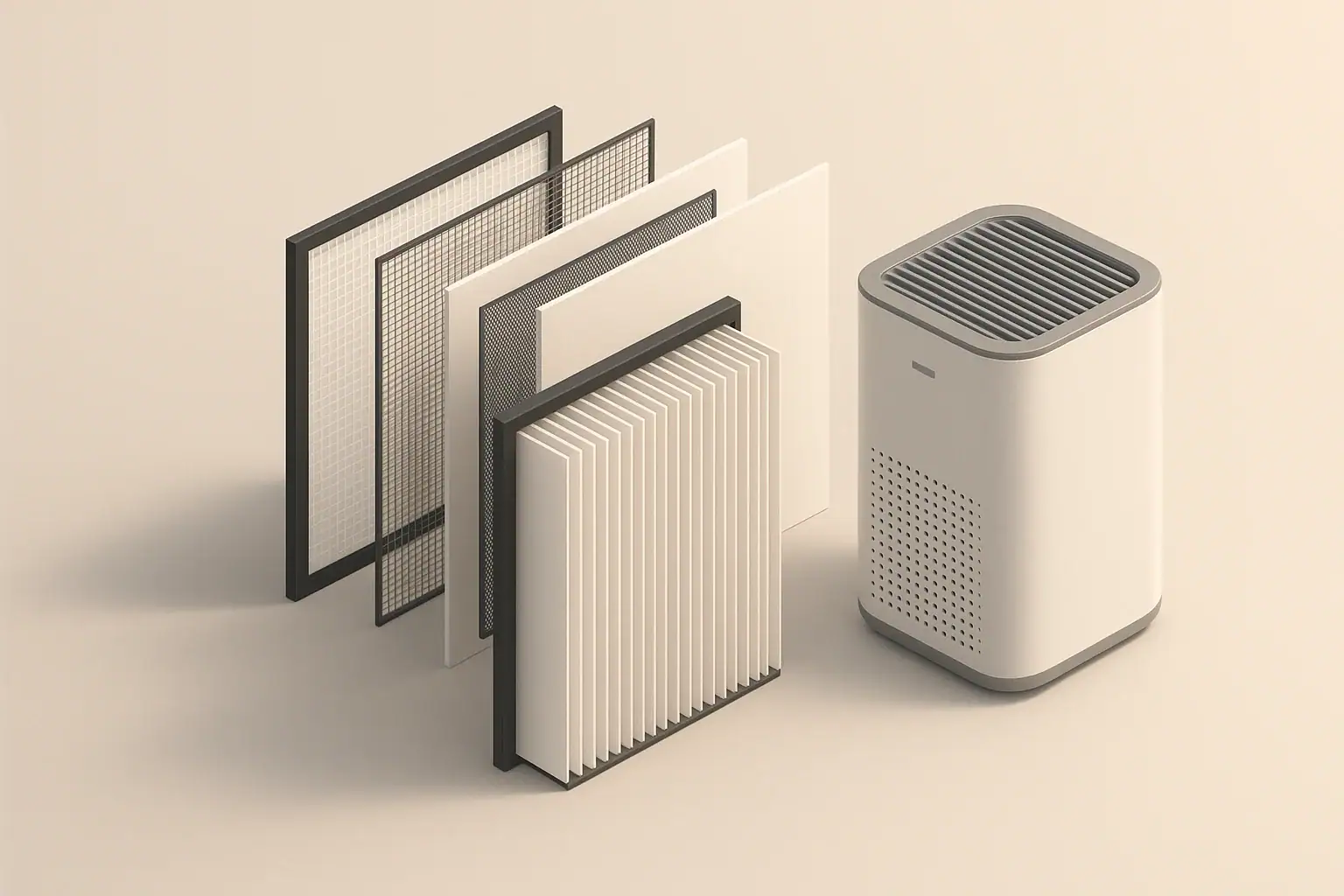
Washable pre-filters usually cost less over time but require regular cleaning, while disposable pre-filters are simpler to replace and may be more consistent when changed on schedule; either type can reduce airflow if it becomes loaded or is installed incorrectly. A pre-filter is the first layer that catches larger lint, hair, pet fur, and visible dust before air reaches a HEPA or carbon filter. The better choice depends on your dust load, tolerance for cleaning, replacement budget, and whether the purifier or HVAC unit is designed for that filter type.
What Pre-Filters Do in Home Air Cleaning
A pre-filter is a coarse first-stage filter. In a portable air purifier, it usually sits before the HEPA-grade particle filter and, when present, before activated carbon. In an HVAC return, a filter may act as the main system filter rather than a separate pre-filter, but the basic job is similar: capture larger debris before it reaches more sensitive parts.
Pre-filters are not usually the layer responsible for capturing the smallest particles. Fine particle performance depends more on the main particle filter, the seal around the filter, fan airflow, room size, and run time. Still, the pre-filter matters because a clogged first layer can restrict the entire system.
For home indoor air quality, pre-filters are most useful for practical maintenance. They can reduce how quickly hair and lint build up on the main filter surface. That may help keep airflow steadier between main filter changes, especially in homes with pets, carpets, fabric furniture, or frequent window opening.
Washable vs Disposable Pre-Filters: Main Tradeoffs
The core difference is maintenance style. A washable pre-filter is cleaned and reused. A disposable pre-filter is removed and replaced. Both can work well when they are the correct size, installed in the right orientation, and maintained before they become heavily loaded.
Washable pre-filters often appeal to households that want fewer recurring purchases and do not mind rinsing, vacuuming, or drying a filter panel. Disposable pre-filters appeal to households that want predictable replacement and less mess. Neither option is automatically better for airflow; the cleaner, correctly fitted filter is usually the better-performing one in day-to-day use.
Airflow depends on resistance across all filter layers. A thicker or denser pre-filter may capture more visible debris, but it can also add resistance if the purifier was not designed for it. Avoid adding extra filter material or substituting a different type unless the appliance instructions allow it.
| Factor | Washable pre-filter | Disposable pre-filter |
|---|---|---|
| Routine task | Vacuum, rinse, or wash if approved | Remove and replace |
| Typical attention needed | Every 2 to 4 weeks for inspection | Every 1 to 3 months for replacement checks |
| Upfront cost | Often included with the unit | May require multi-packs or cut-to-fit sheets |
| Ongoing cost | Lower material cost, more time | Higher material cost, less cleaning effort |
| Airflow risk | Can restrict airflow if dirty, wet, warped, or reinstalled poorly | Can restrict airflow if overdue, too dense, or incorrectly sized |
| Mess factor | Dust can be stirred up during cleaning | Dust is contained if removed carefully |
| Best fit | People comfortable with regular upkeep | People who prefer scheduled replacement |
How Airflow Changes When a Pre-Filter Gets Dirty
Air purifiers and HVAC blowers move air through resistance. As dust, lint, and hair collect on a pre-filter, that resistance can increase. The system may still run, but the amount of air moving through the filter path can drop.
Reduced airflow matters because clean air delivery depends on both filtration and the volume of air moved. A very efficient filter with weak airflow may not mix and recirculate room air as effectively as expected. In a room purifier, this may show up as less noticeable air movement at the outlet or slower particle readings after cooking, cleaning, or smoke intrusion events.
During heavy pollution periods, smoke events can load a pre-filter faster than normal, so it is worth checking the intake more often than you would in a low-dust season.
Common airflow warning signs
- The outlet airflow feels weaker than normal at the same fan setting.
- The fan sounds strained, louder, or higher pitched.
- Dust is visibly matted on the intake side.
- The filter does not sit flat, leaving gaps or bypass paths.
- The purifier indicates maintenance sooner than expected.
Do not assume higher fan noise means better cleaning. It can also mean the fan is working against a loaded filter. When in doubt, turn the unit off, inspect the pre-filter, and follow the cleaning or replacement instructions.
Maintenance Checklist for Washable and Disposable Pre-Filters
A simple maintenance routine is usually enough. The goal is not to keep the filter looking new; it is to prevent heavy loading, poor fit, odors from damp material, and airflow restriction.
For washable pre-filters
- Check the intake side every 2 to 4 weeks in normal use.
- Vacuum loose dust gently if the material allows it.
- Rinse or wash only when the instructions say the filter is washable.
- Use mild cleaning methods and avoid harsh chemicals unless specified.
- Let the filter dry completely before reinstalling; overnight may not always be enough in humid conditions.
- Replace the pre-filter if it is torn, stretched, warped, or no longer seals properly.
For disposable pre-filters
- Keep a simple calendar reminder for inspection and replacement.
- Replace sooner if the pre-filter is visibly clogged or airflow drops.
- Use the correct dimensions and thickness for the appliance.
- Do not stack extra layers unless the manufacturer allows it.
- Seal the used filter in a bag before disposal if it is dusty.
For either type, turn the appliance off before removing filters. Reinstall filters in the intended order, with the intake-facing side oriented correctly when the filter has a direction.
Cost Planning: Time, Replacement Packs, and Main Filter Life
The cost comparison is not only the price of the pre-filter. It also includes cleaning time, replacement frequency, shipping or store trips, and whether poor maintenance causes the main filter to load faster.
A washable pre-filter may have a lower material cost over several years. However, it requires a place to clean it, time to dry it, and enough consistency to prevent clogging. If it is reinstalled damp, it can create odor issues and may affect nearby filter media.
A disposable pre-filter has a clearer material cost. If a package costs a modest amount and lasts several months, the annual expense is easy to estimate. The tradeoff is that skipping replacements can reduce airflow and may allow larger debris to reach the main filter surface.
A simple cost estimate
For disposable pre-filters, multiply the replacement cost by the number of changes per year. For example, a pre-filter changed every two months requires about six replacements per year. For washable pre-filters, estimate the time spent cleaning and drying, plus occasional replacement if the material wears out.
Main filters should be considered separately. A clean pre-filter can help keep lint off the main filter, but it does not make the main filter permanent. HEPA-grade and carbon filters still need replacement based on use, loading, odor saturation, and manufacturer guidance.
Real-World Examples: Which Option Fits Different Homes
Different homes place different demands on pre-filters. The best choice is often the one that the household will maintain consistently.
Pet household with visible hair
A washable pre-filter can be convenient if hair builds up quickly and the owner is willing to vacuum or rinse it often. The key is frequent attention. A disposable option can also work, but replacement intervals may be shorter than in a low-dust home.
Apartment with limited cleaning space
A disposable pre-filter may be simpler where there is no utility sink, outdoor area, or good drying space. It reduces the chance of reinstalling a damp washable filter and can make maintenance less messy.
Bedroom purifier used at night
Airflow and noise are both important in bedrooms. A clogged pre-filter may make the fan sound more noticeable. Inspecting the pre-filter before increasing fan speed can help maintain airflow without unnecessary noise.
Home near seasonal smoke or outdoor dust
During periods with more outdoor particles, either type may load faster. A practical approach is to check the pre-filter weekly during high-use periods, then return to a longer interval when conditions are calmer.
Safety, Compatibility, and Standards Considerations
Pre-filters are mechanical components. They do not intentionally generate ozone, and they should not require any chemical treatment to work. If a device also includes ionization, UV-C, or other electronic features, review those features separately and use them only as directed.
Compatibility matters. A pre-filter that looks similar may not fit correctly, may be too dense, or may interfere with the designed airflow path. Gaps around the edge can allow bypass, where air goes around the filter instead of through it. A filter that is too restrictive can reduce clean air delivery and may strain the appliance.
Do not wash a HEPA filter, carbon filter, or combined filter unless the instructions specifically say it is washable. Many fine filters are damaged by water, and wet carbon can be messy or ineffective for odor adsorption until fully dry if it is designed to be reused at all.
For HVAC systems, use filters that match the system design and avoid increasing filter resistance beyond what the system can handle. If airflow problems occur across multiple rooms, a qualified HVAC professional can evaluate the system without guessing or modifying safety controls.
| Filter layer | Typical interval range | What changes it | Reminder |
|---|---|---|---|
| Washable pre-filter | Inspect every 2 to 4 weeks | Pets, lint, open windows, heavy dust | Dry completely before reinstalling |
| Disposable pre-filter | Replace about every 1 to 3 months | Visible loading, reduced airflow, high use | Use the correct size and thickness |
| Foam or mesh pre-filter | Clean about monthly | Hair, fabric dust, kitchen proximity | Replace if stretched or crumbling |
| Main particle filter | Often 6 to 12 months | Runtime, room dust, smoke events | Follow the device indicator or manual |
| Activated carbon layer | Often 3 to 6 months | Odors, cooking, VOC sources | Particle pre-filters do not refresh carbon |
| HVAC return filter | Often 1 to 3 months | System use, filter depth, household dust | Check airflow and fit at the return |
| Stored spare filters | Check before use | Moisture, packaging damage, age | Keep sealed in a dry location |
Related guides: Do You Need a Pre-Filter? Extending HEPA Life and Reducing Costs • Air Purifier Maintenance Checklist: Filters, Sensors, and Cleaning • How Often Should You Replace a HEPA Filter?
Frequently asked questions
Which lasts longer: washable or disposable pre-filters?
Washable pre-filters usually last longer in terms of the filter media itself because they are reused after cleaning. Disposable pre-filters are replaced more often, so their lifespan is shorter by design. The better option depends on whether you want to trade cleaning time for lower ongoing material cost.
Do washable pre-filters reduce airflow more than disposable ones?
Not necessarily. Airflow depends more on how loaded, wet, dirty, or poorly fitted the filter is than on whether it is washable or disposable. A clean, correct-fit pre-filter of either type should generally support better airflow than an overdue one.
How often should I clean or replace a pre-filter?
Many washable pre-filters should be inspected every 2 to 4 weeks, while disposable pre-filters are often checked and replaced about every 1 to 3 months. Homes with pets, heavy lint, smoke, or open windows may need shorter intervals. Always follow the appliance manual if it gives a specific schedule.
Can I use a washable pre-filter in a device made for disposable ones?
Only if the manufacturer says it is compatible. A filter that fits physically may still be too dense, too thin, or shaped in a way that causes bypass or airflow problems. Using an unapproved filter can reduce performance and may affect the appliance warranty or safety guidance.
What happens if a pre-filter gets too dirty?
A loaded pre-filter can reduce airflow, make the fan sound strained, and allow less air to pass through the rest of the filtration system. Over time, that can also make the main filter load faster. Cleaning or replacing the pre-filter usually helps restore normal performance.
Are disposable pre-filters better for hygiene than washable ones?
Disposable pre-filters can be less messy because the dust stays contained during removal and disposal. Washable pre-filters can still be sanitary if they are cleaned properly and dried completely before reuse. The more important factor is consistent maintenance, not the material alone.
Summary: Practical Takeaways
Washable and disposable pre-filters can both support good airflow and easier maintenance when they are used as intended. Washable pre-filters reduce recurring material cost but require consistent cleaning and complete drying. Disposable pre-filters are easier to schedule and replace, but they create an ongoing supply cost.
The most important airflow rule is simple: keep the pre-filter clean enough that the fan can move air freely, and keep it fitted well enough that air does not bypass the filter. Inspect every few weeks, shorten the interval when dust or pet hair increases, and avoid adding unapproved layers.
If you prefer lower waste and do not mind upkeep, a washable pre-filter may fit your routine. If you prefer predictable, low-mess maintenance, disposable pre-filters may be the better practical choice. In either case, the main filter, carbon layer, room size, fan setting, and placement still matter for overall indoor air quality performance.
Recommended next:
- True HEPA vs HEPA-Type: What the Labels Really Mean
- HEPA H13 vs H14: Differences, Efficiency, and When It Matters
- How Often Should You Replace a HEPA Filter?
- Do HEPA Filters Remove Viruses, Bacteria, and Allergens?
- HEPA Grades Explained (H10–H14): What’s Relevant for Homes?
- True HEPA vs HEPA-Type vs “HEPA-Like”: Label Tricks to Avoid
- More in HEPA Filters →
- Clear sizing logic (room size → CADR/ACH)
- HEPA vs carbon explained for real use-cases
- Humidity + ventilation basics to reduce mold risk