
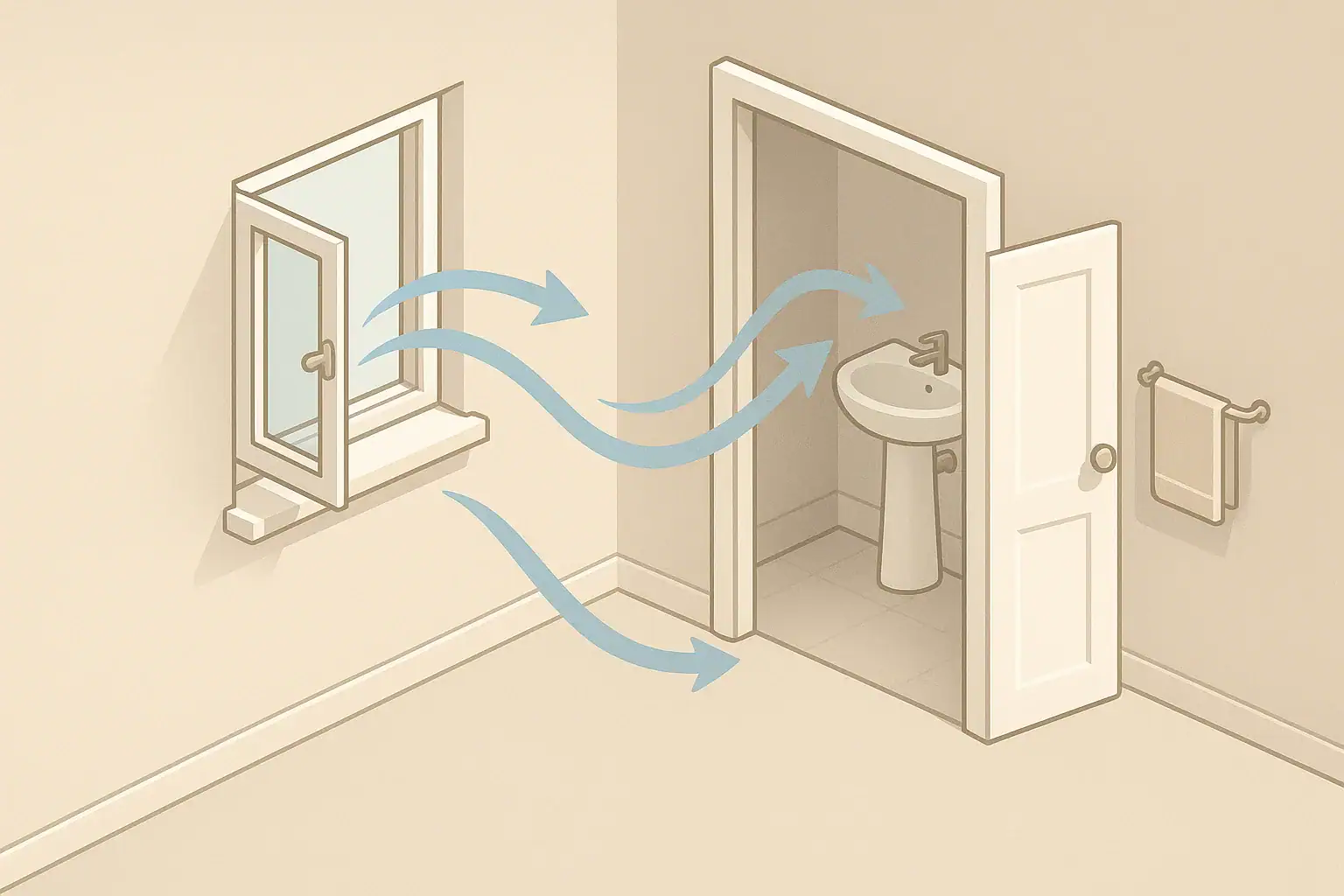
A bathroom usually dries faster after a shower with the exhaust fan running and the door open or cracked, because replacement air can enter and help carry moisture out.
The best door position depends on your fan, bathroom layout, and the humidity in the rest of the home. A fully closed door can slow drying if the fan cannot pull in enough makeup air, while a fully open door without a fan can let moisture drift into nearby rooms.
Quick answer
- Fastest common setup: run the exhaust fan and leave the door open several inches, or fully open if nearby rooms are dry.
- Humidity target: aim for indoor relative humidity below about 60%, with many homes more comfortable around 30% to 50% seasonally.
- Fan timing: run the bath fan during the shower and for about 20 to 30 minutes afterward; longer if mirrors, walls, or towels stay damp.
- If no fan: open a window when outdoor conditions are dry enough, and leave the door open to improve air movement.
- Watch the recovery time: if humidity stays high for more than 45 to 60 minutes, improve ventilation, airflow, or dehumidification.
Why Bathroom Door Position Matters After a Shower
A hot shower adds a large amount of water vapor to a small room in a short time. Some of that moisture stays in the air. Some lands on mirrors, tile, painted walls, grout, curtains, bath mats, and towels.
Drying happens when that moisture moves from wet surfaces into the air and then leaves the bathroom. Door position affects both parts of that process. It changes how easily drier air can enter and how easily humid air can leave.
For indoor air quality, the goal is not to make the bathroom bone-dry instantly. The practical goal is to reduce lingering dampness so surfaces dry within a reasonable time and the bathroom does not stay humid for hours.
The Drying Logic: Moisture, Airflow, and Makeup Air
Bathroom drying is mostly about airflow and humidity difference. Air that is already humid cannot absorb much more moisture. Drier air can pick up moisture from wet surfaces more effectively.
How an exhaust fan changes the answer
An exhaust fan removes humid air from the bathroom and sends it outdoors if it is properly ducted. For the fan to work well, replacement air has to enter the bathroom from somewhere. This replacement air is called makeup air.
If the door is fully closed and there is only a small gap under it, the fan may move less air than expected. In that case, cracking the door or leaving it open can improve airflow and speed drying.
When a closed door can make sense
A closed door can help contain steam while you shower, which may make the room feel warmer and reduce moisture movement into hallways. After the shower, however, a closed door is usually best only if the bathroom still has enough airflow through an undercut door, transfer grille, open window, or another designed air path.
If your mirror stays fogged for a long time with the fan running and the door closed, the fan may not be getting enough replacement air.
| Situation | Door position | Main action | What to watch |
|---|---|---|---|
| Fan works well and vents outdoors | Open or cracked | Run fan during and after shower | Mirror clears and surfaces dry steadily |
| Fan is weak with closed door | Cracked open | Allow makeup air into bathroom | Less fog and faster humidity drop |
| No exhaust fan | Open | Use window if outdoor air is suitable | Moisture should not linger in nearby rooms |
| Rest of home is very humid | Partly closed | Use fan, window, or dehumidifier strategy | Drying may be slower overall |
| Small interior bathroom | Cracked open | Maximize fan airflow path | Towels and corners should dry between uses |
| Cold or wet outdoor weather | Open or cracked indoors | Rely on exhaust fan before opening windows | Avoid bringing in damp outdoor air |
Door Open vs Closed: What Usually Dries Faster
In most homes, the fastest drying setup is fan on plus door open or cracked. The open door gives the fan an easier air path. Humid air exits through the fan, and drier household air replaces it.
Door fully closed with the fan on can still work if the bathroom door has a generous undercut or the room has another transfer-air path. But if the fan sound changes sharply when the door shuts, or the bathroom stays steamy, airflow may be restricted.
Door open with no fan is mixed. It may dry the bathroom surfaces faster by increasing air mixing, but it can also move moisture into the hallway, bedroom, or closet area. That may be fine in a dry home with good whole-home ventilation. It is less helpful if nearby rooms already feel damp.
A simple rule
Use the exhaust fan first, then adjust the door to help the fan breathe. If the fan is on, crack or open the door after the shower. If there is no fan, use the best available combination of window ventilation, open door, and general air movement.
Practical Checklist for Drying a Bathroom Faster
You can usually improve drying without complicated equipment. Small habits matter because bathrooms repeatedly get wet.
- Turn the exhaust fan on before or at the start of the shower.
- Leave the fan running after the shower for about 20 to 30 minutes.
- Open or crack the door after showering unless you are intentionally using a window and keeping moisture isolated.
- Spread out towels so air can reach both sides.
- Pull shower curtains or doors partly open so surfaces can dry.
- Squeegee glass, tile, or smooth walls if they hold visible water.
- Keep bath mats from staying wet against the floor.
- Use a basic humidity monitor if you are unsure how long the room stays damp.
A useful target is recovery, not perfection. If the bathroom returns below roughly 60% relative humidity within about 30 to 60 minutes, that is generally a better sign than a room that stays humid for hours.
Real-World Examples: What to Do in Common Bathrooms
Small bathroom with a working fan
Run the fan during the shower and leave the door cracked or open afterward. This is the most common answer for apartments, condos, and smaller houses. If the bathroom air clears quickly, no extra step may be needed.
Bathroom with no exhaust fan but a window
Open the window when outdoor air is cooler or drier than the bathroom air, and leave the door open enough to avoid trapping humidity. In humid weather, a window may not help much. In that case, air movement and whole-home humidity control become more important.
Bathroom connected to a bedroom or closet
Use the fan and crack the bathroom door after the shower, but avoid pushing a large steam cloud directly into a closet. Keep closet doors closed while the bathroom clears, and let towels dry in a location with good airflow.
Shared bathroom with back-to-back showers
Leave the fan running between showers and after the final shower. Open the door between uses when privacy is not needed. Repeated showers can keep surfaces wet longer than one shower, even if each shower seems short.
Indoor Air Quality and Safety Basics
Moisture control is part of basic indoor air quality. Damp materials take longer to dry when air movement is poor, and persistent dampness can support musty odors and surface growth over time. The practical response is steady ventilation, drying, and cleaning rather than panic.
Bath fans should exhaust outdoors, not into an attic, wall cavity, or crawl space. If you are unsure where a fan vents, a qualified professional can inspect it. Avoid modifying electrical fixtures, fan wiring, or ducting unless you are trained to do so and local code allows it.
For bathrooms, ozone generators are not a moisture solution and should not be used to intentionally generate ozone indoors. Ionizers and UV-C devices are also not substitutes for removing moisture at the source. The basics remain ventilation, airflow, surface drying, and humidity control.
Use caution with portable appliances in or near bathrooms. Keep cords, plugs, fans, and dehumidifiers away from wet areas, and follow general electrical safety instructions for damp locations.
Maintenance and Troubleshooting Cues
If the right door position does not seem to help, the problem may be maintenance or airflow restriction. A dusty grille can reduce fan performance. A kinked, long, blocked, or poorly routed duct can also limit exhaust.
Listen and observe. A fan that is loud is not always moving much air. A quiet fan may also be ineffective if the duct is blocked. The clearest practical signs are whether steam clears, the mirror unfogs, and damp surfaces dry.
- Clean the fan grille periodically so lint and dust do not block airflow.
- Check that the fan damper, if visible and accessible, is not stuck closed.
- Look for condensation on walls, ceilings, window frames, or cabinets.
- Replace or wash shower curtains and liners as needed to reduce residue buildup.
- Wash bath mats and let them dry fully between uses.
- Consider a timer switch or humidity-sensing control installed by a qualified person if the fan is often turned off too soon.
A low-cost humidity monitor can help you compare door positions. Put it outside direct splash zones and watch how long the bathroom takes to return to the home’s usual humidity range after a shower.
| Goal | Simple actions | Helpful tool | Note |
|---|---|---|---|
| Clear steam quickly | Run fan and crack door | Timer | Start fan before humidity peaks |
| Keep humidity from lingering | Run fan 20 to 30 minutes after use | Humidity monitor | Extend time if surfaces stay wet |
| Dry towels faster | Spread towels on bars or hooks with space | Extra towel bar | A folded wet towel dries slowly |
| Reduce wet surfaces | Squeegee glass or tile | Squeegee | Less standing water means faster recovery |
| Manage no-fan bathrooms | Use window and open door when suitable | Portable circulation fan outside wet zones | Do not place electrical items near water |
| Check progress | Compare humidity before and after shower | Basic humidity monitor | Below about 60% is a common practical target |
Related guides: Bathroom Mold Prevention: Exhaust Fan Timing and Humidity Control • Exhaust Fan Best Practices: Bathrooms and Kitchens That Actually Clear Air • Best Indoor Humidity Level to Prevent Mold (With Seasonal Targets)
Frequently asked questions
Should the bathroom door be open or closed after a shower?
In most homes, the bathroom door dries the room faster when it is open or cracked and the exhaust fan is running. That setup gives humid air a path out and lets drier air replace it. A fully closed door can slow drying if the fan cannot get enough makeup air.
Does leaving the bathroom door open help prevent mold?
Leaving the door open can help the room dry faster, but mold prevention depends on overall moisture control, not the door alone. The most important factors are running the fan, drying wet surfaces, and keeping humidity from staying high for long periods. If the room remains damp for hours, ventilation likely needs improvement.
Is it better to keep the door closed while showering?
A closed door can help keep steam inside the bathroom while you shower, which may keep nearby rooms drier. After the shower, however, opening or cracking the door usually helps the bathroom dry faster if the fan is on. The best choice depends on whether the fan has enough replacement air.
How long should I leave the fan on after a shower?
A common guideline is to run the fan for about 20 to 30 minutes after showering. If mirrors, walls, towels, or the air still feel damp, longer runtime may be needed. The main goal is for the bathroom to return to a normal humidity range within about 30 to 60 minutes.
What if my bathroom has no exhaust fan?
If there is no fan, open a window when outdoor air is dry enough and leave the door open enough to improve air movement. In humid weather, a window may not help much, so whole-home ventilation or a dehumidifier may matter more. The key is to avoid trapping moisture in the room.
Why does my mirror stay fogged when the door is closed?
A fogged mirror after showering can mean the bathroom is not removing humid air fast enough. If the fan sounds weak or changes noticeably when the door closes, it may not be getting enough makeup air. Cracking the door, cleaning the fan grille, or checking for duct problems can help.
Summary: The Simple Rule for Most Bathrooms
For most homes, leave the bathroom door open or cracked after a shower and run the exhaust fan. This usually dries the room faster than keeping the door fully closed because the fan gets the replacement air it needs.
Keep the door more closed only when you have a good reason, such as preventing steam from moving into a closet or when a window is handling ventilation well. Even then, the bathroom still needs an air path.
The practical target is simple: clear visible steam, dry surfaces, and bring humidity back down within about 30 to 60 minutes. If that does not happen, focus on fan runtime, airflow path, towel drying, and basic maintenance before assuming the door position alone is the problem.
Recommended next:
- Ventilation vs Air Purifier: When You Need One, the Other, or Both
- CO2 in Bedrooms: What Levels Mean and How to Improve Air Exchange
- How to Ventilate in Winter Without Freezing: Practical Strategies
- Exhaust Fan Best Practices: Bathrooms and Kitchens That Actually Clear Air
- Air Exchange Basics: ACH, Infiltration, and Why “Stuffy” Happens
- ERV vs HRV: What They Do for Indoor Air Quality
- More in Ventilation & Air Exchange →
- Clear sizing logic (room size → CADR/ACH)
- HEPA vs carbon explained for real use-cases
- Humidity + ventilation basics to reduce mold risk