
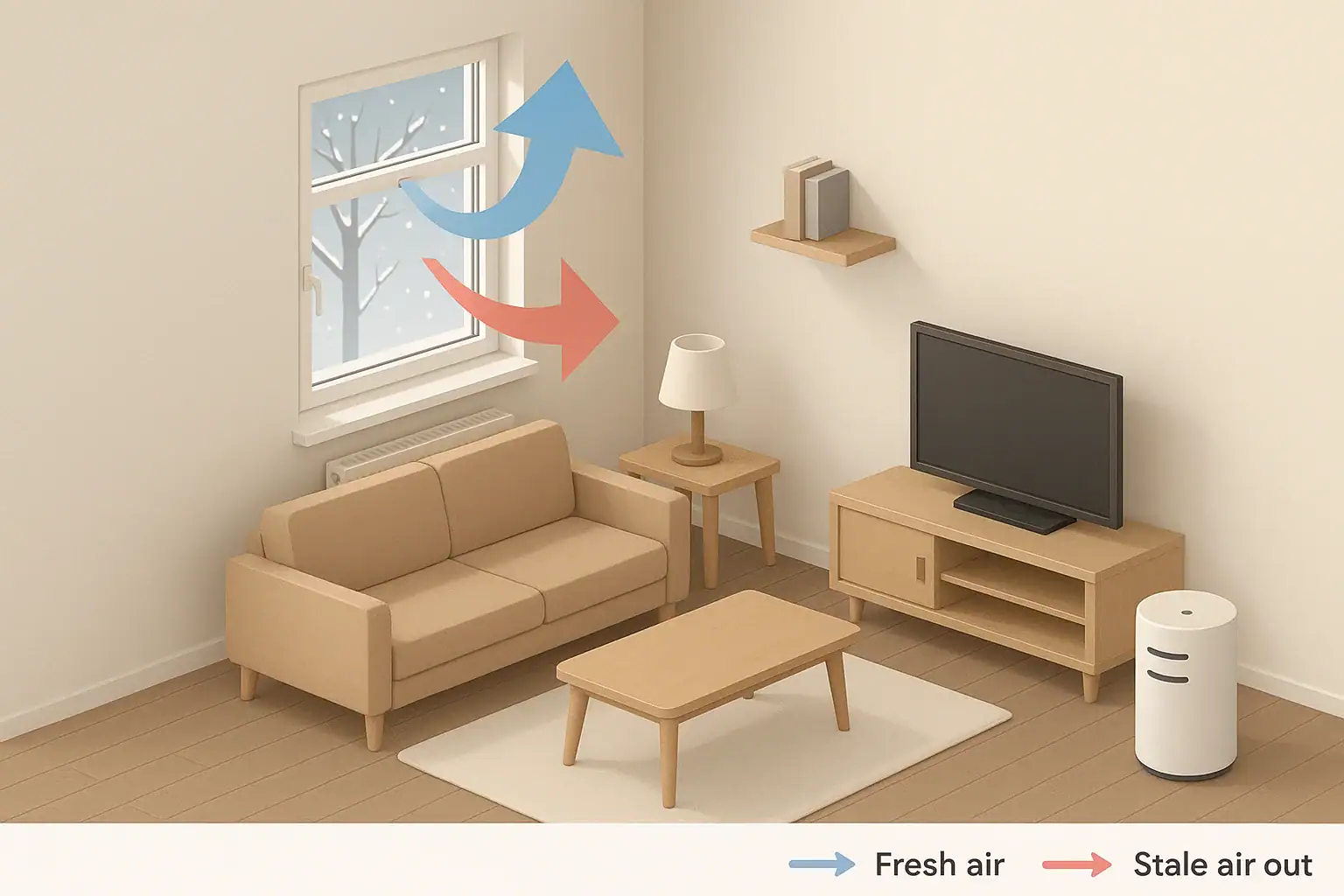
You can ventilate in winter without freezing by using short, controlled airing, balancing fresh air with heat retention, and supporting it with filtration where needed.
In cold weather, completely sealing a home keeps heat in but also traps indoor pollutants and moisture. With a few simple strategies, you can bring in enough fresh air for comfort and indoor air quality while keeping heat loss, drafts, and energy waste to a minimum.
- Aim for brief window openings (3–10 minutes) several times a day instead of leaving a window cracked all day.
- Target around 0.3–0.5 air changes per hour (ACH) as a general minimum for most homes, higher for crowded or stuffy rooms.
- Use cross-ventilation (two openings) when possible so air exchanges quickly and you can close windows sooner.
- Run kitchen and bathroom exhaust fans during and shortly after cooking or showering to remove moisture and pollutants.
- Use air purifiers and range hoods to reduce particles and some gases so you can ventilate a bit less aggressively in extreme cold.
- Keep indoor temperature and humidity in a comfortable range (about 68–72°F, 30–50% RH) to avoid condensation and chills.
Why winter ventilation matters for indoor air quality
In winter, people often close windows for weeks at a time to stay warm and save on heating costs. While this reduces drafts, it also allows indoor pollutants to build up. Everyday activities like cooking, showering, cleaning, burning candles, and simply breathing all add moisture and contaminants to indoor air.
Without some form of ventilation, you may see:
- Stuffy, stale-feeling rooms
- Rising carbon dioxide (CO2) levels from people indoors
- Excess humidity, leading to condensation on windows and potential mold growth on cold surfaces
- Lingering odors from cooking or household products
- Accumulation of fine particles (for example, from cooking or smoke) and volatile organic compounds (VOCs)
Good winter ventilation does not mean leaving windows wide open all day. Instead, the goal is controlled air exchange: bringing in enough fresh air to dilute pollutants and moisture, while limiting unnecessary heat loss and discomfort.
Key concepts: air exchange, ACH, and balanced strategies
To ventilate intelligently in cold weather, it helps to understand a few basic concepts. You do not need precise measurements in most homes, but rough targets can guide your choices.
Air changes per hour (ACH)
Air changes per hour (ACH) is a way to describe how often the air in a space is replaced with outdoor air in one hour. For example, 0.5 ACH means that half of the air volume is replaced every hour, on average.
In practice, most existing homes end up somewhere around 0.3 to 0.7 ACH from natural leakage plus intermittent window opening and fans. Very tight homes may be lower, and older, draftier homes may be higher even without deliberate ventilation.
As rough guidance:
- Below ~0.3 ACH: Air may feel increasingly stale, especially with several occupants.
- Around 0.3–0.5 ACH: Often acceptable for many households if pollutant sources are moderate and localized exhaust is used.
- Above ~0.5 ACH in winter: Fresher air but potentially more heat loss unless managed with short bursts or heat recovery.
Ventilation versus filtration
Ventilation exchanges indoor air with outdoor air, diluting pollutants and moisture. Filtration, such as using a HEPA air purifier, removes particles from indoor air but does not lower CO2 or humidity. A balanced winter strategy often combines the two.
- Use ventilation (windows, vents, exhaust fans) to manage CO2, moisture, and gases.
- Use filtration to reduce fine particles (dust, PM2.5, smoke) when opening windows is impractical or outdoor air is poor.
Short, intense airing vs. constant small leaks
Opening windows wide for a short period can exchange air quickly, then you can close them and let the heating system recover. This often wastes less energy than leaving a window slightly open for hours, which creates a continuous stream of cold air and cools surrounding surfaces.
| Home situation | Main issue noticed | Primary action type | Why this is a good first step |
|---|---|---|---|
| Tight home, windows rarely opened | Stuffy air, grogginess, rising CO2 on monitor | Increase ventilation (windows or mechanical) | Fresh outdoor air directly reduces CO2 and stale feeling. |
| Cooking daily with gas or high-heat methods | Odors and fine particles lingering | Use exhaust hood and/or air purifier | Local exhaust and filtration reduce particles and smells. |
| Small bathroom, frequent showers | Foggy mirror, condensation on walls | Run exhaust fan; brief window opening | Removes humid air at the source, limiting moisture spread. |
| Bedroom with closed door all night | Stale smell in morning, mild headache | Short airing cycles; possible purifier | Window airing resets air; purifier helps with particles. |
| Cool exterior walls and windows | Condensation or mold spots | Control humidity; targeted ventilation | Lowering indoor humidity reduces condensation risk. |
| Outdoor air occasionally smoky or dusty | Concern about bringing in particles | Time ventilation; rely more on filtration | Ventilate when outdoor air is cleaner; filter when not. |
| Basement or lower level | Damp smell, higher humidity | Dehumidification plus limited ventilation | Moisture removal and modest fresh air manage dampness. |
Common winter ventilation mistakes and what to watch for
Trying to stay warm often leads to patterns that quietly worsen indoor air quality. Recognizing these can help you adjust your approach without large renovations.
Leaving a window slightly open all day
A constant small gap can cause continuous cold drafts and cool adjacent walls, which may lead to condensation. You pay to heat a steady stream of incoming cold air. Short, deliberate openings usually exchange air more efficiently.
Blocking or ignoring exhaust fans
Kitchen and bathroom exhaust fans are valuable tools in winter. Common issues include:
- Not using the hood when cooking due to noise or habit.
- Shutting off the bathroom fan immediately after a shower instead of letting it run 15–20 minutes.
- Dirty fan covers or weak fans that do not move much air.
These fans primarily remove humid, polluted air directly at the source with limited impact on overall heat loss when used for short periods.
Over-humidifying closed spaces
Humidifiers can make dry winter air more comfortable, but in sealed rooms they can quickly raise humidity beyond the recommended range. This increases condensation on cold windows and walls. If you use a humidifier, monitor humidity with a basic hygrometer and adjust runtime and ventilation accordingly.
Relying only on filtration and never airing out
HEPA filtration can significantly reduce particles, but it does not remove CO2, water vapor, or all gases. Even in very cold conditions, some level of outdoor air exchange is beneficial. Filtration is a complement, not a complete replacement for ventilation.
Ignoring warning signs in specific rooms
Winter problems often show up first in certain spaces. Signs that a room needs better ventilation or humidity control include:
- Persistent condensation on windows, especially at the bottom edges
- Musty odors or visible mold spots on exterior walls or ceilings
- Strong cooking or chemical odors that linger for many hours
- People regularly complaining that a room feels stuffy or air feels “heavy”
Practical strategies: how to ventilate in winter without freezing
Combining short airing cycles, exhaust use, and filtration lets you manage air quality while keeping your home comfortable. Adjust frequency and duration to your climate, insulation level, and household size.
1. Use short, scheduled window airing
Instead of leaving windows cracked for long periods, try controlled airing:
- How long: Open windows wide for about 3–10 minutes, depending on outdoor temperature and wind.
- How often: Typically 2–4 times per day in frequently occupied rooms (morning, midday, evening, and after specific activities like cooking).
- Cross-ventilation: If safe and possible, open two windows or a window and a door on opposite sides of the space to create a quick airflow path.
During airing, you can lower thermostats slightly to keep the heating system from overshooting, then return to your normal setting afterward.
2. Target high-pollution activities
Some activities briefly create much higher pollution than typical background levels. Ventilate most around these events:
- Cooking: Use the range hood on a setting that vents outdoors, and run it for several minutes after cooking. If you do not have a hood that vents outside, open a nearby window in short bursts and consider using a portable air purifier near the cooking area.
- Showering: Run the bathroom fan during and at least 15–20 minutes after showering. If the bathroom has a window, a short opening after the shower can clear moist air faster.
- Cleaning or painting: Many products release VOCs. Increase ventilation while using them and for a while afterward, especially if odors are noticeable.
3. Rotate ventilation between rooms
In colder climates, you may not want many windows open at once. A practical approach is to ventilate rooms in sequence:
- Open bedroom windows wide for 3–5 minutes while you are not in the room, then close them.
- Later, air out the living room for another 3–5 minutes.
- Use closed interior doors to limit drafts into occupied spaces during these short cycles.
This pattern keeps overall heat loss modest while giving each room a periodic fresh air reset.
4. Combine ventilation with air purifiers
When outdoor air is very cold or has temporary issues (such as nearby traffic or smoke), you can lean more on filtration to control particles and use shorter ventilation bursts.
- Run a suitable HEPA air purifier sized for the room, placed so that it can circulate air effectively without obstructing airflow.
- Ventilate when outdoor air is relatively cleaner (for example, away from rush hour or local events that generate smoke).
- Use purifiers to maintain lower particle levels between ventilation events.
This combination allows reasonable indoor air quality while reducing how long windows must stay open in harsh weather.
5. Manage humidity alongside ventilation
In winter, indoor humidity often drops, but in well-sealed homes it can sometimes become too high in certain rooms. Aim for roughly 30–50% relative humidity. To help stay in this range:
- Ventilate and exhaust moisture at the source in kitchens and bathrooms.
- Avoid drying large amounts of laundry indoors without extra ventilation.
- Use humidifiers carefully, with a hygrometer, and reduce output or add airing when humidity climbs above about 50–55% for extended periods.
Realistic home scenarios and example strategies
Every home is different, but some common situations illustrate how winter ventilation strategies can be adapted without major changes to the building.
Small apartment with sealed windows and central heat
If your windows are tight and you cannot open them widely, use what you can access:
- Open available windows for brief periods on milder winter days.
- Run kitchen and bathroom exhaust fans during and after use.
- Place an air purifier in the main living area or bedroom to reduce particulate buildup.
- If allowed and safe, use the building’s ventilation features (trickle vents, dedicated vents) so they remain unblocked.
Detached house in a cold climate
Homes in colder regions may experience bigger temperature swings when windows open. You can still ventilate efficiently by:
- Performing 3–5 minute cross-ventilation in the morning and evening.
- Limiting airing to one or two rooms at a time, closing doors to unused rooms.
- Using local exhaust (kitchen, bath) more often, as these are targeted and relatively brief.
- Insulating and weather-stripping to reduce uncontrolled drafts, then using controlled window openings instead.
Bedroom used heavily at night
Bedrooms often have elevated CO2 by morning because doors and windows stay closed for hours. For these rooms:
- Air out the bedroom for several minutes shortly before bed and again in the morning.
- Where safe, keep the door slightly open at night to allow central air circulation.
- Consider a small air purifier to reduce particles from bedding, dust, and nearby activities.
- Watch for condensed moisture on windows; increase ventilation or reduce humidifier settings if it appears routinely.
Safety, devices, and standards-related considerations
Some ventilation and air-cleaning devices include additional features beyond simple fans and filters. It is helpful to understand what they do and how they fit into a winter strategy.
Ozone-generating devices
Ozone can react with indoor air components in ways that may produce byproducts and is generally not desired in occupied spaces. For home use, many people prefer devices that are described as not producing intentional ozone, especially in winter when windows are closed more often.
Ionizers and electrostatic devices
Some air cleaners use ionization or electrostatic methods to remove particles. While they can reduce certain particles, they can sometimes generate small amounts of ozone as a byproduct, depending on design. If you use such devices in winter, consider:
- Reading manufacturer information on ozone output and usage recommendations.
- Avoiding running them continuously in tightly closed rooms if you are unsure of their byproducts.
- Supplementing with regular ventilation to dilute any byproducts.
UV-C features
Some systems incorporate UV-C light to address microorganisms within ducts or inside the device. These features do not replace ventilation. If a device uses UV-C:
- Ensure the light source is enclosed so occupants are not directly exposed.
- Follow manufacturer guidance for placement, maintenance, and lamp replacement.
- Continue to use regular ventilation and filtration practices alongside UV-C features.
Using monitors to guide winter ventilation
Basic consumer air quality monitors can show trends for CO2, PM2.5, and sometimes total VOCs. While readings can be imprecise, trends can help you understand when spaces benefit most from ventilation. In winter, you might:
- Note how quickly CO2 rises in bedrooms at night and adjust airing or door positions.
- See how long cooking particles or odors linger and adjust hood use or window-opening time.
- Watch humidity readings and increase dehumidification or ventilation if they stay elevated near cold surfaces.
Maintenance and ongoing upkeep in winter
Good winter ventilation depends not only on when you open windows, but on how well your systems and components are maintained. A few small tasks can make a noticeable difference.
Keep exhaust fans effective
Over time, lint, dust, and grease can reduce fan performance.
- Clean range hood filters as recommended so they can move air efficiently.
- Vacuum or wipe bathroom fan grilles periodically to remove dust.
- Listen for changes in noise or airflow that might indicate a failing fan.
Maintain air purifier performance
Filters clog gradually, reducing airflow and effectiveness.
- Replace HEPA and carbon filters on the schedule suggested by the manufacturer or sooner if heavily used.
- Vacuum pre-filters if they are designed to be cleaned.
- Place purifiers where their airflow is not blocked by furniture, curtains, or walls.
Check windows and seals
Well-sealed windows allow you to control when and how you ventilate, instead of losing heat through random leaks.
- Use weather-stripping or caulk to fix obvious drafts.
- Ensure windows can still open and close easily for short airing cycles.
- Consider using interior curtains or blinds at night to reduce radiant heat loss, opening them during airing periods.
Frequently asked questions about winter ventilation
How often should I ventilate my home in winter?
A common pattern is two to four brief airing sessions per day in main living areas and bedrooms, plus targeted ventilation during activities like cooking and showering. The exact frequency depends on how many people are present, the tightness of the building, and your climate.
Is it better to keep a window slightly open all night?
This may be comfortable for some people, but from an energy standpoint it usually leads to continuous heat loss and can cool nearby surfaces. A mix of pre-bed airing, door position adjustments, and occasional night-time window opening may be more efficient while still supporting comfort.
Can I rely on my kitchen range hood alone for winter ventilation?
A vented range hood is excellent for removing cooking-related pollutants, but it mainly affects the kitchen area and times when you cook. You still benefit from broader whole-room airing from time to time, especially in bedrooms and living areas.
What if outdoor air quality is sometimes poor?
You can time ventilation for periods when outdoor air is relatively better and use filtration more heavily when outdoor conditions are worse. Short, targeted airing even during less-than-ideal outdoor conditions may still be useful if you quickly follow it with filtration to capture incoming particles.
How cold is too cold to open windows?
There is no strict temperature cutoff. In very cold conditions, you can shorten airing times to just a few minutes with strong cross-ventilation, use interior doors to shield occupied areas, and rely more on exhaust fans. The goal is to exchange air quickly and then close up again.
| Humidity goal | Simple actions | Tools that can help | Notes |
|---|---|---|---|
| Around 30–40% RH in very cold weather | Limit humidifier output; ventilate after moisture-heavy activities. | Hygrometer; bathroom and kitchen exhaust fans. | Lower humidity reduces condensation on cold windows and walls. |
| Around 40–50% RH in mild winter | Use moderate humidification if air feels dry; open windows briefly. | Humidifier with adjustable output; window airing. | Balance comfort with avoiding persistent window condensation. |
| Humidity often above ~55% | Increase exhaust use; avoid drying laundry indoors without extra ventilation. | Dehumidifier (if needed); fans to move air off cold surfaces. | Prolonged high humidity increases risk of mold growth in cool corners. |
| Condensation on windows most mornings | Air out bedrooms after waking; reduce overnight humidifier use. | Timed exhaust fans; short cross-ventilation. | Focus on moisture sources near bedrooms first. |
| Localized mold spots on exterior walls | Improve airflow to that area; manage humidity; consider moisture-resistant finishes. | Fans; furniture spacing from walls. | Keep furniture a few inches from cold walls to allow air circulation. |
| Basement or crawlspace feels damp | Use dehumidification; seal obvious water entry; ventilate moderately. | Dehumidifier; sump or drainage improvements (if applicable). | Too much cold outdoor air can cool surfaces, so balance ventilation and drying. |
Related guides: Ventilation vs Air Purifier: When You Need One, the Other, or Both • How to Stop Condensation on Windows (And Why It Matters for Mold) • CO2 Monitors for Homes: What Good Numbers Look Like and Why They Matter
Key takeaways for ventilating in winter without freezing
Ventilating in winter is about timing and focus, not leaving windows open all day. Short, intentional airing and targeted exhaust during high-pollution activities can maintain fresher air with limited heat loss. Filtration helps manage particles when it is too cold or inconvenient to rely solely on open windows.
Watching for signs like condensation, lingering odors, and persistent stuffiness gives you feedback about whether your current approach is working. With modest adjustments—using fans effectively, caring for filters, and scheduling quick window openings—you can balance comfort, energy use, and indoor air quality through the winter season.
Frequently asked questions
How long should I open windows during a winter airing session?
Open windows wide for roughly 3–10 minutes depending on outdoor temperature and wind; in very cold weather aim for the shorter end (around 3 minutes) with cross-ventilation if possible. The goal is a quick exchange of indoor air to dilute CO2 and moisture while minimizing heat loss to surfaces.
Can I rely solely on HEPA air purifiers instead of opening windows in winter?
HEPA air purifiers effectively remove particles like dust and smoke but do not reduce CO2, humidity, or many gases. Purifiers are a useful complement, but periodic outdoor air exchange is still advisable to manage CO2 and moisture.
What is the best way to ventilate after cooking in winter without losing too much heat?
Use a vented range hood that exhausts outdoors when available and run it for several minutes after cooking. If you lack an exhaust hood, open a nearby window briefly and consider running a portable air purifier to reduce lingering particles while keeping the airing time short.
How should I manage indoor humidity to avoid condensation and mold in winter?
Aim for roughly 30–50% relative humidity (lower in very cold weather), exhaust moisture at source when showering or cooking, and monitor levels with a hygrometer. Reduce humidifier output or add brief ventilation if humidity regularly exceeds about 50–55% to limit condensation on cold surfaces.
What if outdoor air is smoky or polluted—how can I still ventilate in winter?
Time ventilation for periods when outdoor air is cleaner and rely more on filtration (HEPA and activated carbon) when outdoor conditions are poor. Short, targeted airing followed by running air cleaners can help balance reducing particles while maintaining acceptable indoor air quality.
Recommended next:
- Clear sizing logic (room size → CADR/ACH)
- HEPA vs carbon explained for real use-cases
- Humidity + ventilation basics to reduce mold risk