
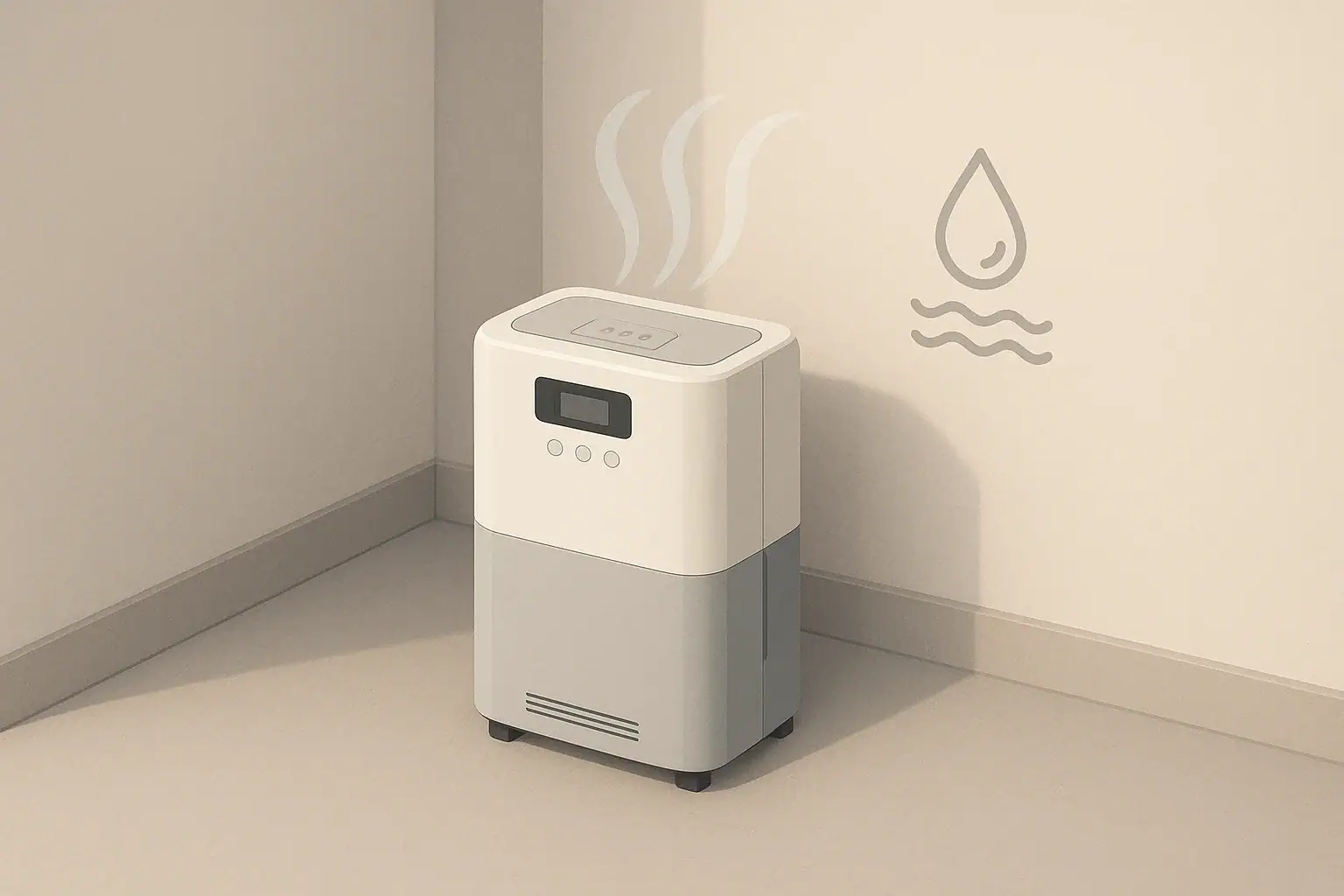
A basement dehumidifier should be set up on a level surface near a drain or collection point, with at least a few inches of clearance for airflow and a humidity target around 40–50% relative humidity (RH) in most climates.
Getting the basics right—placement, drainage, and realistic humidity targets—matters more than picking a specific model. A correctly set up dehumidifier can help keep a basement more comfortable, discourage mold growth, and protect stored items from excess dampness, without needing constant attention. The steps below focus on simple, practical choices you can adapt to your own basement layout.
- Target around 40–50% RH in finished basements; up to 55–60% is often acceptable in unfinished spaces.
- Place the dehumidifier on a stable, level surface with 6–12 inches of clearance around air inlets and outlets.
- Use gravity drain (hose to floor drain or sump), condensate pump, or regularly empty the bucket.
- Keep doors open within the basement level so air can circulate between rooms or storage areas.
- Run the unit continuously or on a humidistat setting during damp seasons; adjust if air feels too dry.
Why Basement Dehumidifier Setup Matters
Basements tend to be cooler and more humid than the rest of the house because they are partly or fully below grade. Ground moisture, small leaks, and limited sunlight make them prone to condensation and damp materials. A dehumidifier can help manage this moisture, but only if it can move air freely and get rid of the collected water reliably.
Poor setup can lead to short cycling, overflowing buckets, or areas of the basement that stay damp even while the dehumidifier runs. Over-drying can also be a problem, especially in cold weather, making the space uncomfortable and potentially stressing wood and other materials.
Good setup focuses on three questions:
- Where should the dehumidifier sit so air can circulate across as much space as possible?
- How will the water drain without constant manual emptying, if possible?
- What RH target is realistic for your basement and local climate?
Key Concepts: RH Targets, Sizing, and Airflow
Before moving the dehumidifier around, it helps to understand how humidity and capacity interact in a basement environment.
Practical RH targets for basements
Relative humidity is the amount of moisture in the air compared to the maximum the air can hold at that temperature. In basements, practical ranges are:
- Finished basements used regularly: aim for roughly 40–50% RH.
- Unfinished storage basements: up to about 55–60% RH is often acceptable if surfaces stay dry and materials aren’t musty.
- Colder seasons: slightly higher RH may be acceptable because cold air holds less moisture; focus on avoiding visible condensation.
Lower is not always better. RH much below about 35–40% for long periods can feel dry and may not provide additional benefit for most materials in a basement.
Sizing basics for basement dehumidifiers
Dehumidifier capacity is typically given as pints of water removed per day under standard test conditions. Actual performance will be lower in cooler basements, but capacity guidelines are still useful. When thinking about sizing, consider:
Airflow and room layout
Dehumidifiers need to move basement air across their coils. For that to happen:
- Keep at least 6–12 inches clearance around air intake and exhaust areas.
- Face the exhaust toward open space, not directly into a wall or large object.
- Open doors between rooms on the same level so air can circulate.
- Consider a small fan to help move air into dead corners or behind shelving if needed.
The more evenly air circulates, the closer your whole basement will be to the same RH level.
| Task | Why it matters | Notes |
|---|---|---|
| Measure basement area | Aligns roughly with dehumidifier capacity | Include all rooms that share air with the unit |
| Check for visible water issues | Identifies problems that dehumidifiers alone cannot fix | Look for leaks, standing water, or seepage first |
| Choose a central location | Improves air mixing across the basement | Avoid tight corners if possible |
| Confirm a drainage path | Prevents bucket overflows and interruptions | Plan hose routing before permanent placement |
| Set initial RH target | Prevents over-drying or under-dehumidifying | Start around 45–50% RH and adjust |
| Test for a few days | Shows how the setup performs in real conditions | Use a separate hygrometer in a few spots |
| Adjust doors and fans | Reduces humid pockets and uneven results | Reposition if some areas stay noticeably damp |
Example values for illustration.
Common Basement Dehumidifier Mistakes
Certain patterns show up frequently in damp basements, even when a dehumidifier is running. Recognizing these makes troubleshooting easier.
Poor placement and blocked airflow
Placing a dehumidifier directly against a wall, behind large furniture, or in a tight closet can starve it of air. This can lead to:
- Reduced moisture removal, even if the unit runs constantly.
- Higher noise and wear because the fan is working harder.
- Localized dry spots near the unit and damp areas farther away.
Aim for an open area, such as a central section of the basement or a spot near the stairwell where air naturally circulates.
Inadequate drainage planning
Another common issue is relying on the internal bucket in a very damp basement, then forgetting to empty it. When the bucket fills up, most units shut off until it is drained. Problems include:
- Humidity creeping up again when the unit stops.
- Risk of spillage if the bucket is overfilled or jostled.
- Extra work carrying water up stairs or across the basement.
Where possible, continuous drainage or a condensate pump helps the dehumidifier run steadily.
Unrealistic RH targets
Trying to drive a basement to very low RH, especially in a humid climate, can lead to constant operation with little gain. Signs your target may be too aggressive include:
- The unit running nearly nonstop but RH readings changing slowly.
- Noticeably dry air and static in other parts of the home when air mixes.
- Higher energy costs without additional practical benefit.
Adjusting to a moderate RH target often balances comfort, protection of belongings, and energy use.
Ignoring building moisture problems
Dehumidifiers manage airborne moisture. They do not fix structural water entry, such as foundation cracks, failed gutters, or plumbing leaks. If walls are visibly wet or there is standing water, addressing those issues first usually makes dehumidification more effective and reliable.
Practical Setup: Placement, Drainage, and RH Settings
Once you understand the basics, you can focus on step-by-step setup in your specific basement.
Choosing the location
Good placements in basements often include:
- Near the center of the open area: encourages even air mixing.
- Close to a floor drain or sump pit: simplifies hose routing for drainage.
- On a slightly raised, stable surface: such as a low platform or sturdy stand to keep the unit above minor spills.
Avoid locations where water could drip onto electrical connections or where dust and lint are very heavy, such as directly under woodworking tools or near a dryer vent that leaks lint into the room.
Setting up drainage options
There are three common drainage approaches in basements:
- Bucket only: simplest but requires regular manual emptying. Suitable for moderately damp basements where you are often present.
- Gravity drain hose: connect a hose to the unit’s drain port and run it downhill to a floor drain, sloped floor, or sump. The outlet must be lower than the dehumidifier’s drain point.
- Condensate pump: a small pump that lifts water from the unit to a higher drain point, like a utility sink or standpipe.
When routing hoses, keep them as straight as possible, avoid kinks, and make sure the end is secure in the drain to prevent splashing.
Leveling and clearance
Use a level or visual check to make sure the unit is not leaning. A slight tilt toward the drain side is sometimes recommended by manufacturers, but extreme tilts can cause noise or internal issues. Leave enough clearance—often at least 6–12 inches from walls, shelving, or stored boxes—around both intake and exhaust sides. This encourages smooth airflow and more uniform drying.
Setting the humidistat
Many basement dehumidifiers include a built-in humidistat. If so:
- Start with a target around 45–50% RH in a finished basement.
- In an unfinished storage basement, 50–55% can be a reasonable starting point.
- Allow a few days of operation and check readings with a separate hygrometer placed away from the unit.
If the built-in display and your separate hygrometer differ, use the external readings primarily for decisions, as they better reflect conditions in the rest of the space.
Real-World Basement Scenarios
Each basement has its own combination of materials, leaks, and airflow paths. Here are some typical patterns and how setup might differ.
Unfinished utility basement with floor drain
In a large, open, unfinished basement with a floor drain near the furnace or water heater:
- Place the dehumidifier a few feet from the drain, on a stable platform.
- Run a short gravity drain hose into the floor drain.
- Set RH to around 50–55% and monitor stored items such as cardboard boxes for signs of dampness.
- Open any interior doors on that level to include adjacent rooms if desired.
Finished basement family room and bedroom
In a finished basement with separate rooms:
- Place the dehumidifier in a hallway or open family room where air can spread to both the bedroom and other spaces.
- Keep doors open during the day so humidity can equalize, closing them only when needed for privacy.
- Consider a small fan to help pull air from the farthest room toward the dehumidifier.
- Aim for around 40–50% RH for comfort, adjusting slightly based on how the space feels.
Basement with known seepage or heavy dampness
If there is visible water entry during rainstorms or consistent damp patches on walls:
- Address drainage, gutters, grading, or interior waterproofing strategies where possible.
- Locate the dehumidifier away from direct water paths to reduce the risk of splashing onto the unit.
- Expect to run the unit more frequently and possibly at a higher RH target to balance comfort and energy use.
In such spaces, a single dehumidifier may not solve all moisture problems, but it can still help control airborne humidity and protect items that are kept off the floor.
Safety, Electrical Considerations, and Add-On Features
While dehumidifiers are common household appliances, basements present specific safety considerations.
Electrical safety in damp areas
Because basements can be damp:
- Plug the dehumidifier directly into a properly grounded outlet; avoid long extension cords whenever possible.
- Keep the cord path away from standing water areas and where it won’t be tripped over.
- Follow any local requirements for ground-fault circuit interrupter (GFCI) outlets in unfinished or damp locations.
Temperature limits
Most standard residential dehumidifiers are designed for moderate temperatures. In very cool basements, coils can frost. Many newer units have defrost cycles, but performance still decreases at lower temperatures. If your basement stays quite cold for long stretches, expect slower moisture removal and monitor for frost buildup.
Air cleaning and extra features
Some dehumidifiers include basic air filters primarily meant to protect the coils from dust. These are usually not high-efficiency particle filters. Other technologies such as ionization or UV-C may be offered in certain air-treatment devices; these should be evaluated on their own merits, taking into account energy use, maintenance needs, and any manufacturer safety guidance. For most basements, the main priorities remain moisture control, safe operation, and clean airflow through the unit.
Maintenance, Filters, and Energy Use
Routine care keeps a basement dehumidifier working efficiently and reduces the chance of odors or performance loss.
Regular cleaning tasks
- Dust the intake and grille: wipe or vacuum periodically to maintain airflow.
- Clean or replace the pre-filter: rinse or change according to the manual; a clean filter reduces strain on the fan and coil.
- Check the bucket and drain hose: rinse the bucket occasionally, and inspect the hose for kinks, algae, or mineral buildup.
- Inspect the coil area: if accessible, gently remove lint and dust buildup, taking care not to bend fins.
Monitoring performance over time
Simple cues that your setup may need attention include:
- Unit runs more often than it used to for the same RH readings.
- Noticeable musty smells returning despite the unit operating.
- Condensation on windows or cool surfaces even when the unit is running.
These signs may mean filters or coils are dirty, drainage is partially blocked, or moisture entering the basement has increased.
Energy considerations
Dehumidifiers can be one of the larger contributors to basement electricity use, especially in humid months. To manage this:
- Use a moderate RH target rather than the lowest possible setting.
- Seal obvious air leaks and improve drainage so the unit doesn’t have to work against constant new moisture.
- Close basement windows on humid days; outside air can quickly raise moisture levels.
Basement Humidity FAQs
Homeowners often have similar questions when they start managing basement humidity.
Should a basement dehumidifier run all the time?
During very humid seasons, it is common for a dehumidifier to cycle frequently or even run nearly continuously when set to a low RH target. Using the built-in humidistat or an external controller allows the unit to shut off once the target is reached. In drier months, it may run only occasionally.
Where should the RH sensor be located?
If you use a separate hygrometer, place it at roughly breathing height in a representative location away from direct airflow from the dehumidifier, windows, or vents. For finished basements, measuring in the main living area and in at least one corner or storage area offers a clearer picture of how even the RH is.
Is it better to dehumidify the whole house or just the basement?
This depends on your home layout and moisture sources. If dampness is mainly in the basement, a dedicated basement dehumidifier is usually sufficient. If humidity is high throughout the house, whole-house strategies like improved ventilation, moisture control in other rooms, or additional dehumidification on upper floors may be helpful.
| Goal | Simple actions | Tools | Note |
|---|---|---|---|
| Keep finished basement comfortable | Set RH around 45–50%, run unit in humid months | Dehumidifier with humidistat, hygrometer | Adjust a bit higher in colder weather |
| Protect stored items from dampness | Raise items off floor, use moderate RH target | Shelving, pallets, dehumidifier | Aim near 50–55% RH if space is unfinished |
| Reduce musty odor after rain | Check for leaks, run unit continuously for several days | Dehumidifier, fan, hygrometer | Address water entry points in addition to drying air |
| Smooth humidity between rooms | Open doors, add small fan to move air | Box fan, dehumidifier | Helps avoid humid pockets in closed-off rooms |
| Limit energy use | Use moderate RH setpoint, seal leaks, close windows | Weatherstripping, caulk, dehumidifier | Reducing moisture sources lowers runtime |
| Prepare for very humid season | Clean filter, test drain, confirm RH reading | Dehumidifier, hygrometer | Do a short test run before peak humidity |
Example values for illustration.
Related guides: Basement Dehumidifier Guide: Targets, Drainage, and Energy Use • Basement Dampness 101: RH Targets, Dehumidifiers, and Ventilation • Dehumidifier Capacity Estimator: Room Dampness to Liters/Day
Key Takeaways for Basement Dehumidifier Setup
Effective basement dehumidification depends on a few fundamentals: stable placement with good airflow, reliable drainage, and realistic RH targets tailored to how you use the space. Finished basements generally benefit from RH around 40–50%, while unfinished areas can often be kept slightly higher as long as surfaces remain dry and odors are controlled.
Checking conditions with a separate hygrometer, inspecting for water entry, and doing simple maintenance on filters and drains help your dehumidifier work steadily over time. With these basics in place, most homeowners can keep basement dampness in check without constant adjustments.
Frequently asked questions
Where exactly in a basement should I place a dehumidifier for the most even RH control?
Place the unit in a central, open area such as a hallway or near the stairwell so air can circulate to adjoining rooms. Keep at least 6–12 inches of clearance around intake and exhaust and avoid corners or enclosed closets that create dead spots.
What is the best drainage option if my floor drain is higher than the dehumidifier’s outlet?
Use a condensate pump to lift the water to a higher drain point or route the hose to a lower sump pit if available; gravity drains require the outlet to be lower than the unit’s drain. Make sure hoses are straight, secure, and checked periodically for algae or kinks.
What RH target should I set for a finished versus an unfinished basement?
For a finished basement used as living space, aim for about 40–50% RH for comfort and mold prevention. In unfinished storage areas, 50–55% (up to ~60% in some cases) is often acceptable as long as surfaces remain dry and there’s no musty odor.
Should a basement dehumidifier run constantly, or can I rely on the humidistat?
During very humid periods the unit may need to run frequently, but a properly set humidistat will cycle the unit off once the target RH is reached. Running continuously is reasonable if the space has persistent moisture, but using a moderate RH setpoint saves energy while protecting belongings.
How can I avoid humid pockets so the dehumidifier treats the whole basement?
Keep interior doors open when practical, position the unit centrally, and use small fans to move air from far corners toward the dehumidifier. Also place separate hygrometers in different areas to verify even humidity and relocate or add fans if some spots stay noticeably damp.
Recommended next:
- How to Size a Dehumidifier (Sq Ft, Pints/Day, and Real-World Tips)
- Desiccant vs Compressor Dehumidifiers: Which Is Better for Cold Rooms?
- Basement Dehumidifier Guide: Targets, Drainage, and Energy Use
- Dehumidifier Running Cost: How Much Electricity Will It Use?
- Dehumidifier Sizing: Liters/Day, Room Type, and Dampness Levels
- More in Dehumidifiers →
- Clear sizing logic (room size → CADR/ACH)
- HEPA vs carbon explained for real use-cases
- Humidity + ventilation basics to reduce mold risk