
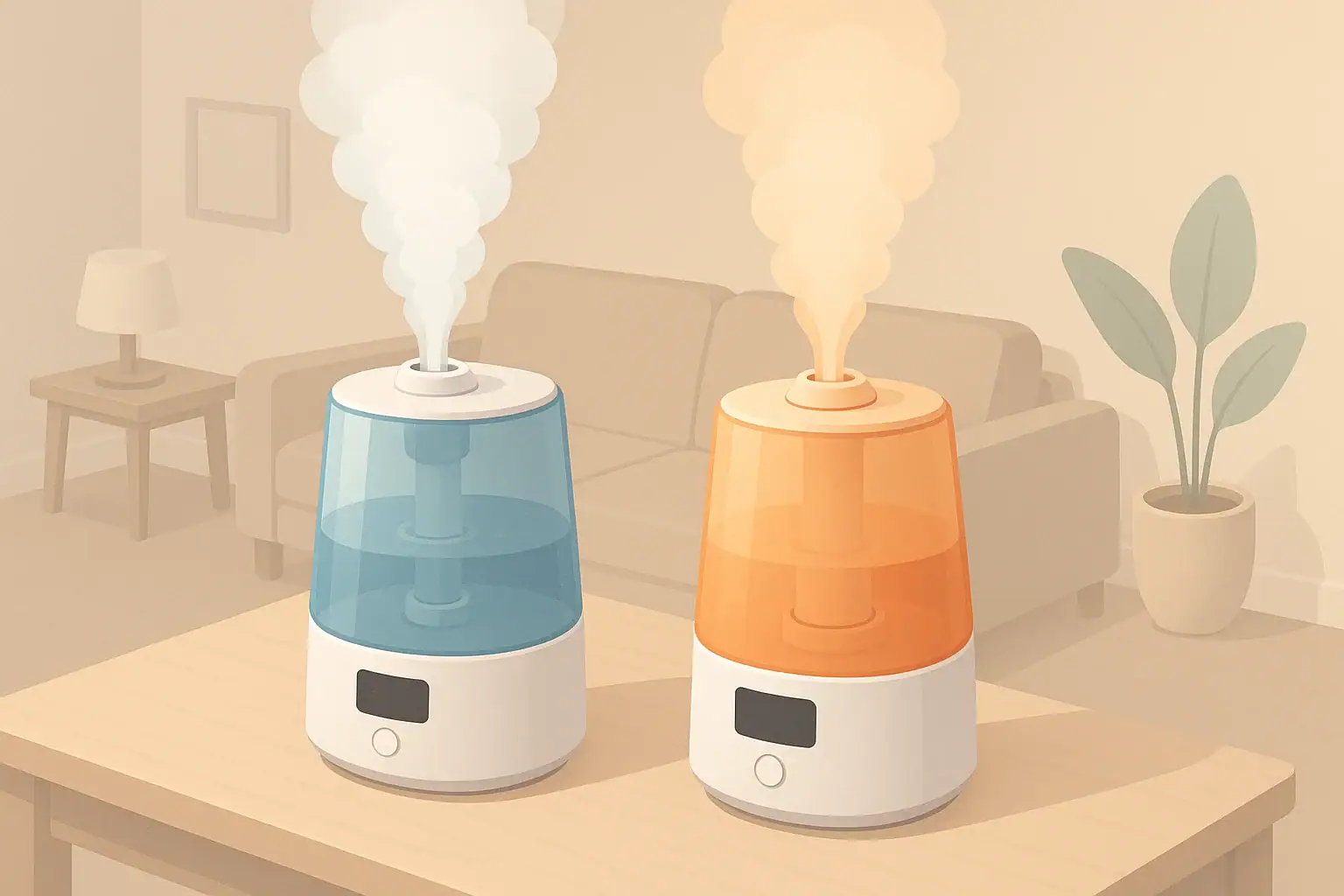
Humidifiers can make dry indoor air more comfortable, especially during winter heating season or in arid climates. Choosing between warm mist and cool mist models affects hygiene, comfort, noise, and safety in your home. Both types can raise relative humidity, but they do it in different ways and come with distinct trade-offs.
This comparison focuses on practical, home-oriented considerations: how each type works, what it means for cleaning and hygiene, how they feel to use, and where they fit into an overall indoor air quality plan.
Understanding the basic mechanisms makes it easier to see why hygiene and comfort differ between warm and cool mist devices.
Warm mist humidifiers (often called steam vaporizers) rely on heat. Inside the unit, water is heated until it produces steam, which cools slightly as it leaves the device. The output may feel pleasantly warm but typically does not raise room temperature by much.
Why Compare Warm Mist vs Cool Mist Humidifiers?
Humidifiers can make dry indoor air more comfortable, especially during winter heating season or in arid climates. Choosing between warm mist and cool mist models affects hygiene, comfort, noise, and safety in your home. Both types can raise relative humidity, but they do it in different ways and come with distinct trade-offs.
This comparison focuses on practical, home-oriented considerations: how each type works, what it means for cleaning and hygiene, how they feel to use, and where they fit into an overall indoor air quality plan.
How Warm Mist and Cool Mist Humidifiers Work
Understanding the basic mechanisms makes it easier to see why hygiene and comfort differ between warm and cool mist devices.
How Warm Mist Humidifiers Work
Warm mist humidifiers (often called steam vaporizers) rely on heat. Inside the unit, water is heated until it produces steam, which cools slightly as it leaves the device. The output may feel pleasantly warm but typically does not raise room temperature by much.
Key characteristics of warm mist systems include:
- Heating element: Boils or nearly boils water to create steam.
- Simple airflow path: Steam rises and mixes with room air, usually without a fan.
- Mineral handling: Minerals in tap water may deposit inside the tank or on internal parts.
Because water is heated, some microorganisms in the tank water are inactivated before reaching the air. However, hygiene still depends strongly on cleaning practices.
How Cool Mist Humidifiers Work
Cool mist humidifiers add moisture to the air without heating the water. The two most common types are ultrasonic and evaporative.
- Ultrasonic: Uses a high-frequency vibrating membrane to create a fine water mist that is pushed into the air.
- Evaporative: Uses a wick or filter that absorbs water; a fan blows air through the wet material so water evaporates naturally.
General characteristics of cool mist systems include:
- No intentional heating: Output feels neutral or slightly cool.
- Fan use (often): Evaporative models rely on a fan, while ultrasonic units may use a gentle airflow system.
- Mineral handling: Ultrasonic models may release fine white dust from minerals in hard water, while evaporative wicks can trap many minerals in the filter media.
Because water is not heated, hygiene depends heavily on tank cleanliness, water quality, and regular maintenance.
Example values for illustration.
| Aspect | Warm Mist | Cool Mist (Ultrasonic / Evaporative) |
|---|---|---|
| Moisture output temperature | Warm steam that cools quickly | Room-temperature mist or vapor |
| Typical power draw (example) | Higher (e.g., heating element may use tens to hundreds of watts) | Lower (e.g., fan or small transducer may use tens of watts) |
| Noise profile | Soft boiling or bubbling sounds | Fan noise (evaporative) or faint hum (ultrasonic) |
| Mineral handling | Minerals tend to build up inside the unit | Ultrasonic may release white dust; evaporative traps minerals in wick |
| Scald risk | Higher, due to hot water and steam | Lower, mist and water stay cool |
| Perceived comfort | Can feel cozier in cool rooms | Can feel fresher, especially in warmer rooms |
| Cleaning priority | Important, especially for mineral buildup | Very important, especially for tank hygiene |
Hygiene Considerations: Warm Mist vs Cool Mist
Both warm and cool mist humidifiers can operate hygienically when maintained correctly. The differences lie in how forgiving each type is if cleaning habits are not perfect, and how they handle minerals and potential microbial growth.
Microorganisms and Water Temperature
Warm mist units heat water, which can reduce some microorganisms in the steam that reaches the air. However, this does not make them maintenance-free. Biofilm and residue can still form on surfaces in contact with water, especially if the unit is not emptied and cleaned regularly.
Cool mist units do not use heat, so the water in the reservoir stays at room temperature. This can be comfortable to use but also means:
- Microorganisms can potentially grow if water sits for long periods.
- Stagnant water, even if visually clear, may still require cleaning and refreshing.
- Filters and wicks need routine attention to avoid musty odors and buildup.
In both cases, using fresh water, emptying tanks between uses when possible, and following the manufacturer’s cleaning recommendations are central to hygienic operation.
Minerals, White Dust, and Residue
Tap water contains dissolved minerals such as calcium and magnesium. How a humidifier handles these minerals affects both hygiene and housekeeping.
- Warm mist: Minerals tend to stay behind in the tank and on heating elements as scale. Over time, this buildup can reduce performance and make cleaning more difficult. Descaling becomes a key maintenance task.
- Cool mist ultrasonic: The vibrating membrane can atomize both water and minerals. These minerals may settle as a fine white dust on nearby surfaces. This dust is mainly a cleanliness and filter-dusting issue, but it signals that water hardness is high.
- Cool mist evaporative: Many minerals remain in the wick or filter. The wick may stiffen or discolor as it loads with minerals, and needs regular replacement or cleaning if the model allows it.
Using lower-mineral water (such as distilled or low-mineral filtered water) can reduce dust and scale, regardless of humidifier type. This can simplify hygiene and keep the unit easier to clean.
Cleaning Workload and Routine
Hygiene is more about habits than technology. Typical good practices include:
- Daily or frequent: Empty tank, rinse, and refill with fresh water.
- Weekly (or as recommended): Deeper cleaning of tank surfaces, caps, and any parts in contact with water.
- As needed: Descale mineral deposits, replace wicks or filters, and inspect for signs of residue or odor.
Warm mist models often require more descaling; cool mist models often require more attention to wicks, filters, and tank cleanliness. Choosing the type that best matches your willingness to do each kind of maintenance can support better hygiene over time.
Comfort and Sensory Experience
Comfort from a humidifier comes from both humidity level and how the output feels and sounds. Warm and cool mist units can reach similar humidity targets, but daily experience differs.
How the Mist Feels in the Room
Once moisture mixes with room air, the air’s temperature is largely determined by your heating or cooling system, not the humidifier. However, the immediate sensation near the unit can differ:
- Warm mist: The steam plume can feel cozy on cool winter nights. Some people prefer this feeling in bedrooms when air is otherwise chilly.
- Cool mist: Output feels neutral or slightly cool. This can be more comfortable in warmer rooms or during milder seasons when extra warmth is not desired.
Both types can help air feel less dry when humidity is raised into a moderate range, commonly around 30–50% relative humidity, which many people find comfortable for general living spaces.
Noise, Light, and Sleep Considerations
Noise level and sound type can matter a lot in bedrooms and nurseries.
- Warm mist: May emit gentle boiling or gurgling sounds. The lack of a fan can be appealing where very low airflow noise is desired.
- Cool mist ultrasonic: Often very quiet, with a soft hum or faint buzzing from the transducer and airflow system.
- Cool mist evaporative: Uses a fan, so noise depends on speed. Low settings may work as light white noise for some people.
Indicator lights, control panels, and glowing water tanks can also influence sleep. Many models offer dim or night modes, but brightness levels vary. If you are sensitive to light or noise, consider control placement, fan speeds, and whether you can position the unit farther from the bed.
Perceived Warmth and Seasonal Use
In cold climates, warm mist units can feel more seasonally appropriate, even though they generally do not replace meaningful heating capacity. In contrast, cool mist models can feel more comfortable in shoulder seasons or in rooms that tend to run warm.
Some households use different modes or different units by season: warm mist for very cold months and cool mist for the rest of the year. Others choose one type and adjust room temperature and placement to stay comfortable.
Safety and Household Suitability
Safety is a central consideration, especially in homes with children, pets, or limited space. Both warm and cool mist humidifiers can be used safely when placed and maintained correctly, but their risk profiles differ.
Scald and Burn Risks
Warm mist devices contain hot water and produce hot steam at the outlet. Risks include:
- Accidental tipping or pulling down the unit, potentially spilling hot water.
- Touching hot surfaces or steam outlets at close range.
For this reason, warm mist units are usually placed out of reach on stable, level surfaces and away from high-traffic areas.
Cool mist devices operate at or near room temperature, so scald risk is lower. They still require stable placement to avoid spills and electrical hazards, but burns from the mist or tank water are not a primary concern.
Electrical and Placement Safety
All humidifiers combine water and electricity, so basic precautions apply to every type:
- Keep the unit on a stable, water-resistant surface.
- Avoid placing directly on carpets or wooden surfaces that could be damaged by moisture.
- Allow clearance around the unit so mist can disperse and not condense heavily on walls, windows, or furniture.
- Route cords to minimize tripping and accidental tipping.
Over-humidifying a room may lead to condensation on windows or cooler surfaces. Persistent dampness can contribute to mold-friendly conditions. Using a separate hygrometer or an indoor air quality monitor with humidity readout can help keep humidity in a moderate range.
Households with Children, Older Adults, or Pets
In homes where devices may be bumped, grabbed, or knocked over, cool mist humidifiers often fit better from a scald-risk standpoint. If you prefer warm mist for comfort, consider:
- Placing the unit on a high, stable surface away from common pathways.
- Ensuring the cord is not dangling or easy to pull.
- Supervising use in play areas or shared spaces.
Regardless of type, regularly inspecting the tank, cord, and plug for wear or damage supports safe, long-term use.
Energy Use and Cost of Operation
When comparing warm mist vs cool mist, energy use and ongoing costs are another practical trade-off. While humidifiers are usually not the largest energy users in a home, differences can add up over a dry season.
Electricity Use
Warm mist models use electricity to heat water. Heating generally requires more power than running a small fan or ultrasonic transducer.
- Warm mist: The heating element may draw significantly more power while operating. If run for many hours a day, this can be noticeable on electricity use.
- Cool mist ultrasonic: Typically lower power draw; much of the energy goes to the transducer and modest airflow system.
- Cool mist evaporative: Mainly powers a fan; power use depends on fan speed and size but is usually moderate.
If operating costs are a priority, cool mist units often have an advantage, especially when used for long periods or in multiple rooms.
Filter, Wick, and Descaling Costs
Ongoing costs are not just about electricity. They also include cleaning supplies and any replaceable components:
- Warm mist: May require descaling solutions or tools to remove mineral deposits. Some models include replaceable components, while others rely mainly on manual cleaning.
- Cool mist ultrasonic: Some users choose to buy low-mineral water to reduce white dust; this can increase operating cost but may reduce cleaning time.
- Cool mist evaporative: Wicks or filters need replacement at intervals recommended by the manufacturer. Costs vary by size and type.
Factoring in both energy use and replacement supplies helps estimate the total cost of running a humidifier through a heating season.
Choosing the Right Type for Your Home
Warm mist vs cool mist is not about one being universally better. It is about matching device characteristics to your home layout, climate, and comfort preferences.
Questions to Ask Before You Buy
Consider the following when deciding between warm and cool mist humidifiers:
- Who will use the room? Children, older adults, and pets may influence your tolerance for scald risk.
- How cold or warm is the space? Very cold bedrooms may feel better with warm mist; warmer spaces may suit cool mist.
- How hard is your water? Hard water increases scale in warm mist units and white dust or wick loading in cool mist units.
- What kind of maintenance do you prefer? Are you more comfortable descaling heating elements or replacing wicks and filters?
- Where will you place the unit? Space, outlets, and distance from beds or desks matter for noise, light, and safety.
Integrating Humidifiers into Overall Air Quality
Humidifiers are one piece of indoor air quality. To keep air comfortable and pleasant over time, combine them with other simple strategies:
- Use exhaust fans or window ventilation when weather and security allow, to reduce stuffiness.
- Consider air purifiers with appropriate sizing (matching clean air delivery to room volume) for particle and odor control.
- Monitor indoor humidity and basic particulate levels with simple meters or monitors to avoid over-humidifying.
- Address sources of moisture, such as leaks or persistent condensation, separately from comfort humidification.
This broader view helps keep humidity in a comfortable range while limiting unwanted side effects like condensation or musty smells.
Example values for illustration.
| Goal | Simple actions | Tools | Note |
|---|---|---|---|
| Keep humidity in a moderate range | Run humidifier only until hygrometer shows a mid-level range (example: roughly 30–50% RH) | Standalone hygrometer or basic air quality monitor with humidity | Avoid continuous maximum output without checking levels |
| Limit window condensation | Reduce humidifier setting, increase ventilation when safe, and move unit farther from windows | Visual checks each morning during cold weather | Persistent condensation can signal over-humidifying or insulation issues |
| Prevent musty odors | Empty and clean humidifier regularly, allow parts to dry between uses if possible | Soft brushes, mild cleaning agents, clean towels | Odor often indicates buildup in tanks, wicks, or filters |
| Avoid damp corners and closets | Do not direct mist into confined spaces; keep airflow paths open | Small fan or improved room layout for airflow | Localized dampness can occur even when room-wide humidity seems moderate |
| Balance humidifiers with other moisture sources | Use kitchen and bathroom exhaust fans during cooking and showers | Range hood, bathroom fan, or window ventilation | Reduces surplus moisture so comfort humidification stays in check |
| Plan for seasonal changes | Adjust run times as outdoor temperature and heating use change | Basic seasonal checklist or reminder | Dry winter air may need more humidification than milder seasons |
Summary: Weighing Hygiene and Comfort Trade-Offs
Warm mist and cool mist humidifiers both help relieve the discomfort of very dry indoor air. Warm mist units offer a cozier feel in cold rooms and a heating process that can reduce some microorganisms in the steam, but they draw more power, require regular descaling, and carry higher scald risk. Cool mist units are generally more energy-efficient and safer to touch, but they rely even more on diligent tank cleaning and, for ultrasonic types, may produce mineral dust when used with hard tap water.
Choosing between them means thinking about who uses the space, how much time you want to spend on maintenance, your water hardness, and your preferred room feel. By pairing the right type of humidifier with thoughtful placement, moderate humidity targets, and routine cleaning, you can support a comfortable, practical indoor environment through the dry months.
Frequently asked questions
How often should I clean warm mist vs cool mist humidifiers?
Emptying and rinsing the water tank daily when the unit is in regular use is a good baseline for both types. Perform a deeper weekly clean of surfaces and parts that contact water, descale heating elements on warm mist models as needed, and replace or clean wicks/filters on evaporative cool mist units according to the manufacturer’s schedule.
Is distilled water necessary to prevent white dust and scale?
Distilled or low-mineral water is not strictly required but it greatly reduces mineral scale in warm mist units and white dust from ultrasonic cool mist units. Using lower-mineral water lowers cleaning frequency and can extend the life of filters and components, though it may raise operating costs if you buy larger quantities.
Can using a humidifier increase mold risk in my home?
Humidifiers can contribute to mold-friendly conditions if they cause persistent condensation or over-humidify a room. To reduce risk, aim for moderate indoor humidity (commonly 30–50% RH), monitor with a hygrometer, avoid directing mist toward cool surfaces, and maintain ventilation and routine cleaning.
Which humidifier type is safer for homes with children or pets?
Cool mist humidifiers generally present lower scald risk because they do not contain hot water or steam. Warm mist models can still be used safely if placed out of reach on stable surfaces and monitored to prevent tipping, but many households with active children or pets prefer cool mist for peace of mind.
How can I reduce mineral white dust from an ultrasonic humidifier?
Use distilled or low-mineral water, run a demineralization cartridge if available, and clean the unit regularly to minimize dust. Placing the unit on surfaces that are easy to wipe and avoiding very hard tap water are also effective strategies.
Recommended next:
- HEPA vs Activated Carbon: Best Setup for Allergies, Odors, and Smoke
- Air Purifier vs Dehumidifier: Which One Solves Musty Air?
- Humidifier vs Dehumidifier: When to Add Moisture vs Remove It
- Air Purifier vs Ozone Generator: Safety, Effectiveness, and Myths
- HEPA vs Carbon Filters: When Each One Matters Most
- Air Purifier vs Ventilation: Which Fixes Stuffy Bedrooms Better?
- More in Comparisons →
- Clear sizing logic (room size → CADR/ACH)
- HEPA vs carbon explained for real use-cases
- Humidity + ventilation basics to reduce mold risk