
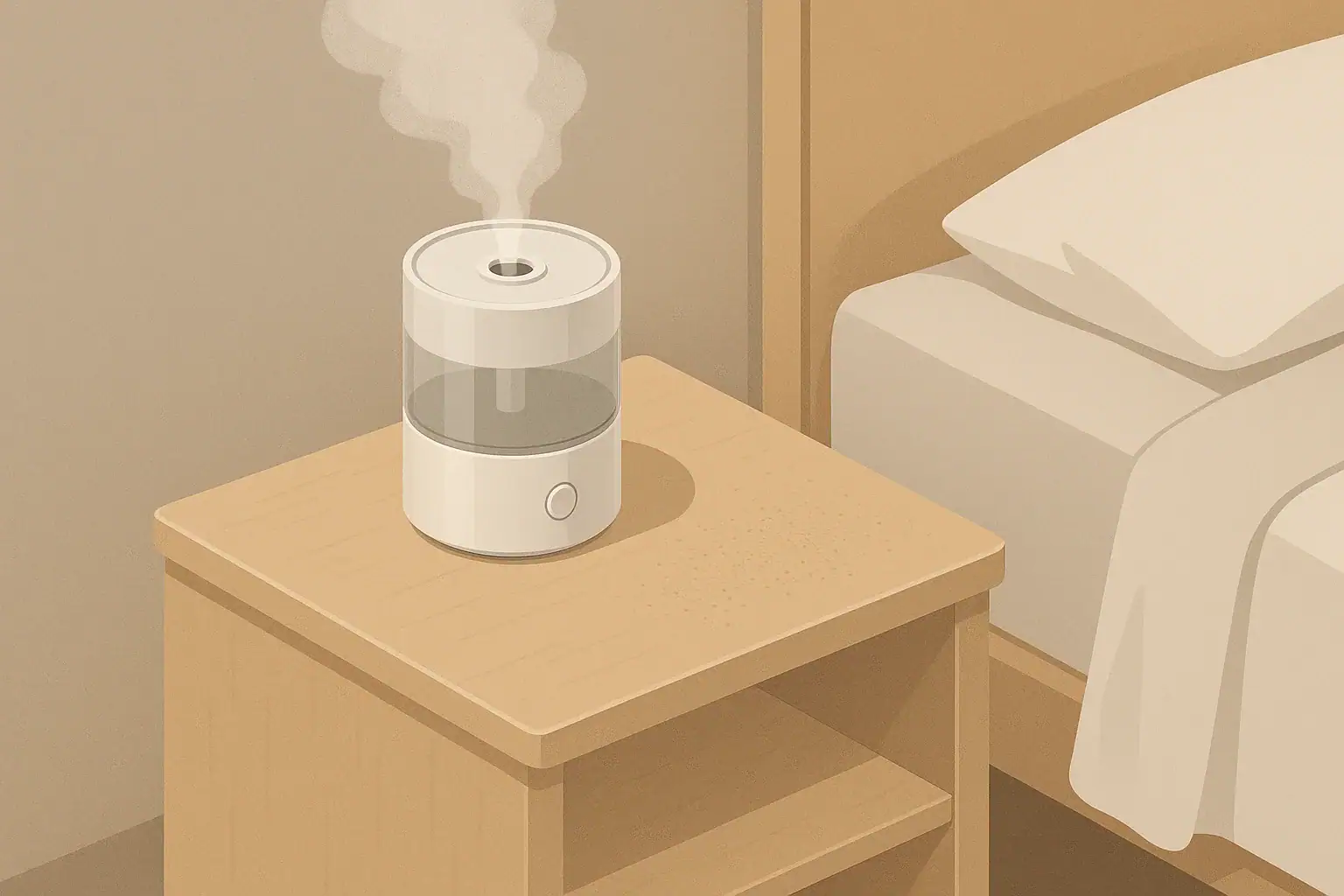
Humidifier white dust is fine mineral powder left behind when a humidifier sprays tap water into the air and the water evaporates. It is mostly a hard-water residue, not mold, but it can add to indoor dust, coat electronics, and bother people who are sensitive to particles. If you see a light, chalky film on furniture near your cool mist humidifier, you are almost certainly dealing with white dust.
Understanding what causes this residue makes it much easier to control. By choosing lower-mineral water, adjusting humidity targets, and maintaining the unit, most homes can cut visible white dust dramatically without giving up the comfort benefits of added moisture. This guide walks through how white dust forms, what it means for indoor air quality, and the practical steps to reduce it day to day.
What Humidifier White Dust Is and Why It Matters
Humidifier white dust is the dry mineral residue that settles on surfaces after using certain portable humidifiers, especially ultrasonic and other cool mist models. It usually looks like:
- A soft, pale film on dark furniture or floors
- Fine powder on TV stands, speakers, or computer cases
- Light specks that reappear shortly after dusting in rooms where the humidifier runs the longest
These particles come from dissolved minerals in tap water, such as calcium and magnesium. When the humidifier turns water into tiny droplets, the water portion evaporates in the air while the minerals remain as airborne particles that eventually settle as dust.
White dust matters for a few reasons:
- Cleaning workload: It can make surfaces look dirty faster and require more frequent dusting.
- Indoor air quality: It contributes to the total amount of fine particles in the air, which some people prefer to keep as low as practical.
- Electronics and equipment: Any extra dust can collect in vents, fans, and keyboards over time.
In most homes, white dust is more of a nuisance than a major health hazard, but it is reasonable to want to limit it, especially if you already work to control dust, allergies, or asthma triggers indoors.
Key Concepts: How Humidifier White Dust Forms
To manage humidifier white dust effectively, it helps to understand the main factors that drive it: water mineral content, humidifier type, and how you operate the unit.
Minerals in Tap Water (Hard vs. Soft)
Tap water naturally contains dissolved minerals. The higher the mineral content, the “harder” the water. When hard water is used in a humidifier that sprays liquid droplets, the device does not remove those minerals. Instead, it sends them into the air as part of the mist.
- Hard water: More calcium and magnesium; more potential white dust.
- Softer water: Fewer minerals; less potential white dust.
- Distilled or demineralized water: Very low mineral content; usually the least visible dust.
Once droplets leave the humidifier, the water evaporates quickly, especially in heated indoor air. The minerals cannot evaporate, so they stay behind as tiny solid particles that float briefly, then settle onto nearby surfaces.
Humidifier Technology and White Dust
Different humidifier designs handle minerals differently:
- Ultrasonic humidifiers: Use a vibrating diaphragm to create a cool mist of fine droplets. They tend to send the most minerals into the air and are the most common source of white dust.
- Impeller (cool mist) humidifiers: Use a spinning disk to fling water at a diffuser. They also create droplets that can carry minerals into the room.
- Evaporative humidifiers: Pull air through a wet wick or filter. Many minerals stay trapped in the wick as water evaporates, so visible white dust is often lower, though the wick can accumulate scale.
- Warm mist or steam vaporizers: Boil water and release steam. Most minerals stay in the tank as scale deposits instead of becoming airborne, so white dust is typically minimal.
The more directly a humidifier sprays liquid water into the room, the more likely it is to generate white dust when used with mineral-rich water.
Operating Conditions That Increase White Dust
Even with the same water and device, how you run the humidifier affects how much dust you see:
- Run time and output: High output on maximum settings for many hours per day releases more total minerals.
- Room size: Small or enclosed rooms show deposits faster than large, open spaces.
- Airflow: Poor circulation allows particles to settle quickly around the unit instead of dispersing.
- Existing dust load: Homes that already have a lot of dust may hide some of the white dust visually, even though particle levels still increase.
| Humidifier type | Typical white dust level* | Mineral handling | Maintenance focus |
|---|---|---|---|
| Ultrasonic (cool mist) | High with hard tap water | Sprays minerals into room as fine droplets | Use low-mineral water, clean tank and mist outlet often |
| Impeller (cool mist) | Moderate to high | Minerals carried in droplets, some settling in tank | Control output setting, descale moving parts |
| Evaporative (wick + fan) | Low to moderate | Many minerals stay in wick as scale | Replace wick regularly, rinse mineral buildup |
| Warm mist / steam | Low | Most minerals remain in tank as scale | Descale tank and heating chamber periodically |
*Relative levels assume use with typical hard tap water and similar run times.
Real-World Examples of Humidifier White Dust at Home
Seeing how white dust shows up in everyday situations can help you recognize and troubleshoot it quickly.
Example 1: Dusty Nightstand Near an Ultrasonic Humidifier
A bedroom uses an ultrasonic cool mist humidifier on a high setting overnight. The unit sits on a small wooden nightstand, about a foot from a lamp and alarm clock. In the morning, there is a light, powdery film on the nightstand and a faint haze on the clock display.
What is happening: Hard tap water is being atomized into droplets. As the water evaporates, minerals fall out as fine dust, which settles mostly on the nearest flat surface.
Simple improvements:
- Move the humidifier to a dresser a few feet away from electronics.
- Switch from tap water to a mix of tap and distilled water.
- Lower the output setting and use a hygrometer to avoid over-humidifying.
Example 2: White Film on Dark Hardwood Floors
In a small nursery, a cool mist humidifier runs most of the day in winter. Parents notice a pale film on the dark hardwood floor within a radius of about three to four feet around the unit, even though they mop regularly.
What is happening: Mist is being released at or slightly above floor level. Droplets fall and evaporate near the ground, leaving mineral residue where the child plays.
Simple improvements:
- Place the humidifier higher, on a sturdy, water-safe shelf or stand.
- Use lower-mineral water and reduce output once humidity reaches a comfortable level.
- Vacuum and damp mop regularly to remove settled mineral dust from the play area.
Example 3: White Dust in a Home Office with Electronics
A home office has a computer, printer, and several monitors. An ultrasonic humidifier is placed on the desk for convenience. Over a few weeks, a noticeable layer of white dust appears on the printer and vents of the computer case.
What is happening: The mist stream is directed toward sensitive electronics, so mineral particles settle directly on vents and fans.
Simple improvements:
- Move the humidifier to a side table away from the main electronics cluster.
- Rotate the mist outlet so it points toward open room space, not devices.
- Use compressed air or careful vacuuming to remove existing dust from vents.
Example 4: Minimal Dust with Evaporative Humidification
Another household uses an evaporative humidifier with a wick filter in the living room. They also have hard water but notice only minor white dust, mainly inside the unit and on the wick itself.
What is happening: Minerals are being captured in the wick as water evaporates, so fewer mineral particles reach the air.
Simple improvements:
- Replace the wick as it becomes stiff, crusty, or discolored.
- Rinse the water tray regularly to remove loose mineral deposits.
- Monitor humidity to avoid running the unit longer than needed.
| What you notice | Likely cause | Practical response |
|---|---|---|
| White film on furniture within 2–3 feet of humidifier | High mineral tap water plus strong local mist stream | Move unit farther from surfaces, mix in distilled water, lower output |
| Powder collecting on electronics and screens | Mist directed toward devices, limited air circulation | Reposition humidifier, redirect mist, improve airflow in room |
| Crusty scale in tank but little dust in room | Minerals depositing inside unit (evaporative or steam) | Descale tank and components, follow cleaning schedule |
| White dust mostly on floor around humidifier | Low placement causing droplets to fall and evaporate near ground | Raise humidifier on stable stand, avoid directing mist at floor |
| More dust after increasing run time or setting | Higher total mineral output into air | Use a hygrometer, reduce run time or setting once target humidity is reached |
Common Mistakes and Troubleshooting Humidifier White Dust
Many white dust problems come from a few predictable habits. Correcting these can quickly reduce buildup on surfaces.
Mistake 1: Using Straight Hard Tap Water
Symptom: Heavy white film on nearby furniture and electronics, even with normal run times.
Why it happens: Hard tap water carries a large mineral load that becomes airborne with each refill.
How to fix it:
- Switch to distilled or demineralized water where practical.
- If that is not realistic for every refill, start with a 50/50 mix of tap and distilled water and adjust based on results.
- Consider a humidifier design that traps more minerals internally if white dust remains high.
Mistake 2: Over-Humidifying the Room
Symptom: Condensation on windows, damp patches near the humidifier, and thick dust layers forming quickly.
Why it happens: Running the humidifier on maximum settings for long periods pushes more water and minerals into the air than the room needs.
How to fix it:
- Use a simple hygrometer to track indoor relative humidity.
- Aim for a moderate range rather than the upper end of the scale.
- Turn the humidifier down or off once the room reaches your target range.
Mistake 3: Poor Placement and Airflow
Symptom: Heavy dust ring around the humidifier, but less elsewhere in the room.
Why it happens: The mist is not mixing well with room air. Droplets fall and evaporate close to the unit, dropping minerals in a tight circle.
How to fix it:
- Place the humidifier on a stable, water-safe surface 2–4 feet above the floor.
- Keep it a few feet away from walls, curtains, and large furniture.
- Point the mist outlet toward open space, not directly at objects or surfaces.
Mistake 4: Infrequent Cleaning and Descaling
Symptom: White dust plus visible scale inside the tank or along the mist outlet, and sometimes reduced performance.
Why it happens: Minerals accumulate inside the unit over time, which can change how water flows and sprays.
How to fix it:
- Empty and refill the tank daily with fresh water.
- Wipe accessible surfaces inside the tank with a soft cloth to remove film.
- Follow the manufacturer’s instructions for descaling with appropriate agents.
When to Suspect Another Problem (Not Just White Dust)
White dust is mineral-based and dry. If you notice any of the following, there may be an additional issue:
- Colored residue (pink, green, or black) inside the tank or on surfaces, which can suggest microbial growth or other contaminants.
- Musty or unpleasant odors coming from the humidifier when it runs.
- Visible slime or film that feels sticky or greasy instead of powdery.
In these cases, stop using the humidifier until it has been thoroughly cleaned and inspected according to the manual. White dust alone is not slimy or strongly odorous.
Humidifier White Dust and Safety Basics
While humidifier white dust is mainly a comfort and cleanliness concern, it connects to broader safety issues around humidity and particle exposure.
Respiratory and Sensitivity Considerations
Mineral particles from white dust are small enough to be inhaled. For many people, the levels produced in a typical home are mainly a nuisance. However, some individuals prefer to minimize any additional particles indoors, particularly if they:
- Have asthma, chronic bronchitis, or other respiratory conditions
- Are sensitive to general airborne dust or fine particles
- Are caring for infants, older adults, or people with compromised lungs
In these situations, controlling white dust is a reasonable part of an overall indoor air quality plan. This usually includes good cleaning habits, ventilation, and—if desired—air filtration, along with careful humidifier use.
Humidity, Mold Risk, and Surfaces
White dust itself is not mold, but humidity levels that are too high can create conditions where mold and dust mites thrive. Over-humidifying in an attempt to fight dry air can lead to:
- Condensation on windows and cold surfaces
- Damp spots on walls, ceilings, or around vents
- Musty odors in closets, corners, or behind furniture
Keeping humidity in a moderate range helps support comfort while limiting moisture-related risks. It also reduces how much mist—and therefore how many minerals—the humidifier needs to release.
Protecting Electronics and Delicate Items
Any fine dust, including white dust, can gradually collect in vents and on fans in electronics. Over years, this may:
- Reduce airflow through equipment
- Increase the need for cleaning and maintenance
- Contribute to overheating if dust is allowed to build up unchecked
To protect devices, keep humidifiers a reasonable distance away, avoid pointing the mist directly at screens or vents, and dust or vacuum electronics gently on a regular schedule.
Maintenance and Long-Term Humidifier Use
Good maintenance habits limit both white dust and other humidifier-related issues. Over time, they also help the unit perform more consistently.
Daily and Weekly Maintenance Habits
Simple routines make the biggest difference:
- Daily: Empty and refill the tank with fresh water. Quickly wipe any visible film or residue inside the tank.
- Every few days: Inspect the mist outlet and surrounding plastic for mineral spots and wipe them away.
- Weekly or as directed: Descale internal parts to remove hardened mineral deposits.
- Filter or wick care: Rinse or replace according to the schedule provided with your unit.
End-of-Season Storage
If you only use your humidifier during certain months, proper storage helps prevent stale odors, scale hardening, and residue problems when you bring it back out.
- Drain all water from the tank and base.
- Clean and descale the unit thoroughly, then allow all parts to dry completely.
- Remove and discard used wicks or filters that will not be reused.
- Store the humidifier in a dry location, away from dust and temperature extremes.
At the start of the next season, inspect the unit, replace any filters or wicks, and run it briefly with fresh water before regular use.
Coordinating Humidifier Use with Cleaning
Because white dust adds to overall dust levels, pairing humidifier use with regular cleaning keeps visible buildup under control:
- Dust with damp or microfiber cloths in the area where the humidifier runs most often.
- Vacuum carpets and rugs with a machine that has good particle filtration.
- Wipe hard floors and flat surfaces where you see a recurring pale film.
These steps remove both mineral dust and regular household dust, improving how clean the room feels even when the humidifier is in active use.
Practical Takeaways and Specs to Look For
Managing humidifier white dust is mainly about reducing how many minerals reach the air and how much mist you actually need. A few focused changes often make a noticeable difference within days.
- Use the lowest-mineral water that is practical for your household.
- Aim for moderate indoor humidity and avoid running the humidifier at maximum output all day.
- Place the unit where mist can mix with room air instead of hitting surfaces directly.
- Clean and descale the humidifier on a consistent schedule, especially with hard water.
- Pay attention to where dust appears and adjust placement, water, or settings accordingly.
Specs to Look For When Choosing or Replacing a Humidifier
If you plan to buy a new humidifier or upgrade from a model that creates a lot of white dust, certain features can make long-term management easier. When comparing options, consider:
- Humidification method: Note whether the unit is ultrasonic, impeller, evaporative, or warm mist, and how that aligns with your white dust tolerance and maintenance preferences.
- Water treatment features: Look for designs that support mineral-reducing filters, cartridges, or wicks if you expect to use hard tap water.
- Output control: Multiple output levels or automatic humidity control help avoid over-humidifying and reduce total mineral release.
- Tank size vs. room size: Choose a capacity that matches your room so you do not need to run the unit at maximum power constantly.
- Ease of cleaning: Wide tank openings, simple internal shapes, and removable parts make routine wiping and descaling more practical.
- Clear maintenance guidance: Units with straightforward schedules for cleaning, descaling, and filter replacement are easier to keep in good condition.
- Noise and placement flexibility: Quieter units with adjustable mist direction can be positioned farther from sensitive surfaces without disturbing sleep or work.
By matching these specs to your home’s water hardness, room layout, and comfort goals, you can enjoy the benefits of a humidifier while keeping white dust to a manageable minimum over the long term.
Frequently asked questions
Which humidifier features most help reduce white dust?
Look for humidifiers with water-treatment options (demineralization cartridges or filters), evaporative designs, or models that support distilled water. Good output controls and easy-to-clean tanks also make it simpler to limit mineral release and keep the unit maintained.
Does using tap water cause humidifier white dust?
Yes—tap water with higher mineral content (hard water) is the main cause of white dust because minerals become airborne when droplets evaporate. Using low-mineral or distilled water greatly reduces the amount of dust produced.
Is humidifier white dust harmful to breathe?
For most healthy adults, white dust is primarily a nuisance rather than a severe health hazard, but the particles can be inhaled and may bother people with asthma or other respiratory sensitivities. Reducing mineral output and maintaining good ventilation and cleaning are sensible ways to lower exposure.
Will switching to distilled water eliminate white dust completely?
Switching to distilled or demineralized water usually eliminates most visible white dust because those waters lack the minerals that form residue. It may not address other contaminants or microbes, so regular cleaning remains important.
How should I position a humidifier to minimize white dust?
Place the humidifier 2–4 feet above the floor on a stable, water-safe surface and keep it away from walls, curtains, and electronics. Aim the mist toward open room space and ensure some airflow so droplets disperse rather than settle nearby.
How often should I clean and descale my humidifier to prevent white dust?
Empty and refill the tank daily and wipe visible film as needed; inspect and clean the mist outlet every few days. Descale internal parts weekly or according to the manufacturer’s guidance, and replace wicks or filters on the recommended schedule.
- Clear sizing logic (room size → CADR/ACH)
- HEPA vs carbon explained for real use-cases
- Humidity + ventilation basics to reduce mold risk