
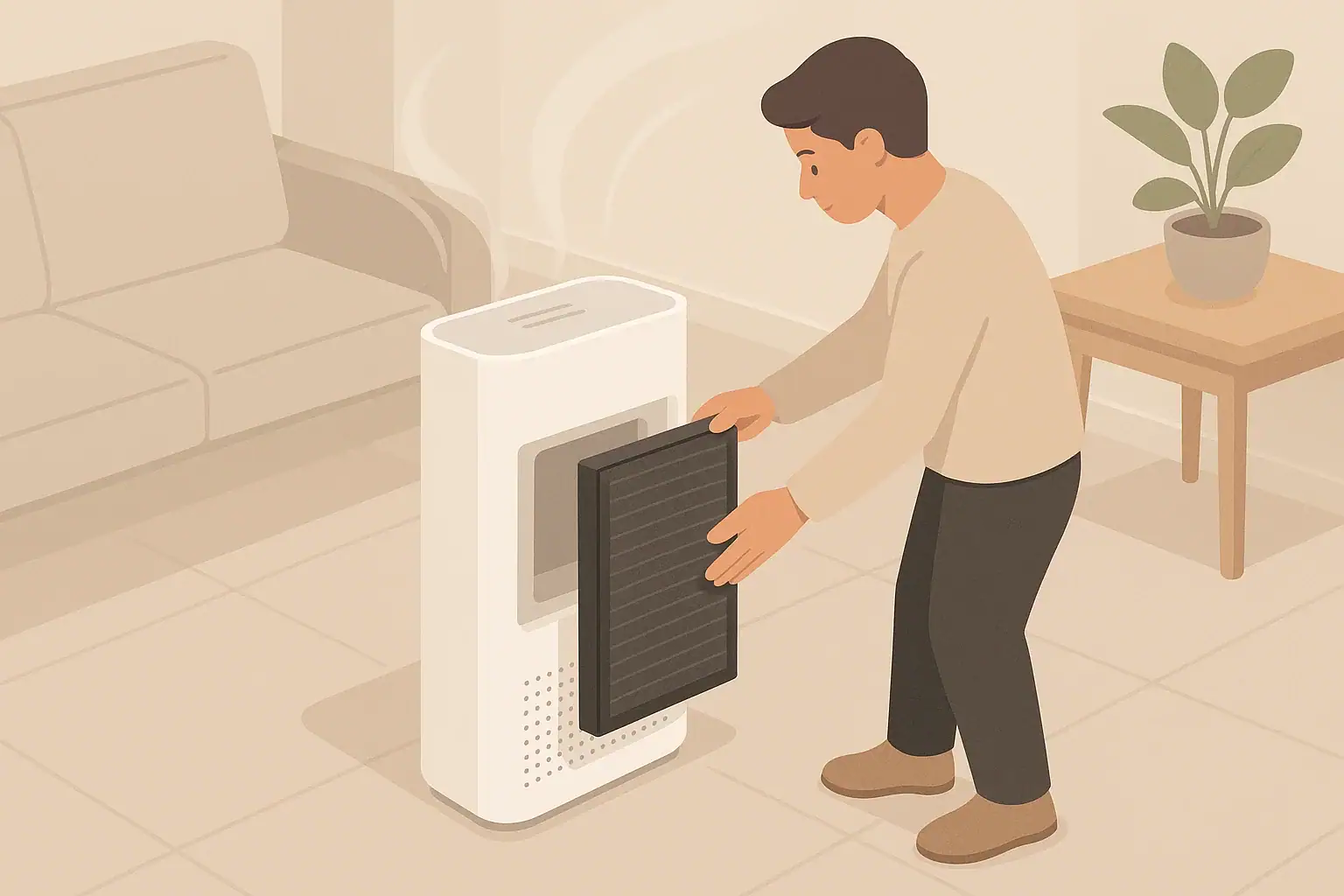
You should replace a carbon filter when odors start to break through sooner than they used to or when it has reached the end of its recommended service window, typically every 3–6 months in most homes. Even if it still looks clean, a saturated carbon filter can no longer capture smells or gases effectively and simply lets them pass through.
This guide explains how carbon and charcoal filters work, how long they usually last in real homes, and the clearest signs that yours is spent. You will see practical examples for kitchens, bedrooms, and whole-house systems, plus common mistakes that shorten filter life. There is also a safety section, a troubleshooting checklist, and a simple way to plan replacements without lab equipment or special tools.
Use these steps to match your carbon filter schedule to your cooking habits, occupancy, and ventilation so you can avoid lingering odors, reduce exposure to some gases, and keep your air purifier or range hood working close to its design performance.
What Carbon Filters Are and Why They Matter
Carbon filters (often called activated carbon or activated charcoal filters) are odor and gas filters used in air purifiers, range hoods, some HVAC systems, and specialty odor-control units. Instead of catching dust like a typical furnace or HEPA filter, they are designed to reduce smells and certain airborne chemicals.
In a home, carbon filters are commonly used to manage:
- Cooking odors from frying, grilling, and strong spices
- Pet and litter box smells
- Garbage, bathroom, and laundry room odors
- Some volatile organic compounds (VOCs) from cleaning products, paints, and new furnishings
- Smoke odors from cooking, fireplaces, or nearby outdoor smoke
They matter because once the carbon is saturated, it quietly stops doing its job. Air may still move freely, but odor and VOC reduction drops off sharply. That can leave a home smelling stale even when the air purifier or hood is running, and it can also undermine any effort to reduce exposure to certain gases indoors.
Knowing when to replace carbon filters is therefore less about how dirty they look and more about time in service, odor performance, and how heavily they are used.
How Carbon Filters Work and Why They Wear Out
Carbon filters work by adsorption, not absorption. Air passes through a bed or sheet of activated carbon that has an enormous internal surface area. Gas molecules and odor compounds bump into that surface and stick to it.
Each tiny pore on the carbon has a limited number of sites where molecules can attach. Over time, those sites fill up. When most of them are occupied, the filter is considered spent or saturated. At that point, new odor molecules are more likely to pass straight through or displace older ones, which can even re-release smells the filter captured earlier.
Carbon filters also behave differently from particle filters:
- A saturated carbon filter often still looks clean.
- Airflow may stay normal because the carbon media is not necessarily clogged with dust.
- Performance loss shows up as odor breakthrough, not as a noisy fan or weak airflow.
Because of this, you cannot reliably judge a carbon filter by appearance alone. You need to combine a basic time schedule with symptom-based checks.
| Filter type | Primary job | What it does not handle well | Typical replacement driver |
|---|---|---|---|
| Activated carbon filter | Odors, some VOCs, smoke smells | Fine particles like dust, pollen, spores | Odor breakthrough and time in service |
| Granular carbon cartridge | Higher odor and gas loads in kitchens or living areas | Hair, lint, large debris | Frequent odor exposure and saturation |
| Thin carbon-impregnated sheet | Light odors, pre-filtering for purifiers | Heavy smoke or high VOC concentrations | Quick saturation and mechanical wear |
| HEPA or high-efficiency particle filter | Fine particles: dust, pollen, dander, smoke particles | Most gases and many odors | Visible dirt buildup and airflow restriction |
| Pre-filter (mesh or foam) | Hair, lint, large dust | Odors and gases | Dust loading and clogging |
Because carbon stages saturate silently, manufacturers usually give a time-based guideline such as “replace every 3–6 months.” In practice, the real lifespan depends on:
- Odor and VOC load: frequent frying, smoking, or strong cleaners shorten life.
- Runtime and fan speed: 24/7 operation on high uses capacity faster than a few hours on low.
- Humidity and temperature: steam and high humidity can reduce adsorption efficiency.
- Amount of carbon: thicker, heavier carbon media usually has more capacity than a thin sheet.
Real-World Lifespans and Examples in Common Home Setups
When manuals are vague or missing, use these ranges as starting points and then adjust based on what you notice in your home.
- Portable air purifiers in living rooms: about 3–6 months of regular use.
- Bedroom purifiers: about 4–9 months, depending on overnight runtime and nearby odor sources.
- Recirculating range hoods: about 3–6 months with typical cooking; heavy frying can shorten this to 1–3 months.
- HVAC return or whole-house carbon panels: often 3–6 months, checked when you service main HVAC filters.
- Thin carbon pre-filter sheets: sometimes 1–3 months, especially in dusty or high-odor areas.
Because every home is different, it helps to compare a few realistic households.
| Home scenario | Typical setup | Observed odor behavior | Practical carbon replacement interval |
|---|---|---|---|
| Small apartment, heavy cooking | Recirculating range hood + purifier in living room | Frying several times per week, spice odors linger | Range hood: about 2–3 months; purifier: about 3 months |
| Family home with pets | Purifier in living room and near litter box | Pet and litter odors increase before filter change | Living room: about 4–6 months; litter area: about 3–4 months |
| Quiet bedroom in low-odor home | Bedroom purifier on low all night | Little cooking smell, no smoking, windows opened regularly | About 6–9 months, checked twice per year |
| Whole-house HVAC with carbon panel | Carbon panel at main return plus standard particle filter | Odors generally low, but panel sees all circulated air | About 3–6 months, inspected at every HVAC filter change |
| Home near busy road or wildfire region | Purifiers in main living spaces | Outdoor smoke and exhaust odors noticeable during events | About 2–4 months during high-smoke seasons |
Use these examples to calibrate your own schedule. If your home resembles the “heavy cooking” case, aim for the shorter end of the range. If your usage is closer to the “quiet bedroom” scenario, you may safely extend intervals while still monitoring for odor breakthrough.
Common Mistakes and Troubleshooting When Odor Control Is Poor
When you are trying to decide when to replace a carbon filter, it helps to know which issues to check first. Many odor problems come from a combination of filter age, installation, and basic usage habits.
Typical mistakes that shorten carbon filter life
- Relying only on appearance: assuming the filter is fine because it is not visibly dirty.
- Ignoring heavy odor events: not shortening replacement intervals after smoke, strong chemicals, or extended frying.
- Blocking airflow: placing purifiers in corners or behind furniture so air does not circulate properly.
- Skipping pre-filter cleaning: letting dust and grease clog pre-filters, which can force air to bypass the carbon stage.
- Trying to wash non-washable carbon: rinsing or soaking carbon media that is not designed for it, which usually ruins performance.
How to troubleshoot weak odor removal
If you notice that smells are not clearing like they used to, work through these checks in order.
- 1. Check time in service. If the carbon filter has been in use longer than the recommended window (or more than about 6 months in a typical living space), replace it first.
- 2. Compare odor behavior. Think back to when the filter was new. If cooking or pet odors used to fade in 30–60 minutes and now linger for several hours, that is a strong saturation cue.
- 3. Run a simple before/after test. After a normal odor event (like cooking dinner), run the purifier or hood on a higher setting for an hour. Leave the area briefly, then return and notice whether the space still smells strong. Repeat after installing a fresh carbon filter to create a baseline.
- 4. Inspect pre-filters and particle filters. If they are visibly clogged with dust or grease, clean or replace them according to the manual. Poor airflow can make it seem like the carbon is ineffective even when it still has capacity.
- 5. Confirm installation. Make sure the carbon filter is seated flat, with no gaps where air can bypass around the edges.
- 6. Reassess placement and ventilation. In kitchens, move portable purifiers closer to the main odor source and use mechanical exhaust when possible.
| What you notice | Likely cause | What to try next |
|---|---|---|
| Odors that used to clear now linger for hours | Carbon media saturated from normal use | Replace carbon filter; note install date for future tracking |
| Musty or sour smell when unit first turns on | Moisture and organic buildup in filters or housing | Replace carbon and pre-filters; clean housing surfaces per manual |
| Good airflow but almost no odor reduction | Carbon spent or incorrectly installed; possible bypass | Check seating and orientation; install new carbon media |
| Loud fan, weak airflow, and poor odor control | Clogged particle filters or pre-filters | Clean or replace pre-filters and HEPA; then reassess carbon |
| Odors strongest in one area despite purifier running | Poor placement or blocked airflow path | Reposition unit for better circulation; avoid corners and tight alcoves |
When to replace based on symptoms alone
If you have lost track of installation dates, use symptom-based triggers:
- Odors consistently linger longer than they did with a new filter.
- The appliance itself smells stale or musty when starting.
- You have recently had a major odor event (such as indoor smoke) and performance seems reduced afterward.
In any of these cases, replacing the carbon filter is usually the simplest and most effective first step.
Safety Basics for Handling and Replacing Carbon Filters
Most household carbon filters are straightforward to handle, but a few simple precautions can make replacement cleaner and safer.
Before you open the unit
- Turn the appliance off and, if possible, unplug it before opening any panels.
- Allow hot range hoods or appliances near stoves to cool completely.
- Have a trash bag ready so you can place the used filter directly inside.
While removing the used filter
- Handle the filter gently to avoid spilling granular carbon or dust.
- Hold filters upright so loose carbon does not fall into the appliance.
- Avoid shaking, tearing, or crushing the media, which can release fine particles.
Personal protection and disposal
- Wear light gloves if the filter is greasy, dusty, or has been near strong chemicals or smoke.
- Change filters in a well-ventilated area if they have captured noticeable smoke or solvent odors.
- Seal the used filter in a bag before placing it in household trash to contain smells and debris.
Most areas allow used carbon filters in regular household waste. If your local waste authority provides specific guidance for filters or odor-control media, follow that advice.
Long-Term Use: Maintenance, Storage, and Planning Ahead
Carbon filters work best when they are part of a simple, repeatable maintenance routine. A few small habits can extend useful life and make it easier to know when replacement is due.
Pair carbon changes with other maintenance tasks
- Check carbon filters whenever you change your HVAC filter.
- Add carbon inspections to seasonal home checklists, such as at the start of heating and cooling seasons.
- Look at purifiers in kitchens and bedrooms during deep-cleaning days.
Track usage in a simple log
- Write the installation date directly on the filter frame or on a small label inside the unit.
- Note approximate daily runtime, such as “8 hours on medium” or “24/7 on low.”
- Record any clear changes in odor performance (for example, “cooking smells lingered after 4 months”).
After a few replacement cycles, you will have a home-specific schedule that is more accurate than any generic rule.
Storing spare carbon filters
- Keep unopened filters in their original, sealed packaging until you are ready to use them.
- Store them in a cool, dry place away from strong odors, chemicals, or garages where fumes are present.
- Avoid storing loose carbon media in open containers, where it can slowly adsorb background odors before it ever goes into service.
Combining carbon filters with ventilation and source control
- Use kitchen and bathroom exhaust fans to remove steam and odors at the source.
- Open windows when outdoor air quality allows, especially after cooking or cleaning.
- Limit unnecessary use of strong air fresheners or solvents indoors, or use them in well-ventilated areas.
- Place purifiers where air can circulate freely rather than in corners or behind furniture.
These steps reduce the load on your carbon filters so they last closer to the upper end of their expected range.
Putting It All Together and Key Specs to Look For
Carbon filters are consumable odor and gas filters. They do not usually clog like dust filters; instead, they quietly saturate and stop working while still looking clean. In most homes, that means replacement about every 3–6 months for living areas and kitchens, and roughly every 4–9 months in low-odor bedrooms, with shorter intervals after heavy smoke or frequent high-odor cooking.
The most reliable way to decide when to replace carbon filters is to combine a time-based plan with symptom checks: watch for odor breakthrough, musty startup smells, and any decline compared with how a new filter performed in the same situation.
When you are choosing replacement carbon filters or evaluating a new device, a few basic specs and design details can make maintenance easier and performance more predictable.
Practical specs and features to look for
- Clear replacement interval: Look for a stated carbon filter schedule (for example, “every 3–6 months”) rather than vague “replace as needed” language.
- Type and amount of carbon: Thicker media or granular cartridges usually contain more carbon and may last longer under the same conditions than thin, lightly coated sheets.
- Separate carbon stage: A distinct carbon layer that can be replaced independently of the main particle filter makes ongoing costs and scheduling easier to manage.
- Good seal and fit: Frames, gaskets, or snug-fitting panels help prevent air from bypassing around the carbon media.
- Filter change reminder: A time-based reminder or simple hour counter is useful for staying on schedule, even if it does not directly measure saturation.
- Accessible filter compartment: Easy-to-open panels and tool-free filter changes encourage regular maintenance.
- Documented operating modes: Clear guidance on which fan speeds to use for odor events versus quiet background operation helps you balance performance and filter life.
By matching these specs to your home’s odor sources and habits, and by watching how long it takes for odors to return, you can build a straightforward replacement routine. That routine will keep your carbon filters working closer to their intended performance and make it much easier to tell when they are truly spent.
Frequently asked questions
Which filter specifications should I prioritize when choosing replacement carbon filters?
Look for a clear stated replacement interval, the type and amount of carbon media (thicker or granular media typically provide more capacity), and a dedicated carbon stage that can be changed independently of particle filters. Also prioritize a good seal and an accessible filter compartment to prevent bypass and make regular changes easier.
Is appearance a reliable way to tell if a carbon filter needs replacing?
No. Activated carbon often looks clean even after its adsorption sites are saturated. Rely on time in service and odor performance (odor breakthrough or musty startup smells) rather than visual inspection alone.
Do I need protective gear when replacing a used carbon filter?
Basic precautions are recommended: turn off and unplug the unit, wear light gloves if the filter is greasy or dusty, and change filters in a well-ventilated area if they contain smoke or solvent odors. Seal the used filter in a bag before disposing to contain dust and smells.
How often should I replace carbon filters in kitchens versus bedrooms?
Kitchens typically need more frequent changes—often every 1–6 months depending on cooking frequency and intensity—while bedroom purifiers in low-odor homes can often run 4–9 months. Use these ranges as starting points and shorten intervals after heavy smoke or strong-odor events.
What should I check if my purifier has good airflow but odors persist?
Check whether the carbon media is saturated (odor breakthrough), confirm the carbon is seated correctly with no bypass, and inspect or clean pre-filters that may be clogged and reducing effective contact with the carbon. If symptoms persist after those checks, replacing the carbon stage is a simple test to restore performance.
Can I extend carbon filter life by cleaning or reactivating it at home?
Generally no: washing or rinsing household carbon filters usually damages the media and reduces performance, and true reactivation requires high temperatures not practical at home. Instead, store spares sealed and follow usage-based replacement to avoid premature adsorption of background odors.
- Clear sizing logic (room size → CADR/ACH)
- HEPA vs carbon explained for real use-cases
- Humidity + ventilation basics to reduce mold risk