
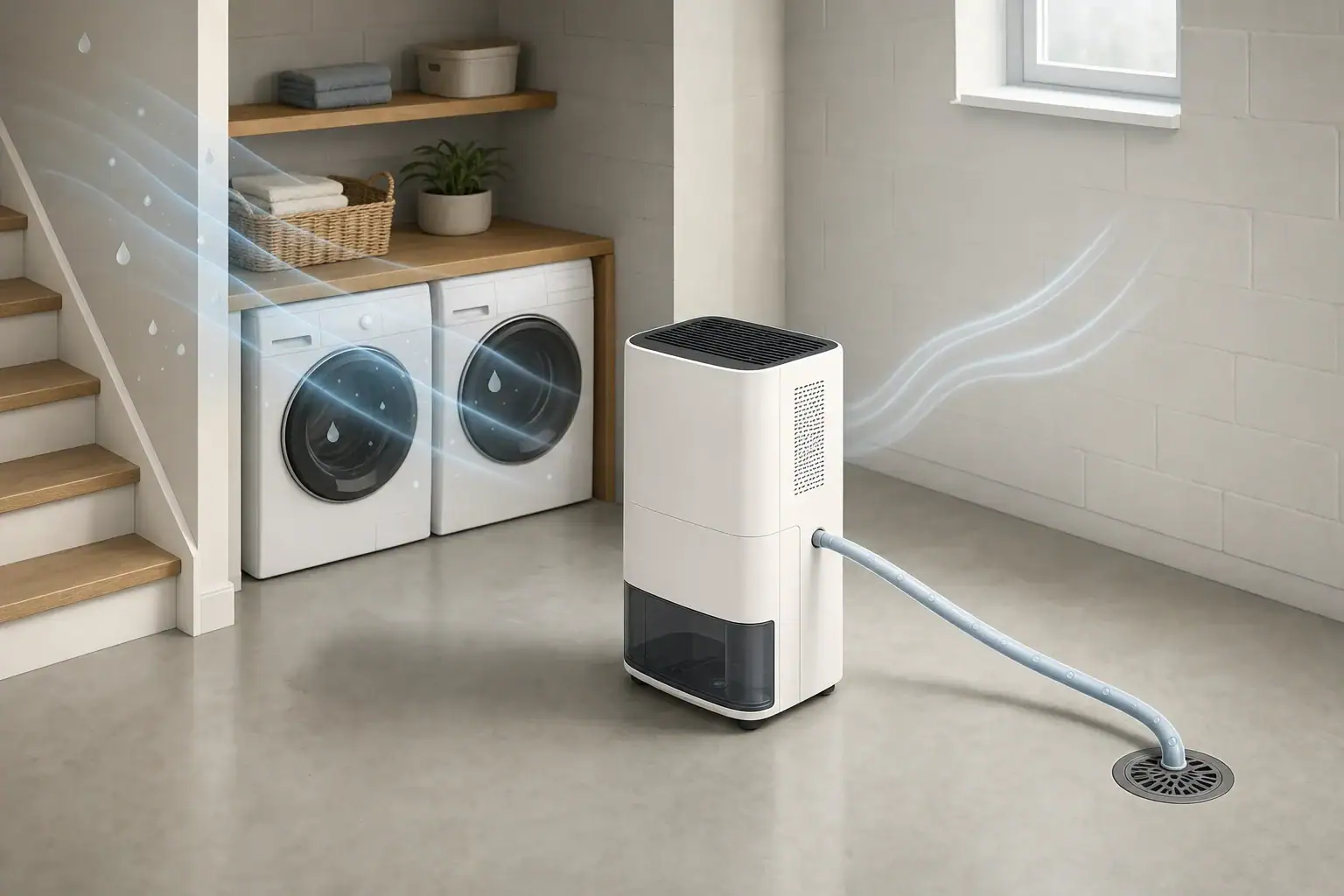
Set up a basement dehumidifier drain hose with a continuous downhill path to a suitable drain, or use a condensate pump when gravity cannot move the water.
The hose should match the appliance outlet, remain free of kinks, and end where discharged water is permitted and unlikely to back up. The dehumidifier’s instructions and local plumbing rules take priority because drainage connections and allowed destinations vary.
- Use gravity drainage only when the hose can run continuously downhill from the dehumidifier to the drain.
- A practical slope target is about 1/4 inch of drop per foot where the layout permits, unless the appliance instructions specify otherwise.
- Use a condensate pump when the destination is higher than the outlet or a reliable downhill route is unavailable.
- Keep indoor relative humidity generally around 30% to 50%; many basements are managed near 40% to 50% as conditions allow.
- Check the hose, drain, pump reservoir, and air filter at least monthly during frequent operation.
How continuous dehumidifier drainage works
A dehumidifier removes moisture from passing air and collects the resulting condensate. Portable units normally send that water to a removable bucket, a gravity-drain outlet, or an internal or external pump system.
Continuous drainage reduces bucket-emptying work, but it does not make the installation maintenance-free. Lint, sediment, biological buildup, hose movement, freezing, and drain backups can interrupt water flow.
The position of the drain outlet matters more than the top of the appliance. With gravity drainage, the entire hose route generally needs to stay below that outlet and descend toward the destination. A low floor drain is therefore easier to use than a laundry sink positioned above the machine.
Suitable destinations may include a floor drain, utility sink, condensate drain, or sump system, depending on the building and local requirements. Avoid assuming that any opening or exterior location is acceptable. Water should not create a walkway hazard, damage finishes, overload a small container, or flow toward the foundation.
Gravity drain hoses versus condensate pumps
When gravity is the simpler option
Gravity drainage has few mechanical parts. It works well when the dehumidifier can sit above a nearby drain and the hose can follow a smooth, consistently descending route.
For planning, a 12-foot run at a 1/4-inch-per-foot slope needs about 3 inches of total drop. This is an illustrative layout target rather than a universal appliance requirement. A steeper route is usually acceptable if the hose remains supported and does not pull on the connection.
When a pump is needed
A condensate pump collects water in a small reservoir and activates at a set level. It can move water upward to a sink, standpipe, or other approved destination. Some dehumidifiers include a pump; others can discharge into a separate pump designed for condensate.
Check the required vertical lift, often called head height, against the pump instructions. Horizontal distance, tubing diameter, bends, check valves, and elevation all affect performance, so maximum lift should not be treated as the ideal everyday target.
- Choose gravity when a dependable downhill route is available.
- Choose a pump when water must rise, cross an obstruction, or reach a distant approved drain.
- Retain the bucket shutoff function when the appliance design uses it as backup protection.
| Condition | Gravity hose | Condensate pump |
|---|---|---|
| Drain below outlet | Usually suitable | Usually unnecessary |
| Drain above outlet | Not suitable | Usually needed |
| Continuous downhill route | Required | Not required for the full run |
| Power requirement | No additional power | Requires a suitable power source |
| Moving parts | None in the hose | Pump, float, and possibly a check valve |
| Primary maintenance | Inspect slope and clear buildup | Clean reservoir and test operation |
| Power outage behavior | Can continue if the unit operates | Cannot pump without backup power |
How to install a gravity drain hose
Start by turning off and unplugging the dehumidifier. Confirm that the model supports continuous gravity drainage, identify the correct outlet, and follow its instructions for removing any cap or adapter. Do not drill the cabinet, alter the drain pan, defeat a float switch, or force incompatible fittings.
- Select the destination. Confirm that the drain is open, permitted for condensate, and below the dehumidifier outlet.
- Choose the correct hose. Use the diameter and connection type specified for the appliance. A loose hose can leak, while a crushed or undersized hose can restrict flow.
- Plan the route. Keep it as short and direct as practical. Avoid loops, raised sections, tight bends, and long unsupported spans.
- Create a steady slope. Aim for continuous downward movement. Where feasible, about 1/4 inch of drop per foot is a useful planning target.
- Support the hose. Use non-damaging supports so the hose cannot sag into water-trapping pockets or shift when bumped.
- Secure the discharge end. Position it so it cannot jump out of a drain or become submerged in standing water.
- Test for leaks and flow. Operate the unit under humid conditions or use the manufacturer-approved test procedure. Inspect every connection and confirm that water reaches the destination.
Do not seal a hose into a drain in a way that conflicts with plumbing requirements. An appropriate air gap may be needed to reduce the chance of contaminated drain water being siphoned toward the appliance.
How to set up a condensate pump
Place an external condensate pump on a level, stable surface below the dehumidifier’s gravity outlet. Run a short, continuously descending inlet hose from the dehumidifier to the pump reservoir. The pump’s discharge tube can then rise toward the approved destination.
Use only tubing sizes, lift heights, and check-valve arrangements allowed by the pump instructions. A check valve may prevent water in the elevated discharge line from flowing back into the reservoir after each cycle, but it should not be added or removed contrary to the specified setup.
Connect the pump to a properly grounded receptacle that is appropriate for a potentially damp location. Keep plugs and connections away from pooled water. Extension cords and improvised adapters can introduce electrical and trip hazards and should be avoided unless expressly allowed by the equipment instructions and applicable codes.
Testing pump operation
Before relying on unattended drainage, test the system according to its instructions. Confirm that the float activates the pump, the reservoir empties, and the discharge line does not leak or detach. If the pump has an overflow safety switch compatible with the dehumidifier, use it only as directed rather than bypassing normal controls.
A pump should have enough capacity for the dehumidifier’s condensate output, but more capacity does not compensate for excessive lift or blocked tubing. Repeated short cycling, unusual noise, or a reservoir that remains full indicates that the setup needs attention.
Common drain hose mistakes and troubleshooting
Bucket fills despite a connected hose
The appliance may not be level, the hose may rise after leaving the outlet, or a cap or adapter may be installed incorrectly. Some units require the bucket to remain fully seated even during continuous drainage because it operates a safety switch.
Water leaks around the connection
Look for cross-threading, a missing specified washer, an incompatible hose, or tension pulling the fitting sideways. Hand-tightening is commonly appropriate for plastic fittings, but follow the instructions because excessive force can damage threads.
Water remains in a low spot
A sag creates a trap that can slow or stop gravity flow. Shorten the route, add support, or reposition the dehumidifier to restore a continuous slope. Simply raising the hose after the sag usually creates another obstruction.
Pump runs but water does not move
Possible causes include excessive lift, a kinked discharge tube, an obstructed check valve, air leakage at a connection, or a blocked outlet. Disconnect power before inspecting the reservoir or tubing. Replace damaged components rather than attempting unsafe internal repairs.
Drainage stops during cold weather
An exterior discharge line can freeze and send water back toward the appliance. Route condensate to an indoor approved drain where practical. If exterior discharge is allowed, its design must account for freezing temperatures, drainage direction, and local rules.
Basement layouts, examples, and safety considerations
Dehumidifier beside a floor drain
If the outlet is 8 inches above the drain opening and the hose run is 10 feet, there is generally enough elevation for a modest continuous slope. The hose still needs support so it does not sag behind stored items.
Dehumidifier draining to a utility sink
If the sink rim is higher than the drain outlet, gravity will not work. A condensate pump may lift water to the sink, provided its rated lift and installation instructions support the route. Secure the discharge tube so it cannot fall onto the floor.
Finished basement with no nearby drain
A pump can cover distance, but the tube should be protected from furniture, doors, foot traffic, and sharp edges. Concealing tubing inside walls or connecting it directly to plumbing may require code-compliant materials and professional work.
General safety checks
- Keep the dehumidifier upright on a firm, level surface with the specified airflow clearance.
- Use a grounded outlet and follow applicable requirements for ground-fault circuit protection in basement or damp locations.
- Do not place electrical connections where drain backups or leaks could submerge them.
- Do not bypass bucket switches, pump floats, overflow controls, or other safety features.
- Confirm that floor drains and sump systems are functional before unattended operation.
- Follow local rules for discharging condensate outdoors, into sanitary plumbing, or into a sump.
Maintenance and humidity control after installation
Inspect a frequently used drainage system about once a month and after moving the appliance. Verify that the hose still slopes correctly, fittings are dry, and the discharge destination is open. Homes with lint, sediment, or seasonal pest activity may require more frequent checks.
Clean the air filter at the interval specified by the appliance instructions. Restricted airflow can reduce moisture removal and may contribute to frost on coils. Clean the drain hose, bucket, or pump reservoir using only methods and solutions approved for those materials, then rinse as directed.
A separate hygrometer can help confirm conditions away from the unit. Many homes aim for 30% to 50% relative humidity, while a practical basement target is often around 40% to 50%. Readings vary with temperature and location, so avoid placing the sensor directly in the dehumidifier’s dry exhaust stream.
Drainage does not address the source of bulk water. Plumbing leaks, groundwater entry, foundation seepage, overflowing gutters, and wet materials need separate correction. A dehumidifier can manage moisture in the air, but it should not be used as a substitute for repairing active water intrusion.
| Goal or condition | Simple action | Check |
|---|---|---|
| Maintain typical indoor humidity | Start within a 40% to 50% basement target | Verify with a separate hygrometer |
| Gravity drainage | Keep the full hose route descending | Look for sags and standing water |
| Drain located above outlet | Use a suitable condensate pump | Confirm lift and tubing requirements |
| Frequent pump operation | Inspect reservoir and discharge line | Check for leaks or short cycling |
| Seasonal shutdown | Drain, clean, and dry components | Store the hose without sharp bends |
| Humidity remains elevated | Check airflow, settings, and moisture sources | Look for leaks or water entry |
Related guides:How to Size a Dehumidifier (Sq Ft, Pints/Day, and Real-World Tips) •Basement Dehumidifier Guide: Targets, Drainage, and Energy Use •Dehumidifier Running Cost: How Much Electricity Will It Use?
Basement dehumidifier drain setup summary
Use gravity drainage when the dehumidifier outlet is above an approved drain and the entire hose can maintain a continuous downward slope. A short, supported route with no kinks, loops, or submerged end is the most reliable arrangement.
Use a condensate pump when water must travel uphill. Confirm the pump’s lift capability, tubing requirements, electrical setup, and overflow protections before depending on it for unattended operation.
Whichever method is used, test the system, inspect it regularly, and keep the drain destination clear. Pair continuous drainage with reasonable humidity settings and correction of any active leaks or water entry.
Frequently asked questions
Does a dehumidifier drain hose need to slope downhill the entire way?
For gravity drainage, the hose should run continuously downhill from the dehumidifier outlet to the drain. Any rise, loop, or sag can trap water and may slow or stop drainage. If a downhill route is not possible, use a condensate pump rated for the required lift.
How much slope should a basement dehumidifier drain hose have?
About 1/4 inch of drop per foot is a practical planning target when the layout allows, but the appliance instructions control. The key requirement is a consistent downward path without low spots that hold water. Support the hose so stored items or foot traffic cannot create a sag later.
Can I drain a basement dehumidifier into a utility sink?
A utility sink can be a suitable destination when local rules permit it and the discharge is secured. Gravity drainage only works if the sink drain connection is below the dehumidifier outlet; a sink rim above the outlet requires a condensate pump. Avoid arrangements that could allow drain water to backflow or siphon toward the appliance.
Why is my dehumidifier bucket filling even though the drain hose is connected?
Common causes include a hose that rises or sags, a kink or blockage, an incorrect adapter, or an unlevel appliance. Some models also require the bucket to remain fully seated because it activates a safety switch. Check the manufacturer instructions before changing fittings or removing components.
How often should I check a dehumidifier drain hose and condensate pump?
Inspect the hose, fittings, and drain destination about monthly during frequent use and after moving the unit. For a pump setup, also check the reservoir, discharge tubing, and pump operation for leaks, buildup, or short cycling. More frequent checks may be needed where lint, sediment, or freezing conditions are concerns.
Recommended next:
- How to Size a Dehumidifier (Sq Ft, Pints/Day, and Real-World Tips)
- Desiccant vs Compressor Dehumidifiers: Which Is Better for Cold Rooms?
- Basement Dehumidifier Guide: Targets, Drainage, and Energy Use
- Dehumidifier Running Cost: How Much Electricity Will It Use?
- Dehumidifier Sizing: Liters/Day, Room Type, and Dampness Levels
- Basement Dehumidifier Setup: Drainage, Placement, and RH Targets
- Clear sizing logic (room size → CADR/ACH)
- HEPA vs carbon explained for real use-cases
- Humidity + ventilation basics to reduce mold risk