
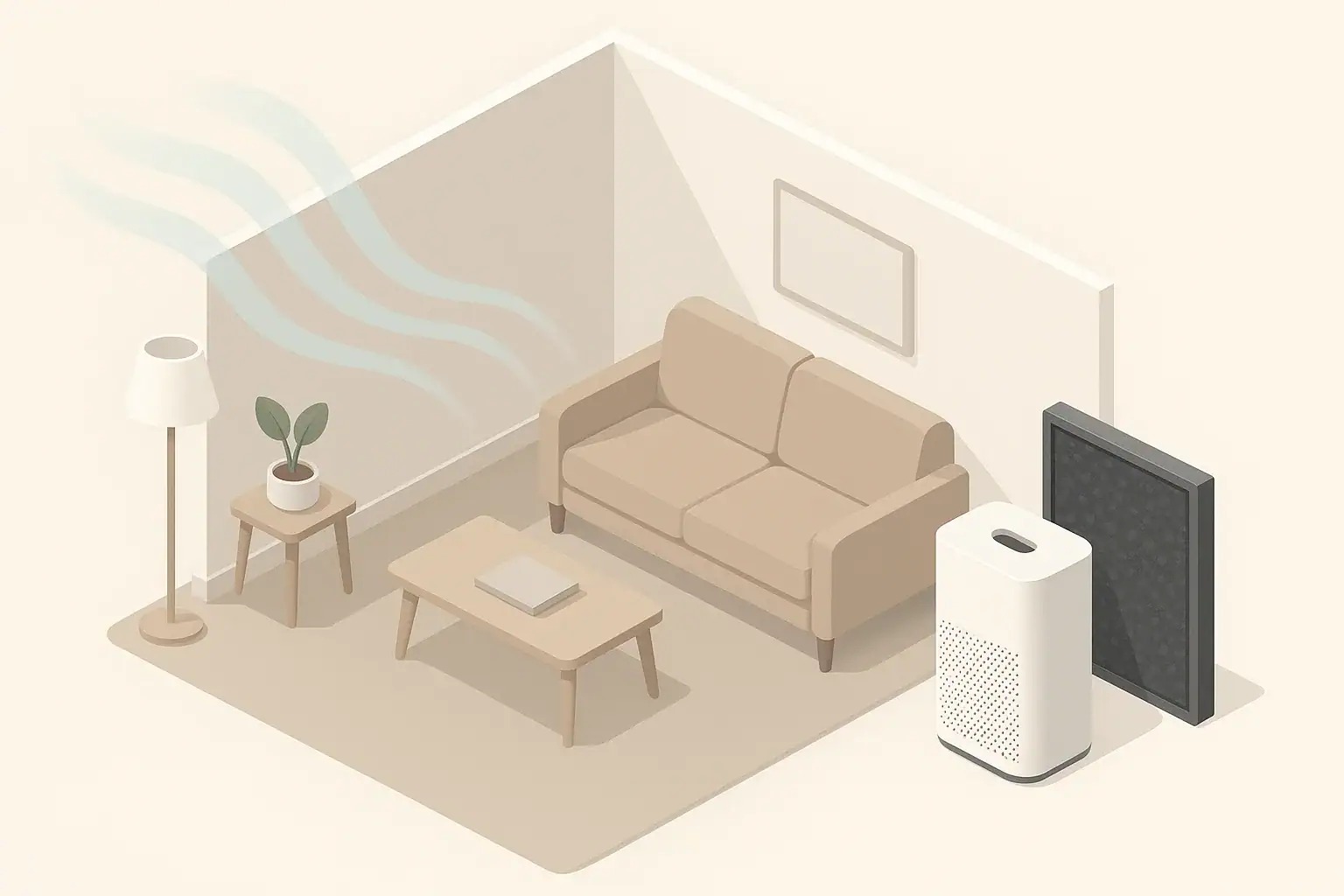
An air purifier can reduce candle soot particles and some odors, but it needs both particle filtration and enough activated carbon, and it works best with sensible ventilation.
Candle smoke is a mix of tiny particles, visible soot, vapor-phase compounds from fragrance and wax, and normal combustion byproducts. A purifier can help clean the room air after or during candle use, but it does not make poor burning habits or inadequate ventilation irrelevant.
- For soot and smoke particles, use a purifier with a high-efficiency particle filter and a CADR sized for the room.
- For fragrance VOCs and lingering odor, look for a meaningful activated carbon or sorbent filter, not just a thin deodorizing sheet.
- As general guidance, plan around 4–6 air changes per hour for noticeable particle reduction in the room where candles are used.
- Ventilate briefly when outdoor conditions are reasonable, especially after extinguishing candles or when odors build up.
- Trim wicks to about 1/4 inch and avoid drafts to reduce visible soot at the source.
What Candle Smoke Adds to Indoor Air
Candles can affect indoor air in several ways. The most visible issue is soot, which may show up as gray or black film near the candle, on nearby glass, or around air currents. Soot is made of fine particles produced by incomplete combustion.
Many candles also release fragrance compounds. These are not captured the same way as soot particles because many are gases or vapors. A particle filter can remove smoke particles, but vapor-phase compounds need adsorption media such as activated carbon filters or other sorbents.
Burning any flame indoors also uses oxygen and produces combustion byproducts. In normal household candle use, the practical response is not to panic, but to combine source control, ventilation, and filtration. The purifier is one part of that plan, not the entire plan.
How An Air Purifier Handles Soot, Smoke, And Fragrance VOCs
Different parts of candle emissions require different control methods. A high-efficiency particle filter is the main tool for smoke particles and soot. Activated carbon is the main tool for many odor and VOC concerns, although performance depends heavily on the amount and type of carbon, airflow design, and how saturated the filter becomes.
Particle filtration for soot
For candle soot and fine smoke, the most relevant purifier number is CADR, or clean air delivery rate. CADR estimates how much filtered air the unit can deliver for particles. A higher particle CADR generally means faster reduction of airborne particle levels in an appropriately sized room.
HEPA-type terms can be confusing. A well-sealed purifier with a true high-efficiency particle filter is usually more important than chasing a higher filter label alone. Air that leaks around the filter or through a poor seal can reduce real-world performance.
Activated carbon for fragrance and odor
Activated carbon works by adsorption, meaning gas molecules stick to internal surfaces in the carbon. More usable carbon generally provides more capacity than a very thin layer. However, consumer specifications often do not provide enough detail to predict exact VOC performance from the label alone.
Carbon also saturates over time. A filter that once handled candle odor well may become less effective before the particle filter looks dirty. If fragrance smells return quickly, carbon capacity may be used up or the purifier may not have enough gas-phase media for the candle load.
| Situation | Most useful tool | Why it helps | Practical note |
|---|---|---|---|
| Visible soot or haze | Particle filtration | Captures airborne smoke particles | Size by CADR and room volume |
| Lingering fragrance | Activated carbon | Adsorbs some vapor-phase odor compounds | Thin carbon layers may have limited capacity |
| Stuffy room after burning | Ventilation | Dilutes indoor generated pollutants | Use when outdoor air is acceptable |
| Black marks near candle | Source control | Reduces soot before it spreads | Trim wick and limit drafts |
| Smoke spike after blowing out candle | Extinguishing method and filtration | Reduces immediate smoke release | Use a snuffer or ventilate briefly |
| Open-plan living area | Higher CADR or multiple units | Improves mixing across a larger zone | Do not size only by a small corner area |
Sizing an Air Purifier for Candle Smoke Without Guessing
Room size matters because a small purifier cannot clean a large space quickly. A useful way to think about sizing is air changes per hour, or ACH. ACH estimates how many times per hour the air volume of a room passes through the purifier.
A simple planning formula is: CADR needed equals room volume multiplied by target ACH, divided by 60. Room volume is floor area multiplied by ceiling height. For example, a 200-square-foot room with an 8-foot ceiling has about 1,600 cubic feet of air. At 5 ACH, the rough CADR target would be about 133 cubic feet per minute.
This is only planning math. Real rooms have furniture, doorways, heat sources, drafts, and imperfect air mixing. Still, it is a practical way to avoid undersizing, especially when candles are used in a living room rather than a small bedroom.
For candle smoke particles, a general target of 4–6 air changes per hour in the active room is reasonable for noticeable reduction. If candles are burned frequently, in an open floor plan, or near cooking areas, a higher CADR or more than one purifier may be more practical than running a small unit at its loudest setting.
Ventilation Still Matters for Candle Fragrance and Combustion Byproducts
Filtration and ventilation solve different problems. A particle filter recirculates room air and removes particles. Carbon can reduce some gases and odors. Ventilation brings in outdoor air and lets indoor air leave, diluting pollutants that filters may not fully capture.
When outdoor air quality is reasonable, short, controlled ventilation can be useful after candle use. This may mean opening a window for a few minutes, using a bathroom or kitchen exhaust fan briefly when appropriate, or creating cross-ventilation between two openings. In apartments, ventilation choices may be more limited, so source control and purifier sizing become more important. For broader context, see Ventilation vs Air Purifier.
When to ventilate
- After extinguishing a candle, especially if the wick smokes.
- When fragrance remains strong after the candle is out.
- When several candles were burned in one room.
- When a room feels stale or heavy despite filtration.
Ventilation should be balanced with outdoor conditions. If outdoor smoke, heavy traffic pollution, or very high humidity is present, it may be better to keep windows closed and rely more on filtration until conditions improve.
Placement and Source Control Checklist
Good placement helps the purifier process room air instead of just cleaning a small pocket. Put the purifier in the same room where the candle is used, with open space around the intake and outlet. Avoid pushing it tightly into a corner, hiding it behind furniture, or placing it where curtains block airflow. See also Air Purifier Placement: Where to Put It for Best Results.
For candle use, do not place the purifier so close that it blows directly on the flame. Drafts can make a candle flicker and soot more. A few feet of separation is often better, with the purifier set up to circulate room air rather than disturb the candle.
Reduce soot at the source
- Trim the wick to about 1/4 inch before lighting, unless the candle maker gives different safety instructions.
- Keep the candle away from strong drafts, vents, and fans.
- Extinguish the candle if the flame becomes very tall, unstable, or visibly smoky.
- Limit burn time to the candle’s instructions and avoid burning to the very bottom of the container.
- Use fewer candles at once in enclosed rooms.
These actions can reduce the load before the purifier has to handle it. Source control is often the simplest way to keep soot from becoming a cleaning problem.
Common Mistakes and Troubleshooting Clues
One common mistake is buying a purifier based only on the room-size claim on the box. Room-size claims may be based on different assumptions, such as lower ACH targets. For smoke and soot, CADR-based planning is more reliable.
Another mistake is expecting a basic particle-only purifier to remove fragrance. If the smell is the main issue, activated carbon capacity matters. If the purifier has only a mesh prefilter and a small deodorizing insert, it may reduce some odor but should not be expected to perform like a unit with a substantial sorbent filter.
If soot settles on walls, jars, or nearby surfaces, the candle may be producing more soot than the purifier can reasonably capture. Check for a long wick, drafts, poor flame stability, or too many candles in a small room.
If a room monitor shows particle spikes during candle use, that is expected. The practical question is how quickly levels fall after the candle is extinguished and the purifier is running. Slow recovery can point to undersizing, poor placement, low fan speed, or ongoing sources.
Real-World Examples for Different Rooms
In a small bedroom, one scented candle may create a noticeable fragrance and a short particle spike. A properly sized purifier on a medium or high setting can help reduce particles, while opening the door or window briefly afterward may reduce lingering scent.
In a living room with an open connection to a kitchen or hallway, the effective air volume is larger than the seating area. A purifier sized only for the rug area may underperform. In this case, a higher CADR unit or two smaller units placed apart can improve air mixing.
In a bathroom, candles are often used in a small space with limited airflow. A purifier may not be practical in a damp location, and electrical safety should come first. Brief use of an exhaust fan after candle use may be a better ventilation step, depending on the room layout and fan condition.
In a home office, fragrance may be the main complaint rather than visible smoke. Here, a purifier with meaningful carbon and low enough noise for work may be more useful than a particle-only unit with a very high fan speed.
Safety, Ozone, Ionizers, and UV-C Considerations
For candle smoke, the core technologies to prioritize are mechanical particle filtration and activated carbon or other sorbent media. Ozone generation is not needed for normal home candle odor control, and intentionally generating ozone indoors is not a practical air-cleaning strategy for occupied spaces.
Some purifiers include ionizers, plasma features, or UV-C lights. These features vary widely in design, and their benefit for candle soot and fragrance is not as straightforward as particle filtration plus carbon. If a unit has optional ionization, many households prefer to leave it off unless they have verified that the device is designed not to add ozone under normal operation. For more detail, see Air Purifier vs Ozone Generator.
UV-C is mainly discussed for certain biological concerns inside devices, not for removing candle soot or fragrance VOCs from room air. It should not be treated as a substitute for CADR, filtration, carbon capacity, ventilation, or safe candle handling.
Maintenance, Filter Life, and Cost Planning
Candle smoke can load filters faster than normal dust alone. Particle filters may darken as they collect soot, while carbon can lose odor-control capacity even when the filter looks acceptable. Follow the purifier’s replacement guidance, but also pay attention to performance changes.
Do not wash a filter unless the manufacturer specifically says it is washable. Washing non-washable particle or carbon filters can damage the media, reduce performance, or create drying problems. Washable prefilters, if present, should be fully dry before reinstalling.
Cleaning around the purifier also matters. Dust around the intake, soot film on nearby surfaces, and blocked grilles can reduce airflow. Keep the purifier on a stable surface, allow clearance, and vacuum exterior vents gently as part of routine cleaning.
| Filter or part | Typical interval range | What can shorten it | Reminder |
|---|---|---|---|
| Washable prefilter | Every 2–4 weeks for cleaning | Dust, lint, pet hair, visible soot | Dry fully before reinstalling |
| Disposable prefilter | About 1–3 months | Frequent candle use or dusty rooms | Replace if clogged or darkened |
| Particle filter | About 6–12 months | Smoke, soot, high fan use | Check airflow and indicator lights |
| Activated carbon filter | About 3–6 months | Strong fragrance, cooking odors, smoke | Odor return can signal saturation |
| Exterior grille | Monthly cleaning check | Dust buildup near the purifier | Vacuum gently with power off |
| Room placement | Review seasonally | Furniture changes, closed doors | Keep intake and outlet clear |
Related guides: Do Air Purifiers Help With Smoke and Odors? • How to Choose the Right Air Purifier for Your Room Size • Air Purifier Placement: Where to Put It for Best Results
Summary: The Practical Answer
An air purifier can help with candle smoke when it is sized for the room and designed for both particles and some gas-phase odors. For soot, focus on particle CADR, room volume, and good airflow. For fragrance VOCs and lingering smells, activated carbon capacity matters more than filter marketing terms alone.
Ventilation remains useful because it dilutes compounds that recirculating filters may not fully capture. The best overall approach is simple: burn fewer candles at once, keep wicks trimmed, avoid drafts, run a properly sized purifier in the same room, and ventilate briefly when outdoor conditions are suitable.
If candle use is frequent, plan for faster filter replacement and keep an eye on odor return, visible soot, and slower particle recovery. These cues are more useful than assuming one purifier setting or filter schedule will fit every home.
Frequently asked questions
Does an air purifier help with candle smoke?
Yes, an air purifier can reduce candle smoke particles and some of the odor, provided it has strong particle filtration and enough airflow for the room. It works best when the unit is sized properly and used along with reasonable ventilation.
What type of filter is best for candle soot?
A high-efficiency particle filter is the most important part for soot and visible smoke. A good seal and enough CADR matter as much as the filter label, because leaked air reduces real-world performance.
Will a HEPA air purifier remove candle smell?
HEPA or HEPA-type filtration is good for particles, but candle smell is often caused by gases and vapors. For odor control, you also need a meaningful amount of activated carbon or another sorbent media.
How big of an air purifier do I need for candle smoke?
For noticeable smoke reduction, a practical target is around 4–6 air changes per hour in the room where the candle is used. That usually means choosing a unit based on CADR and room volume, not just the manufacturer’s room-size claim.
Should I run the purifier while the candle is burning or after?
Either can help, but it is useful during and after candle use because it can reduce airborne particles as they are produced and help clear lingering smoke afterward. Short ventilation after extinguishing the candle can also help when outdoor air conditions are reasonable.
Why does my purifier still leave candle odor behind?
The carbon or sorbent media may be too small for the amount of fragrance being released, or it may already be saturated. If odors return quickly, the purifier may need more gas-phase media, better placement, or more frequent filter replacement.
Recommended next:
- Activated Carbon Filters Explained: VOCs, Odors, and What They Can’t Do
- How Much Activated Carbon Do You Need to Remove Odors?
- Carbon Filter vs HEPA: What Each One Removes (And What It Doesn’t)
- Formaldehyde in Homes: Sources, Risks, and How to Reduce It
- Activated Carbon Types: Pellet vs Granular vs Impregnated Carbon
- How Much Carbon Do You Need for Odors? Weight, Depth, and Contact Time
- More in Carbon Filters & VOCs →
- Clear sizing logic (room size → CADR/ACH)
- HEPA vs carbon explained for real use-cases
- Humidity + ventilation basics to reduce mold risk