
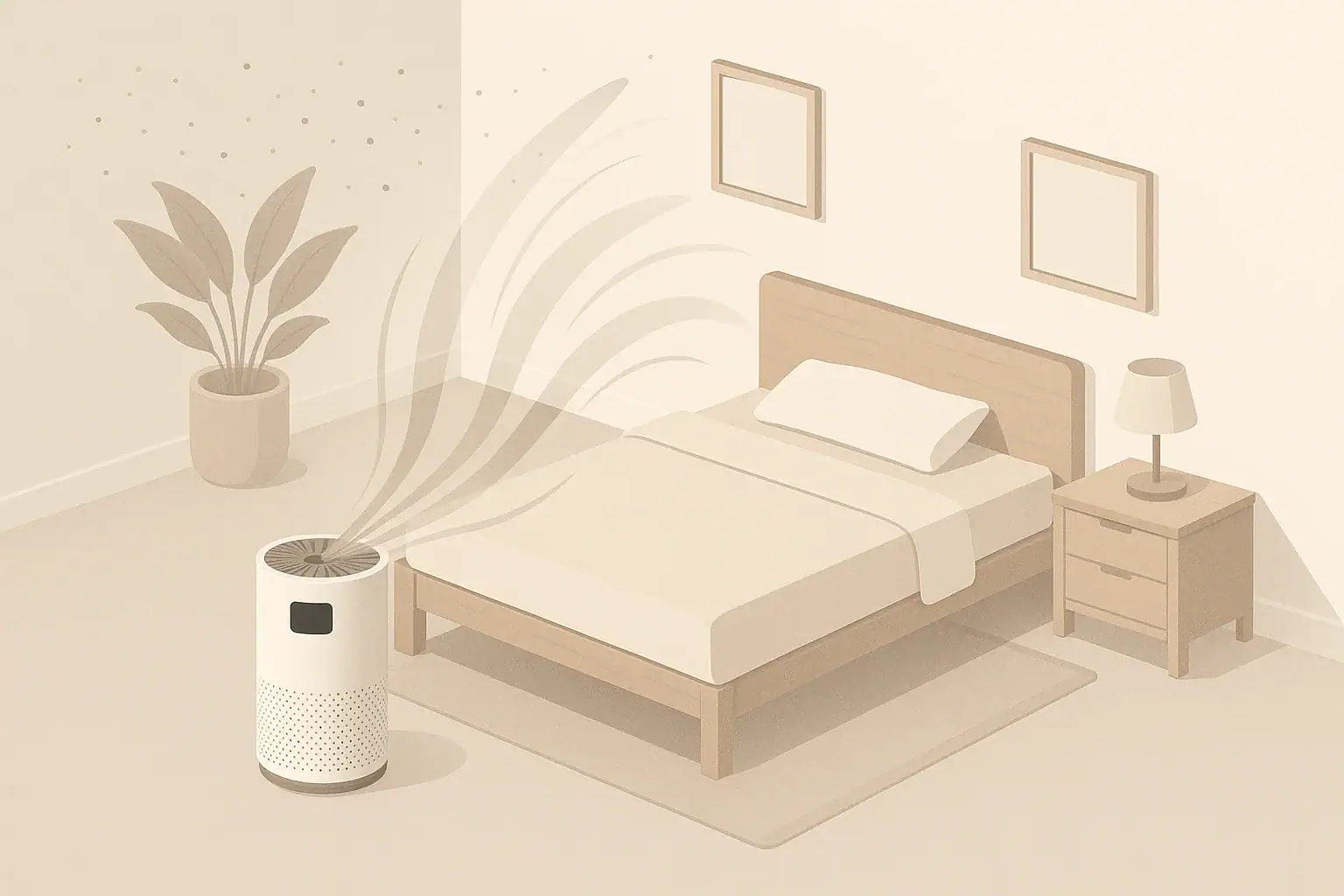
A practical pet dander allergy setup combines source control, cleaning, and a portable air cleaner sized for the room. These measures may reduce airborne exposure, but they do not diagnose or treat an allergy, and symptom improvement varies. The U.S. Environmental Protection Agency (EPA) reports that studies of portable HEPA air cleaners have found possible allergy or asthma benefits, but the improvements have not been universal or consistently substantial.
Start with the bedroom, where you spend many consecutive hours: keep the pet out, use a HEPA air cleaner with an appropriate clean air delivery rate (CADR), and reduce allergen reservoirs such as carpet, unnecessary fabric, and dusty bedding. Then apply the same approach to the pet’s main living area. The National Institute of Environmental Health Sciences (NIEHS) recommends a combination of bedroom exclusion, HEPA air cleaning, HEPA-filtered vacuuming, damp dusting, and reducing carpet rather than relying on one measure alone.
This guide explains how to choose and place an air cleaner, reduce settled pet allergens, troubleshoot the setup, and recognize when symptoms require medical care rather than more equipment adjustments.
What Pet Dander Allergies Mean for Your Indoor Air
Pet allergies are reactions to proteins associated with an animal’s dander, saliva and, for some animals, urine. Fur can carry these allergens, but visible hair is not itself the only issue. According to NIEHS guidance on pet allergens, allergen-containing particles can remain in the air, collect on furniture and other surfaces, and travel to other locations on clothing.
That behavior creates two exposure routes an indoor-air plan should address:
- Airborne particles: Particles released or disturbed in a room may follow air currents and pass through an air cleaner if the cleaner moves enough air.
- Settled reservoirs: Allergens can accumulate in carpet, upholstered furniture, bedding, pet beds, and dust. Walking, sitting, cleaning, or handling fabrics can return some of that material to the air.
A portable air cleaner addresses only particles that reach its intake. It does not remove allergens already embedded in furnishings, prevent the pet from producing more allergens, or replace cleaning and exposure control. It is therefore better to judge an air cleaner as one part of a multicomponent plan than as a treatment by itself.
Symptoms such as sneezing, itchy eyes, congestion, cough, wheeze, or chest tightness can have more than one cause. If the trigger is uncertain or symptoms persist, discuss the pattern with a healthcare professional. The CDC’s home asthma assessment checklist specifically recommends discussing pet-allergy testing when pet exposure may be relevant.
How Pet Dander Moves, Settles, and Gets Captured
What HEPA does—and does not—mean
The EPA defines a high-efficiency particulate air (HEPA) filter as one that can theoretically remove at least 99.97% of airborne particles measuring 0.3 micrometers in a filter test. Particles larger or smaller than 0.3 micrometers may be captured with even greater efficiency. This specification describes the filter under test conditions; it does not mean that a room cleaner will remove 99.97% of all allergens in a room. Room airflow, device leakage, operating speed, placement, and settled allergen reservoirs all affect real-world exposure. See the EPA’s HEPA filter explanation.
Avoid treating labels such as “HEPA-type” or “HEPA-like” as equivalent to a documented HEPA specification. For the complete appliance, CADR and room sizing are more useful than filter efficiency alone because a highly efficient filter cannot help with particles the unit does not draw in.
Particles versus odors
Particle filtration and odor control are different jobs. HEPA filtration targets airborne particles. Activated carbon and other gas-phase media may reduce some odors or gases, but performance depends on the type and amount of media and how quickly it becomes saturated. A thin carbon sheet should not be assumed to solve a persistent litter, cage, or pet odor. Clean the odor source first, and treat carbon as an optional supplement rather than an allergen filter.
Choosing and Placing an Air Cleaner
Size by CADR, not marketing language alone
The EPA recommends choosing a portable air cleaner with a smoke CADR large enough for the entire room or open area where it will operate. The EPA sizing table assumes an eight-foot ceiling; a room with a higher ceiling requires more capacity. In an open-plan space, use the dimensions of the connected area rather than only the corner where the cleaner will sit.
CADR is generally measured at the cleaner’s highest speed. A box that advertises coverage for a certain room size therefore does not establish that the unit will provide the same cleaning rate on a quiet or medium setting. If overnight noise matters, look for manufacturer-published CADR or airflow information by speed, or choose enough capacity that the unit remains useful at a setting you can tolerate. The EPA’s Guide to Air Cleaners in the Home explains CADR selection and the limits of portable filtration.
Placement principles
- Use the room where exposure matters most: The allergic person’s bedroom is usually the first priority, followed by the room where the person and pet spend the most time.
- Keep airflow open: Do not put the cleaner behind furniture, under a table, against curtains, or where a bed or pet blanket blocks the intake or outlet.
- Follow the required clearance: Use the manufacturer’s placement and clearance instructions rather than a universal distance from the bed or wall.
- Manage drafts safely: If the outlet creates an uncomfortable draft, redirect or reposition the unit without obstructing it. There is no evidence-based requirement to point the outlet directly at a sleeper.
- Use more operating time when practical: A cleaner filters only while its fan runs, so longer operation generally processes more air. There is no universal pre-bed or post-cleaning runtime that works for every room and appliance.
Pet Dander Control Setups and Habits
1. Build a lower-exposure bedroom
- Keep the pet out of the bedroom and keep the door closed when practical. A pet-free bedroom is more meaningful than allowing the pet in during the day and removing it only at bedtime.
- Run an appropriately sized HEPA air cleaner with unobstructed airflow at a speed the sleeper can tolerate.
- Launder bedding according to its care instructions and clean dust with a damp cloth rather than dry methods that readily disperse it.
- Reduce unnecessary upholstered items, thick rugs, and other hard-to-clean reservoirs where feasible.
For a more detailed room-focused routine, see this bedroom allergy setup.
2. Control the main pet area
- Put the pet bed on a washable surface and clean it according to its label.
- Use a HEPA air cleaner sized for the full connected room, not only the pet’s corner.
- Vacuum with a HEPA-filtered vacuum while the allergic person is out of the room when possible, as NIEHS recommends. A cleaner with a well-sealed body helps limit leakage around the filter.
- Damp-dust hard surfaces and clean upholstery using methods allowed by the manufacturer.
- If grooming releases hair and dust, have a non-allergic person do it outdoors when conditions and animal safety permit.
Air filtration may reduce airborne material, but it will not necessarily prevent visible dust from settling. See what an air purifier can and cannot do about dust on furniture.
3. Manage litter, cage, and small-pet areas
- Use easy-to-clean flooring where possible and keep the enclosure away from the allergic person’s bedroom.
- Clean the litter box or enclosure regularly using low-dust methods appropriate for the animal.
- Place the air cleaner where its intake will not be buried by litter dust or blocked by the enclosure.
- Use odor media only as a supplement. Persistent odor is a reason to inspect and clean the source, not simply to increase fan speed.
4. Use humidity and ventilation carefully
Humidity control is useful for moisture and mold management, but it is not a proven treatment for pet allergy. The EPA recommends keeping indoor relative humidity below 60%, ideally about 30% to 50%, to help control mold and other biological contaminants. If using a humidifier or dehumidifier, monitor relative humidity with a hygrometer and keep the equipment clean.
Opening windows may dilute indoor contaminants, but it can also admit pollen, smoke, humidity, or outdoor pollution. Ventilate only when outdoor air quality, pollen, weather, security, and humidity conditions make it appropriate. Do not open windows during wildfire smoke or other outdoor-air alerts.
Diagnosing Problems Before Changing the Setup
Before buying another cleaner or increasing fan speed, match the problem to a safe check. Symptoms alone cannot confirm that pet allergen is the cause.
| Observation | Safe check | Practical response | When to seek help |
|---|---|---|---|
| Morning congestion, sneezing, or itchy eyes | Record whether the pet enters the bedroom, whether the cleaner runs, and whether airflow is blocked | Strengthen the pet-free bedroom boundary; check CADR, placement, and filters | Seek clinical evaluation if symptoms persist, disrupt sleep, or the trigger is uncertain |
| Little apparent difference when the cleaner runs | Compare the room’s complete dimensions with the smoke CADR; note the speed actually used | Correct blocked airflow, use a suitable operating speed, or resize for the complete open area | Consult the manufacturer if airflow or operation appears abnormal; seek medical advice for uncontrolled symptoms |
| Visible hair or dust on the intake | Turn off and unplug the unit, then inspect the prefilter as directed by the manual | Clean or replace only as the manufacturer permits; restore required clearance | Stop using a damaged, overheating, or electrically unsafe unit and contact the manufacturer or a qualified technician |
| Persistent litter or pet odor | Inspect the litter, cage, pet bedding, damp materials, and odor filter | Clean the source and replace gas-phase media according to the manual | Investigate unexplained burning, chemical, sewage, or mold odors rather than masking them |
| Recurrent wheeze, chest tightness, or increased reliever use | Leave the exposure area and follow the prescribed asthma action plan | Stop equipment troubleshooting until breathing is stable | Contact the treating clinician; if prescribed medicine does not relieve an attack or breathing remains very hard, call 911 or the local emergency number |
For people with asthma, the NHLBI recommends tailoring indoor-allergen measures to a relevant exposure history or allergy testing rather than applying every intervention indiscriminately. Single interventions often do not improve outcomes on their own, which is another reason to combine appropriate exposure reduction with the person’s medical plan.
Safety and Health Boundaries
Avoid ozone-producing devices
The EPA advises against using air cleaners that intentionally produce ozone because ozone is a lung irritant. Some ionizers, electrostatic precipitators, plasma devices, and inadequately coated ultraviolet systems may also emit ozone. A claim that a device meets an ozone-emission limit should not be interpreted as proof that it will improve allergy symptoms. A filtration-focused HEPA unit is the simpler choice when particle removal is the goal.
Physical and electrical safety
- Place the unit on a stable surface where a pet or child is unlikely to tip it over.
- Protect cords from chewing and do not create a tripping hazard.
- Keep water bowls, humidifiers, and cleaning liquids away from electrical equipment.
- Do not cover the intake or outlet with curtains, blankets, toys, or pet beds.
- Use the appliance only with the voltage, filters, and replacement parts specified by its manufacturer.
Filter handling
- Turn off and unplug the cleaner before opening it if the manual directs you to do so.
- Remove a dirty filter slowly and place it directly into a bag rather than shaking it indoors.
- Wash or vacuum only components explicitly described as washable or vacuum-safe.
- If filter handling provokes symptoms, have another person perform the task when possible.
Know when this is a medical issue
An air cleaner is an exposure-control device, not emergency equipment. Anyone with diagnosed asthma should follow the clinician-provided asthma action plan, including any prescribed peak-flow thresholds. The NHLBI guidance on asthma attacks says to call 911 when asthma medicine is not relieving an attack or breathing remains very hard. Do not delay urgent care to change filters, measure humidity, or move an air cleaner.
Maintenance and Verification
Use filter condition and manufacturer instructions
- Prefilter: Inspect it at the interval in the manual and sooner when visible hair or dust accumulates. Clean or replace it only as specified.
- HEPA filter: Follow the manufacturer’s replacement indicator or schedule. Reduced airflow, damage, persistent odor, or heavy soiling may justify earlier inspection, but appearance alone does not reveal filtration efficiency.
- Odor media: Replace it according to the instructions when odor performance declines, after first cleaning the odor source.
- Housing and grilles: Clean them using the approved method while preventing moisture from entering the appliance.
There is no universal filter-replacement schedule for every pet home. Pet numbers, shedding, room dust, operating time, filter area, and appliance design all affect loading.
Verify whether the plan is helping
There is no established household pet-allergen number that guarantees symptom relief, and consumer particle sensors do not specifically identify pet allergen. Instead, document the setup and observe relevant outcomes over time:
- nighttime waking and morning congestion;
- sneezing, itchy eyes, cough, wheeze, or chest tightness;
- activity limits and where symptoms occur;
- reliever use, if prescribed;
- whether the pet entered the controlled room;
- the cleaner’s operating speed, blocked-airflow problems, and filter condition.
When practical, change one documented setup variable at a time so you can tell what changed. Do not use an arbitrary improvement deadline: response varies, and settled allergen reservoirs may persist. Stop do-it-yourself troubleshooting and obtain clinical advice if symptoms worsen, cleaning repeatedly triggers breathing problems, reliever use increases, or symptoms remain uncontrolled.
Pet Dander Air Cleaner Checklist
- Particle filtration: A documented HEPA filter rather than an undefined “HEPA-type” claim.
- Room capacity: A smoke CADR appropriate for the entire room or connected open area, adjusted for ceilings above eight feet.
- Usable speed: Enough performance at a noise level you will actually tolerate; remember that published CADR is generally measured at the highest speed.
- Prefilter: An accessible, manufacturer-approved layer for hair and larger debris.
- Odor media: Optional carbon or other gas-phase media when odors matter, without treating it as a substitute for HEPA filtration or source cleaning.
- No intentional ozone: Avoid ozone generators and investigate whether optional ionization, plasma, electrostatic, or UV features can emit ozone.
- Placement compatibility: Enough space to maintain the clearances stated in the manual.
- Maintenance: Available replacement filters, understandable instructions, and costs you can sustain.
- Safety: Stable construction and a cord arrangement suitable for the pets and children in the home.
The strongest home plan is not simply the cleaner with the highest filter-efficiency claim. It is a correctly sized device used with a pet-free bedroom, unobstructed airflow, appropriate cleaning, and medically informed care when symptoms warrant it.
Frequently asked questions
Which air cleaner specifications matter most for pet allergens?
Look for documented HEPA filtration and a smoke CADR adequate for the complete room or connected area. Also consider the operating speed you can tolerate, prefilter access, replacement-filter availability, and whether the device intentionally generates ozone. Carbon is optional for odors and does not replace particle filtration.
Why might an air cleaner not reduce my symptoms?
The cleaner may be undersized, blocked, used at a speed that delivers too little airflow, or located in the wrong room. Settled allergens and continued pet access can also dominate exposure. Symptoms may have another trigger or require medical treatment, so a lack of improvement is not automatically evidence that the filter is defective.
Should I run the air cleaner continuously?
An air cleaner filters only while its fan operates, and longer operation generally processes more room air. Run it as much as practical at a useful speed, while following the manufacturer’s instructions. No universal number of hours or pre-bed runtime has been established for every room and device.
Are ionizing or ozone-generating cleaners appropriate for pet allergies?
Avoid devices that intentionally generate ozone because ozone is a lung irritant. Some ionizing, electrostatic, plasma, and UV-equipped products may emit ozone as a byproduct. For airborne particles, a filtration-focused HEPA cleaner is the more straightforward option.
How quickly should symptoms improve?
There is no reliable universal deadline. Exposure, sensitization, other allergens, room conditions, settled reservoirs, and medical treatment all influence the response. Track symptoms and setup changes rather than expecting guaranteed improvement within days or weeks, and seek clinical advice for persistent or worsening symptoms.
How often should filters be changed in a home with pets?
Follow the appliance manufacturer’s schedule and inspect sooner if the prefilter is visibly loaded, airflow declines, or the device indicates replacement. Do not assume a universal monthly or annual interval, and do not wash or vacuum a filter unless its instructions explicitly allow it.
Can cleaning and grooming replace an air cleaner?
Cleaning and source control address settled material and ongoing release, while an air cleaner captures particles that reach its intake. Neither approach guarantees symptom control by itself. NIEHS recommends combining measures such as bedroom exclusion, HEPA air cleaning, HEPA-filtered vacuuming, damp dusting, and reducing carpet where feasible.
- Clear sizing logic (room size → CADR/ACH)
- HEPA vs carbon explained for real use-cases
- Humidity + ventilation basics to reduce mold risk