
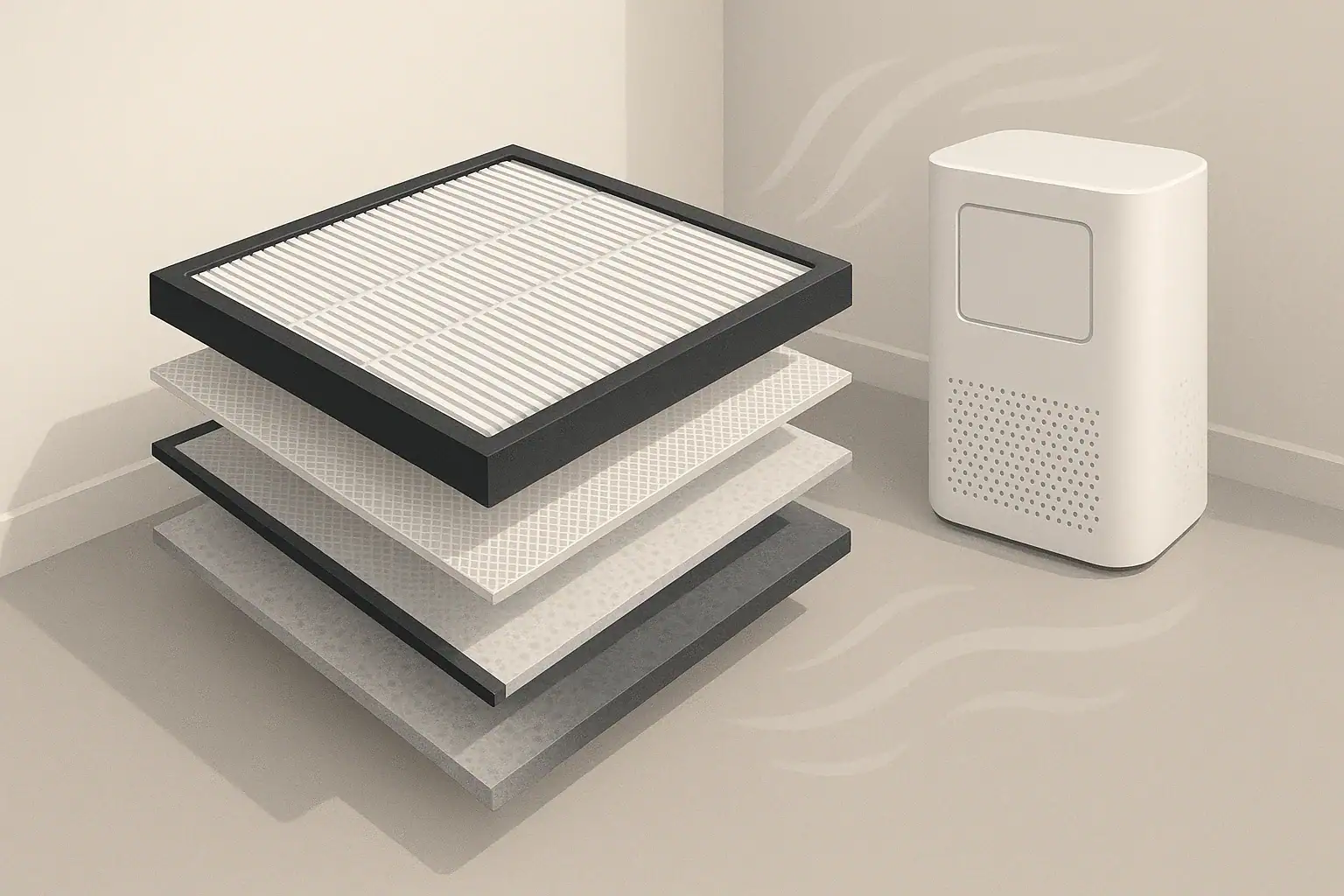
What Are HEPA Grades H10–H14?
HEPA (High Efficiency Particulate Air) is a class of mechanical air filters designed to capture very small particles. In many technical documents, especially in Europe, HEPA filters are divided into grades from H10 to H14. These grades describe how efficiently the filter captures particles under standardized test conditions.
In a typical US home, you will most often see marketing terms like “HEPA,” “True HEPA,” or “medical-grade HEPA,” but not always the formal H10–H14 labels. Still, understanding these grades helps you interpret what these filters are trying to achieve and what matters for everyday use.
Key ideas behind HEPA grades:
- H10–H12: lower to mid HEPA efficiency range.
- H13–H14: higher-efficiency HEPA often associated with more demanding applications.
- Higher grade generally means better particle capture, but also more airflow resistance and potentially more fan noise or energy use.
For homes, the right grade is a balance between filtration efficiency and practical factors like airflow, noise, and cost.
How HEPA Grades Relate to Filtration Efficiency
HEPA grades are based on how well a filter captures fine particles in a controlled test. The formal standards used in laboratories differ somewhat from common marketing language, but the general idea is:
- Filters are tested at the most penetrating particle size (often around 0.1–0.3 microns).
- The test measures what percentage of particles pass through.
- A higher grade allows fewer particles through (higher efficiency).
In real homes, the situation is more complex. The HEPA filter is only one part of the system. The fan power, room size, air changes per hour (ACH), clean air delivery rate (CADR), and how well the filter is sealed can affect how much the filter actually improves air quality.
Approximate relationships often described in technical references (rounded for simplicity):
- H10–H11: entry-level HEPA; captures a large majority of fine particles, but not as high as H13–H14.
- H12: mid-range HEPA with higher capture efficiency than H11.
- H13–H14: high-efficiency HEPA used in cleaner rooms, some medical or industrial settings, and some high-end consumer purifiers.
These ranges are intended to give a relative sense of performance. Actual filter performance depends on specific test standards and setup.
Example values for illustration.
| HEPA grade | Relative particle capture level | Common use context | Typical home relevance |
|---|---|---|---|
| H10 | Lowest HEPA range | Basic air cleaners, some HVAC retrofit filters | Can help with general dust but often not highlighted |
| H11 | Moderate HEPA | Entry-level HEPA purifiers | Reasonable for everyday dust and some smoke particles |
| H12 | Mid HEPA | Higher-end consumer and light commercial units | Good compromise between efficiency and airflow |
| H13 | High HEPA | Cleaner rooms, some healthcare and home devices | Often marketed as “medical-grade”; strong fine particle capture |
| H14 | Very high HEPA | More specialized laboratories and critical environments | Potentially overkill unless specific needs justify it |
| Non-HEPA (MERV-style) | Lower to moderate capture | Typical HVAC filters | Good for system protection, limited for very fine particles |
HEPA in the US vs. Formal H10–H14 Labels
In the United States, consumer air purifiers rarely advertise the H10–H14 designations directly. Instead, you will see terms like:
- HEPA or True HEPA
- HEPA-type or HEPA-like
- H13 HEPA or “medical-grade” HEPA
These terms are not always used consistently. Some manufacturers reference international standards or laboratory tests that roughly correspond to H13 or H14 performance, but consumer labeling is not fully harmonized.
When you see H13 or H14 on US marketing material, it usually means the filter media has been tested to a higher efficiency standard similar to those grades. However, the overall purifier effectiveness still depends on how airtight the filter housing is, how fast air moves through, and how the device is used in the room.
What HEPA Grades Matter Most for Homes?
For most households, the goal is to reduce common indoor particles such as dust, pet dander, smoke particles from cooking or wildfires, and general fine particulate matter (PM2.5). From a practical standpoint, three main points matter more than the exact HEPA grade:
- Good overall CADR and air changes per hour (ACH) for your room size.
- Properly sealed HEPA filter to stop bypass air from leaking around the filter.
- Consistent use and maintenance (filter replacement on time and good placement).
Within that context, here is how the grades generally fit into home needs:
H10–H12: Adequate for Everyday Dust and General Use
Filters in the lower HEPA grades can substantially reduce airborne dust and many fine particles in a typical home, especially when paired with good airflow and continuous operation.
They may be sufficient if your priorities are:
- General cleanliness and reduced visible dust settling.
- Comfort-oriented use, such as reducing stuffy or stale feeling air.
- Moderate concern about urban pollution or seasonal smoke.
These filters often allow a bit more airflow at a given fan speed, which can help achieve better ACH at the same noise level compared with a more restrictive high-grade HEPA.
H13–H14: Higher Efficiency for Fine Particles
H13 and H14 filters aim to capture a very high fraction of fine particles in each pass. In home use, they are sometimes marketed for people who are particularly sensitive to indoor particles or who live in areas with frequent smoke or heavy outdoor pollution.
Practical considerations with H13–H14 filters:
- At the same fan size, airflow can be lower due to higher resistance.
- To maintain high CADR, the purifier may run the fan faster, resulting in more noise.
- Filter replacements may be more expensive than lower grade HEPA.
For many households, an H13 filter paired with good room airflow and placement can be a solid choice, especially where outdoor air quality is frequently poor. H14 is typically more specialized and may not provide a noticeable advantage in everyday home settings compared with H13, once CADR and noise are factored in.
HEPA vs. HEPA-Type and Other Filter Terms
The label on the filter matters almost as much as the grade. Some common terms you may encounter:
“HEPA” or “True HEPA”
These terms generally indicate a filter designed to meet recognized HEPA standards, although not every product will specify an exact grade. For home selection, look for:
- Specific claims about particle sizes (for example, around 0.3 microns) tested under standard conditions.
- References to independent testing or adherence to recognized filtration standards.
“HEPA-Type” or “HEPA-Like”
These phrases usually signal that the filter is not a certified HEPA filter. It may capture many particles better than a basic filter, but it may fall short of official HEPA performance.
This does not mean HEPA-type filters are useless; they can still improve air cleanliness. But if you are aiming for a performance level comparable to H12–H13, verify whether the product provides clear efficiency data.
Pre-Filters, Carbon Filters, and HEPA Together
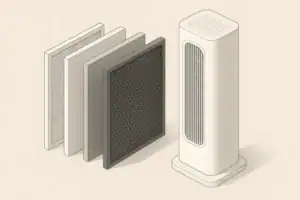
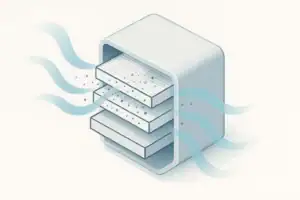
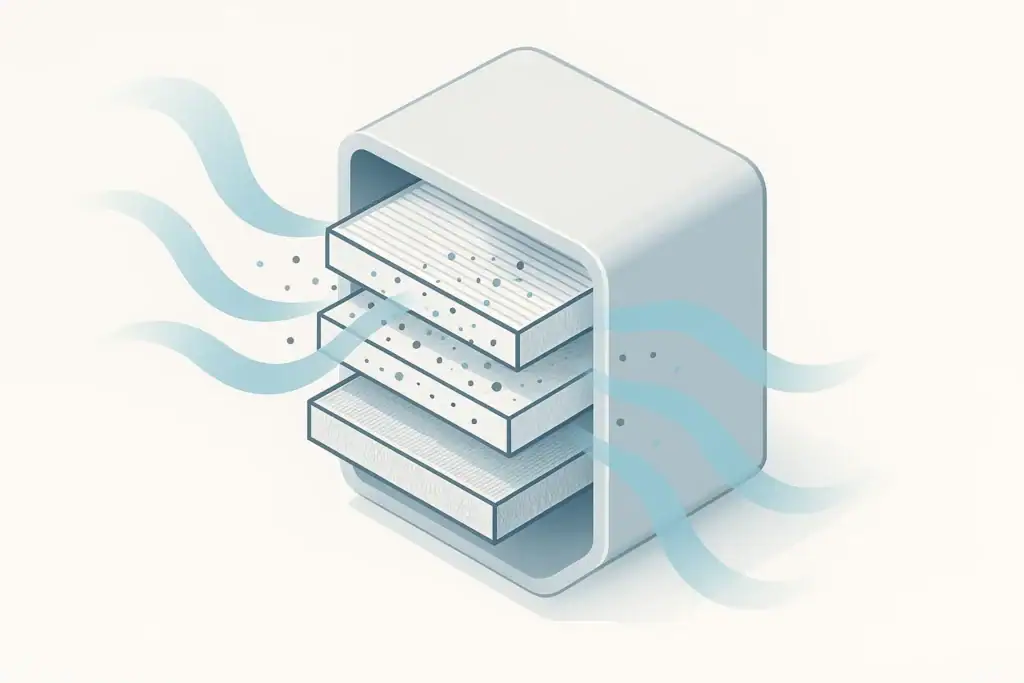
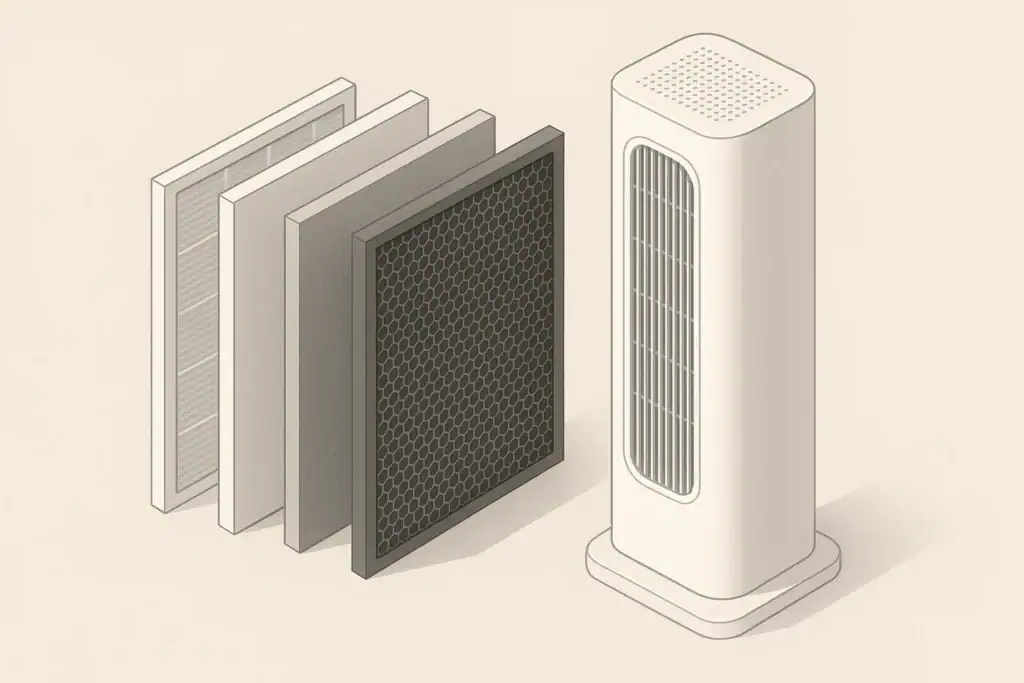
HEPA filters work best as part of a layered system:
- Pre-filter catches larger dust and hair, protecting the HEPA filter and extending its life.
- HEPA filter captures fine particles such as fine dust and smoke particles.
- Activated carbon filter can help reduce certain odors and some gases, but it does not substitute for HEPA for particles.
For home use, a well-designed combination of pre-filter, HEPA of at least mid-grade efficiency, and sufficient carbon media can address both particles and many common smells, as long as expectations are realistic.
HEPA Grade vs. CADR and ACH: Which Matters More?
It is easy to focus on the HEPA grade alone, but the amount of clean air a device delivers to your room over time is often more important. Two key concepts help describe this:
- Clean Air Delivery Rate (CADR): An indicator of how much filtered air a purifier supplies per unit time, usually expressed as a volume per minute.
- Air Changes per Hour (ACH): How many times per hour the purifier can theoretically filter the room’s volume of air.
A purifier with a modest-grade HEPA filter but high CADR can sometimes reduce overall particle levels more effectively than a device with a very high-grade HEPA but low airflow. For most homes, it is sensible to:
- Choose a purifier with enough CADR to achieve multiple ACH in the intended room.
- Then consider a higher HEPA grade (such as H13) if the device still meets your noise and energy preferences.
The right balance depends on room size, how sensitive occupants are to noise, and how consistently the purifier will be used.
Example values for illustration.
| Filter type | Illustrative interval range | What can shorten the interval | Reminder |
|---|---|---|---|
| Pre-filter (washable or vacuumable) | Every 2–8 weeks cleaning | Lots of pet hair, visible dust, heavy use | Check more often if you see buildup on the intake |
| Standard HEPA (H10–H12 range) | About 6–18 months | Continuous high-speed use, very dusty or smoky air | Watch for reduced airflow or persistent dust despite use |
| High-grade HEPA (H13–H14 range) | About 6–24 months | Heavy smoke seasons, urban pollution spikes | Follow the device indicator if available, not just time |
| Thin basic carbon sheet | About 3–6 months | Strong or frequent cooking odors, indoor smoking | Replace when odors no longer fade as before |
| Thicker granular carbon cartridge | About 6–24 months | Continuous exposure to odors or fumes | Heavier cartridges may last longer but depend on load |
| HVAC return filter (high-MERV, non-HEPA) | About 1–3 months | High fan runtime, shedding pets, renovation dust | Do not exceed the system’s recommended pressure drop |
How to Decide Which HEPA Level to Choose
When picking an air purifier or replacement filter, try to look at the whole system instead of just one spec. A simple decision path for most homes:
Step 1: Clarify Your Main Goals
Common priorities include:
- General dust control and a cleaner-feeling home.
- Supportive environment for allergy- or asthma-friendly living, without expecting medical effects.
- Seasonal wildfire smoke or urban pollution events.
- Odor reduction from cooking, pets, or other sources.
If your main interest is basic dust and occasional outdoor pollution, an H11–H12 level filter with good CADR may be sufficient. If you frequently experience heavy smoke or very poor outdoor air, a well-sealed H13 filter paired with strong airflow can be more appropriate.
Step 2: Match Filter Grade to Room Size and Noise Tolerance
Higher-grade HEPA can restrict airflow. To compensate, you may need a larger purifier or to run it at higher speed. When choosing:
- Estimate your room volume and desired ACH, then look for CADR that can support that.
- If you prefer quieter operation, consider a slightly lower HEPA grade that allows enough airflow at lower fan settings.
In many bedrooms, the best practical option is a purifier sized a bit larger than necessary, with a mid-to-high HEPA grade, run at a moderate fan speed to balance noise and cleaning.
Step 3: Consider Maintenance and Long-Term Costs
Over time, filters and electricity are the biggest ownership costs:
- Higher-grade HEPA replacements may cost more than basic HEPA.
- If your environment is very dusty or smoky, filters will load faster regardless of grade.
- Pre-filters that are washable or easily vacuumed can extend HEPA life.
Think about whether you are likely to keep up with recommended filter changes. A slightly lower grade HEPA that you actually replace on time will generally perform better than a very high-grade filter used far beyond its intended life.
Step 4: Do Not Forget Room Layout and Ventilation
Filter grade cannot overcome poor placement or lack of air circulation. For best results:
- Place the purifier where air can flow freely around it, not behind furniture or curtains.
- Run the purifier long enough each day to keep particle levels from building up.
- Combine filtration with reasonable ventilation strategies when outdoor air quality allows, such as occasional window opening or using existing mechanical ventilation systems.
When these basics are covered, HEPA grade H12–H13 is often a comfortable middle ground for many US households, with H11 or H14 becoming more situation-specific choices.
Key Takeaways for Using HEPA at Home
HEPA grades H10–H14 provide a helpful framework for understanding filter performance, but they are only one piece of the indoor air quality picture. For homes, it is usually more productive to ask:
- Does this purifier move enough air for my space at a noise level I can live with?
- Is the HEPA filter well-sealed, and is the device designed to minimize bypass leaks?
- Can I realistically maintain the filters on the suggested schedule?
- How will this purifier fit with my existing ventilation, humidity control, and cleaning habits?
If you address those questions first, then use HEPA grade as a fine-tuning factor, you are more likely to end up with a setup that keeps indoor air cleaner in a practical, sustainable way for daily life.
Frequently asked questions
What is the difference between HEPA grades H10–H14 and which should I choose for home use?
H10–H14 represent increasing particle-capture efficiency measured under standard laboratory tests; higher grades trap a larger fraction of the most penetrating particle size but also create more airflow resistance. For most homes, mid-range to high-grade filters (H12–H13) are a practical balance between efficiency and airflow, while H14 is typically reserved for specialized environments and may not offer noticeable everyday benefits for typical household use.
Will upgrading from H11 to H13 noticeably reduce wildfire smoke or PM2.5 in a typical living room?
Upgrading to H13 can reduce more particles per pass, but real-world improvement depends on the purifier’s CADR, room size, and how well the filter and housing are sealed. A high-CADR H11 purifier can outperform a low-airflow H13 unit, so ensure adequate air changes per hour to see consistent reductions in smoke and PM2.5.
How do HEPA grades affect airflow, noise, and energy use?
Higher-grade HEPA media is denser and creates greater pressure drop, which can lower airflow at a given fan speed and cause devices to use more fan power to maintain CADR, increasing noise and energy use. Choosing a purifier with sufficient fan capacity or a slightly lower-grade HEPA can help balance noise and cleaning performance for your space.
Is “True HEPA” the same as H13, or can it include H10–H12 as well?
“True HEPA” generally indicates the filter meets recognized HEPA testing criteria but does not specify a particular grade, so it can cover H10 through H14. If you need a specific level of efficiency, look for the H-grade labeling or independent test data rather than relying solely on the “True HEPA” claim.
How often should I replace H10–H14 HEPA filters compared to each other?
Replacement intervals depend mainly on usage, particle load, and whether a pre-filter is used, not just the grade; heavy smoke or dust shortens filter life for all grades. Follow the device manufacturer’s recommendations and monitor for reduced airflow, increased noise, or filter-change indicators rather than assuming a fixed lifetime based solely on H-grade.
Recommended next:
- Clear sizing logic (room size → CADR/ACH)
- HEPA vs carbon explained for real use-cases
- Humidity + ventilation basics to reduce mold risk
About this site
Home Air Quality Lab publishes practical, independent guides about indoor air quality—clear sizing, safer use, and real-world expectations.
Affiliate disclosure
Some links on this site may be affiliate links. If you buy through these links, we may earn a small commission at no extra cost to you. This helps support our content. Learn more.