
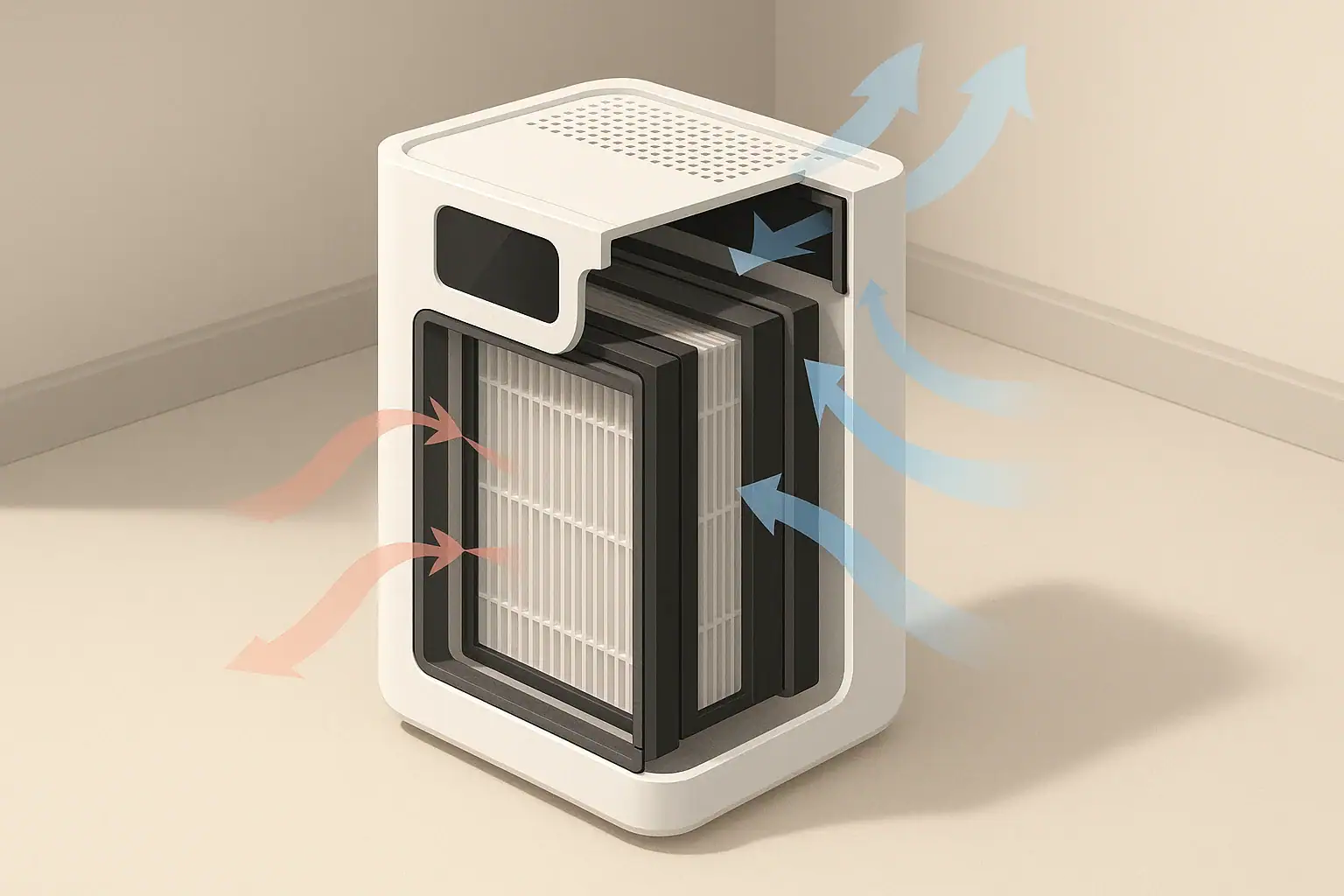
Many people focus on getting a “HEPA” or even “H13” filter for their home air purifier and assume that guarantees clean air. In actual use, however, the filter media is only part of the story. The way the filter is sealed inside the purifier can be just as important as the filter’s rating on paper.
HEPA filter bypass leakage happens when some of the air drawn into a purifier slips around the edges of the filter instead of going through the filter fibers. The purifier may still move a lot of air and sound powerful, but its effective particle removal can drop significantly if air is escaping through gaps.
Understanding bypass leakage helps you:
- Choose purifiers that are more likely to perform close to their stated filtration level.
- Install and re-install filters correctly after cleaning or replacement.
- Troubleshoot disappointing results from an otherwise well-rated machine.
Why HEPA Filter Seals Matter for Real-World Performance
Many people focus on getting a “HEPA” or even “H13” filter for their home air purifier and assume that guarantees clean air. In actual use, however, the filter media is only part of the story. The way the filter is sealed inside the purifier can be just as important as the filter’s rating on paper.
HEPA filter bypass leakage happens when some of the air drawn into a purifier slips around the edges of the filter instead of going through the filter fibers. The purifier may still move a lot of air and sound powerful, but its effective particle removal can drop significantly if air is escaping through gaps.
Understanding bypass leakage helps you:
- Choose purifiers that are more likely to perform close to their stated filtration level.
- Install and re-install filters correctly after cleaning or replacement.
- Troubleshoot disappointing results from an otherwise well-rated machine.
What Is HEPA Filter Bypass Leakage?
Bypass leakage is any path where air can flow around, instead of through, the HEPA filter. A HEPA filter works because air is forced through dense fibers that capture particles. If air can take a shortcut around those fibers, it avoids the main filtering process.
Common bypass paths include:
- Gaps between the filter and the housing: Small spaces along the edges where the frame does not meet the purifier body tightly.
- Poor or missing gaskets: Compressed foam or rubber seals that are too thin, damaged, or absent.
- Warped or misaligned filter frames: Filters that are slightly bent, undersized, or not fully seated in the slot.
- Loose access doors or panels: Panels that do not latch firmly can leave small openings for air to leak around the filter.
Even narrow gaps can pass a surprising amount of air, because air follows the path of least resistance. If going through the HEPA media is harder than slipping through a crack, some portion of the airflow will choose the crack every time.
Example values for illustration.
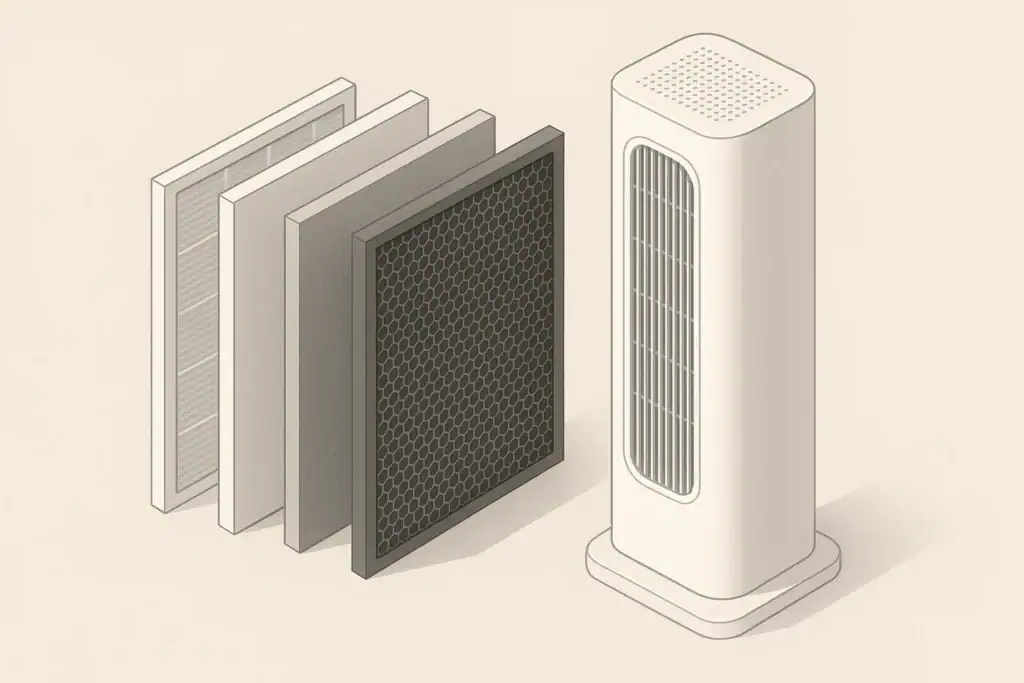
| Filter type | Main target | Typical use in purifiers | Key limitation |
|---|---|---|---|
| HEPA or HEPA-style | Fine particles (dust, PM2.5, smoke) | Primary particle filter for room air | Does not address most gases or odors |
| Higher-grade HEPA (e.g., H13/H14) | Very high particle capture efficiency | Used when higher filtration performance is desired | Requires good seals; more sensitive to bypass gaps |
| Standard activated carbon | Some odors and certain gases | Often paired with HEPA in a combo filter | Capacity is limited; can saturate over time |
| Thicker or pellet-based carbon | Improved gas and odor reduction | Used when odor control is a priority | Heavier and may increase airflow resistance |
| Pre-filter (mesh or coarse fiber) | Larger dust, hair, and lint | Protects downstream HEPA and carbon layers | Does not replace a true HEPA filter |
| Electrostatic media (non-ozone) | Fine particles with enhanced capture | Sometimes integrated into filter layers | Performance can change as media loads with dust |
How Bypass Leakage Undermines a Good HEPA Filter
A HEPA filter’s efficiency rating (for example, capturing a high percentage of 0.3 micron particles under test conditions) assumes that all the air is pushed through the filter media with no leaks around the edges. In a home purifier, that ideal setup may not exist if seals are weak.
Effective Efficiency vs. Filter Efficiency
The useful metric in a real room is not just how efficient the filter media is, but how efficiently the whole system removes particles from the air that passes through it.
Even small leakage can reduce overall performance. For example, if a HEPA filter is highly efficient but 10–20% of the airflow bypasses the media, the effective performance of the purifier can drop noticeably. The purifier may still help, but not at the level the filter rating alone might suggest.
Impact on CADR and ACH Plans
Clean Air Delivery Rate (CADR) and Air Changes per Hour (ACH) are often used to estimate how fast a purifier can reduce particle levels in a room. These planning tools assume that most of the air going through the machine is actually being filtered.
Bypass leakage means that the machine’s real-world “clean air” output can be lower than you expect, especially at higher fan speeds where pressure across the filter is greater and air is more likely to push through any weak spots in the seals.
Where Leaks Happen: Common Seal and Housing Issues
Identifying where bypass leakage tends to occur helps you choose better-designed purifiers and handle filters more carefully during replacement.
Filter Frame and Gasket Problems
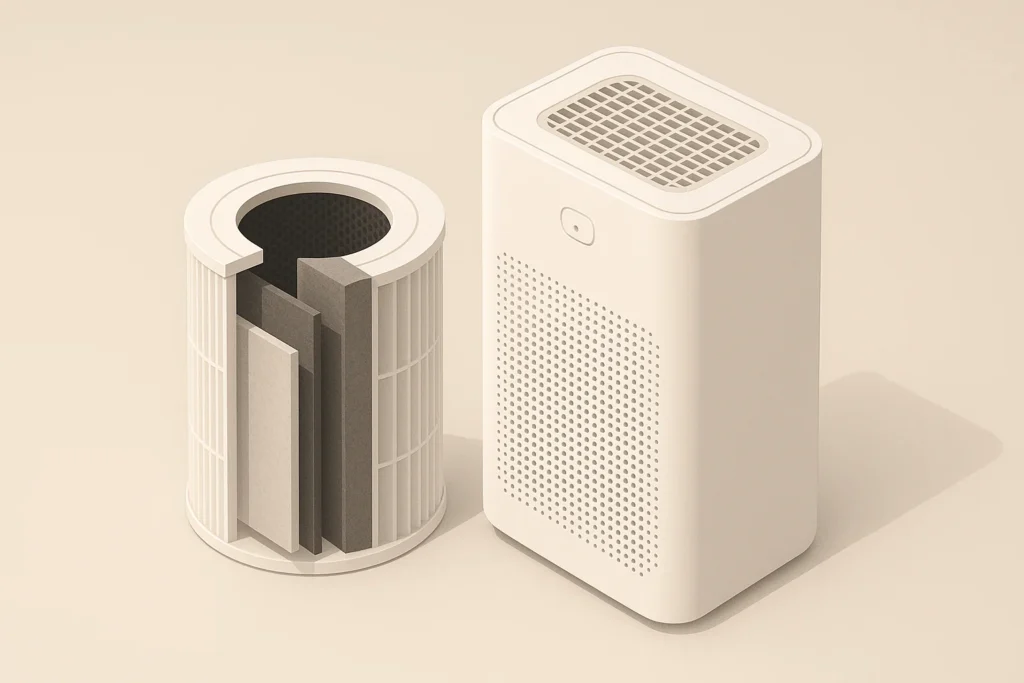
Most HEPA filters sit in a frame and rely on some type of gasket to seal against the purifier body. Weak points include:
- Thin or uneven gaskets: If the sealing material does not compress evenly, some corners or edges may not fully contact the housing.
- Aged or brittle seals: Over time, foam or rubber can harden and lose flexibility, leaving small voids.
- Improperly seated filters: If a filter is not pushed fully into place, the gasket may barely touch or miss the sealing surface on one side.
Housing Geometry and Access Panels
The purifier’s body also matters. Design-related leak paths can include:
- Loose filter doors: Doors that latch at only one or two points can flex, leaving slight gaps at the edges.
- Complex internal shapes: Sharp corners or steps inside the filter cavity can make it hard for gaskets to seal continuously.
- Multiple filter stages with gaps between them: If there is space between a pre-filter, carbon layer, and HEPA layer, air can sneak around one of the stages.
User-Introduced Issues
Even a well-designed purifier can leak if something about installation or maintenance is off. Common examples:
- Leaving protective plastic wrap on a new filter, forcing the door to bulge and preventing a tight seal.
- Installing a filter backwards or upside down when the frame is not symmetrical.
- Trapping dust, hair, or debris along the gasket surfaces so they cannot seat evenly.
Practical Ways to Check for Bypass Leakage at Home
Most households do not have laboratory instruments, but there are simple checks that can help you spot obvious bypass issues in a home purifier.
Visual and Physical Inspection
Start with a basic inspection whenever you change or handle filters:
- Look at the filter frame: It should be straight, not twisted or bowed.
- Inspect the gasket: Check for cracks, missing chunks, or areas that look permanently flattened.
- Check the housing: Run your finger along the sealing surface inside the purifier. It should be clean, smooth, and free of buildup.
- Confirm a solid closure: When you close the filter door or panel, it should latch firmly without wobble or gaps.
Simple Airflow “Feel” Tests
While not precise, you can use airflow to get a sense of obvious leaks:
- With the purifier running on a higher setting, carefully run your hand near the edges of the filter door (without blocking vents). Strong jets of air from seams or corners can indicate leakage.
- Listen for whistling or hissing noises around the filter door that change when you press gently on the panel.
These basic checks do not replace instruments, but they can reveal large leak paths that are easy to correct by reseating a filter or ensuring the door is properly closed.
Using a Consumer Particle Monitor Thoughtfully
Some people use simple indoor particle monitors that report PM2.5 or similar metrics. While these devices vary in quality, they can provide rough feedback.
- If particle levels drop slowly despite the purifier running at higher speed in a moderately sized room, bypass leakage (or undersizing) might be part of the reason.
- If levels drop faster after you reseat the filter, clean the gasket areas, and fully latch the door, that suggests sealing made a difference.
Any single test is only a clue, not a lab-grade measurement, but trends over time can help you gauge whether your purifier setup is working as expected.
How to Minimize Bypass Leakage in Everyday Use
While you cannot change the internal engineering of a purifier, you can optimize what you control: filter installation, maintenance, and operating habits.
Install Filters Carefully
Each time you replace a filter:
- Follow the orientation markings: Many filters have an indicated air-flow direction or front/back side; align them as specified.
- Seat the filter fully: Press evenly around all edges until you feel or hear it set into place.
- Remove all packaging: Take off plastic wraps and covers that are meant only for shipping. Leaving them on can warp the door and compromise the seal.
Keep Seal Surfaces Clean
Dust and lint can act like spacers between the gasket and the housing. When you replace filters:
- Wipe the sealing surfaces gently with a dry or slightly damp cloth (unplug the unit first).
- Check that the gasket itself is free of clumps of dust or fibers.
Check Door Alignment and Latches
If the filter door or panel does not sit flush:
- Open it again and confirm nothing is trapped along the edges.
- Verify that the filter is not protruding or incorrectly positioned.
- Ensure all latches, clips, or screws are fully engaged, but do not over-tighten to the point of damaging plastic parts.
Operate at Appropriate Fan Speeds
Higher fan speeds create more pressure across the filter. That can be helpful for faster air cleaning, but if seals are weak, higher pressure can drive more air through any existing gaps.
Once you have good sealing practices in place, you can run higher speeds for quicker clean-up and then switch to lower speeds for ongoing maintenance and noise control.
Example values for illustration.
| Filter type | Typical interval range (example) | What changes it | Reminder |
|---|---|---|---|
| Pre-filter (washable mesh or foam) | Clean every 1–3 months | Visible dust buildup; pets; nearby roads | Clogged pre-filters increase resistance and may encourage bypass |
| HEPA or HEPA-style cartridge | Replace every 6–18 months | Fan speed use, dust levels, and runtime hours | A heavily loaded HEPA can deform or stress seals |
| High-grade HEPA (e.g., H13 range) | Replace every 6–24 months | Air quality, usage intensity, and room size | Check gaskets closely during each replacement |
| Thin carbon sheet | Replace every 3–6 months | Odor exposure from cooking, smoke, or hobbies | Odor reduction fades before airflow drops much |
| Thicker carbon canister or tray | Replace every 6–24 months | Concentration and duration of gas/odor exposure | Follow manufacturer guidance for gas-phase media |
| Combination HEPA + carbon filter | Replace every 6–12 months | Both particle load and odor exposure | Monitor for airflow changes and recurring odors |
How Seals Fit into a Whole-Home Air Quality Strategy
Good HEPA sealing is important, but it is only one part of managing indoor air in a typical U.S. home or apartment. Bypass leakage can reduce the effectiveness of your purifier, but so can undersizing the unit, poor placement, or ignoring other sources of pollution.
Room Size, Placement, and Airflow
Even with excellent seals, a purifier needs to move enough air to keep up with the room and its sources of particles. To support whole-room filtration:
- Match the purifier’s capacity to your room size and ceiling height when planning CADR and ACH.
- Place the purifier where airflow is not blocked by furniture or heavy curtains.
- Aim to avoid corners that trap air; near the center of a wall or in a clear area can be more effective.
Ventilation and Source Control
Purifiers with well-sealed HEPA filters are most effective when they complement basic ventilation and source reduction steps such as:
- Using kitchen exhaust fans when cooking to reduce indoor particle and odor loads.
- Limiting indoor smoking or high-particle hobbies in confined spaces.
- Opening windows when outdoor conditions are suitable to dilute indoor pollutants.
Monitors, Humidity, and Maintenance
Simple particle and humidity monitors, periodic cleaning, and staying on top of filter changes all help your purifier perform closer to its potential. Well-sealed filters are one important piece in a broader routine that includes:
- Keeping humidity in a comfortable, moderate range with humidifiers or dehumidifiers as needed.
- Managing dust with regular vacuuming and surface cleaning.
- Checking that safety features are intact and avoiding intentional ozone-generating devices for everyday indoor air cleaning.
When you think of a HEPA purifier as a system—filter media plus seals, housing, fan, and room conditions—it becomes clear why preventing bypass leakage is worth the small amount of extra attention during every filter change.
Frequently asked questions
How can I tell if my HEPA filter is experiencing bypass leakage?
Start with visual and physical checks: look for gaps, warped frames, or compressed gaskets and run your hand near seams while the unit is running to feel for jets of air. Listening for whistling noises and noting whether a particle monitor shows faster improvement after reseating the filter are also practical indicators.
Will a high-rated HEPA filter still fail to perform because of poor seals?
Yes. Laboratory efficiency ratings assume all air passes through the media, so even small edge leaks can substantially reduce real-world capture and lower the system’s effective performance. Ensuring proper sealing is therefore as important as choosing a higher-grade filter.
Can I fix bypass leakage myself, and what should I try first?
Often you can: reseat the filter, remove any shipping plastic, clean gasket and sealing surfaces, and ensure access panels latch fully. If the frame is warped or the gasket is cracked or brittle, replace those parts to restore a reliable seal.
Does running the purifier at high fan speed make bypass leakage worse?
Yes, higher fan speeds increase pressure across the filter and can drive more air through gaps, so leaks tend to worsen at higher settings. After confirming good seals, short periods at high speed are useful for quick clean-up, followed by lower speeds for ongoing maintenance.
How often should I inspect seals and gaskets for signs of bypass leakage?
Inspect seals and gasket surfaces whenever you replace or clean filters and check them visually every month if the unit is used heavily or you have pets or high dust loads. Replace any gasket or filter that looks cracked, permanently compressed, or warped to keep performance consistent.
Recommended next:
- True HEPA vs HEPA-Type: What the Labels Really Mean
- HEPA H13 vs H14: Differences, Efficiency, and When It Matters
- How Often Should You Replace a HEPA Filter?
- Do HEPA Filters Remove Viruses, Bacteria, and Allergens?
- HEPA Grades Explained (H10–H14): What’s Relevant for Homes?
- True HEPA vs HEPA-Type vs “HEPA-Like”: Label Tricks to Avoid
- More in HEPA Filters →
- Clear sizing logic (room size → CADR/ACH)
- HEPA vs carbon explained for real use-cases
- Humidity + ventilation basics to reduce mold risk
About this site
Home Air Quality Lab publishes practical, independent guides about indoor air quality—clear sizing, safer use, and real-world expectations.
Affiliate disclosure
Some links on this site may be affiliate links. If you buy through these links, we may earn a small commission at no extra cost to you. This helps support our content. Learn more.