
Why HEPA Labels Are So Confusing
Walk down any aisle or browse online for an air purifier, and you will see phrases like “True HEPA,” “HEPA-type,” “HEPA-style,” and “HEPA-like.” They sound similar, but they can describe very different levels of filtration performance.
This matters if you are trying to reduce indoor particles such as dust, pet dander, smoke particles, or pollen. The filter is the heart of an air purifier, and its efficiency is what largely determines how much fine particulate matter (including PM2.5) is removed from the air passing through it.
Manufacturers sometimes use creative wording to make products sound more capable than they are. Understanding the language around HEPA helps you:
- Avoid paying more for filters that do not perform like true HEPA
- Match the filter type to your indoor air goals
- Read packaging and specifications with a critical eye
What “True HEPA” Really Means
“True HEPA” is a marketing phrase, but it usually refers to filters that meet a widely accepted HEPA efficiency benchmark: capturing at least 99.97% of particles with a diameter of 0.3 microns in a controlled laboratory test.
In practice, “true HEPA” filters are:
- Made of dense fibrous media that traps particles through interception, impaction, and diffusion, not like a simple mesh screen.
- Tested at a challenging particle size around 0.3 microns, often called the “most penetrating particle size” in filter testing.
- Designed to seal tightly in the purifier so air does not easily leak around the edges (bypass).
H13 or H14 under European-style ratings, which refer to even higher efficiencies at certain test sizes. However, the most important point for home use is whether the filter is clearly described as meeting a recognized HEPA efficiency standard, not just having “HEPA” somewhere in its name.
Also remember: a high-efficiency filter alone does not guarantee clean air in a room. Airflow, room size, placement, and air changes per hour (ACH) all affect real-world results.
| Term on packaging | Typical meaning (general) | What to verify before buying |
|---|---|---|
| True HEPA | Often indicates 99.97% at 0.3 micron lab efficiency | Look for an explicit efficiency number and tested particle size |
| HEPA (without qualifier) | May or may not meet true HEPA lab criteria | Check for a written standard or detailed test description |
| HEPA-type | Usually lower efficiency than true HEPA | See if any efficiency is listed at 0.3 microns or similar |
| HEPA-like | Broad marketing term with no specific standard | Be cautious if no numerical particle capture is disclosed |
| Medical grade HEPA | Marketing phrase, not a single universal rating | Look for recognized filter class (such as H13 or comparable) |
| 99% efficient filter | Percent may be at larger, easier-to-capture particles | Confirm which particle size and test conditions were used |
Example values for illustration.
HEPA-Type and HEPA-Like: What They Usually Mean
“HEPA-type” and “HEPA-like” filters are not standardized technical terms. They usually describe filters that resemble HEPA in appearance or construction but do not meet the strict efficiency criteria associated with true HEPA under controlled test conditions.
Manufacturers may use these softer terms when their filters:
- Have lower efficiency at the most penetrating particle sizes
- Are tested only at larger particles (for example, 1–3 microns)
- Have less dense media to reduce cost or resistance to airflow
This does not mean HEPA-type filters are useless. They can still capture a significant amount of larger particles and may be acceptable when:
- Your main concern is general dust and larger particles, not the finest particles
- You want lower resistance to airflow, potentially allowing more clean air volume
- You have modest air quality goals and a limited budget
The key is to understand that HEPA-type or HEPA-like labels do not guarantee HEPA-level performance. Without a stated capture efficiency and particle size, it is impossible to compare them directly with a true HEPA filter.
How HEPA Filters Are Tested
To appreciate the difference between filter labels, it helps to understand how HEPA performance is usually measured in the lab. While test standards differ across regions and industries, several common concepts show up repeatedly:
Most Penetrating Particle Size (MPPS)
HEPA filters are not equally efficient at all particle sizes. Counterintuitively, extremely small particles (below about 0.1 microns) may be captured fairly effectively because they move randomly and collide with fibers. Larger particles above about 1 micron are often captured easily by interception and impaction.
Somewhere in between—typically around 0.1–0.3 microns—is the size range where particles can slip through most easily. This is called the most penetrating particle size (MPPS). That is why 0.3 microns is often used as a reference point when quoting HEPA performance.
Single-Pass Laboratory Tests
Standard HEPA test methods generally evaluate how much of a test aerosol passes through the filter in a single pass at a specific airflow. The efficiency figure (such as 99.97%) describes removal under those controlled conditions, not real-life whole-room performance.
Real rooms are more complex. Clean air mixes with room air over time, and the effective removal of particles depends on:
- Clean air delivery rate (CADR)
- Room size and ceiling height
- Air circulation patterns and placement of the purifier
- How often new particles are generated (for example, from cooking or dusting)
Pressure Drop and Airflow
Higher-efficiency filters usually create more resistance to airflow (higher pressure drop). A purifier must have a fan powerful enough to push air through the filter while still delivering useful CADR and manageable noise. This is why some devices with very dense filters may run more loudly or provide less reach than you expect if the fan is weak.
Common Label Tricks and How to Read Around Them
Once you know what HEPA means technically, it becomes easier to spot vague or confusing marketing language. Here are patterns to watch for and how to interpret them calmly and critically.
Trick 1: Vague “99% Efficient” Claims
A filter might boast “99% efficiency” without saying what size particles that number refers to. Capturing 99% of particles that are 3 microns or larger is much easier than capturing 99% of particles around 0.3 microns.
What to look for:
- A particle size paired with the percentage (for example, “99.97% at 0.3 microns” in a lab test)
- An indication that testing followed a recognized method (rather than a vague “internal test”)
Trick 2: “As Small As” Language
Some packages say “captures particles as small as 0.3 microns” without giving an efficiency. Technically, almost any filter will capture some of these particles; the real question is what fraction is removed.
What to look for:
- A numerical efficiency (for example, 95%, 99%, or 99.97%) at a given particle size
- Whether the statement refers to the filter alone or the entire purifier system
Trick 3: HEPA-Type With No Numbers
When a filter is described as HEPA-type or HEPA-like without efficiency data, you can assume it is not claiming true HEPA performance. It might still help with larger particles, but you should not treat it as equivalent to a tested HEPA filter.
What to look for:
- Any third-party test results that specify particle sizes and efficiencies
- Whether the device lists a particle-related CADR (for example, for smoke or dust), which gives a more practical measure of whole-device performance
Trick 4: Emphasis on Extra Features Over Filtration
Some air cleaners minimize discussion of the actual filter and instead highlight ionizers, UV-C, or other add-ons. These technologies have their own pros, cons, and safety considerations, but they do not replace the need for effective mechanical filtration when your goal is particle reduction.
What to look for:
- Clear description of the main filter (HEPA, HEPA-type, or otherwise)
- Whether optional features can be turned off if you prefer to rely on the filter alone
True HEPA vs HEPA-Type vs HEPA-Like in Real-World Use
In actual homes, the difference among these filter categories shows up in how quickly and how thoroughly they reduce airborne particles, especially the finest ones that stay suspended for long periods.
When True HEPA Is Worth Prioritizing
True HEPA filters tend to make the most sense when:
- You are sensitive to indoor particles and want more aggressive particle reduction
- You live in an area affected by wildfire smoke or urban PM2.5 pollution
- You want a purifier that can deliver strong particle CADR for its size
Even then, you will get the best results when the purifier and filter are correctly sized for the room, with enough airflow to deliver multiple air changes per hour.
When HEPA-Type May Be Sufficient
For some homes, HEPA-type filters can still be useful, especially when:
- Your greatest concern is visible dust and larger particles
- You run the device for longer periods, allowing repeated passes through the filter
- You combine filtration with other strategies like regular cleaning and basic ventilation
Because HEPA-type filters may be less dense, the purifier can sometimes move air more quietly or at a lower cost, although this varies widely by design.
Why HEPA-Like Needs Extra Scrutiny
“HEPA-like” generally signals the weakest link to a formal standard. If there are no numbers and no mention of recognized testing methods, treat performance claims as broad marketing, not a guarantee. That does not mean the filter is useless, but it does mean you cannot easily compare it to true HEPA in any precise way.
How HEPA Fits With Carbon and Other Filters
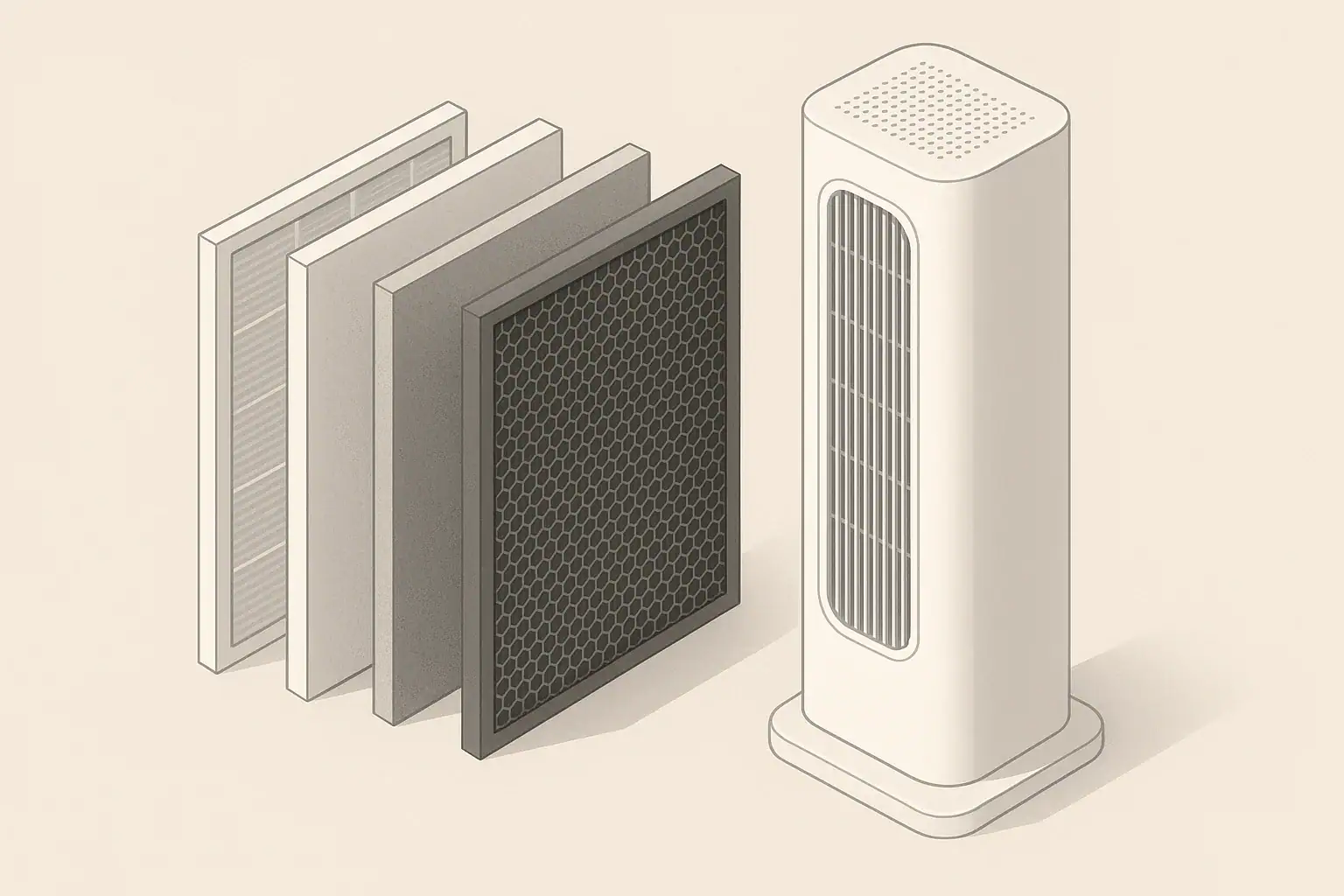
Most home purifiers use multiple filter stages. HEPA or HEPA-type media is primarily for particles, while other filter layers address different concerns.
HEPA vs Activated Carbon
HEPA filters are not designed to remove gases or odors. For that, manufacturers often add an activated carbon filter or other sorbent media. This separate layer can help reduce certain smells and some volatile organic compounds (VOCs), although performance varies widely based on the amount and type of carbon, contact time, and contaminant levels.
A general multi-stage setup might include:
- A pre-filter to catch hair and large dust, protecting the main filter
- A HEPA or HEPA-type filter for fine particles
- An activated carbon layer for some gases and odors
Seal Quality and Bypass
Even the best HEPA filter will underperform if air leaks around it. Good designs use gaskets, tight frames, or other features to minimize bypass. When comparing devices, pay attention not only to filter labels but also to how solidly the filter appears to fit into the housing.
| Filter type | Typical interval range (example) | What changes the interval | Reminder |
|---|---|---|---|
| Pre-filter (washable) | Every 2–4 weeks cleaning | Pet hair, visible dust, fan speed | Rinse or vacuum to protect main filter |
| True HEPA filter | About 6–18 months | Air pollution levels, usage hours, fan setting | Follow device guidance and monitor airflow and noise |
| HEPA-type filter | About 6–12 months | Particle load, indoor activities like cooking | Inspect for discoloration and clogging |
| Activated carbon filter | About 3–12 months | Odor intensity, smoking, cooking frequency | Replace when odors linger despite running purifier |
| Combined HEPA + carbon cartridge | About 6–12 months | Both particle and odor loads | Do not wait for strong smells; use schedule |
| HVAC furnace filter (high-MERV) | About 1–3 months | Fan runtime, dust, construction nearby | Check monthly at first to learn your pattern |
Example values for illustration.
Practical Checklist for Choosing a HEPA-Based Air Purifier
You do not need to become a filtration engineer to make a good choice. Use this simple checklist when you compare options:
1. Clarify Your Main Goal
- Particle-focused: dust, smoke particles, pet dander, pollen → prioritize true HEPA or clearly specified HEPA-level filters and particle CADR.
- Odor-focused: cooking smells, mild household odors → ensure there is a meaningful activated carbon stage.
- General refresh: basic dust reduction and fresher feel → a well-sized HEPA-type filter may be acceptable when combined with regular cleaning and ventilation.
2. Examine the Filter Language Carefully
- Is it called True HEPA or similar and backed by a numerical efficiency at a stated particle size?
- If it says HEPA-type or HEPA-like, does the packaging provide any actual test data?
- Are there vague phrases like “captures particles as small as…” without percentages?
3. Look Beyond the Filter to Whole-Room Performance
- Check the clean air delivery rate (CADR) for particles relevant to you, such as smoke or dust.
- Match CADR and airflow to your room size and ceiling height.
- Consider noise levels at the fan speed you are likely to use for several hours a day.
4. Plan for Maintenance
- Estimate ongoing filter costs over several years, not just the upfront device cost.
- Check how easy it is to access and replace filters without tools.
- Set reminders to clean pre-filters and replace main filters on schedule.
5. Combine Filtration With Other Basics
Even with the best HEPA filter, indoor air quality also responds to simple habits:
- Using exhaust fans when cooking or showering, where available
- Ventilating with outdoor air when conditions allow and it is practical
- Reducing particle sources, such as limiting indoor smoking and handling dusty tasks with care
By reading HEPA labels carefully and focusing on both filter quality and overall airflow, you can choose equipment that supports cleaner indoor air in a practical, informed way.
Frequently asked questions
How can I verify that a “True HEPA” filter actually meets 99.97% at 0.3 microns?
Look for an explicit efficiency number and the particle size on the packaging or technical sheet (for example, “99.97% at 0.3 µm”). Prefer products with third-party or standardized test references and, when provided, a recognized filter class such as H13/H14. If only vague claims or no test details are shown, treat the label as marketing rather than a confirmed performance metric.
Is a HEPA-type filter sufficient for wildfire smoke or PM2.5 protection?
For wildfire smoke and PM2.5, true HEPA filters are generally recommended because they are tested and rated for the smallest, most penetrating particles. HEPA-type filters may reduce larger visible particles but often lack verified efficiency for fine smoke particles, so they may not provide comparable protection.
Will adding activated carbon make a HEPA-type filter effective against gases and odors?
Activated carbon targets gases and many odors, which HEPA media does not remove, so adding carbon can improve performance against smells and some VOCs. The effectiveness depends on the amount and type of carbon and contact time; a small carbon layer may have limited impact on heavier or high-concentration gases.
How often should I replace True HEPA versus HEPA-type filters?
Replacement intervals vary with use and pollution levels, but typical guidance is about 6–18 months for true HEPA filters and about 6–12 months for HEPA-type filters. Factors such as fan speed, indoor particle load, and whether a pre-filter is cleaned regularly will change how long a filter remains effective.
Can higher airflow or CADR make up for a lower-efficiency (HEPA-type) filter?
Higher CADR and airflow increase the volume of air processed and can improve whole-room particle removal, so a high-CADR HEPA-type unit may perform acceptably for some goals. However, airflow does not change the filter’s intrinsic capture efficiency for the smallest particles, so true HEPA filters usually outperform lower-efficiency media for fine particle removal even at similar CADR.
Recommended next:
- Clear sizing logic (room size → CADR/ACH)
- HEPA vs carbon explained for real use-cases
- Humidity + ventilation basics to reduce mold risk