
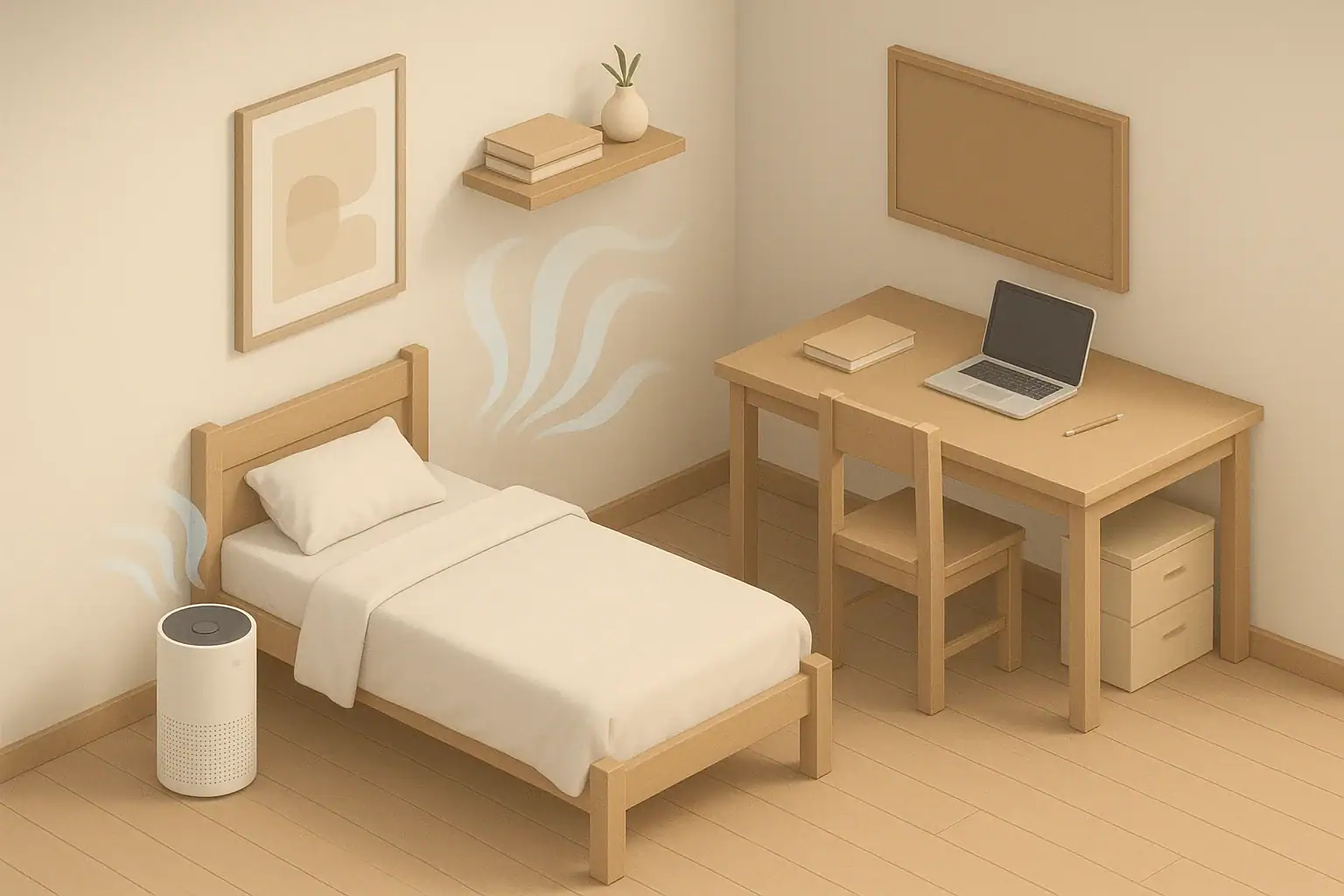
A good dorm room allergy setup combines right-sized HEPA filtration, steady cleaning, clutter control, and simple humidity awareness in a small space.
Dorm rooms are compact, shared, and often hard to ventilate consistently, so small changes can make a noticeable difference in dust, particles, odors, and general comfort. The goal is not to make medical promises, but to reduce common indoor triggers and keep the room easier to maintain.
Quick answer
- Choose a purifier with a particle CADR that can support about 4–5 air changes per hour for the room volume, as general small-room guidance.
- Use a true HEPA-style particle filter for dust, pollen, and fine particles; add activated carbon if odors are a concern.
- Keep indoor relative humidity roughly 30%–50% when possible to support comfort and reduce dampness issues.
- Place the purifier with open space around the intake and outlet, not under a bed, behind a chair, or tight against laundry piles.
- Use a simple weekly cleaning routine: wash bedding, vacuum or sweep, wipe hard surfaces, and remove clutter that traps dust.
Why dorm rooms need a small-room allergy setup
Dorm rooms are different from many bedrooms at home because they compress sleeping, studying, storage, laundry, and eating into one small area. That means dust, fabric fibers, outdoor particles, food odors, and humidity from daily routines can build up quickly.
Many dorm rooms also have limited control over central heating, cooling, and ventilation. Windows may open only partway, filters in building systems may not be accessible, and roommates may have different cleaning habits. A practical setup focuses on what students can usually control: filtration, placement, cleaning, humidity awareness, and reducing dust reservoirs.
Allergy-friendly dorm planning is best viewed as source reduction plus air cleaning. Source reduction means keeping dust, damp items, and clutter from accumulating. Air cleaning means using a properly sized purifier to capture airborne particles as room air circulates through the filter.
Size dorm room filtration without guessing
The most useful sizing number for an air purifier is clean air delivery rate, commonly called CADR. CADR is usually listed in cubic feet per minute and indicates how much filtered air the unit can deliver for a particle type under test conditions. In real rooms, placement, filter condition, fan speed, and furniture can affect results.
A practical way to think about sizing is air changes per hour, or ACH. ACH estimates how many times per hour the room’s air volume could pass through the purifier. A common planning target for small rooms is about 4–5 ACH for particles, when noise and budget allow.
Use this simple formula for a general estimate:
- Room volume = floor area in square feet × ceiling height in feet.
- Needed CADR = room volume × target ACH ÷ 60.
- Example: a 120-square-foot dorm room with an 8-foot ceiling is about 960 cubic feet. For 5 ACH, the estimated CADR is 960 × 5 ÷ 60, or about 80 cfm.
For shared rooms, open closets, high ceilings, or heavy clutter, choose a margin above the exact estimate if possible. It is often better to run a purifier on a quieter medium setting continuously than to rely on a loud high setting that will not be used.
HEPA and carbon roles
A true HEPA-style particle filter is intended for particles such as dust, pollen, and fine particulate matter. Activated carbon is different: it is used for some gases and odors, but its usefulness depends on the amount of carbon, airflow, contact time, and the specific compound. Carbon does not replace particle filtration.
| Task | Why it matters | Practical note |
|---|---|---|
| Estimate room volume | Helps size filtration to the actual space | Use floor area times ceiling height |
| Plan for 4–5 ACH | Gives a general particle-filtration target | Use as guidance, not a guarantee |
| Choose HEPA-style filtration | Targets common airborne particles | Check that the filter fits tightly in the unit |
| Add carbon if needed | Can help with some odors | More carbon generally lasts longer than a thin sheet |
| Leave airflow space | Reduces intake or outlet blockage | Avoid tucking the purifier behind furniture |
| Control clutter | Limits surfaces that collect dust | Use closed bins when practical |
| Track filter changes | Maintains airflow and performance | Write the install date on a calendar |
Placement and airflow mistakes to avoid
Even a correctly sized purifier can underperform if air cannot move through it. Dorm rooms make this easy to overlook because floor space is limited and storage often spills into walkways.
Place the purifier where air can enter and exit freely. A common choice is near the sleeping area but not blowing directly at your face if that feels uncomfortable. Keep it away from curtains, bedding, backpacks, and laundry baskets that could block airflow.
Avoid placing a purifier under a lofted bed if the intake or outlet is crowded. If the room has a mini-fridge, microwave, or heat source, do not place the purifier where heat or moisture can affect it. Keep cords routed safely so they do not create a tripping hazard.
Windows are useful at times, but open-window ventilation can also bring in outdoor pollen, smoke, traffic particles, or humid air depending on conditions. If outdoor air quality is poor or pollen is high, running the purifier with windows closed may be more practical. If the room feels stale and outdoor conditions are acceptable, short ventilation periods can help exchange indoor air. air purifier placement
Dorm room cleaning checklist for lower dust load
Cleaning matters because filtration works best when it is paired with reducing dust sources. The goal is a routine that can fit into student life without requiring commercial equipment or complicated steps.
Daily or near-daily habits
- Put dirty laundry in a closed hamper or washable bag instead of open piles.
- Keep shoes near the door or in a tray to reduce tracked-in dust and grit.
- Throw away food packaging and take out trash before odors build.
- Keep the purifier running during normal occupancy if noise and rules allow.
Weekly checklist
- Wash sheets and pillowcases, following fabric care instructions.
- Vacuum rugs or sweep hard floors, especially under the bed and desk.
- Wipe desks, shelves, windowsills, and electronics surfaces with a slightly damp cloth.
- Shake or launder washable throw blankets as needed.
- Check that purifier vents are not covered by dust, papers, or clothing.
Monthly checklist
- Inspect the purifier prefilter if the unit has one and clean it as directed by the manual.
- Look behind furniture for dust clumps, damp items, or forgotten food.
- Review filter life and order replacements before the filter is past due.
- Declutter papers and fabric storage that no longer needs to stay in the room.
Use cleaning products carefully in a dorm room. Strongly scented sprays may add odors or irritating vapors for some people. A damp microfiber cloth, fragrance-free basic cleaner, or campus-approved cleaning method is often enough for routine dust removal.
Real-world dorm setup examples
Different dorm rooms need different priorities. The examples below are general planning scenarios, not product recommendations.
Small single room
In an 80–110 square-foot single room, one properly sized purifier can usually serve the main sleeping and study area if airflow is not blocked. Place it where it can pull from the open room, not inside a closet-like corner. Continuous low or medium operation is often more practical than occasional high-speed use.
Shared double room
In a shared room, the best setup depends on layout and roommate preferences. One larger unit may work if it can sit in open space, but two smaller units can sometimes improve coverage on each side of the room. Coordinate fan noise, placement, and filter maintenance so the setup remains usable.
Room with carpet or lots of fabric
Carpet, upholstered chairs, curtains, extra blankets, and fabric storage cubes can hold dust. Filtration helps with airborne particles, but cleaning and clutter control are especially important in these rooms. Vacuuming with a well-maintained vacuum and keeping textiles washable can reduce the dust reservoir.
Room that feels damp
If the room often feels damp or smells musty, focus first on moisture sources. Do not ignore leaks, condensation, or wet belongings. Report building moisture problems through campus housing channels, keep wet towels spread to dry where allowed, and consider a small humidity monitor with a blank or dimmable display if you want basic awareness. humidity monitor
Safety and standards for dorm air quality gear
Campus housing rules should come first. Many dorms restrict extension cords, appliances, candles, incense, and certain plug-in devices. Choose equipment that fits the rules and does not create tripping, heat, or electrical risks.
For air purifiers, prioritize mechanical filtration for particles. Be cautious with devices that intentionally produce ozone or advertise ionization as the main cleaning method. Ozone can be an indoor air pollutant, and it should not be generated intentionally in occupied rooms. air purifier vs ozone generator
UV-C features, when present in some devices, should be treated as enclosed components that are not user-serviceable unless the manual clearly says otherwise. Do not modify safety covers or look at exposed UV-C lamps. In a dorm context, simple mechanical filtration, good placement, and routine cleaning are usually the most straightforward approach.
If you use a portable humidifier, keep it clean and follow the instructions for water type and maintenance. Over-humidifying a small room can create condensation and damp surfaces. If humidity regularly stays above about 50%–60%, a humidifier is usually not the right tool.
Maintenance, filter changes, and cost planning
A dorm room setup works only if it is maintained. Filters load with dust over time, which can reduce airflow and increase noise. A clogged prefilter can also make the unit less effective at moving air through the main filter.
Check the manual for the recommended filter schedule, but adjust based on room conditions. Heavy dust, open windows, wildfire smoke events, nearby construction, pets in permitted housing, or frequent cooking odors can shorten filter life. A cleaner, low-dust room may allow normal intervals.
Plan the annual cost before buying any purifier. Replacement filters are part of the real cost of ownership. If a unit requires expensive or hard-to-find filters, students may be less likely to change them on time.
Noise is also a maintenance issue in practice. If the high setting is too loud for sleep or studying, make sure the unit can meet your needs at a lower setting. A purifier that runs consistently at a comfortable sound level is usually more useful than one that is frequently turned off. air purifier noise for sleep
| Filter or part | Typical interval range | What can change it | Reminder |
|---|---|---|---|
| Washable prefilter | Every 2–4 weeks | Dust, lint, open windows | Dry fully before reinstalling |
| Disposable prefilter | Every 1–3 months | Visible dust loading | Follow the manual |
| HEPA-style main filter | Every 6–12 months | Smoke, dust, long runtime | Do not vacuum if the manual says not to |
| Carbon filter sheet | Every 1–3 months | Odors and airflow | Replace when odors return |
| Heavier carbon filter | Every 3–6 months | Odor load and carbon amount | Timing varies widely |
| Exterior vents | Monthly | Lint and fabric dust | Wipe gently with power off |
Related guides: How to Choose the Right Air Purifier for Your Room Size • Air Purifier Placement: Where to Put It for Best Results • Activated Carbon Filters Explained: VOCs, Odors, and What They Can’t Do • Best Indoor Humidity Level to Prevent Mold (With Seasonal Targets)
Frequently asked questions
What size air purifier works best for a dorm room allergy setup?
A good target is a purifier that can support about 4–5 air changes per hour for the room volume, as a general small-room guideline. To estimate that, multiply floor area by ceiling height to get room volume, then match the CADR to the space. If the room is shared, cluttered, or has open storage, a little extra capacity can help.
Is HEPA filtration necessary in a dorm room?
For reducing airborne dust, pollen, and similar particles, a true HEPA-style filter is the most relevant choice. It is the main filtration feature to look for if the goal is particle reduction rather than odor control. Activated carbon can be added for odors, but it does not replace particle filtration.
Where should I place a purifier in a small dorm room?
Place it where air can move in and out freely, with space around the intake and outlet. Avoid tucking it under a bed, behind furniture, next to laundry piles, or against curtains that could block airflow. A spot near the sleeping area often works well if it is not blowing directly at your face.
How often should I clean a dorm room if I have allergies?
A simple routine is most effective: daily or near-daily clutter control, weekly bedding and floor cleaning, and monthly checks of the purifier and hard-to-see dust areas. The exact schedule can vary with carpet, fabric, roommate habits, and how much outdoor dust enters the room. Consistency matters more than deep cleaning only once in a while.
Can a humidifier help with dorm room allergies?
A humidifier may help comfort if the room is very dry, but it will not treat allergies directly. It should be kept clean, and indoor humidity generally should stay in a moderate range rather than becoming damp. If humidity is already elevated, adding moisture can make the room less comfortable and may increase dampness concerns.
How do I keep odors under control without making the room more irritating?
Start with trash removal, laundry control, and basic ventilation when outdoor air conditions allow. If odors remain a problem, activated carbon can help with some smells, but stronger scented sprays can irritate some people. In a small room, reducing the source is usually more effective than masking the odor.
Summary and takeaways
A dorm room allergy setup should be simple enough to maintain: right-sized particle filtration, open airflow, routine cleaning, and basic moisture control. Start by estimating room volume and choosing a purifier that can support a practical ACH target at a fan speed you will actually use.
Keep the purifier in open space, reduce dust reservoirs, wash bedding regularly, and avoid damp laundry or cluttered corners. Use carbon only as an odor-support feature, not as a substitute for HEPA-style particle filtration. For safety, avoid ozone-generating approaches and follow campus housing rules.
The most effective setup is usually the one that stays consistent all semester: clean surfaces, clear airflow, reasonable humidity, and filters changed on schedule.
Recommended next:
- Pet Dander Allergy: Best Air Cleaner Setup and Habits That Help
- Dust Mite Allergy: Humidity Targets, Bedding, and Filtration
- Asthma Triggers Indoors: A Practical Checklist to Improve Air Quality
- Bedroom Allergy Setup: The Fastest Changes That Reduce Symptoms
- Pollen Season Indoor Plan: Filters, Ventilation Timing, and Cleaning
- Dust Mites and Humidity: The RH Range That Helps Most
- More in Allergies & Asthma →
- Clear sizing logic (room size → CADR/ACH)
- HEPA vs carbon explained for real use-cases
- Humidity + ventilation basics to reduce mold risk