
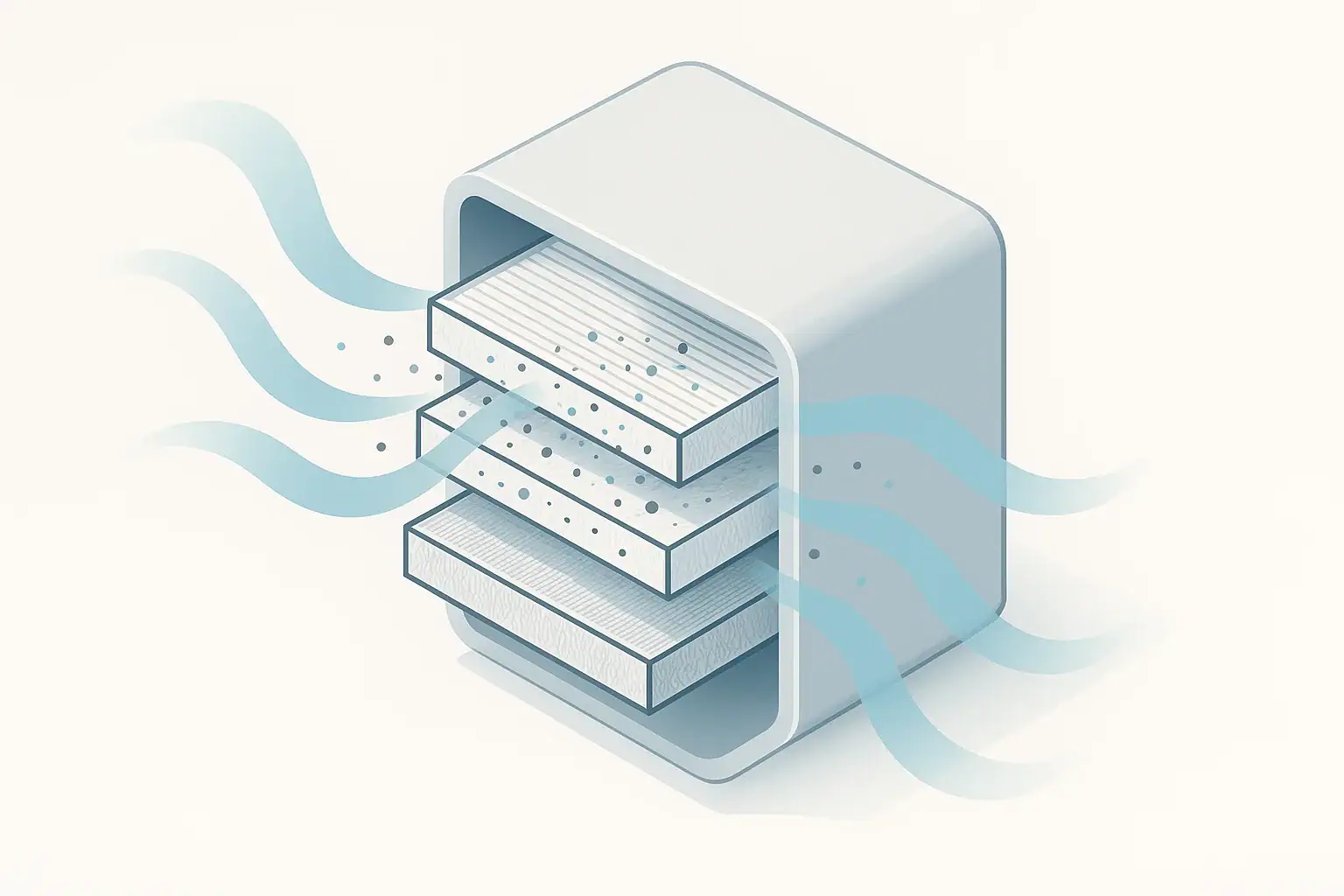
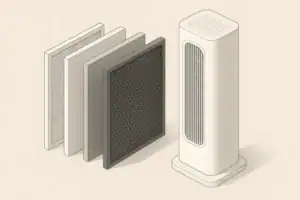
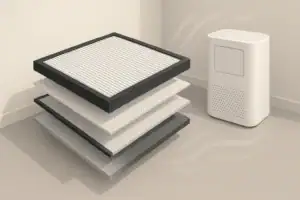
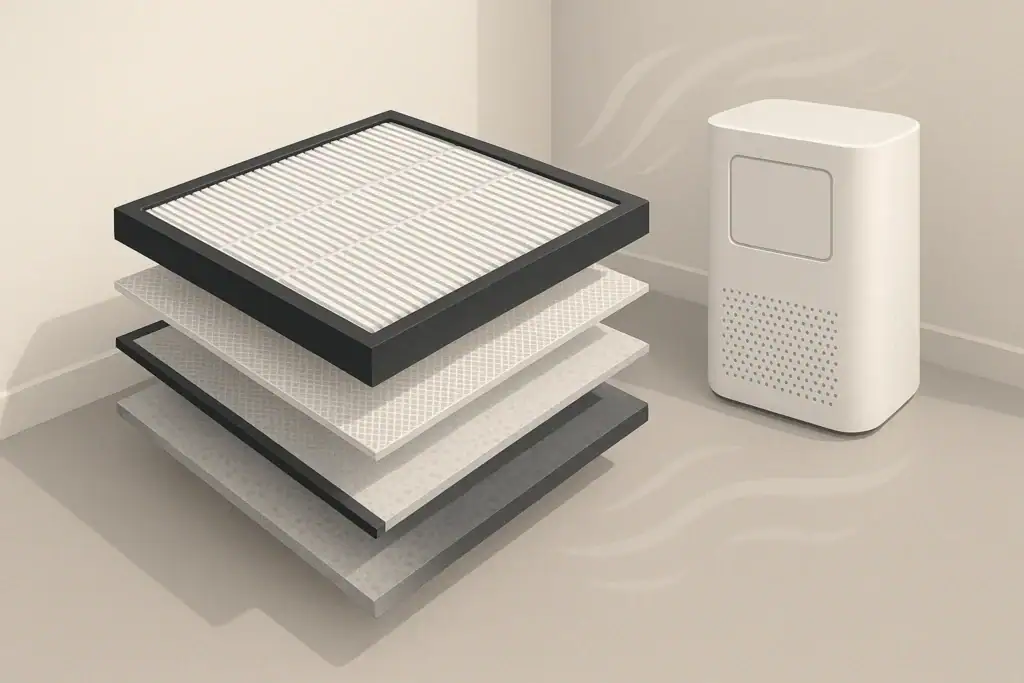
HEPA stands for High Efficiency Particulate Air. A HEPA filter is a dense mat of randomly arranged fibers designed to capture airborne particles as air passes through it. These fibers are usually made from glass or synthetic materials and are packed tightly to create a highly efficient mechanical filter.
The defining feature of a true HEPA filter is its tested efficiency. In many standards, a residential true HEPA filter must remove at least 99.97% of particles with a diameter of 0.3 microns under specified test conditions. Higher medical or industrial grades can be even more efficient, but the underlying principle is the same: force dirty air through a dense, fibrous material that traps particles.
What Is a HEPA Filter?
How HEPA Filters Capture Particles
To understand whether HEPA filters can remove viruses, bacteria, and allergens, it helps to know how they actually trap particles. Despite looking like a simple pad of fibers, several physical mechanisms work together inside a HEPA filter.
Main Filtration Mechanisms
- Inertial impaction – Larger, heavier particles (like coarse dust or pollen clumps) cannot follow the airstream as it moves around the filter fibers. Their inertia causes them to collide with fibers and stick.
- Interception – Particles that follow the airflow streamlines come close enough to a fiber that they touch it and adhere. This works well for mid-sized particles.
- Diffusion – Very small particles (including many fine aerosols) move in random zigzag paths due to Brownian motion. This random motion increases the chance they will bump into a fiber and be captured.
- Sieve effect – For particles larger than the gaps between fibers, the filter behaves like a physical screen; particles simply cannot pass through.
These mechanisms overlap across different particle sizes. The combined effect is that HEPA filters can capture a broad range of airborne pollutants, from larger allergens to very small aerosols.
Why 0.3 Microns Matters
You often see HEPA filters described using “0.3 microns” as a benchmark. This size is considered the most penetrating particle size (MPPS) for many HEPA media. In other words, particles around 0.3 microns are typically the hardest for the filter to capture.
Because certification tests use this challenging particle size, real-world performance for larger and smaller particles is often equal or better than the rated efficiency. This is important when thinking about viruses and bacteria, since many of them fall below or above that 0.3 micron benchmark.
Can HEPA Filters Remove Viruses?
Viruses are much smaller than most allergens, so it is reasonable to question whether a HEPA filter can capture them. The answer depends on how viruses are actually carried through indoor air.
Virus Size vs HEPA Capability
Individual virus particles can be extremely small, often in the range of about 0.02 to 0.3 microns, depending on the virus. At first glance, that seems smaller than what a typical HEPA filter is designed to capture.
However, in indoor environments, viruses rarely float around as isolated, bare particles. They are usually contained within:
- Respiratory droplets from coughing, sneezing, or talking
- Evaporated droplet nuclei (smaller dried residues of droplets)
- Attached to larger airborne particles like dust or skin flakes
These combined particles and droplets are often within, or larger than, the size range that HEPA filters capture efficiently.
HEPA and Virus-Containing Aerosols
Because HEPA filters rely on diffusion as well as interception and impaction, they can capture a significant proportion of fine aerosols that may contain viruses. In controlled environments such as healthcare settings and laboratories, HEPA filtration is commonly used as part of strategies to reduce airborne transmission risk.
However, there are important limitations:
- HEPA filters do not sterilize the air. Captured viruses may remain viable on the filter surface for some time.
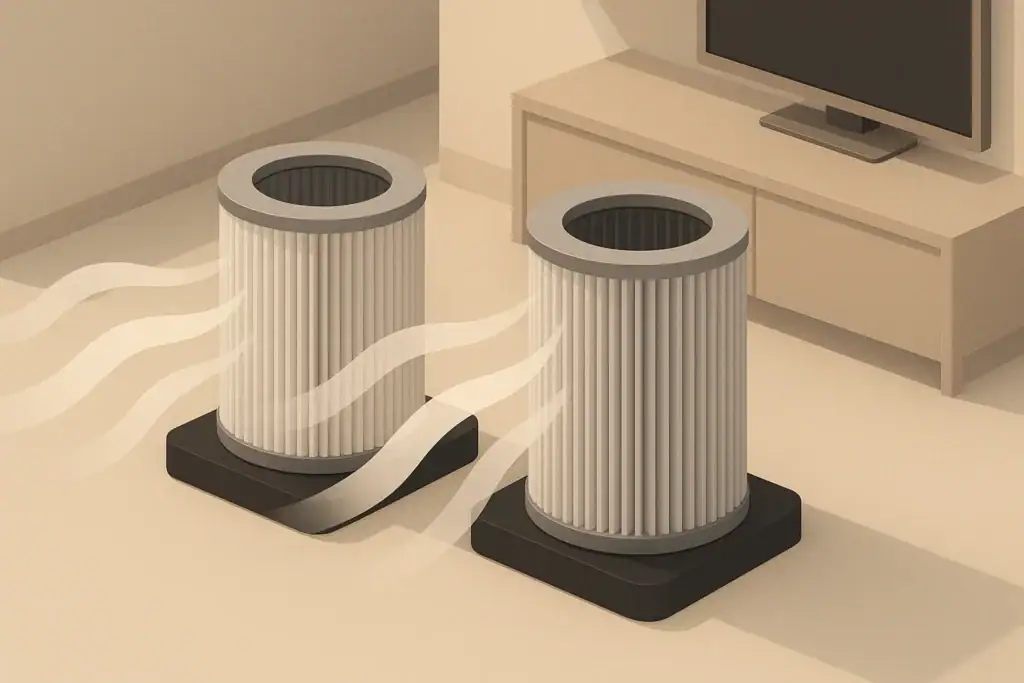
- Filtration is localized to the air that actually passes through the device. Air in corners, near ceilings, or behind obstacles may not be filtered effectively without good room circulation.
- HEPA filtration should be viewed as a complement, not a replacement, for other infection control measures such as ventilation, hygiene, and recommended public health practices.
In short, HEPA filters can substantially reduce the concentration of airborne particles that may carry viruses, but they do not guarantee removal of all virus-containing aerosols or prevent all forms of transmission.
Do HEPA Filters Remove Bacteria?
Bacteria are generally larger than individual viruses, though there is some overlap depending on the species.
Bacterial Particle Sizes
Many common airborne bacteria fall in the approximate size range of 0.3 to several microns. Some may be present as single cells, while others travel in clusters or attached to dust or droplets.
Because true HEPA filters are tested at the 0.3 micron range and perform even better at sizes above that, they can be very effective at capturing airborne bacteria and bacterial clumps that pass through the filter.
Viability and Growth on Filters
Capturing bacteria is only part of the story; what happens to them once they are on or in the filter also matters:
- HEPA filters are not inherently antimicrobial. They trap bacteria but do not necessarily kill them.
- Under certain conditions (warmth, moisture, organic material) microbes could potentially survive for some time on the filter media.
- Most residential HEPA units are designed so that captured material remains contained, but it is important to follow manufacturer guidance on filter replacement to minimize exposure when handling used filters.
Some systems combine HEPA filtration with other technologies, such as ultraviolet germicidal irradiation, to help inactivate captured microorganisms. In a typical home HEPA air purifier, the main role of the HEPA filter is to physically remove bacteria and bioaerosols from the circulating air, reducing their concentration.
How HEPA Filters Handle Allergens
Indoor allergens are one of the most common reasons people consider HEPA filtration. Many of these allergens are found in the size range that HEPA filters capture very efficiently.
Common Indoor Allergens and Their Sizes
- Pollen – Usually around 10–100 microns; these particles are relatively large and easily captured by HEPA and even pre-filters.
- Dust mite allergens – Allergen-carrying particles often fall roughly within 1–20 microns and are typically associated with dust fragments.
- Pet dander – Microscopic skin flakes and proteins carried on fine particles, often in the sub-10-micron range.
- Mold spores – Many spores are in the range of about 2–20 microns, though fragments can be smaller.
These sizes fall well within the effective capture range of HEPA filters. As air passes through the filter, a large fraction of these allergen-carrying particles can be removed.
Allergen Reduction vs Symptom Relief
Reducing airborne allergens does not necessarily eliminate allergy symptoms, but it can help lower overall exposure. The degree of improvement depends on several factors:
- Source control – Limiting indoor sources (such as frequent cleaning or encasing bedding for dust mites) reduces the load that the filter must handle.
- Airflow and coverage – The rate at which room air passes through the filter (often expressed through air changes per hour) affects how quickly allergens are removed.
- Room layout – Obstacles, doors, and air circulation patterns influence how evenly filtration affects the space.
HEPA filtration is most effective as one component of an overall allergen management strategy that may include cleaning, humidity control, and targeted avoidance measures.
Understanding Particle Sizes and PM2.5
When discussing HEPA filters, viruses, bacteria, and allergens, particle size is a recurring theme. Many air quality discussions focus on PM2.5, which refers to particulate matter with a diameter of 2.5 microns or smaller.
Why PM2.5 Matters
PM2.5 particles are small enough to reach deep into the lungs and are associated with various health concerns, especially for sensitive groups. These particles can include:
- Combustion byproducts from cooking, heating, or outdoor pollution
- Fine dust and smoke particles
- Fragments of biological material such as allergens or microbial debris
Because HEPA filters are very efficient at capturing particles in and below this size range, they are commonly used to help reduce PM2.5 levels indoors, as long as the device has sufficient airflow and is properly sized for the room.
Limitations of HEPA Filtration
While HEPA filters are powerful for particle removal, they are not a complete solution for every type of indoor air pollutant or microbe-related concern.
What HEPA Filters Do Not Remove Well
HEPA filters are designed for particulate matter, not gases. They are less effective or ineffective for:
- Volatile organic compounds (VOCs)
- Odors from cooking, smoke, or chemicals
- Carbon monoxide or other gaseous pollutants
Other media, such as activated carbon or specialized sorbent filters, are typically required to address gaseous pollutants and many odors.
Filtration vs Source and Surface Contamination
Even for particles, HEPA filtration has clear boundaries:
- It affects airborne particles, not allergens embedded in carpets, upholstery, or bedding.
- It does not remove mold growth from walls or damp materials.
- It cannot correct underlying moisture problems that cause mold and bacterial growth.
- It does not disinfect surfaces where viruses or bacteria may have settled.
Effective indoor air quality management combines filtration with cleaning, moisture control, ventilation, and when needed, professional remediation for visible contamination.
Factors That Influence Real-World Effectiveness
A HEPA filter’s rated efficiency is measured under controlled conditions. In everyday homes, several practical factors determine how well it reduces viruses, bacteria, and allergens in the air.
Airflow and Air Changes per Hour
The more frequently a room’s air passes through a HEPA filter, the faster particle concentrations can be reduced. One common way to think about this is air changes per hour (ACH), which describes how many times the purifier’s airflow volume matches the room’s volume in an hour.
In general, higher effective ACH in a given room:
- Reduces the time it takes to lower particle concentrations
- Provides more consistent reduction of airborne allergens
- Can help lower the average level of virus- or bacteria-containing aerosols
However, increased airflow usually comes with higher fan speeds and potentially more noise, so people often balance performance with comfort.
Filter Integrity and Seal Leakage
A HEPA filter’s performance depends not only on the filter media but also on how air is directed through it:
- If air can bypass the filter around the edges, overall effectiveness drops.
- Gaskets, frames, and housings should be designed to minimize air leaks.
- Improperly seated or damaged filters can significantly reduce real-world performance compared to the rated efficiency.
In devices where the filter is user-replaceable, following instructions carefully and ensuring a snug, even fit is important for maintaining performance.
Maintenance and Filter Replacement
Over time, HEPA filters become loaded with dust and other particles. This can increase resistance to airflow and may eventually reduce both airflow and effective filtration coverage.
Good maintenance practices include:
- Checking any pre-filters and cleaning or replacing them as recommended to protect the HEPA media
- Replacing the HEPA filter according to the device’s schedule or based on use and observed buildup
- Avoiding direct contact with dusty filter surfaces during replacement and disposing of used filters in a sealed bag
Proper maintenance helps ensure that the filter continues to capture viruses, bacteria, and allergens at its intended efficiency.
HEPA Filters in the Broader Indoor Air Quality Strategy
HEPA filters are an important tool for improving indoor air quality, especially for particle-related concerns such as allergens, fine dust, and some bioaerosols. Still, they work best as part of a broader approach.
Combining Filtration with Ventilation
Ventilation introduces outdoor air and removes indoor air, helping dilute indoor pollutants and control humidity. HEPA filtration and ventilation can complement each other:
- Ventilation handles gases, moisture, and overall freshness.
- HEPA filtration focuses on particulate removal, including PM2.5 and allergens.
In some situations, especially during outdoor pollution events or allergy seasons, HEPA filtration can help maintain indoor air quality while ventilation strategies are adjusted to balance outdoor and indoor pollutant levels.
Role in Allergy and Respiratory Management
For people with allergies or respiratory sensitivities, HEPA filtration can help reduce one aspect of environmental exposure: airborne particles. However, symptom management usually involves several elements:
- Medical guidance and any prescribed treatments
- Source control (such as limiting pet access to certain rooms for pet allergies)
- Regular cleaning with techniques that minimize dust resuspension
- Appropriate humidity control to discourage dust mites and mold growth
When combined with these measures, HEPA filtration can be a useful component of a comprehensive indoor environment strategy.
Key Takeaways on HEPA Filters, Microbes, and Allergens
HEPA filters are highly efficient mechanical filters designed to capture airborne particles across a wide size range. In real indoor environments, they can:
- Substantially reduce airborne allergens such as pollen, dust mite debris, pet dander, and many mold spores
- Capture many bacteria and virus-containing droplets or aerosols that pass through the filter
- Help lower PM2.5 levels when sized and operated appropriately for the space
At the same time, HEPA filters do not sterilize air, do not remove gases and many odors, and do not replace ventilation or surface cleaning. Viewing HEPA filtration as one tool among several for managing indoor air quality provides the most realistic expectations and the best overall results.
Frequently asked questions
Do HEPA filters remove viruses like influenza or coronaviruses from indoor air?
HEPA filters can capture virus-containing droplets and aerosols efficiently when those particles are in the filterable size range, which reduces airborne concentrations of viruses. They do not sterilize air or guarantee elimination of all infectious particles; real-world effectiveness depends on airflow, placement, and air changes per hour.
Can viruses remain infectious on a HEPA filter and is it safe to replace used filters?
Captured viruses may remain viable on filter media for variable periods depending on temperature and humidity, and HEPA media are not inherently antimicrobial. When replacing filters, avoid disturbing the media, follow manufacturer guidance, and consider sealing used filters in a bag and using gloves or a mask to minimize exposure.
Will a HEPA air purifier prevent airborne transmission in a typical room by itself?
A HEPA air purifier can substantially lower airborne virus concentrations but cannot guarantee prevention of airborne transmission on its own. Its effectiveness depends on purifier capacity relative to room size, placement, and air mixing, so it should be used alongside ventilation, masking, and other controls.
Do HEPA filters remove bacteria and mold spores as effectively as allergens?
True HEPA filters are very effective at capturing many airborne bacteria and most mold spores because many of these particles are at or above the HEPA test size or attach to larger particles. However, filters do not kill organisms and will not address active mold growth on surfaces or within building materials.
Should I combine HEPA filtration with other technologies to improve microbial control?
Yes—pairing HEPA filtration with ventilation, source control, humidity management, and when appropriate, ultraviolet germicidal irradiation (UVGI) or activated carbon improves overall control of microbes and pollutants. UVGI can inactivate microbes captured on or passing through a device, while gases and odors that HEPA cannot remove.
Recommended next:
- Clear sizing logic (room size → CADR/ACH)
- HEPA vs carbon explained for real use-cases
- Humidity + ventilation basics to reduce mold risk
About this site
Home Air Quality Lab publishes practical, independent guides about indoor air quality—clear sizing, safer use, and real-world expectations.
Affiliate disclosure
Some links on this site may be affiliate links. If you buy through these links, we may earn a small commission at no extra cost to you. This helps support our content. Learn more.